Hardcover. NY, Time Life, reprint, 1984, Book: Very Good, Dust Jacket: None, 480 pages. Hardcover with no dust jacket. Dark blue leather bound with gilt titles to front cover and spine. Embossed decoration on front cover. Gilt text block edges, red ribbon marker. Clean, tight copy. A well written and well thought out story of the Confederate Secret Service. Headley tells the little known and forgotten story of Confederate operations in Canada.
Hardcover. Canada, Broadview Press, 1st, 1989, Book: Very Good, Dust Jacket: Very Good, 273 pages. Hardcover. B/w illustrations throughout. Dust cover slightly yellowed, but clean inside. In good shape. From the dust cover front flap: " This book presents a compelling view of one of the great travelers of this century and of the last days of "the Old North."
Softcover. NY, Missionary Education Movement of the United States and Canada, 1st, 1923, Book: Good, Dust Jacket: None, Softcover, gray wrappers with purple titles. With front endpaper map of "All Protestant Mission Stations in Japan, Korea, and Formosa". 248 pages, b&w plates. Details early Christian Japanese collaboration on social challenges and reforms. Related newspaper clippings laid in. Covers worn interior clean.
Hardcover. NY, G. P. Putnam's Sons, 1st, 1927, Book: Very Good, Dust Jacket: None, Hardcover, bright blue covers stamped in black, 162 pages, illustrated with b&w photos. A classic account by the step-son of Amelia Earhart who travelled with renowned Captain Robert "Bob" Bartlett to Baffin Island in Arctic Canada.
Hardcover. Exton PA, Schiffer, 1st, 1983, Book: Very Good, Dust Jacket: Very Good, Hardcover, 199 pages. Black and white and color photos throughout. A detailed history and survey of decoy making and the decoy makers of the Canadian Maritime region, including Nova Scotia, Prince Edward Island, and New Brunswick, documenting styles found in the various regions of those areas, as well as notable makers, etc. Bright, unclipped dust jacket.
Hardcover. Exton PA, Schiffer Publishing, 1st, 1981, Book: Very Good, Dust Jacket: Very Good, Hardcover in a lightly worn dust jacket, 271 pages. Black and white and color photos throughout. A history and study of the making and use of duck decoys along the Mississippi flyway, looking at makers in regions such as Canada, Wisconsin, Minnesota, Michigan, Ohio, Indiana, Illinois, Iowa, Missouri, Mississippi and Louisiana.
Hardcover. Paris, Ministere de la culture et de la communication, Editions de la Reunion des, 1st thus, 1988, Book: Very Good, Dust Jacket: Good, Hardcover, 635 pages, copious color and b&w illustrations throughout. Ex-library stamp on front and rear fly leaf only, no other residue. Dust jacket edge wear and corner rips, small open tear on bottom back edge, otherwise, very clean and tight copy. PLEASE NOTE: DUE TO SIZE AND WEIGHT, DOMESTIC SHIPPING ONLY.
Hardcover. NY/Chicago, Revell, 1st, 1911, Book: Very Good, Dust Jacket: None, Hardcover, light green cloth stamped in white and black, 229 pages plus publisher's ads in rear. 12 b&w plates. Frontis photo portrait of Grenfell on his ship with tissue guard. Sir Wilfred Thomason Grenfell (1865 -1940) was a medical missionary to Newfoundland and Labrador. Beginning with Vikings of To-day (1895), he published between 1905 and 1938 a succession of books about Labrador, which was at the time a British colony. Owner's name and date on front fly leaf, mild soil to cover.
Hardcover. NY/Chicago, Revell, 1st, 1910, Book: Very Good, Dust Jacket: None, Hardcover, light green cloth stamped in white and black, 226 pages, 12 photographic plates. Sir Wilfred Thomason Grenfell (1865 -1940) was a medical missionary to Newfoundland and Labrador. Beginning with Vikings of To-day (1895), he published between 1905 and 1938 a succession of books about Labrador, which was at the time a British colony. Frontis photo shows Grenfell and Perry (back from the N. Pole) on the deck of the 'Roosevelt'. This is a collection from six periodicals of 14 sketches by the 'Labrador Doctor.' He has fascinating stories to tell about the natives, the sailors, fishermen, the climate and his doctoring. Small tan stain affecting 10 pages, only in margin. Otherwise clean.
Hardcover. Montreal, Drawn and Quarterly, 1st, 2022, Book: Very Good, Dust Jacket: Very Good, Hardcover in a bright dust jacket, 430 pages illustrated in b&w by Beaton. Before there was Kate Beaton, New York Times best-selling cartoonist of Hark A Vagrant, there was Katie Beaton of the Cape Breton Beatons, a tight-knit seaside community. After university, Katie heads out west to take advantage of Alberta's oil rush, part of the long tradition of East Coast Canadians who seek gainful employment elsewhere when they can't find it in the homeland they love so much. With the singular goal of paying off her student loans, what the journey will actually cost Katie will be far more than she anticipates. Beaton's natural cartooning prowess is on full display as she draws colossal machinery and mammoth vehicles set against a sublime Albertan backdrop of wildlife, Northern Lights, and Rocky Mountains. Her first full length graphic narrative, Ducks: Two Years in the Oil Sands is an untold story of Canada: a country that prides itself on its egalitarian ethos and natural beauty while simultaneously exploiting both the riches of its land and the humanity of its people. Clean copy.
Hardcover. Gottingen GR, Steidl Publishers, 1st, 2009, Book: Very Good, Dust Jacket: Very Good, Hardcover in a bright dust jacket with light edgewear. Large format, 191 pages. Essay by Michael Mitchell. A striking collection of 80 color photographs taken by Burtynsky over the course of seventeen years at various quarry sites around the world. Including Canada, Italy, China, Spain, Portugal, India and America these thought provoking studies of sites that are created as we dig into the earth for material in order to build our cities, urge us to consider how we as viewers are simultaneously attracted yet repulsed by these landscapes somewhere a building is created while a landscape is destroyed. DOMESTIC SHIPPING ONLY.
Hardcover. Berkeley, University of California Press, 1st, 1990, Book: Very Good, Dust Jacket: Very Good, Hardcover in a bright dust jacket, 480 pages. Although he is referred to as a "genius" more often than any other scholar of his period, Edward Sapir has received no full-scale biography since his death in 1939. At long last, Regna Darnell provides a comprehensive assessment of the life, ideas, and wide-ranging interests of this remarkable man. Sapir, the foremost linguist and anthropologist of his generation, contributed substantially to the professionalization of linguistics as an independent discipline. He was the first to apply comparative Indo-European methods to the study of American Indian languages, on which he conducted extensive fieldwork. His theoretical work on the relationship of the individual personality to culture remains fundamental to culture theory in anthropology, as does his insistence on the symbolic nature of culture and the importance of culture as understood by its members, in their own words.Sapir became the first professional anthropologist in Canada and teacher of a whole generation of linguists and anthropologists at Chicago and Yale. Holding to a humanistic view of anthropology (his own work included poetry and literary criticism), he was the most articulate spokesman for the interdisciplinary social science of the late 1920s and 1930s. In both linguistics and anthropology Sapir is a revered master whose ideas continue to inspire discussion and research. A sixteen-volume Collected Works is now in progress. Clean copy.
Softcover. Saskatoon, Saskatchewan, Canada, Mendel Art Gallery, na, 1985, Book: Very Good, Dust Jacket: None, Softcover, 56 pages. Foreword by Linda Milrod. Essays by Jean-Christophe Ammann, Donald B. Kuspit, Bruce W. Ferguson. 21 full page plates in color and b&w. Cover in black with blue lettering. Creasing across front and back covers as well as rubbing, otherwise a very good clean copy.
Hardcover. New York, Hamlyn Publishing Group, Ltd., 1st, 1973, Book: Very Good, Dust Jacket: Very Good, Illustrated guide to historical and modern Eskimo art. 96 pages, illustrated with more than 100 photographs, both color and black/white (many full-page). Book and dust jacket are in very good condition, dust jacket shows some light edge wear.
Hardcover. Chicago, Rand McNally , 1st US, 1963, Book: Very Good, Dust Jacket: Very Good, Hardcover, 192 pages. Black & white Illustrations by Richard Kennedy, with copyright stamps (both US and Canada) on title page.
Hardcover. London, George Routledge & Sons, Ltd., 1st, 1907, Book: Very Good, Dust Jacket: None, Hardcover, 249 pages, 97 b&w photographs. Green cloth covers w/ gilt lettering and design. Top edge gilt. Previous owner's signature on front fly leaf. Light rubbing to cover corners. Binding slightly weak in some places. Else a nice, clean copy.
Softcover. Philadelphia, University of Pennsylvania Press, reprint, 2003, Book: Very Good, Dust Jacket: None, Softcover, 338 pages. In North America industrial agriculture has now virtually displaced diversified family farming. The prevailing system depends heavily on labor supplied by migrants and immigrants, and its reliance on monoculture raises environmental concerns. In this book Jane Adams and contributors--anthropologists and political scientists among them--analyze the political dynamics that have transformed agriculture in the United States and Canada since the 1920s. The contributors demonstrate that people become politically active in arenas that range from the state to public discourse to relations between growers and their contractors or laborers, and that politics is a process that is intimately local as well as global. The farm financial crisis of the 1980s precipitated rapid consolidation of farms and a sharp decline in rural populations. It brought new actors into the political process, including organic farmers and environmentalists. Fighting for the Farm: Rural America Transformed considers the politics of farm policy and the consequences of the increasing alignment of agricultural interests with the global economy. The first section of the book places North American agriculture in the context of the world system; the second, a series of case studies, examines the foundations of current U.S. policy; subsequent sections deal with the political implications for daily life and the politics of the environment.
Softcover. Toronto, Ontario Heritage Foundation, 1st, 1985, Book: Very Good, Dust Jacket: None, Softcover, 128 pages, 201 plates in color and b&w. Softcover exhibition catalog in clean, bright condition. Photos with brief descriptions of folk art & artifacts representing many ethnic groups including Pennsylvania German work. Clean copy.
Hardcover. London, Reaktion Books, 1st, 2019, Book: Very Good, Dust Jacket: Very Good, Hardcover in a bright dust jacket, 256 pages illustrated in color and b&w. Meals associated with train travel have been an important aspect of railway history for more than a century - from dinners in dining cars to lunches at station buffets to foods purchased from platform vendors. For many travelers, the experience of eating on a railway journey is often a highlight of the trip, a major part of the 'romance of the rails'. Food on the Move focuses on the culinary history of these famous journeys on five continents, from the earliest days of rail travel to the present. The engaging story and vivid illustrations invite readers to discover an array of railway feasts: haute cuisine in the elegant dining carriages of the Orient Express, American steak-and-eggs on the Santa Fe Super Chief, and home-cooked regional foods along the Trans-Siberian tracks. Readers will be tempted to eat their way across Canada's vast interior and Australia's spectacular and colourful Outback; grab an infamous `British railway sandwich' to munch on the Flying Scotsman; snack on spicy samosas on the Darjeeling Himalayan `Toy Train'; dine at high speed on Japan's `Bullet Train'; and sip South African wines in a Blue Train luxury lounge car featuring windows of glass fused with gold dust. Food on the Move focuses on the culinary history of these famous journeys. Clean copy.
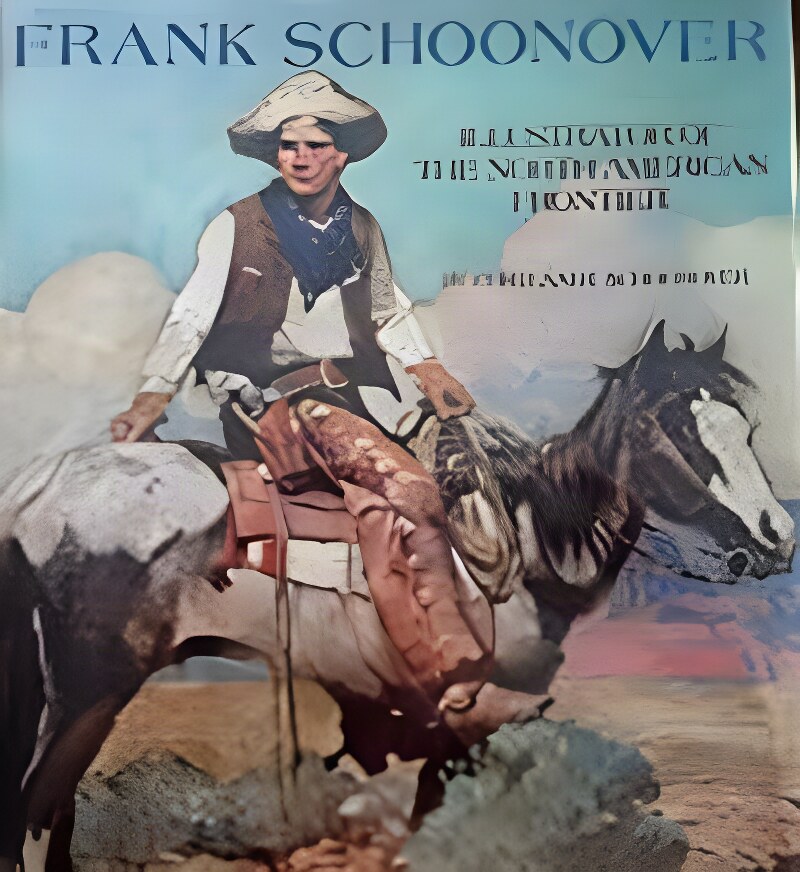
Hardcover. NY, Watson-Guptill, 1st, 1976, Book: Very Good, Dust Jacket: Very Good, Hardcover. Frank Schoonover, one of the giants of the Golden Age of American Illustration, was renowned for his scenes of life on the western frontier of America and Canada. Schoonover captured the flavor of the west and northwest in his dramatic outdoor compositions which depicted cowboys, Indians, trappers, Eskimos - the people and way of life that he knew, loved, and painted first hand. His keen sense of observations, coupled with his vivid documentary style, made his illustrations powerful paintings in themselves. They are now exhibited and collected for their own sake, independent of the books they illustrated, as unforgettable documents of a legendary way of life. Like the other great painter/illustrators of the Brandywine School -he was a student of Howard Pyle and a contemporary of such notables as N. C. Wyeth and Harvey Dunn - Schoonover was passionate about the portrayal of the American past. Although he lived most of his life in the Brandywine River area of Pennsylvania and Delaware, his commitment to the frontier dominated his work. A natural love for adventure and a yearning to find his own style sent him initially to the Canadian northwest, where he took naturally to the challenge of frontier life. Living among the Indians, canoeing, traveling by dogsled, and fending for himself brought authentic flavor to his paintings which illustrated many popular books and stories of adventure - most of which are now forgotten, although the paintings endure. This handsome collection is the first full-scale illustrated study of Schoonover's work, not only rediscovering the paintings of a major artist, but providing an important visual document of frontier life. 208 pages. 10 1/2 X 11 1/4. 48 color plates. 150 black-and-white illustrations. Chronology. Index.
Hardcover. NY, Watson-Guptill, 1st, 1976, Book: Very Good, Dust Jacket: Very Good, Hardcover. Frank Schoonover, one of the giants of the Golden Age of American Illustration, was renowned for his scenes of life on the western frontier of America and Canada. Schoonover captured the flavor of the west and northwest in his dramatic outdoor compositions which depicted cowboys, Indians, trappers, Eskimos - the people and way of life that he knew, loved, and painted first hand. His keen sense of observations, coupled with his vivid documentary style, made his illustrations powerful paintings in themselves. They are now exhibited and collected for their own sake, independent of the books they illustrated, as unforgettable documents of a legendary way of life. Like the other great painter/illustrators of the Brandywine School -he was a student of Howard Pyle and a contemporary of such notables as N. C. Wyeth and Harvey Dunn - Schoonover was passionate about the portrayal of the American past. Although he lived most of his life in the Brandywine River area of Pennsylvania and Delaware, his commitment to the frontier dominated his work. A natural love for adventure and a yearning to find his own style sent him initially to the Canadian northwest, where he took naturally to the challenge of frontier life. Living among the Indians, canoeing, traveling by dogsled, and fending for himself brought authentic flavor to his paintings which illustrated many popular books and stories of adventure - most of which are now forgotten, although the paintings endure. This handsome collection is the first full-scale illustrated study of Schoonover's work, not only rediscovering the paintings of a major artist, but providing an important visual document of frontier life. 208 pages. 10 1/2 X 11 1/4. 48 color plates. 150 black-and-white illustrations. Chronology. Index. Due to size and weight, DOMESTIC SHIPPING ONLY.
Hardcover. London, Constable & Co., 1st UK, 1989, Book: Very Good, Dust Jacket: Very Good, Hardcover in a bight, unclipped dust jacket. SIGNED BY AUTHOR on title page ("Rodney Wingfield 1990"). The first of the author's Inspector Frost mysteries, originally written in 1972 at the prompting of Macmillan (and spurred on by a non-refundable advance of GBP50), the manuscript was promptly rejected, before eventually being published in Canada in 1984. This UK edition followed some five years later and the Yorkshire Television adoptions staring David Jason appeared soon after. Bright, clean copy.

 "Confederate Operations in Canada and New York (Collector's Library of the Civil War)by: Headley, John W.")
 "Coppermine: The Far North of George M. Douglasby: Mallory, Enid")
 "Creative Forces in Japanby: Fisher, Galen M.")

 "Decoys of Maritime Canadaby: Guyette, Dale and Gary")
 "Decoys of the Mississippi Flyway by: Alan G. Haid")

 "Down North on the Labradorby: Grenfell, Wilfred T.")
 "Down to the Seaby: Grenfell, Wilfred T.")
 "Ducks: Two Years in the Oil Sandsby: Kate Beaton")


 "Edward Sapir. Linguist Anthropologist Humanistby: Darnell, Regna")
 "Eric Fischl Paintingsby: N/A")
 "Eskimo Artby: Burland, Cottie")
 "Fantastic Brother, Theby: Guillot, Rene")
 "Farm-Cottage, Camp and Canoe in Maritime Canadaby: Silver, Arthur P.")
 "Fighting for the Farm: Rural America Transformedby: Jane Adams (Ed.)")
 "First World War N/R UKby: Gilbert, M")

 "Food on the Move: Dining on the Legendary Railway Journeys of the Worldby: Sharon Hudgins")
 "Frost at Christmas (SIGNED COPY)by: Wingfield, R.D.")