Hardcover. UK, Oxford University Press, 1st, 2008, Book: Very Good, Dust Jacket: Very Good, Hardcover in a bright dust jacket, 238 pages. The Laws is Plato's last and longest dialogue. Although it has been neglected (compared to such works as the Republic and Symposium), it is beginning to receive a great deal of scholarly attention. Book 10 of the Laws contains Plato's fullest defence of the existence of the gods, and his last word on their nature, as well as a presentation and defence of laws against impiety (e.g. atheism). Plato's primary aim is to defend the idea that the gods exist and that they are good - this latter meaning that they do not neglect human beings and cannot be swayed by prayers and sacrifices to overlook injustice. As such, the Laws is an important text for anyone interested in ancient Greek religion, philosophy, and politics generally, and the later thought of Plato in particular. Robert Mayhew presents a new translation, with commentary, of Book X of the Laws. His primary aim in the translation is fidelity to the Greek. His commentary focuses on philosophical issues (broadly understood to include religion and politics), and deals with philological matters only when doing so serves to better explain those issues. Knowledge of Greek is not assumed, and the Greek that does appear has been transliterated. It is the first commentary in English of any kind on Laws X for nearly 140 years. Light pencil notations to about 15 pages.
Softcover. NY, Oxford University Press, reprint, 2011, Book: Very Good, Dust Jacket: None, Softcover, 384 pages. Plato is the best known and most widely studied of all the ancient Greek philosophers. Malcolm Schofield, a leading scholar of ancient philosophy, offers a lucid and accessible guide to Plato's political thought, enormously influential and much discussed in the modern world as well as the ancient. Schofield discusses Plato's ideas on education, democracy and its shortcomings, the role of knowledge in government, utopia and the idea of community, money and its grip on the psyche, and ideological uses of religion. Clean, bright copy.
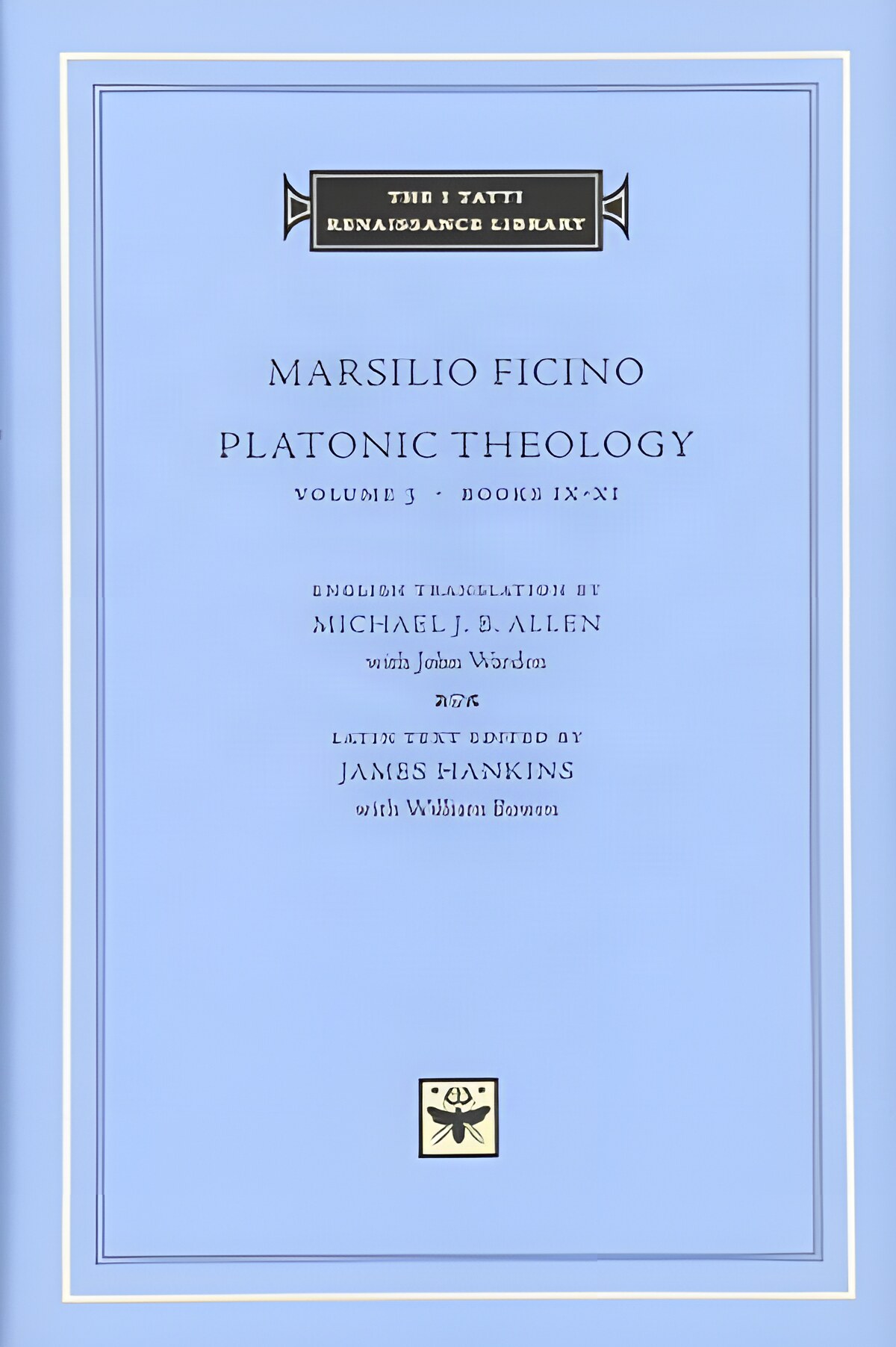
Hardcover. Cambridge MA, Harvard University Press, 1st, 2001, Book: Very Good, Dust Jacket: Very Good, Hardcover in a very good dust jacket with light fading to spine, 342 pages. The Platonic Theology is a visionary work and the philosophical masterpiece of Marsilio Ficino (1433-1499), the Florentine scholar-philosopher-magus who was largely responsible for the Renaissance revival of Plato. A student of the Neoplatonic schools of Plotinus and Proclus, he was committed to reconciling Platonism with Christianity, in the hope that such a reconciliation would initiate a spiritual revival and return of the golden age. His Platonic evangelizing was eminently successful and widely influential, and his Platonic Theology, translated into English for the first time in this edition, is one of the keys to understanding the art, thought, culture, and spirituality of the Renaissance.
Hardcover. Cambridge MA, Harvard University Press, 1st, 2002, Book: Very Good, Dust Jacket: Good, Hardcover in a dust jacket with fading to spine and front cover, 397 pages. The Platonic Theology is a visionary work and the philosophical masterpiece of Marsilio Ficino (1433-1499), the Florentine scholar-philosopher-magus who was largely responsible for the Renaissance revival of Plato. A student of the Neoplatonic schools of Plotinus and Proclus, he was committed to reconciling Platonism with Christianity, in the hope that such a reconciliation would initiate a spiritual revival and return of the golden age. His Platonic evangelizing was eminently successful and widely influential, and his Platonic Theology, translated into English for the first time in this edition, is one of the keys to understanding the art, thought, culture, and spirituality of the Renaissance. Clean copy.
Hardcover. Cambridge MA, Harvard University Press, 1st, 2003, Book: Very Good, Dust Jacket: Very Good, Hardcover in a very good dust jacket with light fading to spine, 362 pages. The Platonic Theology is a visionary work and the philosophical masterpiece of Marsilio Ficino (1433-1499), the Florentine scholar-philosopher-magus who was largely responsible for the Renaissance revival of Plato. A student of the Neoplatonic schools of Plotinus and Proclus, he was committed to reconciling Platonism with Christianity, in the hope that such a reconciliation would initiate a spiritual revival and return of the golden age. His Platonic evangelizing was eminently successful and widely influential, and his Platonic Theology, translated into English for the first time in this edition, is one of the keys to understanding the art, thought, culture, and spirituality of the Renaissance. Name on front fly leaf otherwise clean.
Softcover. UK, Cambridge University Press, 1st pbk, 2019, Book: Very Good, Dust Jacket: None, Softcover, 931 pages. Greek glossary, English glossary, bibliography of Principal editions of secondary sources. Octavo. Glossy burgunday soft covers with gold and white titles. Covers have minimal shelf wear, a small bump at top left front, interior clean and fresh, a few pages have very slight sign of storage bend at the top corner, otherwise very good. Heavy for international shipping. The Enneads is a work central to the history of philosophy in late antiquity. This volume is the first complete edition in English for 75 years and also includes Porphyry's Life of Plotinus. Led by Gerson, a team of experts present up to date translations which are based on the best available text, the editio minor of Henry and Schwyzer and its corrections.... They also offer extensive annotation to assist the reader, together with cross-references and citations. Clean, bright copy.
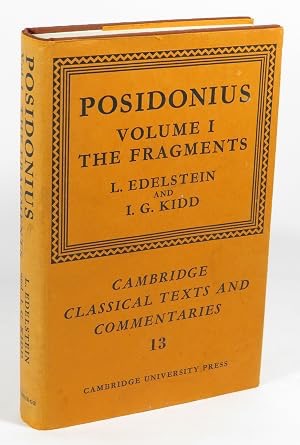
Hardcover. UK, Cambridge University Press , 1st, 1972, Book: Very Good, Dust Jacket: Very Good, Hardcover in a bright orange dust jacket, 336 pages. This book is a commentary on the surviving testimonia and fragments of Posidonius' work collected in Volume I of this edition. Posidonius was one of the most important philosophers and intellectuals writing in the first century BC Graeco-Roman world. The purpose of this commentary is to assess the fragmentary evidence and reports of Posidonius found in the writings of about sixty ancient authors, and to separate what Posidonius himself actually said from the interpretations and distortions of his reporters. Since Posidonius also wrote at length on the sciences and on geography, and composed a large History, Kidd assesses his work against the philosophical, scientific, and historical writings of Posidonius' predecessors and contemporaries. Each fragment is explored through detailed examination of its context, philosophical and scientific content, and its relationship to Posidonius' whole thought and to contemporary ideas. VOLUME 1 ONLY. The fragments are in the original Greek and Latin (mostly Greek). The Introduction is in English. Previous owner's name on front fly leaf, embossed stamp, otherwise a clean copy.
Hardcover. Boston, Kluwer Academic Publishers, 1st, 1987, Book: Very Good, Dust Jacket: None, 271 pages. Light pink boards, 8 essays by various authors. Letter laid-in from editor of the book review section of The Bulletin of the History of Economics, to a professor at Indiana University, requesting the latter's assistance in reviewing this books, printed on Skidmore College's letterhead, dated 5/8/88. Faded spine, light edgewear to covers, very minor pencil markings in page margins to a few pages; overall a very clean, tight copy.
Hardcover. London, Duckworth, 1st, 1985, Book: Very Good, Dust Jacket: Good, Hardcover in a lightly worn dust jacket with fading to spine. A magisterial assessment of the major historian of early Byzantium, by one of today's leading historians of late antiquity. Most of our understanding of the age of Justinian is based on the works of Procopius of Caesarea, the most important Greek historian of late antiquity. Many modern histories of the period virtually paraphrase his major work, the Wars. Today, questions of how we are to reconcile the Wars with Procopius' two minor works-the panegyrical Building and the sensational Secret History, still dominates current scholarship. 297 pages. Clean copy.
Hardcover. Milwaukee WI, Amadeus, 1st, 2016, Book: Very Good, Dust Jacket: Very Good, Hardcover in a bright dust jacket, 406 pages, illustrations. INSCRIBED by co-editor Malcolm Crocker. A rare, revealing look at the composer, written by his granddaughter Tatiana. Featuring a wealth of correspondence and photographs from his family's archives, this book provides new, fascinating details about the composer's life, work, and relations with close friends and colleagues, including Borodin, Mussorgsky, and Tchaikovsky. It also sheds new light on his wife, Nadezhda Purgold, an accomplished composer and pianist who helped her husband with his own compositions. Many letters involve Rimsky-Korsakov's other family members and important figures in art, history, literature, and music of the late 19th and early 20th centuries. Clean copy.
Hardcover. Cambridge University Press, 1st, 1987, Book: Very Good, Dust Jacket: Very Good, Hardcover, dust jacket with light fading to spine, 212 pages, b&w illustrations. In this book, Gabriel Herman offers a new interpretation of Greek xenia, a term traditionally rendered as 'guest-friendship'. Drawing on contemporary literary sources and inscriptions as well as anthropology, sociology, and comparative evidence from other times, he shows that xenia was a bond of fictitious kinship akin to godparenthood, rather than a tie of hospitality or ordinary 'friendship'. Starting off from this proposition, he develops a dynamic model of the formation of elite relationships and values. He explores the concepts of obligation and loyalty, gift and bribe, treason and patriotism, and places the Greek city within a new context of power relations. Clean copy.
Hardcover. NY, Guggenheim Museum, 1st, 2004, Book: Very Good, Dust Jacket: Very Good, Hardcover. Catalogue for an exhibition in Berlin in 2004, which explored the relationship between Mapplethorpe's photography and classical art, particularly the Flemish mannerist engravings and sculpture. 232 pages includes 120 plates and 30 text illustrations, with extended essays by Blessing and Celant.
Hardcover. Schirmer/Mosel, reprint, 2010, Book: Very Good, Dust Jacket: Very Good, Hardcover, 108 pages. A classic, indeed perhaps the best of the Mapplethorpe books. And for many most certainly the most typical Mapplethorpe, now available once again thanks to this re-edition. The Black Book, first published in 1986, presents 96 formally stringent and highly erotic nudes, all of them photographs of black men, either as full figures, or staged as details, as fragments of their bodies. Stylized as classical statues or provocatively in all their presence and sensuous radiance. Black-and-white photography was Mapplethorpe's preferred medium. And his obsessive aesthetics was based on completely mastering it, as this enabled him to visualize any number of tonal gradations and penetrate deep into the very pores of the gleaming black skin. It is a method that reached a climax in these images. The Black Book, Mapplethorpe s homage to the black male body, has always been one of the most important visual contributions to the discussion on beauty, sensuality, and sexuality in photography.
Hardcover. US, PS Artbooks, 1st, 2013, Book: Very Good, Dust Jacket: None, Hardcover with no dust jacket. Clean, unmarked copy with only minor wear to covers. In matching slipcase.
Hardcover. East Yorkshire UK, PS Artbooks, 1st, 2013, Book: Very Good, Dust Jacket: None, Hardcover with no dust jacket. Clean, unmarked copy with only minor wear to covers. Black and white pictures throughout. In matching slipcase.
Softcover. NY/Oxford, Osprey Publishing, 1st, 2005, Book: Very Good, Dust Jacket: None, Softcover, 64 pages illustrated in color and b&w. An unrivaled illustrated reference source on fighting men and commanders of the period. The Sassanians ruled the last great imperial Empire of Persia before the Arab conquests of the 7th century. Rome's only equal in the classical world, the Sassanian Empire had an enormous impact on the development of architecture, mythology, arts, music, military tactics and technology. Within the Sassanian military, the cavalry was the most influential element, and Sassanian cavalry tactics were adopted by the Romans, Arabs, and Turks. Clean copy.
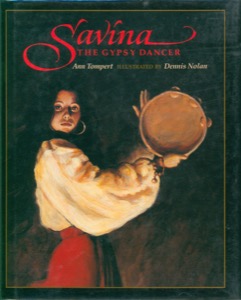
New York , Macmillan , 1st, 1991, Book: Very Good, Dust Jacket: Very Good, Hardcover in a bright, unclipped dust jacket. Illustrated in color by Dennis Nolan. Romantic tale about family & tribal devotion, which captures the spirit of the gypsy people. Rich, classical paintings complement this captivating tale. Savina, the Gypsy dancer, captivates everyone with her remarkable dancing. Clean copy.
Hardcover. NY, Macmillan, 1st, 1991, Book: Very Good, Dust Jacket: Very Good, Hardcover in a bright, unclipped dust jacket. Romantic tale about family & tribal devotion, which captures the spirit of the gypsy people. Rich, classical paintings complement this captivating tale. Savina, the Gypsy dancer, captivates everyone with her remarkable dancing. Clean copy.
Hardcover. NY, Bloomsbury Academic, 1st, 2023, Book: Very Good, Dust Jacket: None, Hardcover, glazed pictorial boards, 362 pages. The essays collected in this volume were written to mark the centenary of the birth of Sir Kenneth Dover, one of the twentieth centurys most influential classical scholars. Between them, they explore the two major sides of his career: his groundbreaking scholarship on Greek language, literature and history, and the more public-facing roles he assumed in universities and at the British Academy which brought him into the national spotlight, not without some notoriety, in his later years.The contributors consider the various facets of Dover's life and work from a range of perspectives which reflect the burgeoning field of the history of scholarship. Some contributors were students and colleagues of Dovers at different stages of his career, while others are themselves leading experts in areas of Classics to which he devoted his energies. Chapters on his academic publications and on the controversies he faced in the public realm are not bland celebrations of his legacy but offer critical assessments of his motivations and achievements, cumulatively demonstrating that there is much to be learned not just about Dover himself but also about the fields he helped to shape. Clean copy.
Hardcover. London, Robert Hale, 1st UK, 1986, Hardcover, 254 pages, in a bright, unclipped dust jacket. Biography of the nineteenth century composer, Franz Schubert (1797-1828). The author "corrects the legend that Schubert was a penniless, myopic roly-poly. This sympathetic and musically astute biography pays tribute to Schubert's raw talent and shows him to have been a composer of outstanding brilliance".
Hardcover. New Haven, Yale University Press, reprint, 1967, Book: Very Good, Dust Jacket: Good, Hardcover, 625 pages, 700 b&w plates. Light edgewear to dust jacket, small tear; previous price sticker on front flap. Foxing to top edge. Else a clean, tight copy.
Hardcover. San Francisco, Chronicle Books, 1st, 2008, Book: Very Good, Dust Jacket: Very Good, Like new in publishers shrink-wrap. Hardcover, 177 pages. From the controlled beauty of classical ballet to the vivacity of salsa, dance can be found in nearly every culture on Earth. Shall We Dance is the result of Pulitzer Prize-winning photographer Brian Lanker's year of travel across the United States, documenting the huge variety of styles (from tap to tango, salsa to swing) and dancers he encountered. What began as a photo-essay for National Geographic soon expanded into a vast documentary project, which includes interviews with dancers from all corners of the globe. Shall We Dance celebrates dance's diversity of culture and capacity to express every emotion imaginable. Featuring a foreword by legendary writer, and former dancer, Maya Angelou, this volume is a treasure trove of dance from around the world.
Softcover. San Francisco, Last Gasp, reprint, 2001-06-01, Book: Near Fine, Dust Jacket: None, Softcover, unpaginated. Like new in publishers shrink-wrap. A first hand account of the 60s and 70s counterculture seen through the eyes of pioneering photographer Charles Gatewood and legendary writer Williams S. Burroughs.


 "Platonic Theology, Volume 2: Books V-VIII (The I Tatti Renaissance Library)by: Ficino, Marsilio/ Editor: Hankins, James / Translator: Allen, Michael")

 "Pre-Classical Economic Thought: From the Greeks to the Scottish Enlightenmentby: Lowry (ed.), S. Todd")

 "Rimsky-Korsakov: Letters to His Family and Friends by: Tatiana Rimsky-Korsakov")
 "Ritualised Friendship & The Greek Cityby: Herman, Gabriel")
 "Robert Mapplethorpe And The Classical Tradition: Photographs and Mannerist Printsby: Celant, Germao and Arkady Ippolitov, with Karole Vail/ Jennifer Blessing")
 "Robert Mapplethorpe: The Black Bookby: Robert Mapplethorpe and Ntozake Shange")
 "Roy Thomas Presents Frankenstein Volume 3 Limited Slipcase Editionby: Briefer, Photographer) Dick (Author")
 "Roy Thomas Presents Frankenstein: Volume 4 Limited Slipcase Editionby: Briefer, Dick and Roy Thomas")

 "Savina - The Gypsy Dancerby: Tompert, Ann")

 "Schubertby: Marek, George R.")
 "Sculpture and Sculptors of the Greeks, The by: Richter, Gisela M. A.")
 "Selections from Polybiusby: Strachan-Davidson (Ed.), James Leigh")
 "Shall We Dance?by: Lanker, Brian")
 "Sidetrippingby: Gatewood, Charles and William S. Burroughs")