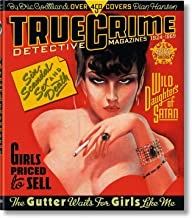
Hardcover. Taschen, 1st, 1013, Book: Very Good, Dust Jacket: Very Good, hardcover, 336 pages. At the height of the Jazz Age, when Prohibition was turning ordinary citizens into criminals and ordinary criminals into celebrities, America's true crime detective magazines were born. True Detective came first in 1924, and by 1934, when the Great Depression had produced colorful outlaws like Machine Gun Kelly, Bonnie and Clyde, Baby Face Nelson, and John Dillinger, the magazines were so popular cops and robbers alike vied to see themselves on the pages. Even FBI boss J. Edgar Hoover wrote regularly for what came to be called the "Dickbooks," referring to a popular slang term for a detective. As the decades rolled on, the magazines went through a curious metamorphosis, however. When liquor was once more legal, the Depression over and all the flashy criminals dead or imprisoned, the "detectives" turned to sin to make sales. Sexy bad girls in tight sweaters, slit skirts, and stiletto heels adorned every cover. Cover lines shouted "I Was a Girl Burglar-For Kicks," "Sex Habits of Women Killers," "Bride of Sin!," "She Played Me for a Sucker," and most succinctly, "Bad Woman."True Crime Detective Magazines follows the evolution and devolution of this distinctly American genre from 1924 to 1969. Hundreds of covers and interior images from dozens of magazine titles tell the story, not just of the "detectives," but also of America's attitudes towards sex, sin, crime, and punishment over five decades. With texts by magazine collector Eric Godtland, George Hagenauer, and True Detective editor Marc Gerald, True Crime Detective Magazines is an informative and entertaining look at one of the strangest publishing niches of all time.
Hardcover. NY, Charles Scribner's Sons, 1st, 1967, Book: Very Good, Dust Jacket: Very Good, Hardcover in a bright dust jacket with light edgewear. In 1945, a previously unknown Vermeer was discovered by the Allied Art Commission in the collection of Hermann Goering. The question arose: where - and how - did Goering acquire it? From the investigation came a story that rocked the art world. The trail finally led to Han van Meegeren, an obscure painter who had sold seven authenticated Vermeers over a number of years. Faced with a possible death sentence for collaborating in a sale of a national treasure to the Nazis, van Meegeren insisted he had not helped the Nazi cause: he had painted all the Vermeers himself. Needless to say, nobody believed him - until he proved he was telling the truth by painting still another Vermeer, before the eyes of an astonished jury. Here, with 24 pages of illustrations, is the story of the audacious forger who fooled the most eminent art critics, yet failed to impress them with his own paintings. Lord Kilbracken offers an exhaustive study of van Meegeren's background - his motives , his two marriages, and all the pieces of the puzzle that go to make up an understandable complex human being. With fascinating detail he also makes it clear exactly how the incredibly bold deception was executed - and why it worked. The result is an eminently readable true account that has all the narrative excitement of a thriller. No markings.
Softcover. Boston, Bulfinch Press, 1st pbk., 2000, Book: Very Good, Dust Jacket: None, Softcover, 262 pages. Essays by Miles Barth, Alain Bergala and Ellen Handy. Includes 265 duotones. A very near fine copy in a French style wrappers. One of the best monographs on Weegee.
Hardcover. New York, Free Press, 1st, 2006, Book: Very Good, Dust Jacket: Very Good, 346 pages, b&w photographs. Remainder mark to top edge. Small tear to dust jacket. Else a very clean, tight copy. Documents the story of the luxury liner that burned off the coast of New Jersey in 1934, drawing on previously classified FBI reports and first-person survivor interviews to reveal how the Morro Castle's captain died under mysterious circumstances seven hours before the ship caught fire and how many of the crew abandoned ship, leaving passengers to fend for themselves.
Hardcover. NY, Archipelago Books, 1st US, 2008, Book: Very Good, Dust Jacket: Very Good, Hardcover in a bright dust jacket, 317 pages. Elias Khoury's most recent novel propels us into a fantastic universe of skewed reality that leaves us breathless to the last page. We follow the path of a young man, Yalo, who is growing up like a stray dog on the streets of Beirut during the long years of the Lebanese civil war. Living with his mother, who "lost her face in the mirror," he falls in with a dangerous gang whose violent escapades he treats as a game. The game becomes a frightening reality, however, when Yalo is accused of rape and imprisoned. He is forced to confess to crimes of which he has no recollection. As he writes, and rewrites, he begins to grasp his family's past and recall all that his psyche has buried, and the true Yalo begins to emerge. Clean copy.



 "When the Dancing Stopped: The Real Story of the Morro Castle Disaster and Its Deadly Wakeby: Hicks, Brian")