Hardcover. New York, Cambridge University Press, 1st US, 1989, Book: Very Good, Dust Jacket: Very Good, Hardcover in a bright dust jacket, 190 pages. Illustrated with black & white photographs. Clean, tight copy. The documentary style that dominates American photography had its origins in the social reform publicity campaigns of the turn of the century. This book traces the history of this genre and its main participants, including Jacob Riis, Lewis Hine, Walker Evans, Dorothea Lange, Ben Shahn, and Russell Lee. Clean copy.
Hardcover. Chicago, University of Chicago Press, 1st, 2010, Book: Very Good, Dust Jacket: Very Good, Hardcover in a bright dust jacket, 321 pages, b&w illustrations. In The Cruel Radiance, Susie Linfield challenges the idea that photographs of political violence exploit their subjects and pander to the voyeuristic tendencies of their viewers. Instead she argues passionately that looking at such images--and learning to see the people in them--is an ethically and politically necessary act that connects us to our modern history of violence and probes the human capacity for cruelty. Grappling with critics from Walter Benjamin and Bertolt Brecht to Susan Sontag and the postmoderns--and analyzing photographs from such events as the Holocaust, China's Cultural Revolution, and recent terrorist acts--Linfield explores the complex connection between photojournalism and the rise of human rights ideals. In the book's concluding section, she examines the indispensable work of Robert Capa, James Nachtwey, and Gilles Peress and asks how photography should respond to the increasingly nihilistic trajectory of modern warfare. Clean copy.
Hardcover. NY, Abrams, 1st, 2008, Book: Very Good, Dust Jacket: Very Good, Hardcover, 300 pages. In this lavishly produced volume, journalist Gaudriault accompanies photographer Rancinan to Africa, Asia, Europe and the United States to interview 23 masters of contemporary photography, paying homage to fashion photographers and photojournalists, traditional chroniclers of their times and conceptual artists. Rancinan's photographs record each encounter in portraits that encapsulate each subject's relationship with his shared discipline. Readers follow paparazzo Ron Galella fending off the camera; Martin Parr, the sardonic chronicler of middle-class British life, having tea in a cafe; Rankin, the creator of the hip magazine Dazed and Confused, hopping into a trashcan filled with his own cast-off images. Gaudriault's short essays quote liberally from her interviews and provide both biographical information and incisive commentary. Several of the older photographers strike an elegiac tone and confess to finding themselves at the end of the eras that gave birth to their visions, but optimism reigns among younger practitioners: David LaChapelle is reinventing himself in Hawaii; Rankin is bearing witness to an age that is still young; and Oliviero Toscani, the radical combination of journalist and marketer behind the Benetton campaigns, describes billboards as the church frescoes of today.
Softcover. NY, Museum of Modern Art, reprint, 2007, Book: Very Good, Dust Jacket: None, Softcover, 156 pages. A guide to the mediums visual language through works by such early masters as Atget, Cartier-Bresson, Evans, Strand and Weston. It contains 172 illustrations that reveal the range of the photograph from the early days of the mediums development to the mid-1960s.
Softcover. Albuquerque, University Of New Mexico Press, 1st pbk, 1987, Book: Very Good, Dust Jacket: None, Softcover, 285 pages, b&w and color illustrations. Nineteen essays on various issues in photography; includes essays about Photographers at War, Robert Doisneau, Helen Levitt, William Klein, Atget, and more. Clean copy.
Softcover. Los Angeles, Museum of Contemporary Art, 1st, 2000, Book: Very Good, Dust Jacket: None, Softcover, pages. A photograph can serve as as both witness and catalyst, art object and call to action. In this catalog of a pivotal exhibition of works from the Ralph R. Parsons Photography Collection at the Museum of Contemporary Art, Los Angeles, photographs capture the heartbeat and mindset of America. Works by French photographer Brassai set the stage; the bulk of the exhibition features photographs by Robert Frank, Helen Levitt , Diane Arbus, Lee Friedlander and Garry Winogrand, among others. When many of these works were first shown, they were met with criticism and outrage, but today, we've accepted them as profound documents of our nation and era. Includes essays by exhibition curator Cornelia H. Butler, as well as Max Kozloff, A.D. Coleman, Liz Kotz and Emily Aer. Dimension: 9 1/4 x 11 1/2 inches, 125 duotone & 11 color reproductions, Exhibition Catalog.
Softcover. Los Angeles, Museum of Contemporary Art, 1st, 2000, Book: Very Good, Dust Jacket: None, Softcover, pages. A photograph can serve as as both witness and catalyst, art object and call to action. In this catalog of a pivotal exhibition of works from the Ralph R. Parsons Photography Collection at the Museum of Contemporary Art, Los Angeles, photographs capture the heartbeat and mindset of America. Works by French photographer Brassai set the stage; the bulk of the exhibition features photographs by Robert Frank, Helen Levitt , Diane Arbus, Lee Friedlander and Garry Winogrand, among others. When many of these works were first shown, they were met with criticism and outrage, but today, we've accepted them as profound documents of our nation and era. Includes essays by exhibition curator Cornelia H. Butler, as well as Max Kozloff, A.D. Coleman, Liz Kotz and Emily Aer. Dimension: 9 1/4 x 11 1/2 inches, 125 duotone & 11 color reproductions, Exhibition Catalog.
Hardcover. Philadelphia, PA, Philadelphia Museum of Art, 1st, 2001, Book: Very Good, Dust Jacket: Very Good, 488 pages. Hardcover with dust jacket. Very clean, unmarked copy still in publishers shrink-wrap. Lavishly illustrated with more than 250 of Eakins's most significant paintings, watercolors, drawings, photographs, and sculpture, the book features essays by prominent scholars who place his art in the context of the history and culture of late nineteenth-century Philadelphia, where he lived.
Hardcover. New Haven, CT, Yale University Press, 1st, 2014, Book: Very Good, Dust Jacket: Very Good, 232 pages. Hardcover with dust jacket. Very clean, unmarked copy still in shrink wrap. Black & white and color photographs throughout. City scenes have been chronicled in photographs since the early 1800s, but street photography as traditionally defined has captured a relatively narrow field of these images. Revolutionizing the history of street photography, Unfamiliar Streets explores the work of Richard Avedon (1923-2004), Charles Moore (1931-2010), Martha Rosler (b. 1943), and Philip-Lorca diCorcia (b. 1951), four American photographers whose careers in fashion, photojournalism, conceptual art, and contemporary art are not usually associated with the genre. Bussard's lively and engaging text, a timely response to a growing interest in urban photography, challenges the traditional understanding of street photography and makes original and important connections among urban culture, social history, and the visual arts, constructing a new historical model for understanding street photography. Illustrated with more than one hundred images, this book provides an interpretation of a compelling genre that is as fresh as its consideration of the city streets themselves, sites of commerce, dispossession, desire, demonstration, power, and spectacle.
Softcover. London, Afterall Books, 1st, 2019, Book: Very Good, Dust Jacket: None, Softcover, 88 pages. Illustrated with b&w and color plates. Kitchen Corner, Tenant Farmhouse, Hale County, Alabama shows a painstakingly clean-swept corner in the house of an Alabama sharecropper. Taken in 1936 by Walker Evans as part of his work for the Farm Security Administration, Kitchen Corner was not published until 1960, when it was included in a new edition of Walker Evans and James Agee's classic Let Us Now Praise Famous Men. The 1960 reissue of Evans and Agee's book had an enormous impact on Americans' perceptions of the Depression, creating a memory-image retrospectively through Walker's iconic photographs and Agee's text. In this latest addition to the Afterall One Work series, photographer Olivier Richon examines Kitchen Corner. The photograph is particularly significant, he argues, because it uses a documentary form that privileges detachment, calling attention to overlooked objects and to the architecture of the dispossessed.
Softcover. London, Afterall Books, 1st, 2019, Book: Very Good, Dust Jacket: None, Softcover, 88 pages. Illustrated with b&w and color plates. Kitchen Corner, Tenant Farmhouse, Hale County, Alabama shows a painstakingly clean-swept corner in the house of an Alabama sharecropper. Taken in 1936 by Walker Evans as part of his work for the Farm Security Administration, Kitchen Corner was not published until 1960, when it was included in a new edition of Walker Evans and James Agee's classic Let Us Now Praise Famous Men. The 1960 reissue of Evans and Agee's book had an enormous impact on Americans' perceptions of the Depression, creating a memory-image retrospectively through Walker's iconic photographs and Agee's text. In this latest addition to the Afterall One Work series, photographer Olivier Richon examines Kitchen Corner. The photograph is particularly significant, he argues, because it uses a documentary form that privileges detachment, calling attention to overlooked objects and to the architecture of the dispossessed.
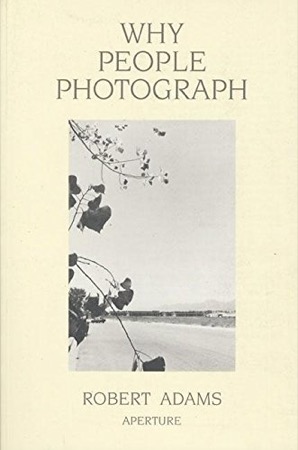
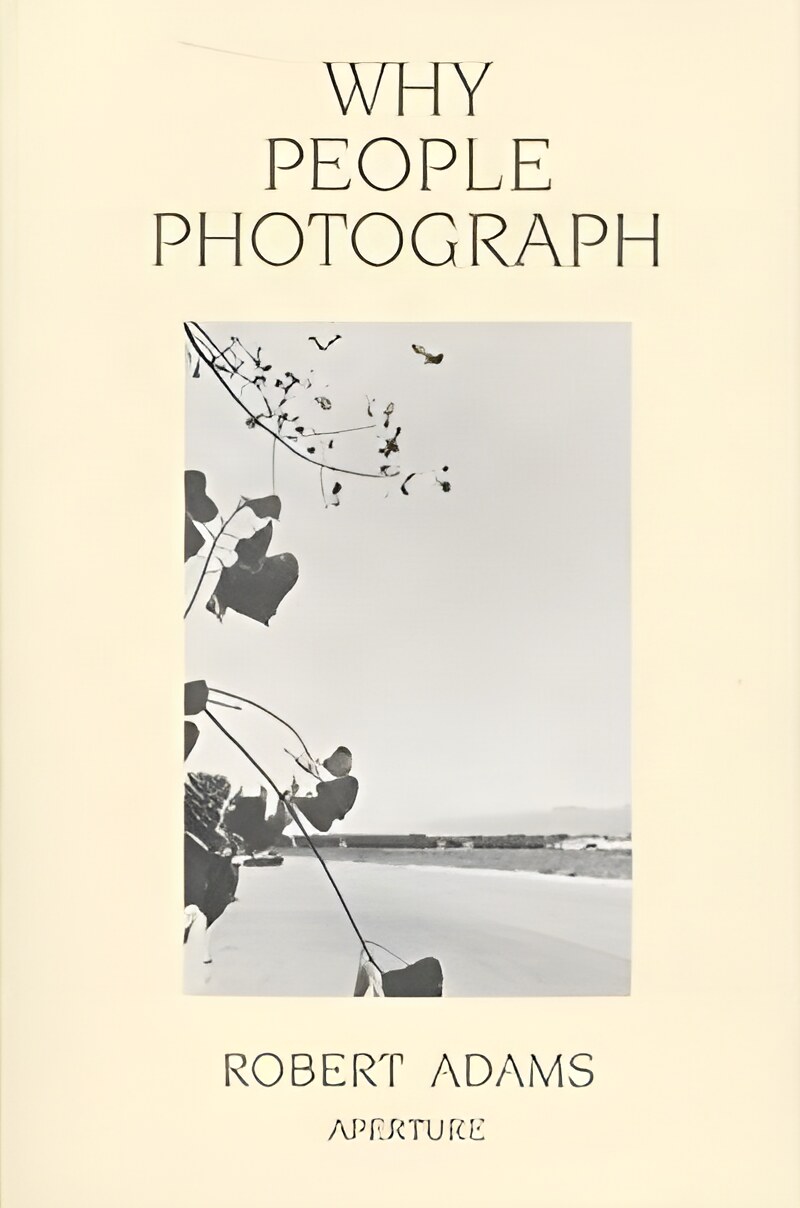
Softcover. NY, Aperture, 3rd pr., 1994, Book: Very Good, Dust Jacket: None, Softcover, 186 pages. A now classic text on the art, Why People Photograph gathers a selection of essays by the great master photographer Robert Adams, tackling such diverse subjects as collectors, humor, teaching, money and dogs. Adams also writes brilliantly on Edward Weston, Paul Strand, Laura Gilpin, Judith Joy Ross, Susan Meiselas, Michael Schmidt, Ansel Adams, Dorothea Lange, and Eugene Atget. The book closes with two essays on "working conditions" in the nineteenth- and twentieth-century American West, and the essay "Two Landscapes." Clean copy.
Softcover. NY, Aperture, 1st, 1994, Book: Very Good, Dust Jacket: None, Softcover, 186 pages, b&w illustrations. A now classic text on the art, Why People Photograph gathers a selection of essays by the great master photographer Robert Adams, tackling such diverse subjects as collectors, humor, teaching, money and dogs. Adams also writes brilliantly on Edward Weston, Paul Strand, Laura Gilpin, Judith Joy Ross, Susan Meiselas, Michael Schmidt, Ansel Adams, Dorothea Lange, and Eugene Atget. The book closes with two essays on "working conditions" in the nineteenth- and twentieth-century American West, and the essay "Two Landscapes." Name on front fly leaf otherwise clean.
Hardcover. Los Angeles, CA, J. Paul Getty Museum, 1st, 2013, Book: Very Good, Dust Jacket: Very Good, 112 pages. Hardcover with dust jacket. Very clean, unmarked copy still in publishers shrink-wrap. The Window in Photographs includes more than eighty color plates spanning the history of photography, all drawn from the J. Paul Getty Museum's permanent collection.
Hardcover. Philadelphia, PA, Philadelphia Museum of Art in association with Yale University Press, 1st, 2015, Book: Very Good, Dust Jacket: None, Hardcover with no dust jacket. Very clean, like new in publishers shrinkwrap. Peter Paul Rubens (1577-1640) proudly described his monumental painting Prometheus Bound as first among "the flower of my stock." This singular work demonstrates how Rubens engaged with and responded to his predecessors Michelangelo and Titian, with whom he shared an interest in depictions of physical torment. The Wrath of the Gods offers an in-depth case study of the Flemish artist's creative process and aesthetic, while also demonstrating why this particular painting has appealed to viewers over time. Many scholars have elaborated on Rubens's affinity for Titian, but his connection to Michelangelo has received far less attention. This study presents a new interpretation of Prometheus Bound, showing how Rubens created parallels between the pagan hero Prometheus and Michelangelo's Risen Christ from the Sistine Chapel's Last Judgment. Christopher D. M. Atkins expands our understanding of artistic transmission by elucidating how Rubens synthesized the works he saw in Italy, Spain, and his native Antwerp, and how Prometheus Bound in turn influenced Dutch, Flemish, and Italian artists. By emulating Rubens's composition, these artists circulated it throughout Europe, broadening its influence from his day to ours.

 "Symbols of Ideal Life - Social Documentary Photography in America 1890 - 1950by: Stange, Maren")

 "The Photographer by: Gerard Rancinan and Caroline Gaudriault")
 "The Photographer's Eyeby: John Szarkowski")

 "The Social Scene, The Ralph R. Parsons Foundation, Photography Collectionby: Cornelia H. Butler, et al.")
 "The Social Scene, The Ralph R. Parsons Foundation, Photography Collectionby: Cornelia H. Butler, et al.")
 "Thomas Eakinsby: Eakins, Thomas")
 "Unfamiliar Streets: The Photographs of Richard Avedon, Charles Moore, Martha Rosler, and Philip-Lorca DiCorciaby: Bussard, Katherine A.")
 "Walker Evans: Kitchen Corner by: Olivier Richon")
 "Walker Evans: Kitchen Corner by: Olivier Richon")
 "Window in Photographs, Theby: Hellman, Karen")
 "Wrath of the Gods, The: Masterpieces by Rubens, Michelangelo, and Titianby: Atkins, Christopher D. M.")