Hardcover. NY, Walker Books, 1st, 1997, Book: Very Good, Dust Jacket: Very Good, Hardcover in a bright, unclipped dust jacket, 214 pages. Over the past couple of decades, our national debt has become a favorite political football for Democrats and Republicans alike. Yet few Americans seem aware that the debt has a long and (mostly) honorable history. Alexander Hamilton considered it a kind of political Krazy Glue, which would also spur American industry by keeping taxes high. This borrowing power enabled the North to win the Civil War without wrecking its economy and rescued us from the Great Depression. John Steele Gordon doesn't deny the dangers of an entire nation living on credit; indeed, he believes that our fiscal affairs are a mess. But he puts this mess in fascinating perspective. And he's quick to see the human side of economic behavior: "One problem," he writes, "is that human nature predisposes us to recognize depression easily and quickly, but prosperity, like happiness, is most easily seen in retrospect." Name on front fly leaf, otherwise clean.
Hardcover. NY, Palgrave/Macmillan, 1st, 2003, Book: Very Good, Dust Jacket: Very Good, Hardcover in a bright dust jacket, 283 pages. Each chapter is devoted to a specific idea of, or a major influence on, Hayek. Foundational ideas incorporated into Hayek's thought are discussed (Darwinianism, German historicism, Austrian school economics) as are significant works that denoted major changes in his thought. Individual chapters deal with Mises, Keynes, Friedman and Popper, and another contrasts Hayek's thought with Marx, Mill, and Freud. Hayek's major economic thought is address in chapters devoted to both his early years and his later work. Ex-lib with stamp on top edge, residue on inside rear cover.
Hardcover. Baltimore, Johns Hopkins University, 1st, 2011, Book: Very Good, Dust Jacket: Very Good, Hardcover in a bright dust jacket, 318 pages. From the time they emerged in American cities in the 1820s, commercial luxury hotels were far more than places where a traveler could eat and sleep-they were icons of style, opulence, and technological sophistication. Molly W. Berger offers a compelling history of the American hotel and how it captured the public's imagination as it came to represent the complex-and often contentious-relationship among luxury, economic development, and the ideals of a democratic society. From New York to San Francisco and points in between, Berger profiles the country's most prestigious hotels, including Boston's 1829 Tremont, which served as a model for luxury hotel design; San Francisco's world famous Palace, completed in 1875; and Chicago's enormous Stevens, built two years before the great crash of 1929. The fascinating stories behind their design, construction, and marketing reveal in rich detail how these buildings became cultural symbols that shaped the urban landscape. Clean copy.
Hardcover. Washington DC, Cooper Hewitt, Smithsonian Design Museum, 1st, 2008-09-15, Book: Very Good, Dust Jacket: Very Good, Hardcover, 160 pages, illustrated throughout in color. Clean, unmarked copy with only minor wear to dust jacket. Essays analyzing these beautiful, exquisitely detailed watercolors and their significance to the Museum's collection, accompanied by the watercolors and related objects from the permanent collection, document the evolution of the domestic interior in the nineteenth century, revealing the impact of economic, social, and political developments on the concept of the home.
Hardcover. Washington DC, Cooper Hewitt, Smithsonian Design Museum, 1st, 2008, Book: Very Good, Dust Jacket: Very Good, Hardcover, 160 pages, illustrated throughout in color. Clean, unmarked copy with only minor wear to dust jacket. Essays analyzing these beautiful, exquisitely detailed watercolors and their significance to the Museum's collection, accompanied by the watercolors and related objects from the permanent collection, document the evolution of the domestic interior in the nineteenth century, revealing the impact of economic, social, and political developments on the concept of the home.
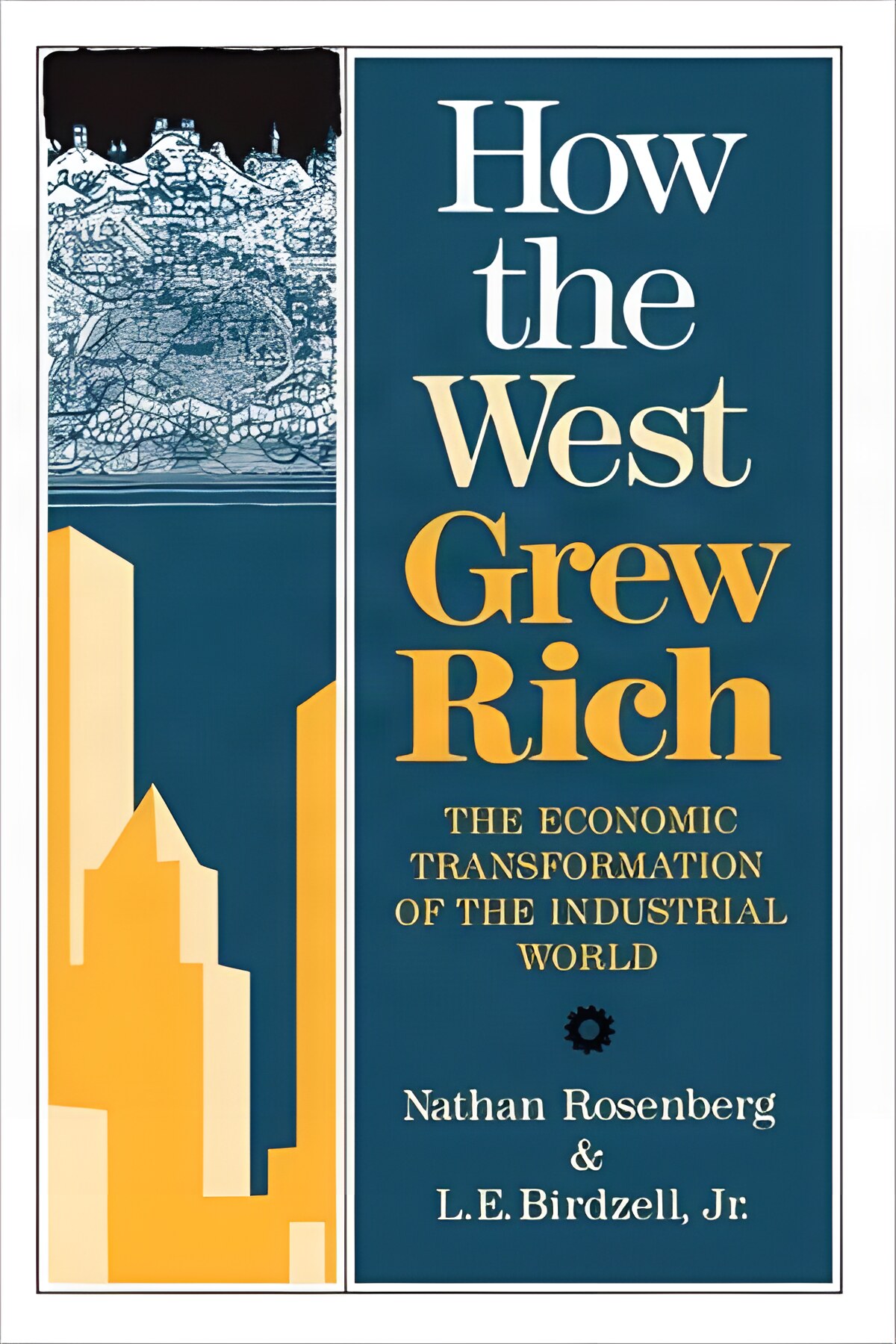
Hardcover. NY, Basic Books, 2nd pr., 1986, Book: Very Good, Dust Jacket: Very Good, Hardcover in a bright dust jacket, 416 pages. How did the West--Europe, Canada, and the United States--escape from immemorial poverty into sustained economic growth and material well-being when other societies remained trapped in an endless cycle of birth, hunger, hardship, and death? In this elegant synthesis of economic history, two scholars argue that it is the political pluralism and the flexibility of the West's institutions--not corporate organization and mass production technology--that explain its unparalleled wealth. Clean copy.
Hardcover. NY, Scribner, 1st, 2013, Book: Very Good, Dust Jacket: Very Good, Hardcover in a bright dust jacket, 364 pages, b&w illustrations. A fresh, meticulous, and entertaining account of Henry Ford, the Model-T, and the invention of the American car industry in the early twentieth century. Born the same year as the battle of Gettysburg, Ford died two years after the atomic bombs fell, and his life personified the tremendous technological changes achieved in that span. Clean copy.
Hardcover. University of Pittsburgh Press, 1st, 2004, Book: Very Good, Dust Jacket: Very Good, Hardcover in dust jacket, 297 pages. James W. Heinzen's work fills a significant gap in the extensive historiography of the New Economic Policy (NEP) . The book studies the organization and staffing of NKZem RSFSR, offers some memorable portraits of its leading figures, especially its head, Alexander Petrovich Smirnov, and delves into the complexity of policy making in this era and the clash of institutional interests that had a major impact on policy. Heinzen makes a convincing case that Smirnov and the specialists in NKZem RSFSR were one of the major sources of ideas and policies for the 'Rightists' within the party leadership. The book is distinguished by its thoroughness, and by its cool and balanced judgment. This study brings out the full complexity of the Bolshevik regime, its dilemmas, and its internal contradictions. Clean copy, light fading to dj spine.
Hardcover. NY, Oxford University Press, 1st, 1967, Book: Very Good, Dust Jacket: Very Good, Hardcover in a lightly worn dust jacket, 228 pages. "The period from Andrew Jackson's presidency to the Civil War has traditionally been considered the age of democracy triumphant in the United States. This book sharply contradicts that assumption, contending that while democracy advanced substantially in the political sense, social and economic distinctions became, if anything, more marked. Powerful forces, especially in the economic field, were working toward the stratification of society." Name on the front fly leaf, otherwise clean.
Hardcover. Cambridge MA, MIT Press, 1st, 1974, Book: Very Good, Dust Jacket: Very Good, Hardcover in a price-clipped dust jacket, 162 pages. Japan's economy enjoyed unprecedented technological growth in the decades after World War II. At first stereotyped as an exported of shoddy goods, Japan enjoyed a worldwide reputation as an efficient manufacturer of high-quality products. This comprehensive analysis of Japanese management treats four related but distinct subject matters: the economic, social, cultural, and political environment pertinent to Japan's industrial and managerial system; the ideologies and background to the Japanese business elite structure and the relationship between government and business; and managerial practices (organizational structure, personnel practices, decision making). The book first describes the postwar technological environment in and outside Japan. It identifies the Schumpeterian characteristics of economic development and the particular set of relationships that Japan had with the United States and with developing nations in Asia that provided it with the incentive and the necessary mechanisms to advance technologically. Name on front fly leaf, otherwise clean.
Softcover. Athens GA, University of Georgia Press, reprint, 2001, Softcover, clean, unmarked pages. 415 pages, followed by a short Index. Fanny Kemble offers a gripping, first-hand account of life on a Southern plantation before the Civil War. Combining a keen observational style with a candid narrative voice, Kemble lays bare the complexities of plantation life, including the stark realities of slavery and the socio-economic hierarchies of antebellum Georgia. The journal entries provide an intimate glimpse into the daily lives of both the enslaved and the plantation owners, reflecting her deep moral convictions and growing abolitionist sentiments against a backdrop of genteel Southern culture. Fanny Kemble, a British actress and writer, was thrust into the world of the Southern elite through her marriage to a plantation owner, which provided her with unprecedented access to the intricacies of plantation management and its social fabric.
Hardcover. New York, Kelley & Millman, Inc., reprint, 1956, Book: Very Good, Dust Jacket: Fair, 293 pages. Collection of lectures given by Smith at the University of Glasgow, as reported by a student in 1763. Edited and with introduction by Edwin Cannan. Dark blue covers, gilt titles to spine, white dust jacket. Edgewear and chipping to dust jacket, previous owner's ink signature to front endpaper, light pencil markings to a few pages, pencil notations to rear endpaper.
Hardcover. Oxford UK, Clarendon Press, 1st, 1991, Book: Very Good, Dust Jacket: Very Good, Hardcover set, complete in two volumes, both with bright dust jackets. Locke on Money presents for the first time the entire body of the philosopher's writings on this important subject (other than Two Treatises of Government). Accurate texts, together with an apparatus listing variant readings and significant manuscript changes, record the evolution of Locke's ideas from the original 1668-74 paper on interest to the three pamphlets on interest and coinage published in the 1690s. The introduction by Patrick Hyde Kelly establishes the wider context of Locke's writings in terms of contemporary debates on these subjects, the economic conditions of the time, and the circumstances of writing and publication. It shows, notably, that Locke's supposed responsibility for the 1696 recoinage is a myth. The account of what Locke derived from Mercantilist writings and of how he reformulated these in accordance with his philosophy illuminates his contribution to the evolution of economics, and will aid reappraisal of Two Treatises. The picture that emerges confirms Locke's status as major economic thinker, contrary to the prevalent view of recent decades. There are two volumes in the edition. The first contains the introductory matter, and the texts of the Early Writings on Interest, 1688-74, and Some Considerations. The second comprises Short Observations, Further Considerations, and the Appendices, Bibliography, and Index. 664 total pages. Name on front fly leaf in Vol. 1, otherwise clean.
Hardcover. NY, Basic Books, 1st, 2004, Book: Very Good, Dust Jacket: Very Good, Hardcover in a bright dust jacket, unclipped. INSCRIBED BY AUTHOR on the title page. Throughout the nineteenth century, swarms of locusts regularly swept across the continent, turning noon into dusk, demolishing farm communities, and bringing trains to a halt as the crushed bodies of insects greased the rails. In 1876, the U.S. Congress declared the locust "the single greatest impediment to the settlement of the country." From the Dakotas to Texas, from California to Iowa, the swarms pushed thousands of settlers to the brink of starvation, prompting the federal government to enlist some of the greatest scientific minds of the day and thereby jumpstarting the fledgling science of entomology. Over the next few decades, the Rocky Mountain locust suddenly--and mysteriously--vanished.A century later, Jeffrey Lockwood set out to discover why. Unconvinced by the reigning theories, he searched for new evidence in musty books, crumbling maps, and crevassed glaciers, eventually piecing together the elusive answer: A group of early settlers unwittingly destroyed the locust's sanctuaries just as the insect was experiencing a natural population crash. Drawing on historical accounts and modern science, Locust brings to life the cultural, economic, and political forces at work in America in the late-nineteenth century, even as it solves one of the greatest ecological mysteries of our time. 294 pages, clean copy.
Hardcover. Cambridge MA, MIT Press , 1st, 2022, Book: Very Good, Dust Jacket: Very Good, Hardcover in a bright dust jacket, 311 pages, b&w illustrations. In the 1930s and 1940s, English fashion houses, spurred by economic and wartime crises, put London on the map as a major fashion city. In this book, Michelle Jones examines the creation of a London-based couture industry during these years, exploring how designer collaboration and the construction of specific networks and narratives supported and shaped the English fashion economy. Haute couture-the practice of creative made-to-measure womenswear-was widely regarded as inherently French. Jones shows how an English version emerged during a period of economic turbulence, when a group of designers banded together in a collective effort to shift power within the international fashion system. Clean, bright copy.
Hardcover. London, Chris Boot, 1st, 2009, Book: Very Good, Dust Jacket: None, Hardcover, 252 pages. In this volume, ten Magnum photographers turn their lenses on contemporary Georgia. Situated on the cusp of Russia and Asia, but with a European culture dating back to the 7th century BC, Georgia was forcibly incorporated into the Soviet Union in 1922. Its independence was restored in 1991, but it then suffered from civil war and a breakdown of its economic infrastructure. In the last decade, however, despite ongoing tensions in its relations with Russia, Georgia has mounted a spirited comeback. Magnum photographers Antoine d'Agata, Jonas Bendiksen, Thomas Dworzak, Martine Franck, Alex Majoli, Gueorgui Pinkhassov, Martin Parr, Paolo Pellegrin, Mark Power and Alec Soth visited the country during spring 2009, each pursuing their own theme (Alec Soth goes in search of the 'most beautiful woman in Georgia', for example). All found themselves enchanted by the Georgian people, something strongly conveyed in their photographs as well as in personal text journals which accompany the images. This well-designed volume also includes a fold-out map, marked with each photographer's journey; a chapter showing the best of Magnum photographers' work over 60 years (including by Magnum's founders Robert Capa from his visit to Georgia with John Steinbeck in 1948 and Henri Cartier-Bresson); and an illuminating introduction by the Paris-based New Yorker writer, and Georgia expert, Wendell Steavenson.
Hardcover. London, Macmillan, reprint, 1924, Book: Very Good, Dust Jacket: None, 438 pages. Reprint of original 1885 first edition. Brown cloth covers, pasted labels with titles to front cover and spine, b&w frontispiece of Mathus's portrait. Slight rubbing to covers, spine label lightly soiled, wear to spine top edge, previous owner's signature to front endpaper dated 1947, stiff binding, pages crisp and unmarked; overall, a very clean, tight copy.
Hardcover. London, Methuen and Co., 1st, 1960, Book: Very Good, Dust Jacket: Fair, Hardcover in a worn, soiled dust jacket, 296 pages. Russet cloth lettered in silver on spine. Illustrated with 2-color line frontispiece, 16 half-tone photographsic plates and 5 line illustrations in the text. An important and early anthropoliogical study of a little known phenomenon. The title is taken from the given name of a native New Guinean who started the cargo cult, circa 1935. Similar to other messianic movements, Burridge's first hand account is a scholarly examination of the religious, political, and economic aspects which make up the cult.
Softcover. Chapel Hill, University of North Carolina Press, 1st pbk, 2002, Book: Very Good, Dust Jacket: None, Softcover, 411 pages, b&w illustrations. Tracing the erosion of white elite paternalism in Jim Crow Virginia, Douglas Smith reveals a surprising fluidity in southern racial politics in the decades between World War I and the Supreme Court's 1954 Brown v. Board of Education decision. Smith draws on official records, private correspondence, and letters to newspapers from otherwise anonymous Virginians to capture a wide and varied range of black and white voices. African Americans emerge as central characters in the narrative, as Smith chronicles their efforts to obtain access to public schools and libraries, protection under the law, and the equitable distribution of municipal resources. This acceleration of black resistance to white supremacy in the years before World War II precipitated a crisis of confidence among white Virginians, who, despite their overwhelming electoral dominance, felt increasingly insecure about their ability to manage the color line on their own terms. Exploring the everyday power struggles that accompanied the erosion of white authority in the political, economic, and educational arenas, Smith uncovers the seeds of white Virginians' resistance to civil rights activism in the second half of the twentieth century. Light marking to 10 pages, otherwise clean, very good.
Hardcover. Bloomington, IN, Indiana University Press, 1st, 2016, Book: Very Good, Dust Jacket: Very Good, 152 pages. Hardcover with dust jacket. A very clean, unmarked copy with only minor wear to dust jacket edges. A tight copy. As a photographer for Life and Fortune magazines, Margaret Bourke-White traveled to Russia in the 1930s, photographed the Nazi takeover of Czechoslovakia in 1938, and recorded the liberation of Buchenwald at the end of WWII. In 1949, Life sent her to South Africa to take photographs in a country that was becoming racially polarized by white minority rule. Life published two photo-essays highlighting Bourke-White's photographs, but much of her South African work remained unpublished until now. Here, these stunning photographs collected by Alex Lichtenstein and Rick Halpern offer an unparalleled visual record of white domination in South Africa during the early days of apartheid. In addition to these powerful and historically significant photographs, Lichtenstein and Halpern include two essays that explore Bourke-White's artistic and political formation and provide background material about the cultural, political, and economic circumstances that produced the rise and triumph of Afrikaner nationalism in South Africa. This richly illustrated book brings to light a large body of photography from a major American photographer and offers a compelling history of a reprehensible system of racial conflict and social control that Bourke-White took such pains to document.
Softcover. London, The Hambledon Press, 1st, 1982, Book: Very Good, Dust Jacket: None, Softcover, 288 pages. The inner workings of early medieval societies cannot be understood without also studying their links - religious, cultural, economic and political - with their neighbours. In this collection Karl Leyser shows how Ottonian and Salian Germany both influenced and was influenced by the societies with which it came into contact. While the author's central interest is in Germany, his work is of value for the study of medieval European society as a whole. Clean copy.
Hardcover. Norman OK, University of Oklahoma Press, 1st, 2001, Book: Very Good, Dust Jacket: Very Good, Hardcover in a bright dust jacket, 348 pages, b&w illustrations. This handsomely illustrated book offers a panoramic view of ancient Mexico, beginning more than thirty thousand years ago and ending with European occupation in the sixteenth century. Drawing on archaeological and ethnohistorical sources, the book is one of the first to offer a unified vision of Mexico's precolonial past. Typical histories of Mexico focus on the prosperity and accomplishments of Mesoamerica, located in the southern half of Mexico, due to the wealth of records about the glorious past of this region. Mesoamerica was only one of three cultural superareas of ancient Mexico, however, all interlinked by complex economic and social relationships. Tracing the large social transformations that took place from the earliest hunter-gatherer times to the Postclassic states, the authors describe the ties between the three superareas of ancient Mexico, which stretched from present-day Costa Rica to what is now the southwestern United States. According to the authors, these superareas-Mesoamerica, Aridamerica, and Oasisamerica - cannot be viewed as independent entities. Instead, they must be considered as a whole to understand the complex reality of Mexico's past.
Hardcover. Boston, Estes and Lauriat, 1894, Book: Very Good, Dust Jacket: None, Hardcover, 405 pages, an early edition, originally published in 1893. Illustrated in b&w. Covers with light edgewear, spine darkened, previous owner's name on front fly leaf, otherwise clean. A tight, attractive copy of this vintage cook book.
Hardcover. Cape Town, Howard Timmins, 1st, 1963, Book: Very Good, Dust Jacket: None, Hardcover, cream color cloth, black lettering on spine. 147 pages, tables, maps, charts, photographs: author spent most of his life in Portuguese East Africa and this is both a history and an authoritative study of the economic and political situation circa early 1960s. Clean copy.



 "Hotel Dreams: Luxury, Technology, and Urban Ambition in America, 1829-1929 by: Berger, Molly W.")
 "House Proud: Nineteenth-Century Watercolor Interiors from the Thaw Collectionby: Davidson, Gail")
 "House Proud: Nineteenth-Century Watercolor Interiors from the Thaw Collectionby: Gail S Davidson Floramae McCarron Cates Charlotte Gere")
 "I Invented the Modern Age: The Rise of Henry Fordby: Richard Snow")


 "Japan's Technological Challenge to the West, 1950-1974:Motivation and Accomplishment by: Ozawa, Terutomo")

 "Lectures on Justice, Police, Revenue and Armsby: Smith, Adam")
 "Locke on Money. Edited together with Ancillary Manuscripts, an Introduction, Critical Apparatus, and Notes by Patrick Hyde Kelly.(2 Volumes)by: Locke, John and Kelly,")


 "Magnum Photos: Georgian Spring-A Magnum Journalby: Wendell Steavenson")
 "Malthus and His Workby: Bonar, James")
 "Mambu: A Melanesian Millenniumby: Burridge, K.O.L. (Kenelm Oswald Lancelot)")

 "Margaret Bourke-White and the Dawn of Apartheidby: Lichtenstein, Alex")
 "Medieval Germany and its Neighbours: 900-1250by: Leyser, K. J.")

 "MISS PARLOA'S YOUNG HOUSEKEEPER DESIGNED ESPECIALLY TO AID BEGINNERS. Economical Receipts for Those who are Cooking for Two or Three by: Parloa, Maria")
 "Mocambique: East African Province of Portugulby: Spence C. F.")