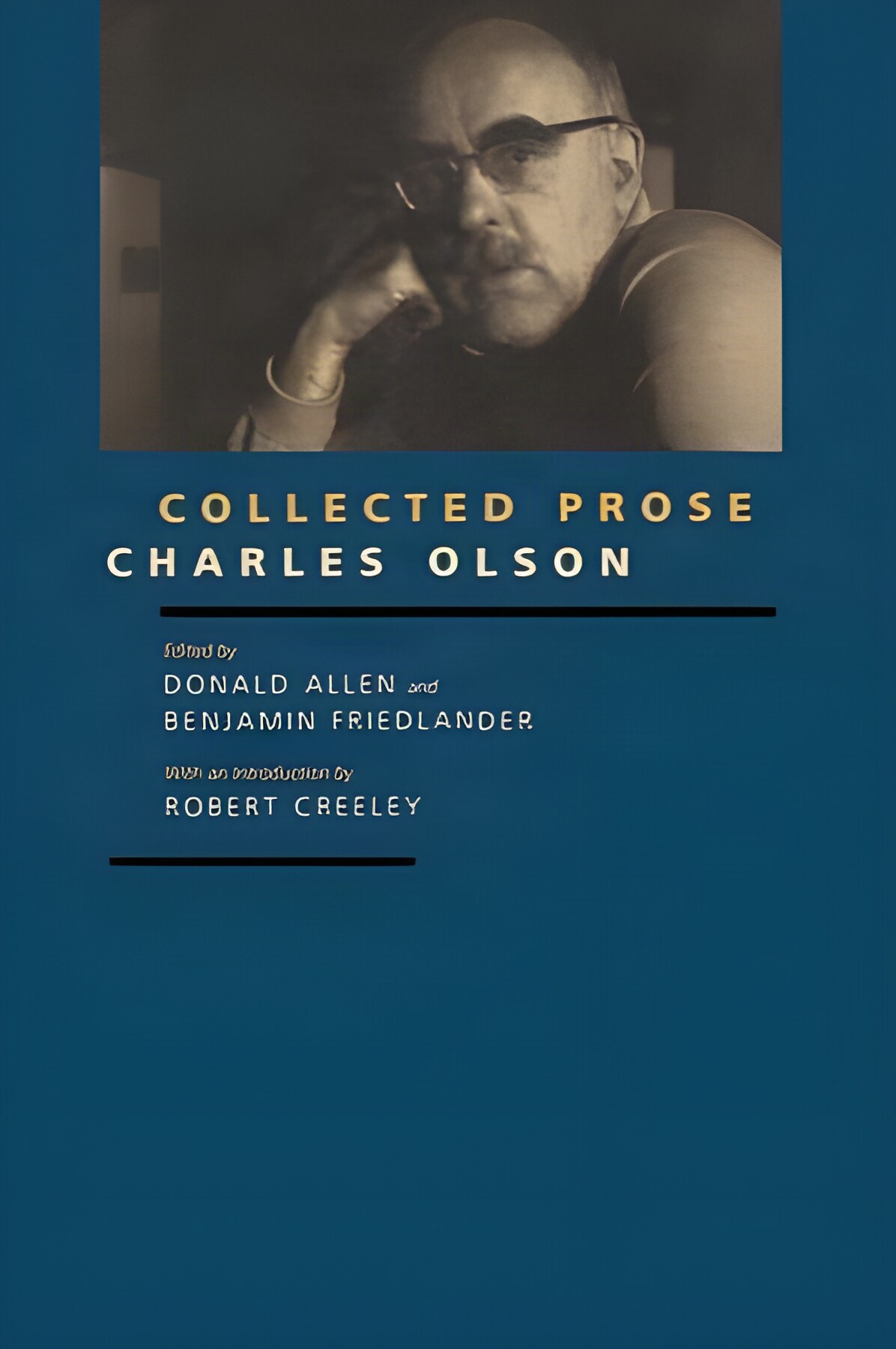
Softcover. Berkeley CA, University of California Press, 1st pbk, 1997, Book: Very Good, Dust Jacket: None, Softcover, 472 pages. The prose writings of Charles Olson (1910-1970) have had a far-reaching and continuing impact on post-World War II American poetics. Olson's theories, which made explicit the principles of his own poetics and those of the Black Mountain poets, were instrumental in defining the sense of the postmodern in poetry and form the basis of most postwar free verse. The Collected Prose brings together in one volume the works published for the most part between 1946 and 1969, many of which are now out of print. A valuable companion to editions of Olson's poetry, the book backgrounds the poetics, preoccupations, and fascinations that underpin his great poems. Included are Call Me Ishmael, a classic of American literary criticism; the influential essays "Projective Verse" and "Human Universe"; and essays, book reviews, and Olson's notes on his studies. In these pieces one can trace the development of his new science of man, called "muthologos," a radical mix of myth and phenomenology that Olson offered in opposition to the mechanistic discourse and rationalizing policy he associated with America's recent wars in Europe and Asia. Clean copy.
Hardcover. Canberra, Australian National University, 1st, 1976, Book: Very Good, Dust Jacket: None, Hardcover in decorative cloth, no dust jacket issued, spine shows fading, 290 pages, several maps and charts. The chapters are: the regional development in pre-European times; the foundation of Port Moresby 1873-1888; the colonial backwater 1889-1941; administration & social change 1889-1941; wartime interlude 1942-1945; expansion of Port Moresby 1946-1974; characteristics of the Port Moresby population; social organisation; race relations; shelter; administration 1945-1974. "Port Moresby" lettered on spine, otherwise clean.
Hardcover. Canada, Deutscher Kunstverlag, 1st, 2012, Book: Very Good, Dust Jacket: None, 159 pages. Like new in publisher's shrink-wrap. The material that was saved from Warsaw in 1939 included more than ten color slides. These slides are the only color photo documents showing that historic moment from the perspective of city residents. The slides were found only in recent years by the photographer's son, Sam Bryan. In addition to color slides this album also includes photographs recorded by Julien Bryan on black-and-white film at that time and iater subjected to a complicated process of colorizing. The colorizing took piace after Bryan's return to the United States in 1939.
Softcover. Durham NC, Duke University Press, 1st, 1993, Book: Very Good, Dust Jacket: None, Softcover, 672 pages. Pointing to a glaring blind spot in the basic premises of the study of American culture, leading critics and theorists in cultural studies, history, anthropology, and literature reveal the "denial of empire" at the heart of American Studies. Challenging traditional definitions and periodizations of imperialism, this volume shows how international relations reciprocally shape a dominant imperial culture at home and how imperial relations are enacted and contested within the United States.Drawing on a broad range of interpretive practices, these essays range across American history, from European representations of the New World to the mass media spectacle of the Persian Gulf War. The volume breaks down the boundary between the study of foreign relations and American culture to examine imperialism as an internal process of cultural appropriation and as an external struggle over international power. Clean copy.
Softcover. Burlington IA, Craftsman Press , 1st, 1995, Book: Very Good, Dust Jacket: None, Softcover, pictorial wraps, 190 pages, b&w illustrations. An infantryman's memoir of World War II in Europe's waning months. INSCRIBED BY BIED on half-title page. Clean copy.
Hardcover. Taschen, 1st, 2008, Book: Very Good, Dust Jacket: Very Good, Hardcover, 580 pages. 1940-1949: Destruction and Reconstruction. This volume covers the 1940s, when fascism came to a climax and World War II led to the extensive destruction of Europe. But the second half of this decade was also a time of reconstruction, democratization, and the related search for new social values. Unlike in Nazi Germany, in fascist Italy Modernism was able to advance in architecture and design - as proved impressively by the buildings and designs by Carlo Mollino, Gian Luigi Banfi, Franco Albini, and Giuseppe Terragni that are documented herein. After the war, Organic Design emerged alongside the International style. This edition reflects upon the economic, social, and cultural problems of the time, but also shows how the force of the avant-garde continued to thrive in Italy, Switzerland, Scandinavia and the USA. Reports and features on modern industrial design and furniture, as well as domestic and business interiors stand side by side with articles about novel prefabricated houses. In publisher's shrink wrap. Due to size and weight, DOMESTIC SHIPPING ONLY.
Hardcover. Boston, Bulfinch Press, 1st, 1992, Book: Very Good, Dust Jacket: Very Good, Hardcover in a lightly worn dust jacket, introduction by Jim Hughes. 144 pages; 114 duo-toned plates plus text illustrations; 10 x 11.25 inches. Bibliography of b&w work. Best known for his masterful color work, this volume presents for the first time Ernst Haas' b&w work including street work from around the world, portraiture, abstractions and Europe after World War II. Minor chips to top of dust jacket, clean copy.
Softcover. Cambridge MA, Harvard University Press, reprint, 1985, Book: Very Good, Dust Jacket: None, Softcover, 291 pages with index. A social history of Europe in all its aspects: economic, political, diplomatic military, colonial-expansionist. Crisply and succinctly written, it describes Europe not through a history of individual countries, but in a common context during the three quarters of a century between the death of Louis XIV and the industrial revolution in England and the social and political revolution in France. It presents the development of government, institutions, cities, economies, wars, and the circulation of ideas in terms of social pressures and needs, and stresses growth, interrelationships, and conflict of social classes as agents of historical change, paying particular attention to the role of popular, as well as upper- and middle-class, protest as a factor in that change. Clean, bright copy.
Hardcover. Chicago, Quadrangle Books, 1st, 1972, Book: Very Good, Dust Jacket: Good, Hardcover in a rubbed, worn dust jacket, 277 pages. Name on front fly leaf, otherwise clean.
Softcover. West Lafayette IN, Purdue University Press , 1st, 2020, Book: Very Good, Dust Jacket: None, Softcover, 529 pages, b&w illustrations. Eva and Otto is a true story about German opposition and resistance to Hitler as revealed through the early lives of Eva Lewinski Pfister (1910-1991) and Otto Pfister (1900-1985). It is an intimate and epic account of two Germans-Eva born Jewish, Otto born Catholic-who worked with a little-known German political group that resisted and fought against Hitler in Germany before 1933 and then in exile in Paris before the German invasion of France in May 1940. After their improbable escapes from separate internment and imprisonment in Europe, Eva obtained refuge in America in October 1940 where she worked to rescue other endangered political refugees, including Otto, with the help of Eleanor Roosevelt. As revealed in recently declassified records, Eva and Otto later engaged in different secret assignments with the US Office of Strategic Services (OSS) in support of the Allied war effort. Despite their vastly different backgrounds, Eva and Otto gave each other hope and strength as they acted upon what they understood to be an ethical duty to help others threatened by fascism. The book provides a sobering insight into the personal risks and costs of a commitment to that duty. Their unusually beautiful writing-directed to each other in diaries and correspondence during two long periods of wartime separation-also reveals an unlikely and inspiring love story.
Softcover. London/NY, Bloomsbury, 1st, 2016, Book: Very Good, Dust Jacket: None, Softcover, 346 pages. This volume makes the key essays of 19th century French philosopher Felix Ravaisson available in English for the first time. In recent years, Ravaisson has emerged as an extremely important and influential figure in the history of modern European philosophy. The volume contains the classic 1838 dissertation Of Habit, studies of Pascal, Stoicism and the wider history of philosophy together with the Philosophical Testament that he left unfinished when he died in 1900. The volume also features Ravaisson's work in archaeology, the history of religions and art-theory, and his essay on the Venus de Milo, which occupied him over a period of twenty years after he noticed, when hiding the statue behind a false wall in a dingy Parisian basement during the Franco-Prussian war, that it had previously been presented in a way that deformed its original bearing and meaning. Clean copy.
Hardcover. NY, Da Capo Press, 1st, 2012, Book: Very Good, Dust Jacket: Very Good, Hardcover in a bright, unclipped dust jacket. When the wartime 1944 presidential election campaign geared up late that spring, Franklin D. Roosevelt had already occupied the White House years longer than any other president. Sensing likely weakness, the Republicans mounted an energetic and expensive campaign, hitting hard at FDR's liberal domestic policies and the war's ongoing cost. Despite gravely deteriorating health, FDR and his feisty running mate, the unexpected Harry Truman, campaigned vigorously against young governor Thomas E. Dewey of New York and old-line Ohio governor John Bricker. Roosevelt's charm and wit, as well as the military successes in Europe and the Pacific, contributed to his sweeping electoral victory. But the hard-fought campaign would soon take its toll on America's only four-term president. Preeminent historian and biographer Stanley Weintraub recaptures FDR's striking "last campaign" and the year's momentous events, from the rainy city streets where Roosevelt, his legs paralyzed by polio since 1922, rode in an open car, to the battlefronts where the commander-in-chief's forces were closing in on Hitler and Hirohito.
Hardcover. NY, St. Martin's Press, 1st, 2023, Book: Very Good, Dust Jacket: Very Good, Hardcover in a bright, unclipped dust jacket, 381 pages. From the beginning of World War II through the early days of Vietnam, groundbreaking female photojournalist and war correspondent Dickey Chapelle chased dangerous assignments her male colleagues wouldn't touch, pioneering a radical style of reporting that focused on the humanity of the oppressed. She documented conditions across Eastern Europe in the wake of the Second World War. She marched down the Ho Chi Minh Trail with the South Vietnamese Army and across the Sierra Maestra Mountains with Castro. She was the first reporter accredited with the Algerian National Liberation Front, and survived torture in a communist Hungarian prison. She dove out of planes, faked her own kidnapping, and endured the mockery of male associates, before ultimately dying on assignment in Vietnam with the Marines in 1965, the first American female journalist killed while covering combat. Small remainder dot on bottom edge otherwise clean.
Hardcover. Montreal, Drawn & Quarterly, 1st, 2003, Book: Very Good, Dust Jacket: None, 140 pages. Hardcover NO dust jacket. Black and white comic. Clean, unmarked copy with minor wear to boards. Award-winning comix-journalist Joe Sacco goes behind the scene of war correspondence to reveal the anatomy of the big scoop. He begins by returning us to the dying days of Balkan conflict and introduces us to his own fixer; a man looking to squeeze the last bit of profit from Bosnia before the reconstruction begins. Thanks to a complex relationship with the fixer Joe discovers the crimes of opportunistic warlords and gangsters who run the countryside in times of war. But the west is interested in a different spin on the stories coming out of Bosnia. Almost ten years later, Joe meets up with his fixer and sees how the new Bosnian government has "dealt" with these criminals and Joe ponders who is holding the reins of power these days...
Softcover. NY, Hard Case Crime, reprint, 2007, Book: Very Good, Dust Jacket: None, Softcover, 254 pages. A man. A woman. A kiss in the dark. That is how it begins. But before his nightmare ends, Prescott Marshall will learn that kisses and darkness can both hide evil intent - and that the worst darkness of all may be lurking inside him. Lost for more than half a century and never before published under Cornell Woolrich's real name, FRIGHT is a breathtaking noir crime novel worthy of the writer who has been called "the Hitchcock of the written word" and "one of the giants of mystery fiction." Nowhere is this better demonstrated than in Fright, a novel set in 1915. A year from Woolrich's childhood but one he recreates with an astonishing attention to detail. (Slang, music, fashion, the distant echoes of the war being waged in Europe, etc.) Fright is very much a period piece albeit one that is timeless in its treatment of guilt and paranoia. Two emotional states the author had more than a passing familiarity with. Clean copy.
Hardcover. New Haven CT, Yale University Press, 1st, 2015, Book: Very Good, Dust Jacket: Very Good, Hardcover in a bright dust jacket. 282 pages, illustrated in b&w and color. Although Surrealism is usually associated with the 1920s and 1930s, it remained a vital force in Paris throughout the postwar period. This important book offers the first detailed account in English of the trajectory of the French Surrealists in the 1950s and 1960s, giving particular emphasis to the significance of myth for the group in its reception of science fiction and its engagement with fantastic art. Offering new readings of the art and writings of the later generation of Surrealists, Gavin Parkinson demonstrates how they were connected to the larger cultural and political debates of the time. Whereas earlier Surrealist art and writing drew on psychoanalytic practices, younger Surrealists engaged with contemporary issues, ideas, and themes of the period of the Cold War and Algerian War such as parapsychology, space travel, fantastic art, increasing consumerism in Europe, emerging avant-gardes such as Nouveau Realisme, and the rise of the whole genre of conspiracy theory, from Nazi occultism to flying saucers. Futures of Surrealism offers a unique perspective on this brave new world. Clean copy.
Hardcover. Boston, Houghton Mifflin, 1st, 1994, Book: Very Good, Dust Jacket: Very Good, Hardcover on a lightly worn dust jacket, 641 pages, b&w illustrations. This is the first full-length biography of the man historian Michael Beschloss calls the keystone figure in the history of American intelligence. Allen Dulles (1893-1969) served in the Office of Strategic Services in Europe during WWII and was named director of the Central Intelligence Agency in 1953, serving under Eisenhower and Kennedy. In an overlong, sometimes tedious narrative, Grose (Israel in the Mind of America) describes how Dulles oversaw the firm establishment of the CIA in the Washington power structure during the Eisenhower years (his older brother, John Foster Dulles, was then the Secretary of State), only to be forced out after the CIA's failure in the 1961 Bay of Pigs invasion. Later appointed to the Warren Commission to investigate the assassination of President Kennedy, Dulles became its most diligent member, according to Grose, and a supporter of the view that Lee Harvey Oswald acted alone. Other controversial issues explored include Dulles's exploitation of ex-Nazi Reinhard Gehler's spy network in the early years of the Cold War, and whether JFK authorized, or even knew about, CIA attempts to liquidate Castro. Grose delves unenlighteningly into Dulles's shortcomings as husband and father; he kept a mistress or two and spent little time at home.
Hardcover. NY, Harper, 1st, 2014, Book: Very Good, Dust Jacket: Very Good, Hardcover in a bright, unclipped dust jacket. A major historical biography of George C. Marshall--the general who ran the U.S. campaign during the Second World War, the Secretary of State who oversaw the successful rebuilding of post-war Europe, and the winner of the Nobel Peace Prize--and the first to offer a complete picture of his life. While Eisenhower Patton, Bradley, Montgomery, MacArthur, Nimitz, and Leahy waged battles in Europe and the Pacific, one military leader actually ran World War II for America, overseeing personnel and logistics: Chief of Staff of the U.S. Army from 1939 to 1945, George C. Marshall. This interpretive biography of George C. Marshall follows his life from his childhood in Western Pennsylvania and his military training at the Virginia Military Institute to his role during and after World War II and his death in 1959 at the age of seventy-eight. It brings to light the virtuous historical role models who inspired him, including George Washington and Robert E. Lee, and his relationships with the Washington political establishment, military brass, and foreign leaders, from Harry Truman to Chiang Kai-shek. It explores Marshall's successes and failures during World War II, and his contributions through two critical years of the emerging Cold War--including the transformative Marshall Plan, which saved Western Europe from Soviet domination, and the failed attempt to unite China's nationalists and communists.
Hardcover. New York , George H. Doran, unknown, ND, Book: Very Good, Dust Jacket: None, Hardcover, red cloth, 249 pages. Faint foxing to edges, Previous owner's inscription on front end paper, else a clean, tight copy.
Hardcover. Beach Lloyd Publishers, 2nd Ed., 2008, Book: Very Good, Dust Jacket: None, Hardcover. pictorial boards, 142 pages. SIGNED BY AUTHOR on the title page. I had all kinds of courage and guts; I don t know where that came from, says Fernande Keufgens Davis ( Freddie ) of the risks that she took as a teenager in the Belgian Resistance of World War II. After the shock of finding her formerly occupied village annexed as part of Germany, Davis was drafted to work in a German munitions factory. Determined not to aid the enemy, she jumped from the train and went underground. Clean copy.
Hardcover. New York, Farrar, Straus and Giroux, 1st, 2003, Book: Near Fine, Dust Jacket: Near Fine, 278 pages, very clean and tight copy.The Great Fire was the winner of the 2003 National Book Award for Fiction. More than twenty years after the classic The Transit of Venus, Shirley Hazzard returns to fiction with a novel that in the words of Ann Patchett "is brilliant and dazzling..." The Great Fire is an extraordinary love story set in the immediate aftermath of the great conflagration of the Second World War. In war-torn Asia and stricken Europe, men and women, still young but veterans of harsh experience, must reinvent their lives and expectations, and learn, from their past, to dream again. Some will fulfill their destinies, others will falter. At the center of the story, a brave and brilliant soldier finds that survival and worldly achievement are not enough. His counterpart, a young girl living in occupied Japan and tending her dying brother, falls in love, and in the process discovers herself.
Hardcover. New York, Tim Duggan Books, 1st, 2017, Book: Very Good, Dust Jacket: Very Good, Hardcover, 248 pages, b&w illustrations. The first great portrait photographer, a pioneering balloonist, the first person to take an aerial photograph, and the prime mover behind the first airmail service, Nadar was one of the original celebrity artist-entrepreneurs. A kind of 19th-century Andy Warhol, he knew everyone worth knowing and photographed them all, conferring on posterity psychologically compelling portraits of Manet, Sarah Bernhardt, Delacroix, Daumier and countless others--a priceless panorama of Parisian celebrity. Born Gaspard-Felix Tournachon, he adopted the pseudonym Nadar as a young bohemian, when he was a budding writer and cartoonist. Later he affixed the name Nadar to the facade of his opulent photographic studio in giant script, the illuminated letters ten feet tall, the whole sign fifty feet long, a garish red beacon on the boulevard. Nadar became known to all of Europe and even across the Atlantic when he launched "The Giant," a gas balloon the size of a twelve-story building, the largest of its time. With his daring exploits aboard his humongous balloon (including a catastrophic crash that made headlines around the world), he gave his friend Jules Verne the model for one of his most dynamic heroes.
Hardcover. NY/London, Oxford University Press, 1st, 2011, Book: Very Good, Dust Jacket: Very Good, Hardcover in a bright, unclipped dust jacket, 470 pages. This central volume in the Collected Essays brings together John Finnis's wide-ranging contribution to central issues in political philosophy. The volume begins by examining the general theory of political community and social justice. It includes the powerful and well-known Maccabaean Lecture on Bills of Rights -- a searching critique of Ronald Dworkin's moral-political arguments and conclusions, of the European Court of Human Rights' approach to fundamental rights, and of judicial review as a constitutional institution. It is followed by an equally searching analysis of Kant's thought on the intersection of law, right, and ethics. Other papers in the book's opening section include an early assessment of Rawls's A Theory of Justice, a radical re-interpretation of Aquinas on limited government and the significance of the private/public distinction, and a challenging paper on virtue and the constitution. The volume then focuses on central problems in modern political communities, including the achievement of justice in work and distribution; the practice of punishment; war and justice; the public control of euthanasia and abortion; and the nature of marriage and the common good. There are careful and vigorous critiques of Nietzsche on morality, Hart on punishment, Dworkin on the enforcement of morality and on euthanasia, Rawls on justice and law, Thomson on the woman's right to choose, Habermas on abortion, Nussbaum and Koppelman on same-sex relations, and Dummett and Weithman on open borders. The volume's previously unpublished papers include a foundational consideration of labor unions, a fresh statement of a new grounding for the morality of sex, a surprising reading of C.S. Lewis's Abolition of Man on contraception, and an introduction reviewing some of the remarkable changes in private and public morality over the past half-century.
Hardcover. London, Phaidon Press, 1st, 1994, Book: Very Good, Dust Jacket: Very Good, Hardcover, 320 pages. George Rodger began his photographic career with the BBC as a stills photographer. His baptism as a photo reporter came with his appointment as a 'stringer' for Life magazine during the Blitz on London in the most threatening days of 1940. Many of his images from that time are still in constant use, because his instinct has always been to concentrate on the humanity of his subjects, even in the face of terrible adversity.It was for Life that George Rodger embarked on a series of adventures that were to take him to almost every theatre of the Second World War in Africa, the Middle East and Asia. The fulcrum of his career came with the liberation of Belsen. As for the first few days he was the only photographer present, the images he captured became crucially important in making known the depravity of the camps. 1948 he embarked on a campaign of photography rediscovering humanity, starting with an expedition from Cape Town to Cairo by road. He found in Africa tribes almost untouched by European influence and was able to create images of enormous power that quickly became world-famous.This book presents the pictures that define George Rodger's long career and a commentary on his extraordinary journey. With a Foreword by Henri Cartier-Bresson and over 260 powerful images, it represents a fitting tribute to George Rodger and a celebration of his life's work.

 "Colonial Town to Melanesian City: Port Moresby, 1884-1974 by: Oram, N.D.")
 "COLORS OF WAR, THE: THE SIEGE OF WARSAW IN JULIEN BRYAN'S COLOR PHOTOGRAPHSby: Bryans, Julien (Photographer)")
 "Cultures of United States Imperialism by: Kaplan, Amy and Donald E Pease (Editors)")


 "Ernst Haas in Black and White by: Haas, Alexander / Haas, Ernst / Hughes, Jim")


 "Eva and Otto: Resistance, Refugees, and Love in the Time of Hitlerby: Pfister, Tom; Pfister, Kathy; Pfister, Peter")

 "Final Victory: FDR's Extraordinary World War II Presidential Campaignby: Stanley Weintraub")
 "First to the Front: The Untold Story of Dickey Chapelle Trailblazing Female War Correspondent by: Lorissa Rinehart")
 "Fixer, The: A Story from Sarajevo by: Sacco, Joe")

 "Futures of Surrealism Myth, Science Fiction and Fantastic Art in France 1936-1969 by: Parkinson, Gavin")
 "Gentleman Spy: The Life of Allen Dullesby: Peter Grose")
 "George Marshall: A Biographyby: Debi Unger / Irwin Unger /Stanley Hirshson")
 "German Fury in Belgium, Theby: Mokveld, L.")
 "Girl in the Belgian Resistance: A Wakeful Eye in the Underground (SIGNED COPY)by: Fernande K. Davis")
 "Great Fire, The by: Hazzard, Shirley")
 "Great Nadar, The: The Man Behind the Cameraby: Begley, Adam")

 "Humanity and Inhumanity: The Photographic Journey of George Rodger by: BERNARD, Bruce and George Rodger")