Hardcover. NY, McGraw-Hill , 1st, 1986, Book: Very Good, Dust Jacket: Very Good, Hatdcover, 364 pages, b&w photo illustrations. notes. bibliography. index. This is the definitive life story of Dr. Josef Mengele, the notorious "Angel of Death" Responsible for the death and mutilation of thousands of prisoners at Auschwitz, Mengele vanished into South America after World War II, where he remained free for more than three decades. How did he escape from the Allies? And how did he elude his pursuers? Granted exclusive and unrestricted access to the Mengele family papers and diaries, Posner and Ware have sifted through more than 5,000 pages of Mengele's writings to construct this extraordinary record of his life~from his childhood in Germany to the horrors of Auschwitz to his years in exile. previous owner's name, notation on front endpapers. Otherwise a clean copy.
Hardcover. Berlin, Museum fur Verkehr und Technik, 1st, 1990, Book: Very Good, Dust Jacket: None, Hardcover, tan boards with paste-down label, 40 pages. Wonderful duotone photos, mostly portraits of Berliners in 1948. GERMAN TEXT. Introduction by Alfred Gottwaldt. Clean copy.
Hardcover. Potsdam, Germany, H.F. Ullmann, 1st, 2012, Book: Very Good, Dust Jacket: Very Good, Hardcover in a bright dust jacket, 512 pages, illustrated in color, b&w. Like new in publisher's shrink-wrap. A retrospective of the most important developments and highlights in design of the past 100 years, beginning with the latest trends for 2011. Concise texts accompanying the individually featured designs, as well as excurses on selected themes and styles written by experts, round off this benchmark illustrated book. PLEASE NOTE: DUE TO WEIGHT, DOMESTIC SHIPPING ONLY.
Hardcover. New Haven CT, Yale University Press, 1st, 2020, Book: Very Good, Dust Jacket: None, Hardcover, Original black lettered cloth quarter laid on pictorial boards, 184 pages. A fascinating exploration of how photography, graphic design, and popular magazines converged to transform American visual culture at mid-century. This dynamic study examines the intersection of modernist photography and American commercial graphic design between 1930 and 1960. Avant-garde strategies in photography and design reached the United States via European emigres, including Bauhaus artists forced out of Nazi Germany. The unmistakable aesthetic made popular by such magazines as Harper's Bazaar and Vogue--whose art directors, Alexey Brodovitch and Alexander Liberman, were both immigrants and accomplished photographers--emerged from a distinctly American combination of innovation, inclusiveness, and pragmatism. Beautifully illustrated with more than 150 revolutionary photographs, layouts, and cover designs, Modern Look considers the connections and mutual influences of such designers and photographers as Richard Avedon, Lillian Bassman, Herbert Bayer, Robert Frank, Lisette Model, Gordon Parks, Irving Penn, Cipe Pineles, and Paul Rand. Essays draw a lineage from European experimental design to innovative work in American magazine design at mid-century and offer insights into the role of gender in fashion photography and political activism in the mass media.
Hardcover. Munch/London/NY, Prestel, 1st, 2022, Book: Very Good, Dust Jacket: Very Good, Hardcover in a bright dust jacket. Still in publisher's shrinkwrap. 656 pages. Published on the twentieth anniversary of the founding of Neue Galerie New York, this stunning volume celebrates the varied achievements of modern art history in the German-speaking world by examining historical developments in Austria and Germany from 1890 to 1940. Illustrated throughout with exquisite reproductions of the museum's holdings, this book considers the influence of Friedrich Nietzsche and his writings on the fine arts and examines the founding of the Secessionist artists' organizations in Germany and Austria. Insightful essays trace the emergence of Expressionism and abstraction, as well as the development of such movements as Dada and New Objectivity. Evolutions in architecture and design are appraised through the legacy of the Arts and Crafts movement, as well as the establishment of the Darmstadt Artists' Colony and the Wiener Werkstatte. The book also examines the role of the German Werkbund and the founding of the Bauhaus school. Finally, the book briefly addresses the horrific impact of the National Socialists' degenerate art campaign, which resulted in incalculable damage and led to the exile and death of artists and designers of the era. From well-known artists such as Otto Dix, Josef Hoffmann, Vasily Kandinsky, Gustav Klimt, and Egon Schiele, to lesser recognized but equally important figures, including Albert Birkle, Alfred Kubin, Felix Nussbaum, and Dagobert Peche, this book offers an authoritative and kaleidoscopic look at a crucial moment in history and a portrait of radical thought that changed forever the way we experience art in our lives. DOMESTIC SHIPPING ONLY.
Hardcover. New Haven CT, Yale University Press, 1st, 2011, Book: Very Good, Dust Jacket: Very Good, Hardcover in a bright, unclipped dust jacket, 336 pages. Despite the apparent incompatibility between Mozart's humanitarian and cosmopolitan outlook and Nazi ideology, the Third Reich tenaciously promoted the great composer's music to further the goals of the fascist regime. In this revelatory book, Erik Levi draws on period articles, diaries, speeches, and other archival materials to provide a new understanding of how the Nazis shamelessly manipulated Mozart for their own political advantage. The book also explores the continued Jewish veneration of the composer during this period while also highlighting some of the disturbing legacies of Mozart reception that resulted from Nazi appropriation of his work. Augmented by rare contemporary illustrations, Mozart and the Nazis will be widely welcomed by readers with interests in music, German history, Holocaust studies, propaganda, and politics in the twentieth century. Clean copy.
Hardcover. NY, Harper & Row, 1st, 1982, Book: Very Good, Dust Jacket: Very Good, Hardcover in a bright dust jacket, 385 pages, b&w photos. A fast-moving re-enactment of the thirty hours of Hitler's 1923 Munich beerhall putsch, based on newspaper reports, police documents, trial records, and the personal recollections of participants and eye-witnesses.
Hardcover. NY , Duell, Sloan and Pearce, 1st, 1948, Book: Very Good, Dust Jacket: Poor, Hardcover in a poor dust jacket with chipping, fading, especially to spine. Wheeler-Bennett worked as the director of the Royal Institute of International Affairs' information department. In particular, Wheeler-Bennett lived in Germany in 1927-1934 and witnessed firsthand the rise of Nazi Germany. After the Second World War, Wheeler-Bennett was a critic of Appeasement, and 10 years after the Munich Agreement wrote a book condemning it. Footnotes. Illustrations, Maps. Bibliography. Index. 507 pages, name on front fly leaf, otherwise clean.
Hardcover. NY, Viking, 1st, 2004, Book: Very Good, Dust Jacket: Very Good, Hardcover, 320 pages, b&w photos, in a bright dust jacket. The true, little-known story of a family torn apart by revolution and war. Olga Chekhova, a stunning Russian beauty, was the niece of playwright Anton Chekhov and a famous Nazi-era film actress who was closely associated with Hitler.
Softcover. Middlebury, VT, Middlebury College Museum of Art, 1st, 2015, Book: Very Good, Dust Jacket: None, 116 pages. Softcover. A very clean, unmarked copy with only minor edgewear. Color illustrations throughout.
Hardcover. Germany, Moderne Kunst Nurnberg, 1st, 2011, Book: Very Good, Dust Jacket: None, 168 pages. Hardcover no dust jacket. Like new in publisher's shrink-wrap. The animated films of Nathalie Djurberg (born 1978) won the artist a Silver Lion at the 2009 Venice Biennale. Her films animate figurines made of cloth and plasticine in a puppet/marionette theater of macabre sexual intrigue. Here, Djurberg's films are accompanied by Hans Berg's musical compositions.
Hardcover. Germany, Moderne Kunst Nurnberg, 1st, 2011, Book: Very Good, Dust Jacket: None, 168 pages. Hardcover no dust jacket. Like new in publisher's shrink-wrap. The animated films of Nathalie Djurberg (born 1978) won the artist a Silver Lion at the 2009 Venice Biennale. Her films animate figurines made of cloth and plasticine in a puppet/marionette theater of macabre sexual intrigue. Here, Djurberg's films are accompanied by Hans Berg's musical compositions.
Softcover. New York, John Day Company, 1st Edition, 1933, Book: Very Good, Dust Jacket: None, 32 pages. Softcover pamphlet with French flaps. Tan wrapper with black title on front cover and text on back cover (see image). Staple bound. A couple of stray marks on front cover (see image). Some light tanning throughout from age. In amazing shape for its age.
Hardcover. NY, HarperCollins, 2nd pr., 1997, Book: Very Good, Dust Jacket: Very Good, Hardcover in a bright dust jacket, 436 pages. A great historian crowns a lifetime of thought and research by answering a question that has haunted us for more than 50 years: How did one of the most industrially and culturally advanced nations in the world embark on and continue along the path leading to one of the most enormous criminal enterprises in history, the extermination of Europe's Jews? Giving considerable emphasis to a wealth of new archival findings, Saul Friedlander restores the voices of Jews who, after the 1933 Nazi accession to power, were engulfed in an increasingly horrifying reality. We hear from the persecutors themselves: the leaders of the Nazi party, the members of the Protestant and Catholic hierarchies, the university elites, and the heads of the business community. Most telling of all, perhaps, are the testimonies of ordinary German citizens, who in the main acquiesced to increasing waves of dismissals, segregation, humiliation, impoverishment, expulsion, and violence. Clean copy.
Softcover. Brighton UK, Sussex Academic Press, 1st, 2010, Book: Very Good, Dust Jacket: None, Softcover, 283 pages. The first book to study the history of the Nazis in Britain. In September 1930, the Nazi Party newspaper, Volkischer Beobachter, sent its first representative to London. Soon afterwards, German residents in London established an Ortsgruppe, or local Nazi group, which provided Party members with a place to congregate and support the new movement. By 1933, more than 100 members belonged to the London group. The Nazis in pre-war London created a dilemma for the Foreign Office and the Home Office, who were divided as to how best to treat residents whose allegiance was to the German Reich. Some felt that all Nazi organizations should be banned, and Party Members should not be allowed to enter the UK. Others, including MI5, argued that it would be easier to keep track of Nazis if they were in-country. Previously unpublished German documents reveal the fates of German diplomats, journalists, and professionals, many of whom were interned in Britain or deported to Nazi Germany once war broke out on September 3, 1939. Clean copy.
Hardcover. Ostfildern GR, Hatje Cantz, 1st, 2005, Book: Very Good, Dust Jacket: None, Hardcover in pictorial boards. 60 pages, 15 color and 1 b&w illustration. Text in German and English. With a chronology. This is the hardbound catalogue published in conjunction with noted Leipzig-based artist Neo Rauch's 2004 exhibition of recent large scale works on paper held at Vienna's Albertina. Essay by Harald Kunde.
Softcover. Chjcago, University of Chicago Press, 2nd pr., 1991, Book: Very Good, Dust Jacket: None, Softcover, 240 pages. Nietzsche's New Seas makes available for the first time in English a representative sample of the best recent Nietzsche scholarship from Germany, France, and the United States. Michael Allen Gillespie and Tracy B. Strong have brought together scholars from a variety of disciplines--philosophy, history, literary criticism, and musicology--and from schools of thought that differ both methodologically and ideologically. The contributors--Karsten Harries, Robert Pippin, Eugen Fink, Hans-Georg Gadamer, Kurt Paul Janz, Sarah Kofman, Jean-Michel Rey, and the editors themselves--take a new approach to Nietzsche, one that begins with the claim that his enigmatic utterances can best be understood by examining the style or structure of his thought. Clean copy.
Hardcover. NY, Doubleday & Company, 1st, 1958, Book: Very Good, Dust Jacket: Very Good, Hardcover in a lightly worn dust jacket, 192 pages. Thomas Hambledon quicksteps from the Western Zone of Germany to the Eastern to locate the missing son of a man most important in atomic defense. His plottings are paralleled by the adventures of young Micklejohn who, escaping his Russian captors, is hidden by an underground group. Hambledon impersonates a Russian agent, and, across the frontier, picks up Micklejohn's trail but can they race back to safety? Clean.
Hardcover. New York, St. Martin's Press, 1st, 1987, Book: Very Good, Dust Jacket: Very Good, 272 pages. Hardcover. B/w illustrations throughout. Gilt title on spine. Dust jacket unclipped. Binding tight. Clean inside and out. In very good condition.
Hardcover. New York, Albert and Charles Boni, 1st, 1931, Book: Very Good, Dust Jacket: Poor, Hardcover, orange cloth stamped in brown and gilt, 274 pages. Previous owner's bookplate on front fly leaf otherwise clean, bright copy. In a poor dust jacket with paper loss at edges. Considered a classic of hoboing, the book chronicles the German writer's life of wandering and his spiritual growth.
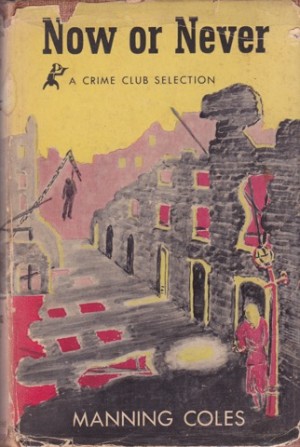
Hardcover. NY, Doubleday & Company, 1st, 1951, Book: Very Good, Dust Jacket: Fair, Hardcover, red textured boards with black lettering on spine. Dust jacket present in fair to poor condition with chipping, tape repairs. Tommy Hambledon is back, and again he's in Germany, posing as a camera- toting tourist while trailing renascent Fascists. The investigation started in Cologne when a corpse was found hung out like a batch of wash from the bare girder of a ruined building. Bookplate on inside front cover, no markings.
Hardcover. Hildesheim, Germany, Georg Olms Verlagsbuchhandlung, Reprint, 1967, Book: Very Good, Dust Jacket: None, Volumes 1-2. Hardcovers. Vol. 1: 512 pages. Vol. 2: 455 pages plus index. Green cloth covers, gilt title on black on spine and gilt title on front cover boards. top edge dyed. Key work by British philosopher, explaining his theories on the mind-body connection, including his doctrines of vibrations and associations, the formation and growth of consciousness, etc. Clean copies.
Hardcover. Gibbs Smith, 1st, 2005, Book: Very Good, Dust Jacket: Very Good, Hardcover, 160 pages. Off the Grid confronts the ecological and cultural problems associated with the way we get and use energy, and explains how it is possible to live in a beautifully designed home using much less--no matter where your home is located. Our homes are connected by a nearly invisible grid of infrastructure that binds us together. It is a system of electrical poles, wire, substations, hydroelectric dams, telecommunication towers, and water extraction and sewage systems. From within this system we work, play, and raise families. We have also created one of the greatest environmental challenges known to modern civilization. The signs of our impact upon the world can be recognized in the reports of environmental changes occurring across the earth, and they can also be seen in the growing failures of the energy grids across the world as the current system is stressed beyond its capacity. Off the Grid beautifully illustrates that this is not just a concept for rural living; examples of homes that are "off the grid" to varying degrees are found in New York City; Ontario, Canada; Stuttgart, Germany; Belmont, California; Pipe Creek, Texas; Clyde Park, Montana; Twin Lakes, Minnesota; Laytonville, California; Venice, California; and New South Wales, Australia.

 "Mel Ramos: I Love Womenby: Gardner, Belinda")

 "Menschen am Zerstorten Anhalter Bahnhof: Fotografien Henry Ries Berlin 1948by: Ries, Henry")

 "Modern Look: Photography and the American Magazine by: Klein, Mason")
 "Modern Worlds: Austrian and German Art, 1890-1940by: Price, Renee / Lauder, Ronald S./Peters, Olaf/ Staggs, Janis")


 "Mozart and the Nazis: How the Third Reich Abused a Cultural Iconby: Erik Levi")


 "Mystery of Olga Chekhova, Theby: Beevor, Antony")
 "Naked Truth: The Body in Early Twentieth-Century German-Austrian Artby: Garrison, Eliza")
 "Nathalie Djurberg & Hans Berg: Snakes Knows It's Yogaby: Fonnesbach, Pernille")
 "Nathalie Djurberg & Hans Berg: Snakes Knows It's Yogaby: Fonnesbach, Pernille")
 "Nazi Culture: The Brown Darkness Over Germanyby: Josephson, Matthew")



 "Nazis in Pre War London 1930 1939: The Fate and Role of German Party Members and British Sympathizers by: James J. Barnes; Patience P. Barnes")
 "Neo Rauch: Works on Paper 2003-2004/Arbeiten auf Papier by: Neo Rauch and Klaus Albrecht Schroder, Harald Kunde")

 "No Entry by: Manning Coles")
 "Norway 1940 by: Kersaudy, Francois")
 "Notes of a Vagabond: Ways of Menby: Bonsels, Waldemar")