Hardcover. Zurich, Scalo, 1st, 2000, Book: Very Good, Dust Jacket: Very Good, Hardcover in a bright dust jacket, 104 pages. In 1999, acclaimed German multimedia artist Rebecca Horn created Concert for Buchenwald, a large-scale, two-part installation in Weimar/Germany commemorating the horrors of genocide and emigration. This darkly intense work evokes both the shoah and the mass murders in former Yugoslavia. The first part of the installation is set in an abandoned train depot. Its walls are lined with glass panes behind whose shiny surfaces you can make out layer upon layer of ashes. Running alongside one of the walls, railroad tracks are blocked up by densely entangled heaps of various stringed instruments, reminiscent of the piles of corpses that were discovered in Buchenwald. The second part of Concert for Buchenwald is installed in Schloss Ettersburg, an 18th century palatial residence. Here, the humming sound of panicked bees is audible from hives suspended from the ceiling of an opulent ballroom, and suggests memories of expulsion and escape. This book includes several essays that explore various aspects and interpretations of Horn's installation, as well as her own notes tracing the origins of the installation's prominent metaphors. Essays by Doris von Drahten, Boris Groys, Rebecca Horn, Bernd Kauffmann, and Martin Mosebach. Clean copy.
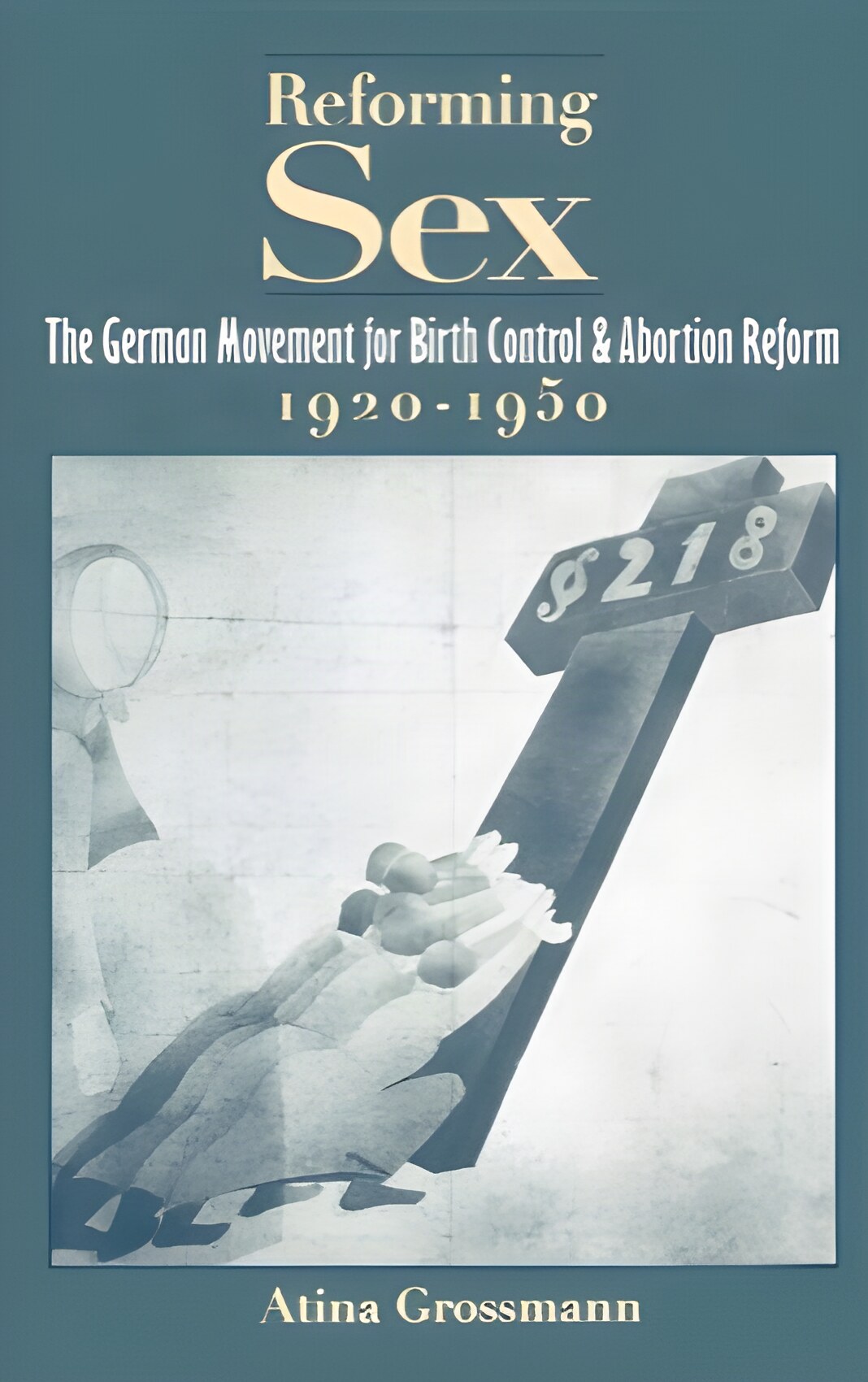
Hardcover. London/NY, Oxford University Press, 1st, 1995, Book: Very Good, Dust Jacket: Very Good, Hardcover in a bright dust jacket, 304 pages. Reforming Sex reconstructs the complicated history of a movement that has been romanticized as the harbinger of 1960s sexual radicalism and demonized as a precursor to Nazi racial policy, but mostly buried and obscured by Nazi book-burnings and repression. Relying on a broad range of sources--from police reports, films and personal interviews to sex manuals unearthed from library basements and secondhand book stores--the book analyzes a remarkable mass mobilization during the turbulent and innovative Weimar years of doctors and lay-people for women's right to abortion and public access to birth control and sex education. Clean copy.
Hardcover. Hatje Cantz Publishers, 1st, 2005, Book: Very Good, Dust Jacket: None, Text is in English and German. Oversized hardcover issued without a dust jacket. Cover has faint wear to corners and edges. Inside is bright and clean, 210 b&w photographs throughout. This handsomely illustrated volume reproduces fine vintage prints from Relang's early reportage career and from the height of her days as a documenter of style, while also providing valuable insight into the historical background of her work.
Hardcover. Germany, Hatje Cantz Publishers, 1st, 2006, Book: Very Good, Dust Jacket: Very Good, Hardcover, 159 pages. Like new in publishers shrink-wrap. The prominent Genovese architect Renzo Piano--recipient of the 1998 Pritzker Award and architect of the Whitney Museum of American Art and Morgan Library renovations, as well as the new New York Times building--has just completed a new and unusual museum building--the Zentrum Paul Klee on the outskirts of Bern. The center, says Piano, is dedicated to the "poet of silence," and thus it was fitting to consider building a museum that would speak softly. The Zentrum Paul Klee rises upward in the form of three hills connected by a 150-meter-long thoroughfare, the "Museum Street" serving as a path within the complex. The three structures make up a harmonious yet prominent landscape sculpture whose roofs are supported by innovative steel construction. Includes photographs, design sketches, plans and models--a living image of a magnificent building.
Hardcover. Germany, Hatje Cantz Publishers, 1st, 2006, Book: Very Good, Dust Jacket: Very Good, Hardcover, 159 pages. Like new in publishers shrink-wrap. The prominent Genovese architect Renzo Piano--recipient of the 1998 Pritzker Award and architect of the Whitney Museum of American Art and Morgan Library renovations, as well as the new New York Times building--has just completed a new and unusual museum building--the Zentrum Paul Klee on the outskirts of Bern. The center, says Piano, is dedicated to the "poet of silence," and thus it was fitting to consider building a museum that would speak softly. The Zentrum Paul Klee rises upward in the form of three hills connected by a 150-meter-long thoroughfare, the "Museum Street" serving as a path within the complex. The three structures make up a harmonious yet prominent landscape sculpture whose roofs are supported by innovative steel construction. Includes photographs, design sketches, plans and models--a living image of a magnificent building.
Hardcover. Germany, Hatje Cantz Publishers, 1st, 2006, Book: Very Good, Dust Jacket: Very Good, Hardcover, 104 pages.Like new in publisher's shrink-wrap. There are no smoking cowboys swinging their lassoes or bare-breasted blondes on heavy motorcycles in this droll collection of highly expressive drawings and watercolors. Au contraire, the inventive shapes and joyful colors recall children's drawings or paintings by the mentally ill. Half-figures of indeterminate gender with staring eyes, big ears and frizzy hair smirk challengingly at the viewer, offering an inventory of possibilities, many of which later find their way into Prince's joke paintings of the same period. This extraordinary little book presents these funny yet sinister works to a larger public for the first time, and allows readers to discover a new side of Richard Prince's oeuvre.
Hardcover. Germany, Steidl, 1st, 2010, Book: Very Good, Dust Jacket: None, Hardcover, 224 pages. Like new in publisher's shrink-wrap. Nowhere is the breezy and urbane romance of Paris conjured as memorably as in the photography of Robert Doisneau (1912-1994). A gentle minstrel of visual anecdote, Doisneau interpreted the city's charms in an iconography that both natives and Francophiles instantly recognize: the young hip couple stealing a spontaneous kiss at a busy intersection, the gendarme chatting with a mother while her kid tiptoes along a riverbank bench, the sweetly melancholic abandoned merry-go-round in the rain and the entire pageant of Parisian life mingling at cafes, bus shelters and on the banks of the Seine. Doisneau was possessed of both lightness of touch and spontaneity, as a result of which he has been sometimes championed as a photographer of the "pure" moment. But his ocular touch is even lighter than that suggests-his images are not so much "seized" as "netted." Accompanying the Fondation Cartier-Bresson's exhibition of around 100 prints from the Doisneau estate, From Craft to Art presents these treasures alongside a new version of Jean-Francois Chevrier's classic 1983 essay on the photographer, which describes Doisneau's knack for capturing "the shining melancholy that separates an individual from the crowd.
Hardcover. Germany, Steidl, 1st, 2010, Book: Very Good, Dust Jacket: None, 160 pages. Hardcover with no dust jacket. Very clean, unmarked copy still in publishers shrink-wrap. Over 100 black and white photographs. Tight copy.
Hardcover. Germany, Steidl, 1st, 2010, Book: Very Good, Dust Jacket: None, 160 pages. Hardcover with no dust jacket. Very clean, unmarked copy still in publishers shrink-wrap. Over 100 black and white photographs. Tight copy.
Hardcover. Germany, Hatje Cantz, 1st, 2007, Book: Very Good, Dust Jacket: None, Like new in publishers shrink-wrap. A new pictorial hardcover book with no dust jacket. Text is in German. Features the multimedia works of Robin Rhode, including photography, performance art, film and sculpture..
Hardcover. Germany, Hatje Cantz, 1st, 2007, Book: Very Good, Dust Jacket: None, Like new in publishers shrink-wrap. A new pictorial hardcover book with no dust jacket. Text is in German. Features the multimedia works of Robin Rhode, including photography, performance art, film and sculpture..
Hardcover. Casemate, 1st, 2010, Book: Very Good, Dust Jacket: Very Good, Hardcover in a bright dustjacket, 264 pages. Following the Allied breakout from the Normandy beachhead in July 1944, the vaunted German Army seemed on the verge of collapse. As British and US forces fanned out across northwestern France, enemy resistance unexpectedly dissolved into a headlong retreat to the German and Belgian borders. In early September an elated Allied High Command had every expectation of continuing their momentum to cripple the enemy's warmaking capability, by capturing the Ruhr industrial complex and plunging into the heart of Germany. After a brief pause to allow for resupply, Courtney Hodge's First Army prepared to punch through the ominous but largely outdated Westwall (Siegfried Line) surrounding Aachen. Drawing on primary Wehrmacht and US sources, including battle analysis and daily situation and after-action reports, The Roer River Battles provides insight into the desperate German efforts to keep a conquering enemy at the borders of their homeland. Tactical maps down to battalion level help clarify the very fluid nature of the combat. Combined, they serve to explain not just how, but why decisions were made and events unfolded, and how reality often differed from doctrine in one of the longest US campaigns of World War II.
Hardcover. New York, Metropolitan Museum of Art, 1st, 1990, Book: Very Good, Dust Jacket: Very Good, Hardcover in a bright, unclipped dust jacket,110 pages, illustrated in color and b&w. Exhibition catalog bound in black cloth covers, gilt lettering on spine. Clean.
Hardcover. Paris, Baudry's European Library, 1st, 1838, Book: Very Good, Dust Jacket: None, Hardcover, calf binding with title label on spine. Illustrated with 8 b&w engravings. Well written, entertaining legends, history and folklore of the Rhine, including the Mouse Tower, Hildegard von Bingen, St. Ursula, etc. Cover is scuffed with surface scars, but binding is firm. 354 pages. Minor foxing. Aside from cover appearance, very good.
Hardcover. Philadelphia, Carey and Hart, 1st, 1843-46, Book: Good, Dust Jacket: None, Five volumes bound into one, 537 total pages. Half leather with marbled boards, edgeworn. All first American editions. The final book's full title: The Military Operations at Cabul, Which Ended in the Retreat and Destruction of the British Army, January 1842. With a Journal of Imprisonment in Afghanistan. Condition good with some browning and foxing to paper. Front inner hinge repaired with tape.
Hardcover. Germany, Steidl, 1st, 2014, Book: Very Good, Dust Jacket: None, When Sam Taylor-Johnson (born 1967) climbed the famous mirrored staircase of Chanel's headquarters at 31 rue Cambon, Paris, she did not quite know what to expect. Her destination was Coco Chanel's private apartment on the second floor; her mission, to photograph it.
Hardcover. Germany, Steidl, 1st, 2014, Book: Very Good, Dust Jacket: None, 76 pages. Hardcover with no dust jacket. Very clean, unmarked copy still in publishers shrink wrap. When Sam Taylor-Johnson climbed the famous mirrored staircase of Chanel's headquarters at 31 rue Cambon, Paris, she did not quite know what to expect. Her destination was Coco Chanel's private apartment on the second floor; her mission, to photograph it.
Softcover. Cambridge MA, Belknap Press / Harvard, reprint, 1996, Book: Very Good, Dust Jacket: None, Softcover, 760 pages. Representing ten years of research into the history of the managerial business system, this book concentrates on patterns of growth and competitiveness in the United States, Germany, and Great Britain, tracing the evolution of large firms into multinational giants and orienting the late twentieth century's most important developments. Clean,bright copy.
Softcover. UK , Cambridge University Press, reprint, 1992, Book: Very Good, Dust Jacket: None, Softcover, 231 pages. Schleiermacher's On Religion: Speeches to its Cultured Despisers is a classic of modern Protestant religious thought that powerfully displays the tensions between the Romantic and Enlightenment accounts of religion. This edition presents the original 1799 text in English for the first time. Richard Crouter's introduction places the work in the milieu of early German Romanticism, Kant criticism, the revival of Spinoza and Plato studies, and theories of literary criticism and of the physical sciences. This fully annotated edition also contains a chronology and notes on further reading. Name on front fly leaf, otherwise clean.
Hardcover. Berlin, Union Deutsche, 4th printing, n.d., Book: Good, Dust Jacket: None, 105 pages, illustrated in color and b&w by Capek. White cloth spine with color illustrated boards. No date listed. German text. Cover edges with light wear.
Hardcover. New Haven CT, Yale University Press, 3rd pr., 1979, Book: Very Good, Dust Jacket: Very Good, Hardcover in a bright dust jacket, 287 pages. The treatment of German physicists under the Nazi regime had far-reaching consequences both for the outcome of the Second World War and for the course of science for decades thereafter. Although this fact has been known from a few famous episodes, it has not been dealt with thoroughly by scholars because it involves two very different disciplines. Political historians have cautiously left it to historians of science, who in turn have shied away from it out of ignorance of the political intricacies. Alan D. Beyerchen here examines this history in detail, basing his research on archival materials in Germany and the United States and on tape-recorded interviews with leading physicists. At least twenty-five percent of Germany's academic physicists who were working in 1933 lost their positions during the Nazi period. The victims -- Jews and other "politically unreliable" persons -- included some of Germany's finest scientists. Those who remained faced opposition not only from Nazi officials but also from certain members of their own community, notably the Nobel laureates Philipp Lenard and Johannes Stark. Beyerchen describes the mechanisms of prejudice, the reaction to the dismissals, and the impact of the "Aryan physics" movement which ultimately failed. Clean copy.
Softcover. Cambridge MA, MIT Press, 4th pr., 1977, Book: Very Good, Dust Jacket: None, Softcover, 82 pages, b&w illustrations. The collected writings of the "dean of the New York School of Abstract-Expressionist Painting." "The creative process lies not in imitating, but in paralleling nature; translating the impulse received from nature into the medium of expression, thus vitalizing this medium. The picture should be alive, the statue should be alive and every work of art should be alive." Thus Hans Hofmann wrote nearly half a century ago. He left the Old World, Germany, for the New, at the age of 50. In 1948, when the retrospective exhibition was held at the Addison Gallery of American Art, Hofmann was 68; he had been in the United States for 18 years, a citizen for seven years. Yet he was scarcely recognized in Europe or America as an artist of significance and had never had a full-scale retrospective exhibition of his work. Beginning with a group exhibition in Germany in 1909, he had been given 12 one-man shows and had been included in four group exhibitions before the exhibit at Andover. Subsequently, he was to have 33 one-man shows and to be in over 60 group exhibitions, including the 1960 Venice Biennale, in which he was one of the four artists chosen to represent America. Clean copy.

 "Rebecca Horn: Concert for Buchenwald by: Horn, Rebecca")
 "Regina Relang: The Elegant World Of Regina Relangby: Relang, Regina, Ulrich Pohlmann and Andreas Ley")
 "Renzo Piano: Zentrum Paul Klee, Bern, The Architectureby: Piano, Renzo")
 "Renzo Piano: Zentrum Paul Klee, Bern, The Architectureby: Piano, Renzo")


 "Richard Prince: Hippie Drawingsby: Brautigan, Richard")
 "Robert Doisneau: From Craft to Artby: Chevrier, Jean-Franaois")
 "Robert Doisneau: From Craft to Artby: ChEvrier, Jean-FranAois")
 "Robert Doisneau: From Craft to Artby: ChEvrier, Jean-FranAois")
 "Robin Rhode: Walk Offby: Rhode, Robin")
 "Robin Rhode: Walk Offby: Rhode, Robin")
 "Roer River Battles: Germany's Stand at the Westwall, 1944")
 "Romantic Vision of Caspar David Friedrich, Theby: Rosenblum, Robert and Boris Asvarishch")
 "Rose Blancheby: Innocenti, Roberto/Christophe Gallaz")


 "Sam Taylor-Johnson: Second Floorby: Taylor-Johnson, Sam (Photographer)")
 "Sam Taylor-Johnson: Second Floorby: Taylor-Johnson, Sam (Photographer)")
 "Scale and Scope: The Dynamics of Industrial Capitalismby: Alfred DuPont Chandler Jr.")

 "Schleiermacher: On Religion: Speeches to its Cultured Despisers by: Friedrich Schleiermacher and Richard Crouter")
 "Schrupp und Schlipp: Geschichte von einem Hund und einer Katzeby: Capek, Josef")

 "Search for the Real and Other Essays by: Hans Hofmann")