Hardcover. Albuquerque, University of New Mexico Press, First Edition, 1969, Book: Very Good, Dust Jacket: Very Good, 419 pages. Hardcover with photographs, illustrations of woodcuts, engravings in bw. Brown cloth boards & black titles to spine. Light marginal foxing to top edge. Dust jacket with toning to spine & light wear to edges. Clean & tight copy.
Softcover. Norman OK, University of Oklahoma Press, reprint, 1997, Book: Very Good, Dust Jacket: None, Softcover, 351 pages. George Wilkins Kendall, who founded the New Orleans Picayune in 1837, was a restless, impatient, and colorful character in an exciting era. For thirty years he guided the Picayune and built it into a powerful force in behalf of America's westward expansion. Kendall's vigorous editorials championed the cause of the infant Republic of Texas. When the Texan Santa Fe Expedition was organized in 1841, for the purpose of occupying New Mexico (then still under Mexican rule), Kendall left his editorial chair to participate--and was marched off to Mexico as a captive for seven months when the expedition was overwhelmed at Santa Fe. A few years later, when Kendall accompanied American forces invading Mexico during the Mexican War, he became America's first war correspondent--reporting directly from the battlefront. His effective "courier expresses" brought the first news of each battle to an eager nation, including President Polk, who often read news of the war in Kendall's Picayune before hearing it from his field commanders. Clean copy.
Hardcover. Albuquerque, University of New Mexico Press, 1st, 1995, Book: Very Good, Dust Jacket: Very Good, Hardcover in a bright dust jacket. 250 pages. b&w illustrations. The Progressive Era promoted a vision of America united by an emphasis on science and progressive reform. The zeal to modernize business, government and social relations extended to farm families and the ways women defined their roles. In this study of the expert advice offered by the domestic economy movement, Holt argues that women were not passive receptors of these views. Seeing their place in agriculture as multi-faceted and important, they eagerly accepted improved education and many modern appliances but often rejected suggestions conflicting with their own views of the rewards and values of farm life. Progressive reform inevitably left a mixed legacy; science and technology did not perfect rural society. But many programs such as 4-H and Master Homemaker still exist and are still shaped by women's desire to preserve and pass on the possibilities of rural life. Clean copy.
Softcover. NY, Seven Stories Press, reprint, 2012, Book: Very Good, Dust Jacket: None, Softcover, 431 pages. A fascinating document of an extraordinary life, Memoirs of A Breton Peasant reads with the liveliness of a novel and bristles with the vigor of an opinionated autodidact from the very lowest level of peasant society. Brittany during the nineteenth century was a place seemingly frozen in the Middle Ages, backwards by most French standards; formal education among rural society was either unavailable or dismissed as unnecessary, while the church and local myth defined most people's reasoning and motivation. Jean-Marie Deguignet is unique not only as a literate Breton peasant, but in his skepticism for the church, his interest in science, astronomy and languages, and for his keen--often caustic--observations of the world and people around him. Born into rural poverty in 1834, Deguignet escapes Brittany by joining the French Army in 1854, and over the next fourteen years he fights in the Crimean war, attends Napoleon III's coronation ceremonies, supports Italy's liberation struggle, and defends the hapless French puppet emperor Maximilian in Mexico. He teaches himself Latin, French, Italian and Spanish and reads extensively on history, philosophy, politics, and literature. He returns home to live as a farmer and tobacco-seller, eventually falling back into dire poverty. Throughout the tale, Deguignet's freethinking, almost anarchic views put him ahead of his time and often (sadly, for him) out of step with his contemporaries. Deguignet's voluminous journals (nearly 4,000 pages in total) were discovered in a farmhouse in Brittany a century after they were written. This narrative was drawn from them and became a surprise bestseller when published in France in 1998. Clean copy.
Hardcover. Hatje Cantz, 1st, 2011, Book: Very Good, Dust Jacket: Very Good, Hardcover, 224 pages. The years from 1945 to 1985 are often identified as the moment in which Los Angeles established itself as a leading cultural center in America. However, this conception of its history entirely excludes the very controversial presence of the Mexican muralists, as well as the work of other artists who were influenced by them and responded to their ideas. It is likewise often thought that Los Angeles' Mexican culture arrived full formed from outside it, when in fact that culture originated within the city--it was in Los Angeles and Southern California that Jose Vasconcelos, Ricardo Flores Magon, Octavio Paz and other intellectuals developed the iconography of modern Mexico, while Anglos and Chicanos were developing their own. David Alfaro Siqueiros, Clemente Orozco, Alfredo Ramos Martinez and Jean Charlot made some of their earliest murals in Los Angeles, influencing the Mexican, Mexican-American and Chicano artists of the 1970s and 80s. MEX/LA: Mexican Modernism(s) in Los Angeles 1930-1985 focuses on the construction of different notions of "Mexicanidad" within modernist and contemporary art created in Los Angeles. From the Olvera Street mural by Siqueiros, to the Golden Age of Mexican cinema and the Disney silver-screen productions, to the revitalization of the street mural, up to the performance art of Guillermo Gomez-Pena, MEX/LA explores the bi-national and hybrid forms of artistic practices, popular culture and mass-media arts that have so uniquely shaped Los Angeles' cultural panorama.
Hardcover. UK, Cambridge University Press, 1st, 2001, Book: Very Good, Dust Jacket: Very Good, 444 pages. Hardcover with dust jacket. Light fading to dust jacket front. Light edgewear to dj. Black and white pictures throughout. Clean, tight copy. In 1999 Pope John Paul II proclaimed Our Lady of Guadalupe a patron saint of the Americas. According to oral tradition and historical documents, in 1531 Mary appeared as a beautiful Aztec princess to Juan Diego, a poor Indian. Speaking to him in his own language, she asked him to tell the bishop her name was La Virgen de Guadalupe and that she wanted a church built on the mountain. During a second visit, the image of the Virgin miraculously appeared on his cape. Through the centuries, the enigmatic power of this image has aroused such fervent devotion in Mexico that it has served as the banner of the rebellion against Spanish rule and, despite skepticism and anticlericalism, still remains a potent symbol of the modern nation. In Mexican Phoenix, David Brading traces the intellectual origins, the sudden efflorescence, and the theology that has sustained the tradition of Our Lady of Guadalupe. Brading also documents the interaction of religion and patriotism, and describes how the image has served as a banner both for independence and for the Church in its struggle against the Liberal and revolutionary state.
Hardcover. NY, Charles J. Folsom, 1st, 1842, Book: Very Good, Dust Jacket: None, Hardcover, publisher's brown cloth, stamped in blind, spine gilt. 256 pages including index with a color folded map laid in. Map was tipped-in and removed leaving a sliver or the map still attached at title page (see photos), map itself is clean, no wear to folds. First edition of this important work. The section on Texas and the Santa Fe expedition is attributed to Franklin Coombs, a veteran of the latter ill-fated debacle, and his account of the expedition and his captivity (which first appeared in NILES WEEKLY REGISTER) is reprinted herein, along with another account (Wagner-Camp 86) of a trip to Santa Fe appearing here for the first time in book form. The map shows Texas, Mexico, and the southwest region as far north as the Arkansas River, south to Yucatan, west to the Pacific, and east to New Orleans. Light chipping to spine cloth at top, penciled notation on front fly leaf, mild foxing to several pages, otherwise a clean, bright copy.
Hardcover. Norman OK, University of Oklahoma Press, 1st, 2001, Book: Very Good, Dust Jacket: Very Good, Hardcover in a bright dust jacket, 348 pages, b&w illustrations. This handsomely illustrated book offers a panoramic view of ancient Mexico, beginning more than thirty thousand years ago and ending with European occupation in the sixteenth century. Drawing on archaeological and ethnohistorical sources, the book is one of the first to offer a unified vision of Mexico's precolonial past. Typical histories of Mexico focus on the prosperity and accomplishments of Mesoamerica, located in the southern half of Mexico, due to the wealth of records about the glorious past of this region. Mesoamerica was only one of three cultural superareas of ancient Mexico, however, all interlinked by complex economic and social relationships. Tracing the large social transformations that took place from the earliest hunter-gatherer times to the Postclassic states, the authors describe the ties between the three superareas of ancient Mexico, which stretched from present-day Costa Rica to what is now the southwestern United States. According to the authors, these superareas-Mesoamerica, Aridamerica, and Oasisamerica - cannot be viewed as independent entities. Instead, they must be considered as a whole to understand the complex reality of Mexico's past.
Hardcover. Norman OK, University of Oklahoma Press, 1st, 1996, Book: Very Good, Dust Jacket: Very Good, Hardcover, 212 pages, b&w photos. Clean, unmarked copy with only minor wear to dust jacket. Today, roughly fifty thousand Tarahumara continue living in ways similar to those of their ancestors, retaining many customs from their pre-Columbian past. Striking sepia-toned monochrome photographs and a historical narrative document the lives and past of people in mountainous southwestern Chihuahua, Mexico.
Hardcover. New York, Aperture, 1st, 2003, Book: Near Fine, Dust Jacket: Near Fine, 220 pages, 155 b&w photographs by Casasola. Edited by Pablo Ortiz Monasterio, essay by Pete Hamill. Agustin Victor Casasola photographed everyone of consequence in Mexico at the time of the revolution, from Francisco (Pancho) Villa, Emiliano Zapata and the exiled Russian leader Leon Trotsky to artists Diego Rivera and Frida Kahlo. For this splendid collection of Casasola's work, the noted American author Pete Hamill has written a rich essay on the photographer and the Mexico he pictured so well.
Softcover. Tucson, AZ, Arizona University Press , 1st paperback, 1993, Book: Very Good, Dust Jacket: None, Softcover. Black & white photos by George Alexander Grant. Some color fade to edges of cover. The Spanish missions founded by Padre Eusebio Kino in Sonora, Mexico, during the 1690s and early 1700s are historical as well as architectural marvels. Once self-supporting villages with central churches, the missions stand today as monuments to perseverance in the face of a hostile New World. These "Kino Missions" were surveyed in 1935 by the National Park Service to prepare for the restoration of the mission at Tumacacori, Arizona, then a National Historic Monument. That report, which was never published, provided insights into the missions' history and architecture that remain of lasting relevance. Perhaps more important, it documented these structures in photographs and drawings--the latter including floor plans and sketches of architectural detail--that today are of historic as well as aesthetic interest. This volume reproduces that 1935 report in its entirety, focusing on sixteen missions and including two maps, 52 drawings, and 76 photographs. With a new introduction and appendixes that place the original study in context,
Softcover. Washington DC, National Geographic Society, 1st, 1930, Book: Very Good, Dust Jacket: None, Original magazines July - December 1930, in a green pebbled hardcover binding. Magazines are dated and paged, with photographs and maps, but do not have covers, advertisements, etc. Includes: Mexico's west coast; 3 articles on the conquest of Antarctica; Unmapped areas of China, Unexplored areas of the Philippines; Chateau country of France; Yugoslavia; Virgil's Aeneid and Roman Geography; Strange tribes in the Shan States of Burma; The Yukon trail of 1898; Viking life in the Faeroes; and much more. Clean, bright volume.
Hardcover. Boston, Houghton Mifflin , 1st, 1889, Book: Good, Dust Jacket: None, Hardcover, green cloth stamped in dark green with drawing of two riders on horseback. Gilt title on spine. Bookseller's sticker on inside front cover, previous owner's signature on front fly leaf otherwise clean.
Hardcover. New York, Scribners, 1st, 1916, Book: Very Good, Dust Jacket: None, Hardcover, 245 pages, b&w illustrations by Peixotto throughout, gilt decorated cover, titles and top edge. Minor corner bumps and spine edge wear, otherwise, very clean and tight copy. Descriptions of the old Spanish Missions and settlements of Arizona, New Mexico and along the Texan border.
Softcover. Tucson, University of Arizona Press, 3rd pr., 1997, Book: Very Good, Dust Jacket: None, Softcover, 325 pages with index. The devotion to Our Lady of Guadalupe, based on the story of apparitions of the Virgin Mary to Juan Diego, an Indian neophyte, at the hill of Tepeyac in December 1531, is one of the most important formative religious and national forces in the history of Mexico. It has variously been interpreted as the source of Mexican national identity, a means of continuity between the Indian past and Spanish domination, a symbol of national liberation, and a way of evangelizing and pacifying the Indians. The aphorism "Mexico was born at Tepeyac" aptly summarizes its importance. In this, the first work ever to examine in depth every historical source of the Guadalupe apparitions, Stafford Poole traces the origins and history of the account, and in the process challenges many commonly accepted assumptions and interpretations. Small corner clip to front fly leaf, otherwise a clean, tight copy.
Hardcover. New Haven, CT, Yale University Press, 1st, 2015, Book: Very Good, Dust Jacket: None, 480 pages. Hardcover with no dust jacket. Very clean, unmarked copy still in shrink wrap. 378 color and 10 black & white illustrations. Tight copy. While European art forms were widely disseminated, copied, and adapted throughout Latin America, colonial painting is not a derivative extension of Europe. The ongoing debate over what to call it-mestizo, hybrid, creole, indo-hispanic, tequitqui-testifies to a fundamental yet unresolved question of identity. Comparing and contrasting the Viceroyalties of New Spain, with its center in modern-day Mexico, and Peru, the authors explore the very different ways the two regions responded to the influence of the Europeans and their art. A wide range of art and artists are considered, some for the first time.
Hardcover. US, University of Arizona Press, 1st, 1984, Book: Very Good, Dust Jacket: Very Good, Hardcover, 252 pages. Light shelf-wear to price clipped dust jacket, else a clean, tight copy.
Hardcover. US, Univ of New Mexico Press, 1st, 1995-10-01, Book: Very Good, Dust Jacket: Very Good, 227 pages. Minor edgewear to dust jacket, else a clean, tight copy. A in depth study of the exhibition held at the Museum of Modern Art in 1955, and its influence, with a final chapter on "Edward Steichen, Robert Frank and American Modernism".
Hardcover. NY, Abbeville Press, 1st, 2010, Book: Very Good, Dust Jacket: Very Good, Hardcover in a bright dust jacket. 336 pages illustrated in color. This authoritative yet accessible study begins with an overview of the aesthetics, meanings, functions, and techniques of Mesoamerican architecture, and then proceeds to survey the historical development of the builder's art in each of the region's cultural areas. As readers travel from the Maya heartland of Guatemala and the Yucatan to the Aztec stronghold of the Valley of Mexico, and all the way to the northern hinterlands of Mesoamerica, they will gain an appreciation of both the unity and the diversity of the region's architecture. Clean copy. DOMESTIC SHIPPING ONLY.
Hardcover. Albuquerque, University of New Mexico Press, 1st, 1999, Book: Very Good, Dust Jacket: Very Good, Hardcover in a bright dust jacket, 307 pages. In all North America you cannot get much lower than the Imperial Valley of southern California, where one town, 186 feet below sea level, calls itself the Lowest Down City in the Western Hemisphere, and where the waters of the Colorado River sustain a billion-dollar agricultural industry. The consequences of that industry drain from the valley into the accidentally man-made Salton Sea, California's largest lake and a vital stopping place for migratory waterfowl. Today the Salton Sea is in desperate environmental trouble. A second river also ends in the Salton Sea. It is a river of dreams, the remains of which may be seen in the failed real estate developments that sprawl beside the sea. As the ending point of both the real Colorado and this river of dreams, the Salton Sea has become emblematic of much of the history of the American West. Its troubling story is masterfully told here in William deBuys's narrative and Joan Myers's austerely beautiful photographs. Mild wear, ereasure to front fly leaf, otherwise clean.
Hardcover. New Haven CT, Yale University Press, 1st, 2008, Book: Very Good, Dust Jacket: Very Good, Hardcover, 208 pages. This engrossing book presents the photographs of four historically engaged artists and explains what they reveal about the highly dramatic revolutionary and post-revolutionary period in Mexico from 1910 to 1935. The works of these photographers--American Walter H. Horne, Italian Tina Modotti, and Mexicans Agustin Victor Casasola and Manuel Alvarez Bravo--are discussed not just as windows onto events but as artworks that offer both objective reporting and stylized expression.The twenty-five years covered in the book encompass some of the most convulsive developments in Mexico, from the violence and cataclysmic changes wrought by the Mexican Revolution to the immense struggles to forge a new nation and a new government. During this period, the work of the four photographers--two primarily documentary, one propagandistic, and one artistic and personal--enabled Mexicans to understand the forces that had brought their nation to armed conflict and social transformation.
Hardcover. Santa Fe NM, Museum of New Mexico Press, 1st, 2000, Book: Very Good, Dust Jacket: Very Good, Hardcover in a bright dust jacket, 165 pages. Little is known about the fifth and last western expedition of the celebrated explorer John Charles Frmont. The great effort to survey a transcontinental railway route across the 38th parallel ended short of success in the snows of Utah in 1854 but involved a meticulous photographic documentation-in daguerreotypes-of the route from the Mississippi westward. It was believed that a central railroad across the country would favor abolitionists in the great debate then raging in the country over slavery. Solomon Nunes Carvalho was hired by Frmont to photograph the expedition-the first time a western expeditionary survey had been systematically documented in photographs. Tragically, the daguerreotypes were destroyed by fire, and Fremont's fifth expedition was lost to history. Author and daguerreotypist Robert Shlaer remarkably has reconstructed the expedition in 120 original daguerreotypes. Using Frmont's maps, expedition documents, and Carvalho's diary accounts, Shlaer recreates the lost expedition across America's most breathtaking landscape using photography's first and most venerable method of daguerreotypy.
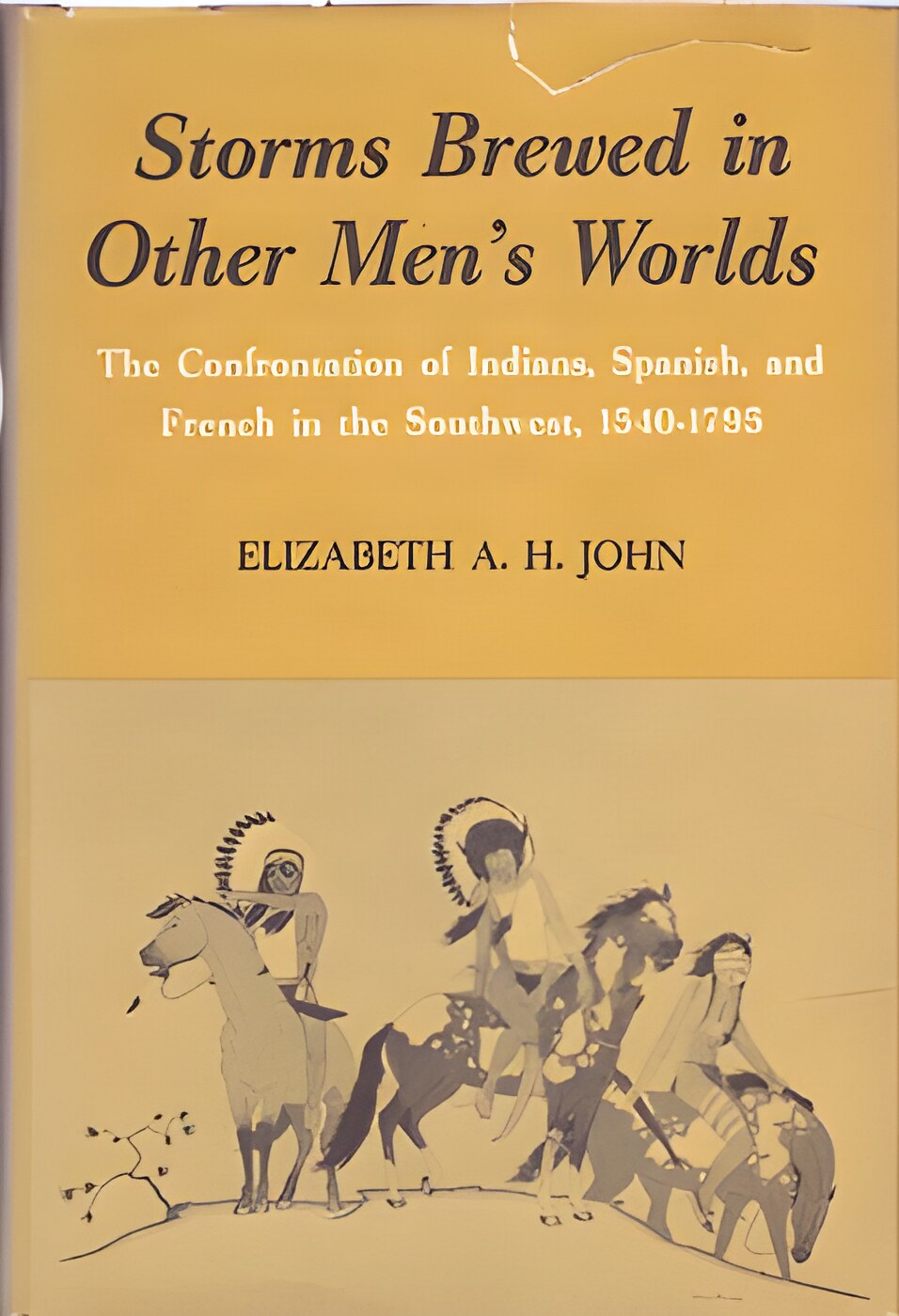
Hardcover. College Station, Texas A&M University Press, 1st, 1975, Book: Very Good, Dust Jacket: Very Good, Hardcover in a bright dust jacket with a small tape repair, 805 pages. The Confrontation of Indians, Spanish, and French in the Southwest, 1540-1795. Spanning two and a half centuries, from the earliest contacts in the 1540s to the crumbling of Spanish power in the 1790s. Storms Brewed in Other Men's Worlds is a panoramic view of Indian peoples and Spanish and French intruders in the early Southwest. The primary focus is the world of the American Indian, ranging from the Caddos in the east to the Hopis in the west, and including the histories of the Pueblo, Apache, Navajo, Ute, and Wichita peoples. Within this region, from Texas to New Mexico, the Comanches played a key, formative role, and no less compelling is the story of the Hispanic frontier peoples who weathered the precarious, often arduous process of evolving coexistence with the Indians on the northern frontier of New Spain. Clean copy.
Hardcover. NY, Abrams Press, 1st, 2021, Book: Very Good, Dust Jacket: Very Good, Hardcover in a bright, unclipped dust jacket. 352 pages, b&w illustrations. The first full biography of the star Negro Leaguer and Hall of Famer James 'Cool Papa" Bell (1903-1991) was a legend in black baseball, a lightning fast switch hitter elected to the National Baseball Hall of Fame in 1974. Bell's speed was extraordinary; as Satchel Paige famously quipped, he was so fast he could flip a light switch and be in bed before the room got dark. Wheeler recounts the life of this extraordinary player, a key member of some of the greatest Negro League teams in history. Born to sharecroppers in Mississippi, Bell was part of the Great Migration, and in St. Louis, baseball saved Bell from a life working in slaughterhouses. Wheeler charts Bell's ups and downs in life and in baseball, in the United States, the Dominican Republic, and Mexico, where he went to escape American racism and MLB's color line.

 "J. Ross Browne - His Letters, Journals & Writingsby: Browne, J. Ross/Lina Fergusson Browne (Editor)")

 "Memoirs of a Breton Peasant, 1834-1905by: Jean-Marie D?©guignet")
 "Mexican Phoenix: Our Lady of Guadalupe: Image and Tradition Across Five Centuriesby: Brading, D.A.")



 "Mexico's Sierra Tarahumara: A Photohistory of the People of the Edgeby: Raat, W. Dirk and Janecek, George R.")
 "Mexico: The Revolution and Beyond - Photographs by Agustin Victor Casasola 1900-1940by: Casasola, Agustin Victor")
 "National Geographic Magazine - Vol. LVIII July - December 1930 (Six Issues)by: National Geographic Society")
 "On Horseback: A Tour in Virginia, North Carolina and Tennessee with notes of travel in Mexico and Californiaby: Warner, Charles Dudley")
 "Our Hispanic Southwestby: Peixotto, Ernest")
 "Painting in Latin America, 1550-1820: From Conquest to Independenceby: Alcala, Luisa Elena")
 "Pancho Villa and John Reed: Two Faces of Romantic Revolutionby: Tuck, Jim")
 "Picturing an Exhibition: The Family of Man and 1950s Americaby: Sandeen, Eric J.")


 "Seeing Mexico Photographed: The Work of Horne, Casasola, Modotti, and Alvarez Bravoby: Leonard Folgarait")
 "Sights Once Seen: Daguerreotyping Fremont's Last Expedition Through the Rockies by: Shlaer, Robert")
 "The Bona Fide Legend of Cool Papa Bell: Speed, Grace, and the Negro Leaguesby: Wheeler, Lonnie")