Softcover. US, Kitchen Sink Pr (Nrt), reprint, 1989, Book: Very Good, Dust Jacket: None, 159 pages. Light edgewear to wrappers. Black and white comics throughout.
Softcover. US, Kitchen Sink Pr (Nrt), reprint, 1989, Book: Very Good, Dust Jacket: None, 159 pages. Light edgewear to wrappers. Black and white comics throughout.
Softcover. US, Kitchen Sink Press, reprint, 2009, Book: Very Good, Dust Jacket: None, 159 pages. Light edgewear to wrappers. Black and white comics throughout.
Softcover. Kitchen Sink Press, 1st, 1989, Book: Very Good, Dust Jacket: None, Softcover, 176 pages, b&w reprints of the early strips. This book contains a complete set of the 1940 daily strips. The first Hollywood adaptation of Li'l Abner was made in 1940. Newspaper columnist Michael Price and the late film historian George Turner provide a fascinating history of this largely forgotten movie, complete with 9 rare stills and lobby cards. The back cover features the very rare Li'l Abner movie poster and another lobby card in full color. Buster Keaton plays Lonesome Polecat in the film but the once hugely popular silent star was in such professional disgrace by 1940 that he was not even listed among the seven acting credits on the film poster! A sidebar provides backgrounds on the producer, director and actors. A second introduction by editor Dave Schreiner provides a political and historical context for the strip itself in 1940. The year begins with Capp's parody of John Steinbeck's The Grapes of Wrath (also made into a movie this year). Dogpatch is wiped out by turnip termites, so our favorite hillbillies are lured to Boston to pick oranges in winter! Li'l Abner also learns how to woo "Dogpatch style" from Adam Lazonga, whom Schreiner speculates is based on controversial philosopher and free thinker Bertrand Russell or possibly playwright George Bernard Shaw. In another episode Mammy and Pappy Yokum get a 100 year-old letter and rush off to the California gold rush. Earthquake McGoon is introduced in the daily strip this year, as is the popular phrase, "As any fool kin plainly see!" Plus the annual Sadie Hawkins Day Race. The cover is drawn by Peter Poplaski.
Softcover. US, Kitchen Sink Pr (Nrt), reprint, 1990, Book: Very Good, Dust Jacket: None, 159 pages. Light edgewear to wrappers. Black and white comics throughout.
Softcover. Kitchen Sink Press, 5th pr, 2009, Book: Very Good, Dust Jacket: None, Softcover, 184 pages. As World War II came to America, Al Capp moved his comic strip firmly into the realm of social satire. Meet the genial hustler. Available Jones, and Joe Btfsplk, world's worst jinx. Abner goes on a quest and Salomey is kidnapped by the Scraggs. While all this, and more, was going on, Capp found time to contribute artwork and time to the Defense and Treasury Departments, the Red Cross, and military hospitals. See it all in this volume of Al Capp's Li'l Abner.
Hardcover. Kitchen Sink Press, 1st, 1990, Book: Very Good, Dust Jacket: None, Hardcover, 182 pages. Glazed boards. In the 1943 run of Al Capp's Li'l Abner, Madame Lazonga taught Daisy Mae how to woo, and Abner came perilously close to the fate he dreaded most. Sir Cecil Cesspool - 'he's deep, he has a certain air about him' - visited the colonies, and brought a monster with him. And Patricia Hallroom, the girl with the hottest lips in the world, made Sadie Hawkins Day even more dangerous than usual. Includes an introduction by Don Thompson and an article that places Capp's strip in historical context.
Softcover. Kitchen Sink Press, 5th pr, 2009, Book: Very Good, Dust Jacket: None, Softcover, 182 pages. In the 1943 run of Al Capp's Li'l Abner, Madame Lazonga taught Daisy Mae how to woo, and Abner came perilously close to the fate he dreaded most. Sir Cecil Cesspool - 'he's deep, he has a certain air about him' - visited the colonies, and brought a monster with him. And Patricia Hallroom, the girl with the hottest lips in the world, made Sadie Hawkins Day even more dangerous than usual. Includes an introduction by Don Thompson and an article that places Capp's strip in historical context.
Hardcover. NY, Doubleday, 1st, 1951, Book: Very Good, Dust Jacket: Very Good, Hardcover, 48 pages, b&w cartoons by Otto Soglow. Humorous illustrations of Latin phrases.
Hardcover. New York, Farrar, Straus, Giroux, 2nd printing, 1995, Book: Very Good, Dust Jacket: Very Good, Hardcover. Non-paginated. TIPPED-IN BOOKPLATE ON FRONT ENDPAPER SIGNED BY AUTHOR AND ILLUSTRATOR. Clean, bright copy.
Hardcover. NY, Villard, 1st, 2011, Book: Very Good, Dust Jacket: None, Pictorial boards, 159 pages, color illustrations. Gliding through the daydreams and realities of a young woman searching for definition, "Life with Mr. Dangerous" showcases acclaimed cartoonist Paul Hornschemeier's gift for deadpan humor and dead-on insight with a droll aftertaste--an unlikely but welcome marriage of the bleak and the hopeful.
Hardcover. Francestown NH, Golden Quill Press, 1ST, Book: Very Good, Dust Jacket: Very Good, Dark red faux leather cloth spine with red and white cloth over boards; gilt-stamped spine and cover titles. Red and white dust jacket in mylar cover. A collection of short humorous poems previously published in various magazines. INSCRIBED BY THE AUTHOR on the front free endpaper:
Softcover. Kitchen Sink Press, 1st, 1992, Book: Very Good, Dust Jacket: None, Softcover, 176 pages. The most popular of Capp's hundreds of distinctive characters was the Shmoo. This lovable little creature loved mankind so much that it would sacrifice itself and turn into a ham steak, a gallon of milk or a dozen eggs: whatever its owner desired. Its whiskers made nice toothpicks and its eyes could be recycled as buttons. Most important, a Shmoo could reproduce faster than a rabbit. Thus, if you had one Shmoo, you were set. You didn't need to work at all. Thus did the apparent book for mankind become its curse and the powers that be decreed that all Shmoos must be exterminated. Capp's insightful morality tale was so popular that it spawned an unprecedented merchandising bonanza. Two introductions, by David Schreiner and by science fiction writer Harlan Ellison, are illustrated with various Shmoo toys manufactured. The large back cover photograph shows a selection of Shmoo merchandise in color from the Denis Kitchen collection. Also featured in this volume: Flying Sausages (parody of "Flying Saucers," a term first coined a few months earlier; Fearless Fosdick, Nightmare Alice, Salomey, Adam Lazonga, Moonbeam McSwine, Cousin Weak-Eyes and Marryin' Sam. See also our Shmoo Facts Sheet for some amazing statistics about this character's popularity.
Softcover. Kitchen Sink Press, 1st, 1992, Book: Very Good, Dust Jacket: None, Softcover, 176 pages. The most popular of Capp's hundreds of distinctive characters was the Shmoo. This lovable little creature loved mankind so much that it would sacrifice itself and turn into a ham steak, a gallon of milk or a dozen eggs: whatever its owner desired. Its whiskers made nice toothpicks and its eyes could be recycled as buttons. Most important, a Shmoo could reproduce faster than a rabbit. Thus, if you had one Shmoo, you were set. You didn't need to work at all. Thus did the apparent book for mankind become its curse and the powers that be decreed that all Shmoos must be exterminated. Capp's insightful morality tale was so popular that it spawned an unprecedented merchandising bonanza. Two introductions, by David Schreiner and by science fiction writer Harlan Ellison, are illustrated with various Shmoo toys manufactured. The large back cover photograph shows a selection of Shmoo merchandise in color from the Denis Kitchen collection. Also featured in this volume: Flying Sausages (parody of "Flying Saucers," a term first coined a few months earlier; Fearless Fosdick, Nightmare Alice, Salomey, Adam Lazonga, Moonbeam McSwine, Cousin Weak-Eyes and Marryin' Sam.
Hardcover. Athens, Ga., Hill Street Press, LLC, 1st, January 1999, Book: Very Good, Dust Jacket: Very Good, Hardcover, 155 pages. B&w illustrations throughout. Light spotting to top edge. Rubbing and light soiling to dust jacket. Else a nice, clean copy.
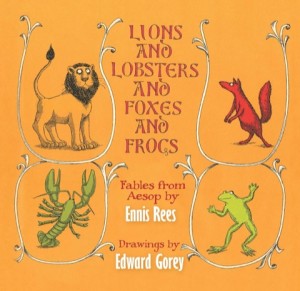
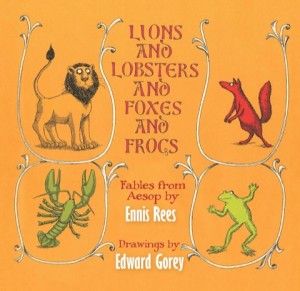
Hardcover. NY, Dover Publications, reprint, 2018, Book: Very Good, Dust Jacket: Very Good, Hardcover in a bright dust jacket, 48 pages illustrated in color by Gorey. A new approach to the ancient fables of Aesop features charming rhymes and winsome images by a beloved illustrator. Artist Edward Gorey sets the scenes for poet Ennis Rees's modern interpretation of Aesop's verses, which recount how animals with all-too-human failings receive their just desserts. Memorable renderings of familiar and lesser-known vignettes include the fable of the industrious ant, who prepares for the hardships of the coming winter, and the feckless grasshopper, whose laziness proves fatal. A mighty lion is amused at the notion of a tiny mouse coming to his rescue, a naive young crustacean admires the bright red shell of a boiled lobster, and a swarm of flies are undone by their attraction to a pool of spilled honey. These and other timeless tales provide humorous insights into the folly of greed and vanity and the rewards of virtuous behavior. Originally published in 1971 by Young Scott.
Hardcover. NY, Dover Publications, reprint, 2018, Book: Very Good, Dust Jacket: Very Good, Hardcover in a bright dust jacket, 48 pages illustrated in color by Gorey. A new approach to the ancient fables of Aesop features charming rhymes and winsome images by a beloved illustrator. Artist Edward Gorey sets the scenes for poet Ennis Rees's modern interpretation of Aesop's verses, which recount how animals with all-too-human failings receive their just desserts. Memorable renderings of familiar and lesser-known vignettes include the fable of the industrious ant, who prepares for the hardships of the coming winter, and the feckless grasshopper, whose laziness proves fatal. A mighty lion is amused at the notion of a tiny mouse coming to his rescue, a naive young crustacean admires the bright red shell of a boiled lobster, and a swarm of flies are undone by their attraction to a pool of spilled honey. These and other timeless tales provide humorous insights into the folly of greed and vanity and the rewards of virtuous behavior. Originally published in 1971 by Young Scott.
Hardcover. Montreal, Drawn & Quarterly, 1st, 2020, Book: Very Good, Dust Jacket: None, Hardcover, 244 pages of color comics plus 30 pages of additional material. Essay on Stanley by Frank Young. Lulu is a strong, assertive young girl who is both entertaining and empowering to girls and women of all ages-even if she sometimes finds herself in hot water. In Little Lulu: The Fuzzythingus Poopi, she outsmarts criminals, sabotages the boys in a masterful snowball fight, and solves the crime of the missing piggy bank! Over the course of these stories, Stanley excels at visual gags, from Lulu winning the soap box derby by turning her frock into a sail, to a lonely cloud almost getting sucked up by a vacuum. This is the second installment in Drawn & Quarterly's landmark reprint series of the classic John Stanley comic strip that was first published by Dell Comics in the 1940s and '50s.
Hardcover. Boston, Little, Brown & Company, First Edition, 2002, Book: Very Good, Dust Jacket: Very Good, 594 pages. Hardcover. Black & white illustrations throughout. Dust jacket with light marginal wear. Features behind the scenes gossip & interviews with a wide variety of stars, writers & guests, too numerous to detail here. Clean, unmarked copy.
Hardcover. London, George Allen & Unwin Ltd., 2nd pr., 1947, Book: Good, Dust Jacket: None, Hardcover in light tan cloth with red lettering to the spine, 361 pages. Although the life of London runs like a thread through the whole fabric of this book, it is not essentially a book about London. Life in Bloomsbury is but the center of a large circle, the point around which the rest of the book revolves, the origin of a disarming commentary on an infinite variety of topics - on Bloomsbury's squares, on the picturesqueness of London a generation ago, on what is true Cockney, on the differences of English and American humor, on the decay of English wit, on books and authors and publishers and the Press, on the literary lions of the past, on the religion of speed, on the charm of Americans, on how the Victorian age was neither so repressed nor so hidebound as most people today like to believe - and so on, one thing leading to another, like good conversation at a good luncheon overlooking the mellow squares of Bloomsbury. The book is full, too, of good stories and reminiscences, both humorous and pathetic, but there is shrewd comment besides on the deficiencies of contemporary society, not the less effective because the author knows how to soften the blow. Mild soil, sunning to covers, clean copy.

 "Li'l Abner: Dailies, Vol. 4: 1938by: Capp, Al")
 "Li'l Abner: Dailies, Vol. 4: 1938by: Capp, Al")
 "Li'l Abner: Dailies, Vol. 5: 1939by: Capp, Al")
 "Li'l Abner: Dailies, Vol. 5: 1939by: Capp, Al")
 "Li'l Abner: Dailies, Vol. 6: 1940by: Capp, Al")
 "Li'l Abner: Dailies, Vol. 6: 1940by: Capp, Al")
 "Li'l Abner: Dailies, Vol. 7: 1941by: Capp, Al")
 "Li'l Abner: Dailies, Vol. 7: 1941by: Capp, Al")
 "Li'l Abner: Dailies, Vol. 8: 1942by: Capp, Al")
 "Li'l Abner: Dailies, Vol. 8: Dailies 1942by: Capp, Al")
 "Li'l Abner: Dailies, Vol. 9: 1943by: Capp, Al")
 "Li'l Abner: Dailies, Vol. 9: Dailies 1943by: Capp, Al")
 "Liberated Latinby: O. Soglow/Dick Shaw")
 "Library, The (SIGNED COPY)by: Stewart, Sarah/David Small")



 "Light Version (SIGNED COPY)by: Gleason, Marian")
 "Lil Abner: Meets the Shmoo, 1948, Vol. 14by: Al Capp and Dave Schreiner")
 "Lil Abner: Meets the Shmoo, 1948, Vol. 14by: Capp, Al")
 "Lines Are Drawn: Political Cartoons of Civil Warby: Smith, Kristen M.")
 "Little Lulu: The Fuzzythingus Poopiby: Stanley, John")
 "Live From New York - An Uncensored History of Saturday Night Liveby: Shales, Tom/James Andrew Miller")
 "Living in Bloomsbury by: Burke, Thomas")