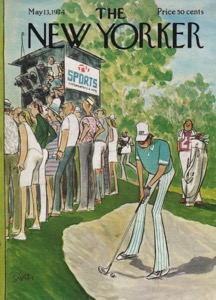
Golfer in sand trap, cartoon art by Charles Saxon. 9 x 11", very good. PLEASE NOTE: The image shown is a scan of the actual product you are purchasing. What you see is what you get. The sheet may have some imperfections beyond the cropped area shown. You are buying THIS PAGE ONLY- not the entire magazine. Your order will be placed carefully between stiff paper and an acetate overlay, then packed in a rigid cardboard sleeve to prevent bending.
Television broadcast control room, cartoon art by Charles Saxon. 9 x 11", very good. PLEASE NOTE: The image shown is a scan of the actual product you are purchasing. What you see is what you get. The sheet may have some imperfections beyond the cropped area shown. You are buying THIS PAGE ONLY- not the entire magazine. Your order will be placed carefully between stiff paper and an acetate overlay, then packed in a rigid cardboard sleeve to prevent bending.
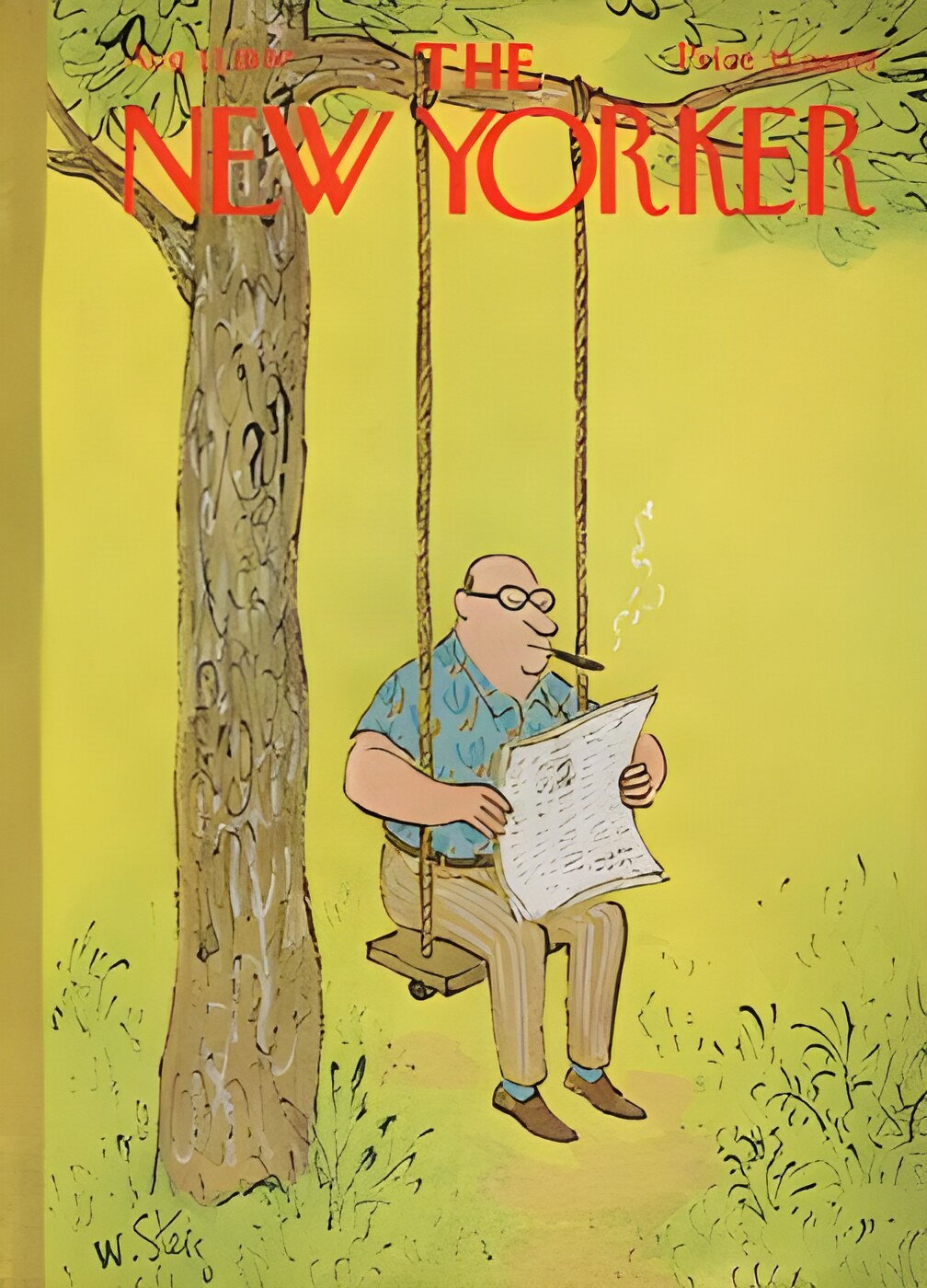
1967, Book: Very Good, Color cartoon of cigar-smoking man sitting on a tree swing by William Steig. 8 3/4 X 12", very good. PLEASE NOTE: The image shown is a scan of the actual product you are purchasing. What you see is what you get. The sheet may have some imperfections beyond the cropped area shown. You are buying THE COVER ONLY- not the entire magazine. Your order will be placed carefully between stiff paper in clear plastic envelope, then packed in a rigid cardboard sleeve to prevent bending.
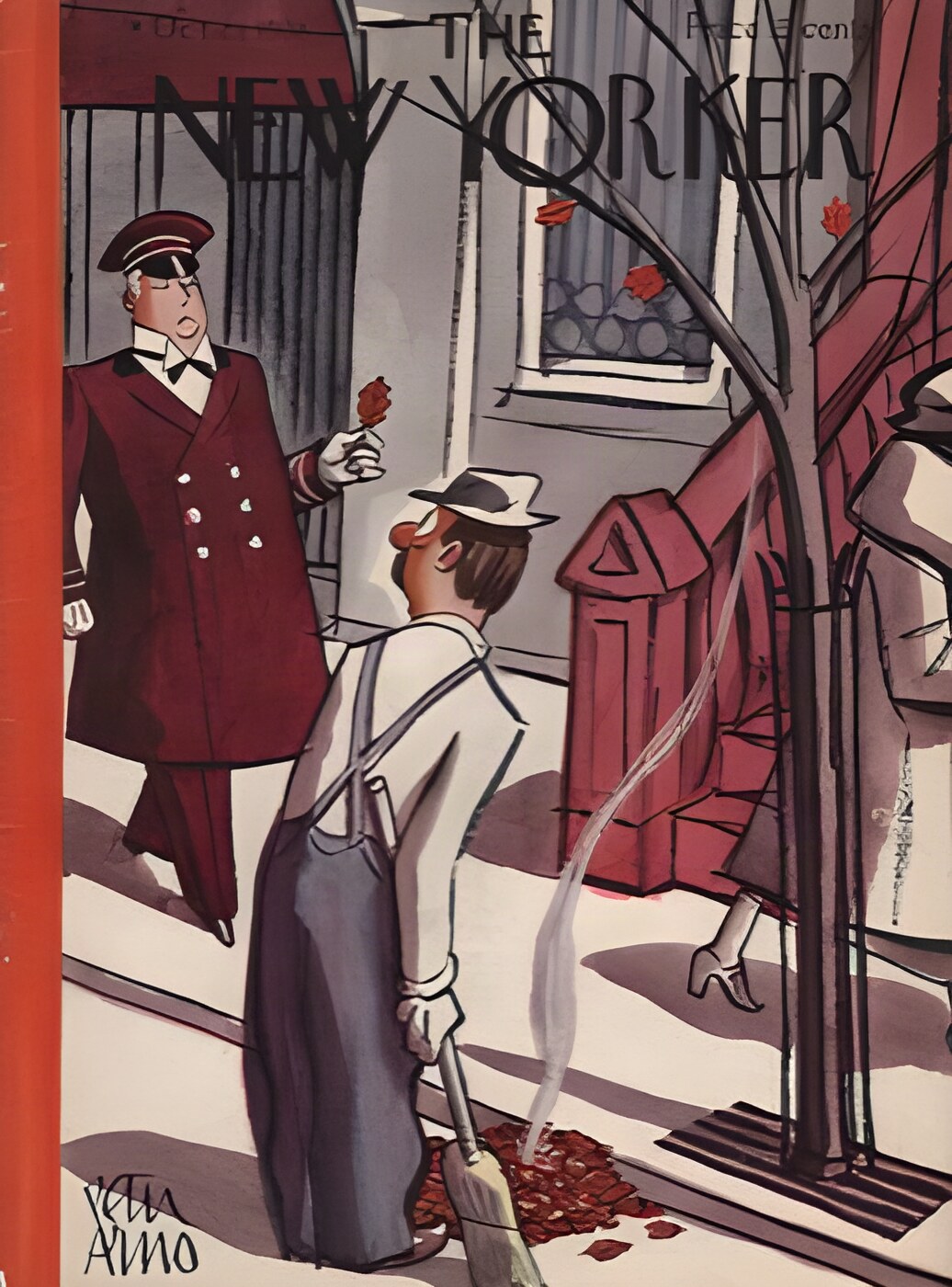
1938, Book: Very Good, Color cartoon of doorman brining last leaf to man burning leaves. 8 3/4 X 12", very good. PLEASE NOTE: The image shown is a scan of the actual product you are purchasing. What you see is what you get. The sheet may have some imperfections beyond the cropped area shown. You are buying THIS PAGE ONLY- not the entire magazine. Your order will be placed carefully between stiff paper and an acetate overlay, then packed in a rigid cardboard sleeve to prevent bending.
Hardcover. Jackson MS, University Press of Mississippi, 1st, 2014, Book: Very Good, Dust Jacket: None, Like new in publisher's shrink-wrap. Hardcover, 168 pages. In The Origins of Comics: From William Hogarth to Winsor McCay, Thierry Smolderen presents a cultural landscape whose narrative differs in many ways from those presented by other historians of the comic strip. Rather than beginning his inquiry with the popularly accepted "sequential art" definition of the comic strip, Smolderen instead wishes to engage with the historical dimensions that inform that definition. His goal is to understand the processes that led to the twentieth-century comic strip, the highly recognizable species of picture stories that he sees crystallizing around 1900 in the United States. Featuring close readings of the picture stories, caricatures, and humoristic illustrations of William Hogarth, Rodolphe Topffer, Gustave Dore, and their many contemporaries, Smolderen establishes how these artists were immersed in a very old visual culture in which images--satirical images in particular--were deciphered in a way that was often described as hieroglyphical. Across eight chapters, he acutely points out how the effect of the printing press and the mass advent of audiovisual technologies (photography, audio recording, and cinema) at the end of the nineteenth century led to a new twentieth-century visual culture. In tracing this evolution, Smolderen distinguishes himself from other comics historians by following a methodology that explains the present state of the form of comics on the basis of its history, rather than presenting the history of the form on the basis of its present state. This study remaps the history of this influential art form.
Hardcover. New York, Scholastic , 1st, 2012, Book: Very Good, Dust Jacket: Very Good, Non paginated. Hardcover. Color illustrations by Jon Agee throughout. Clean, unmarked copy with only minor wear to dust jacket.
Hardcover. New York, Books of Wonder/Morrow, 1st thus, 1994, Book: Near Fine, Dust Jacket: Near Fine, 64 pages, illustrated in color by Michael Witte. The first edition with illustrations by Witte and SIGNED BY BOTH JUSTER AND WITTE on the title page. Like new.
Softcover. New York , Fireside Book/Simon & Schuster, 1st, 1987, Book: Very Good, Dust Jacket: None, 223 pages. Clean, unmarked copy with only minor wear to wrappers.
Hardcover. Chicago, Reilly & Lee, reprint, 1939, Book: Good, Dust Jacket: None, 272 pages. Hardcover. Early reprint. Tan cloth covers with full color paste down illustration to front - paste down with abrasions. Front interior hinge cracked. Black & white illustrations by John R. Neill. Moderate rubbing to corners and edges. Interior clean, tight.
Hardcover. NY, Knopf, 1st, 1997, Book: Very Good, Dust Jacket: Very Good, Hardcover in a bright dust jacket, pages. Vivid, passionate, primitive - 113 paintings by the poet Stan Rice. Here, his canvases explore the terrain of his poetry, as he captures the familiar and the mythical, the magical and the everyday. Here are legendary beasts, card players; images inspired by Greek myths, Bible stories, nursery rhymes. Some pay homage to objects - others to living things. They belong to no contemporary school. They are at once childlike, ironic, and darkly humorous - paintings that attest to the original vision of a talented poet and painter.
Hardcover. New York, Knopf, 1st, 1991, Book: Very Good, Dust Jacket: Very Good, Hardcover, unpaginated, b&w cartoons throughout. Translated from the French by Helen Graves. From the New Yorker cartoonist, an evocation of New York life. Drawings and droll imaginary letters home from a visiting Frenchman. Bright, clean copy in a similar dust jacket.
Hardcover. NY, Bloomsbury USA, 1st, 2004, Book: Very Good, Dust Jacket: Very Good, 96 pages. Clean, unmarked copy with only minor wear to dust jacket. Readers can't get enough of Roz Chast. Together, these cartoons, which originally appeared in The New Yorker, Scientific American, Redbook, and other publications, constitute a spot-on record of our increasingly absurd existence. The book is a powerful reminder of how lucky we are to have Roz Chast among us to tackle some of the toughest themes of the times with uproarious humor: genetically altered mice, birthday parties from hell, and comfort drinks in the age of insecurity.
Softcover. University of Washington Press, 2004, Book: Very Good, Dust Jacket: None, Softcover, 335 pages. "Known for his blending of philosophy, spirituality, humor, and a rollicking good story, Charles Johnson is one of the most important novelists writing today. From his magical first novel, Faith and the Good Thing, to his decidedly philosophical Oxherding Tale; from his swashbuckling indictment of the slave trade in the National Book Award-winning Middle Passage, to his more recent imaginative treatment of Martin Luther King Jr. in Dreamer, Johnson has continually surprised, instructed, and entertained his many avid readers. As this collection of interviews suggests, the novelist is as multifaceted and complex as his novels. Trained in cartooning and philosophy, martial arts and meditation, and producing teleplays, photobiographies, and literary criticism in addition to fiction, Charles Johnson represents a model of what he calls "life as art." Clean copy.
Hardcover. London, Collins, 1st U.K., 1960, Book: Very Good, Dust Jacket: Good, Unpaginated. Hardcover with dust jacket. The English Edition. Dust jacket w/ light edgewear chips. Price-clipped. Light soil on top of page block.
Hardcover. London, Art/Books, reprint, 2019, Book: Very Good, Dust Jacket: None, Hardcover, yellow cloth with black decoration, 186 pages. A beautiful facsimile of the earliest English translation of Gauguin's frank and entertaining memoir, written just before he died, in which he reveals his most inner thoughts on art, life and love Unappreciated in his own lifetime, Paul Gauguin is now recognized as one of the giants of French post-Impressionism and a pioneer of early modernism. A rebel in both art and life, he rejected his bourgeois upbringing and comfortable stockbroker's job to devote his life to painting. Eventually, dismayed by the 'hypocrisy of civilization' and in search of a primitive idyll, he left his wife and children behind in Paris and took up residence in the South Seas, first in Tahiti and, later, in the Marquesas Islands. He would never return to Europe. In the final months of his life, he wrote this witty and revealing autobiographical memoir with the request that it be published upon his death. It first appeared in the original French in 1918, and was translated into English three years later. As his son Emile wrote in the preface, 'These journals are an illuminating self-portrait of a unique personality. They bring sharply into focus for me his goodness, his humor, his insurgent spirit, his clarity of vision, his inordinate hatred of hypocrisy and sham.' Wide-ranging and elliptical, these candid reflections reveal Gauguin's inner thoughts about many subjects, including frank views on his fellow artists back in Paris, his turbulent relationship with Van Gogh, and the charms of Polynesian women, while providing glimpses into his often far-from-idyllic life in the islands. This beautiful facsimile reproduces the first American translation of the journals, a rare limited edition privately published in New York in 1921 for a select group of subscribers. With full-page sketches by the artist, these entertaining and enlightening musings give us a unique insight into Gauguin the man and the artist. Clean copy.
Hardcover. NY, Hurst Co., reprint, Book: Good, Dust Jacket: None, Hardcover, 224 pages. Two stories in one volume. 6 color plates along with many b&w line illustrations. Light water stain pg. 134-160. Light green cloth with black and blue design, gilt on spine. Back hinge cracked. Humorous episodes of a red headed boy playing practical jokes on his Uncle Ike.
Hardcover. London, George Newnes Ltd., 1st, 1903, Book: Good, Dust Jacket: None, Hardcover, gray cloth, black, white and gilt decoration with Speaker of the house in profile on cover, 378 pages. Illustrated with text cartoons throughout and a color frontis by Gould. Sir Henry William Lucy JP, (1842 -1924) was one of the most famous English political journalists of the Victorian era. He was widely known on both sides of the Atlantic. Known as serious commentator of parliamentary affairs, he was also an accomplished humorist, and a parliamentary sketch-writer; acknowledged as the first great lobby correspondent. Owner's signature on blank prelim page, cloth is worn at spine edges with some fraying, title on spine faded. Binding is sound, tight.
Hardcover. NY, Harper & Row , 1st, 1972, Book: Very Good, Dust Jacket: Very Good, Hardcover in a bright, unclipped dust jacket. Color illustrations by Ezra Jack Keats. Minor wear to dust jacket, chipping at edges. Brilliant paintings by Caldecott Medalist Keats evoke all the humor & warmth of Levoy's Chaplinesque character Janos, who must sell his violin to pay his passage to America (New York). Tale of an irrepressible musician and dreamer.
Hardcover. NY, Doubleday, Doran & Company, 1st, 1929, Book: Very Good, Dust Jacket: None, Hardcover, publisher's blue cloth with yellow titles and front decoration, 321 pages. Illustrations by Gordon Grant. Book number three in the Penrod trilogy. Booth Tarkington (1869-1946) was an American novelist known for his portrayals of Midwestern life and humorous portrayals of boyhood and adolescence. Many of his novels have become young-people's classics. Clean copy.
Hardcover. New York, George H. Doran Company, 1st Edition, 1922, Book: Very Good, Dust Jacket: None, 227 pages. Hardcover. B/w illustrations throughout. Illustrated by Ralph Barton. Cover boards bound in black cloth, yellow paste down on front cover board and spine with black titles. Deckled untrimmed edges. Light tanning from age to edges and pages. Binding tight, spine straight. A parody outline of etiquette by the author of "A Parody Outline of History".
Softcover. NY, Farrar, Straus and Giroux, 1986, Book: Very Good, Dust Jacket: None, Softcover, 280 pages. This entertaining and social history of women and cooking at the turn of the 20th century is laced with sly humor and lucid insight. The author uncovers our ancestors' widespread obsession with food, and tells readers why we think as we do about food today. The most memorable of the culinary movers was Fannie Farmer, whose cookbook was published in a modest 3000-copy edition in 1896. Stories about Farmer and other domestic scientists of the period add strong appeal to Shapiro's report. So do the parallels between early feminists and today's advocates of equal rights. Name on front fly leaf, otherwise clean.
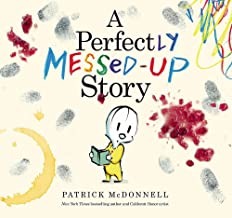
Hardcover. Boston, Little, Brown Books for Young Readers, 2nd pr., 2014, Book: Very Good, Dust Jacket: Very Good, Non-paginated. SIGNED BY AUTHOR on front fly leaf. extensive color illustrations by Patrick McDonnell throughout. Clean, unmarked copy with very good dust jacket.
Hardcover. NY, Harper & Brothers , 1st, 1940, Book: Very Good, Dust Jacket: Good, Hardcover in a worn, chipped dust jacket. 303 pages. Beach was a popular writer of adventure stories. Here he tells his own tale, more colorful, humorous and adventurous than his novels. Clean copy.


 "Origins of Comics, The: From William Hogarth to Winsor McCayby: Smolderen, Thierry/Bart Beaty, et al.")
 "Osborn on Osbornby: Osborn, Robert")
 "Other Side of Town, The by: Agee, Jon")
 "Otter Nonsense (SIGNED COPY)by: Juster, Norton")
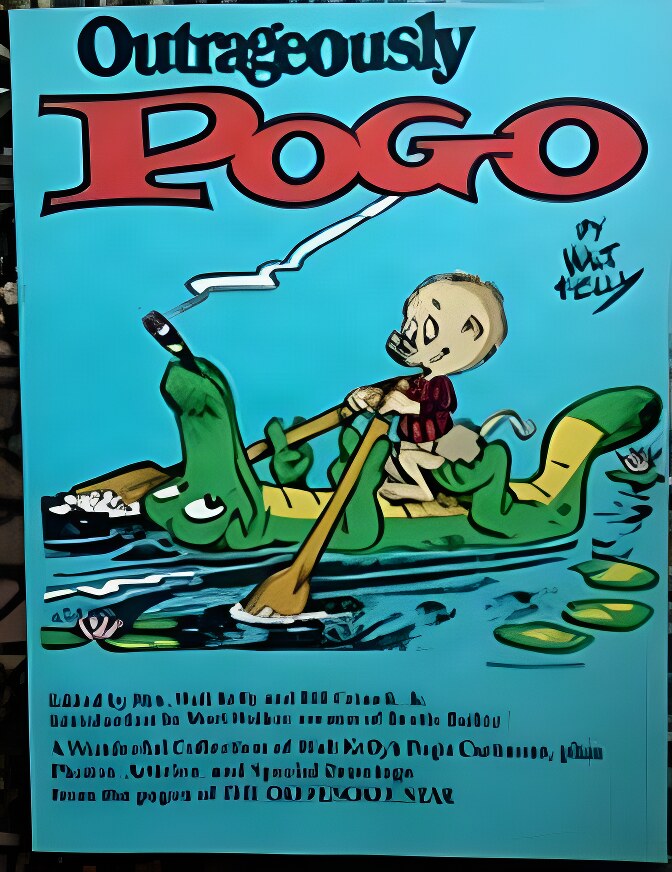
 "Ozoplaning with The Wizard of OZby: Thompson, Ruth Plumly")
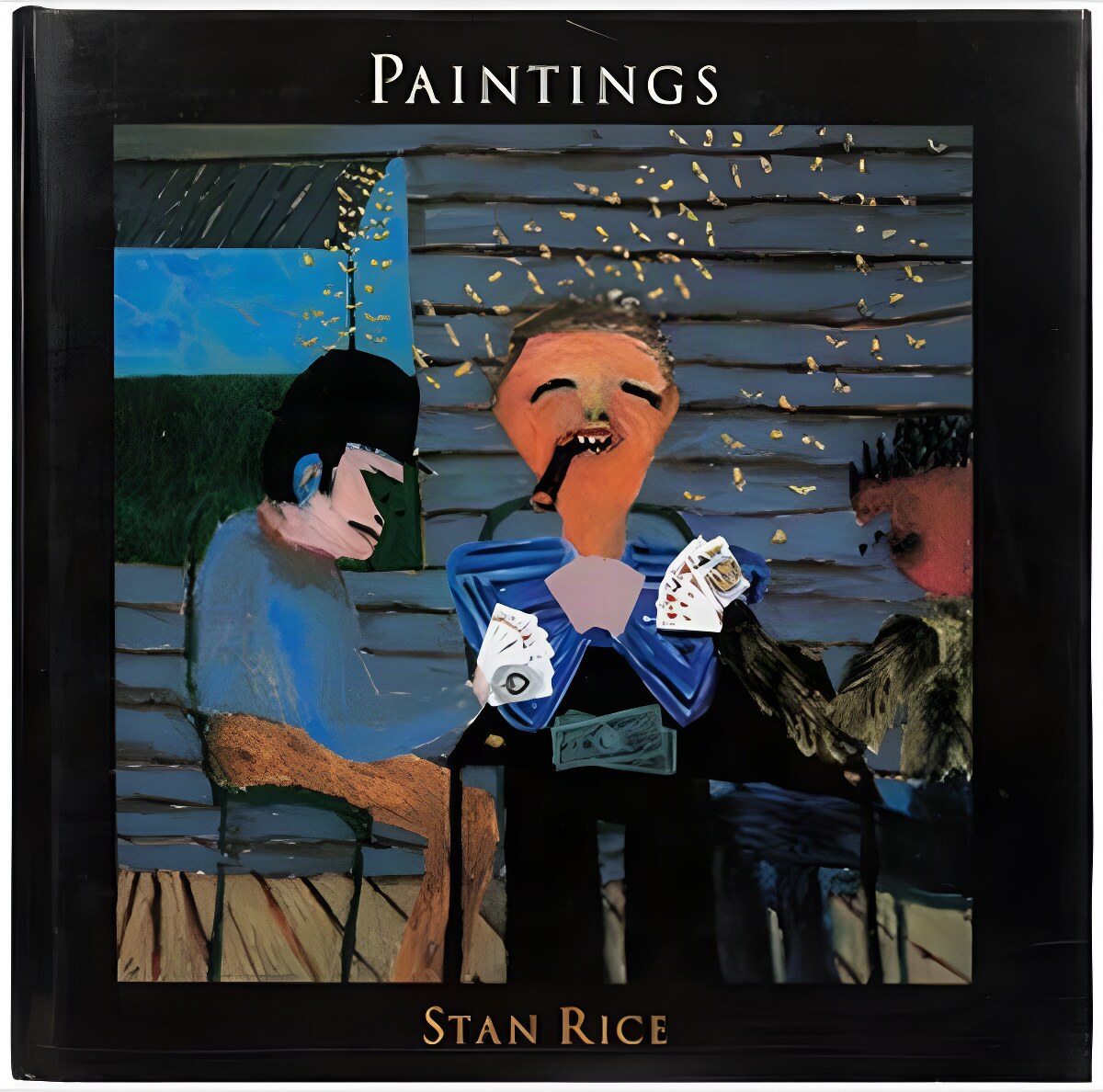
 "Par Avionby: Sempe, Jean-Jacques")
 "Party After You Left, Theby: Chast, Roz")
![Passing the Three Gates: Interviews with Charles Johnsonby: McWilliams, Jim [Editor]](javascript:largeIMTop('https://www.browsingisarousing.com/shop/images/Passing-the-Three-Gates-Interviews-with-Charles-Johnson_by_McWilliams-Jim-Editor-380915-422736.jpg','https://www.browsingisarousing.com/shop/images/Passing-the-Three-Gates-Interviews-with-Charles-Johnson_by_McWilliams-Jim-Editor-380915-422736.jpg',0,'380915',0,'') "Passing the Three Gates: Interviews with Charles Johnsonby: McWilliams, Jim [Editor]")
 "Passionella and Other Storiesby: Feiffer, Jules")
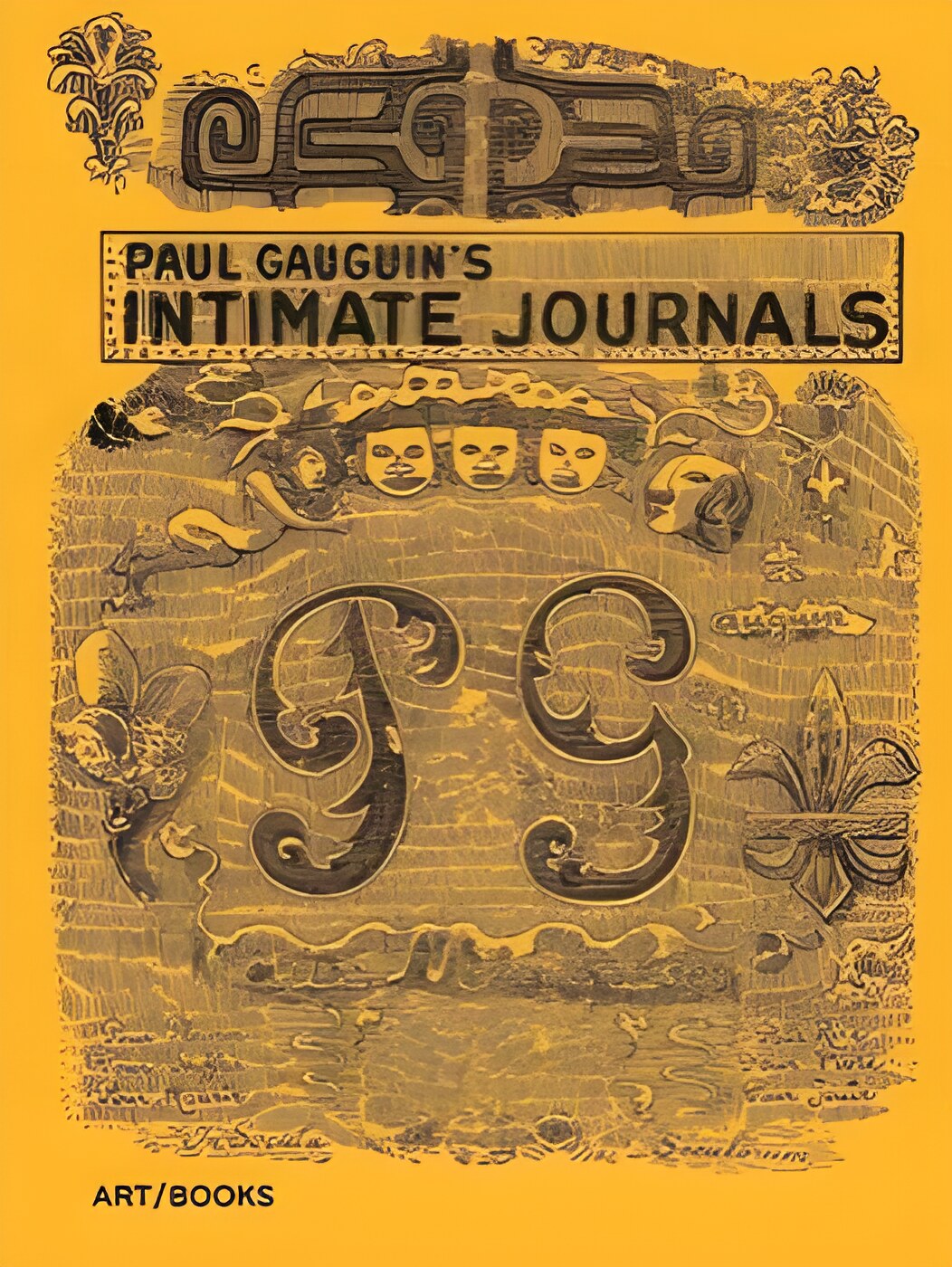
 "Peck's Uncle Ike and the Redheaded Boyby: Peck, George W.")
 "Peeps at Parliament: Taken from Behind the Speaker's Chair by: Henry W. Lucy, F Carruthers Gould (illustrator)")
 "Penny Tunes and Princessesby: Levoy/Ezra Jack Keats, Myron")
 "Penrod Jashberby: Tarkington, Booth")
 "Perfect Behavior: A Guide for Ladies and Gentlemen in All Social Crisesby: Stewart, David Ogden")