Hardcover. Lawrence KS, University Press of Kansas, 1st, 1994, Book: Very Good, Dust Jacket: Very Good, Hardcover with a bright dust jacket. B&w vintage photos throughout. The Midwest's one-room schools were, Fuller observes, the most democratic in the nation. Located in small, independent school districts, these schools virtually wiped out illiteracy, promoted democratic values, and opened up new vistas beyond the borders of their students' lives. Entire communities, Fuller shows, revolved around these schools. At various times they were used as churches, polling places, sites of political caucuses, and meeting halls for local organizations. But as America urbanized and the movement to consolidate took hold in rural counties, these little centers of learning were left at the margins of the educational system. Some were torn down, some left to weather away, some sold at auction, and still others transformed into museums.
1978, Book: Very Good, Color art by Mihaesco of a lawn with sprinklers. 8 3/4 X 12", very good. PLEASE NOTE: The image shown is a scan of the actual product you are purchasing. What you see is what you get. The sheet may have some imperfections beyond the cropped area shown. You are buying THE COVER ONLY- not the entire magazine. Your order will be placed carefully between stiff paper in clear plastic envelope, then packed in a rigid cardboard sleeve to prevent bending.
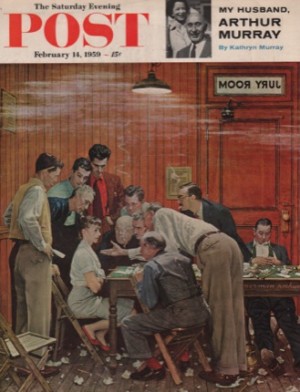
1959, Book: Very Good, Color art of woman holdout in smoky jury room by Norman Rockwell. 10 X 13", very good. PLEASE NOTE: The image shown is a scan of the actual product you are purchasing. What you see is what you get. The sheet may have some imperfections beyond the cropped area shown. You are buying THIS PAGE ONLY- not the entire magazine. Your order will be placed carefully between stiff paper and an acetate overlay, then packed in a rigid cardboard sleeve to prevent bending.
Hardcover. New York, Morrow, 1st, 1989, Book: Very Good, Dust Jacket: Very Good, Hardcover. INSCRIBED BY AUTHOR. Review copy. 260 pages. A very clean, tight copy.
Hardcover. NY, Henry Holt, 1st, 1987, Book: Very Good, Dust Jacket: Very Good, Hardcover in a bright, unclipped dust jacket. A series of dazzlingly successful armored-car robberies, with no link to the underworld, takes place in the New England of the 1970s. . Young urban terrorists, turned on by the radical politics of the sixties... unwilling to bother with distinctions between ends and means. In this fiendishly well-crafted and explosive novel about betrayers and the betrayed, Higgins shows how the establishment... takes revenge by forging alliances that move its members beyond the law. Clean copy.
Hardcover. Lanham, Md., Rowman & Littlefield, 1st, 2000, Book: Very Good, Dust Jacket: Very Good, Hardcover, 492 pages. Clean, unmarked copy with only minor wear to dust jacket.
Hardcover. University of Washington Press, 1st, 2001, Book: Very Good, Dust Jacket: Very Good, Hardcover in a bright dust jacket, 285 pages. Over the Line: The Art and Life of Jacob Lawrence includes essays by eight distinguished art historians examining the ways in which Jacob Lawrence's art speaks so powerfully to different audiences. It is the first multi-author, in-depth probe of the artist's entire career: the nature of his work, his education, the critical climate in which he worked, and his use of materials and techniques. It reproduces, in full color, more than 200 works, most of which have not been published in color, or at all, in other books on the artist.
Softcover. NY, Oxford University Press, 1st pbk., 2020, Book: Very Good, Dust Jacket: None, Softcover, 649 pages. Collects twenty-six newly commissioned, original chapters on the philosophy of the English thinker Thomas Hobbes (1588-1679). Best known today for his important influence on political philosophy, Hobbes was in fact a wide and deep thinker on a diverse range of issues. The chapters included in this Oxford Handbook cover the full range of Hobbes's thought--his philosophy of logic and language; his view of physics and scientific method; his ethics, political philosophy, and philosophy of law; and his views of religion, history, and literature. Several of the chapters overlap in fruitful ways, so that the reader can see the richness and depth of Hobbes thought from a variety of perspectives. The contributors are experts on Hobbes from many countries, whose home disciplines include philosophy, political science, history, and literature.
Hardcover. Chicago, University of Chicago Press, 1st, 2010, Book: Very Good, Dust Jacket: Very Good, Hardcover in a bright dust jacket. Parchment, Paper, Pixels offers an engaging exploration of the impact of three technological revolutions on the law. Beginning with the invention of writing, continuing with the mass production of identical copies of legal texts brought about by the printing press, and ending with a discussion of computers and the Internet, Peter M. Tiersma traces the journey of contracts, wills, statutes, judicial opinions, and other legal texts through the past and into the future. Clean copy.
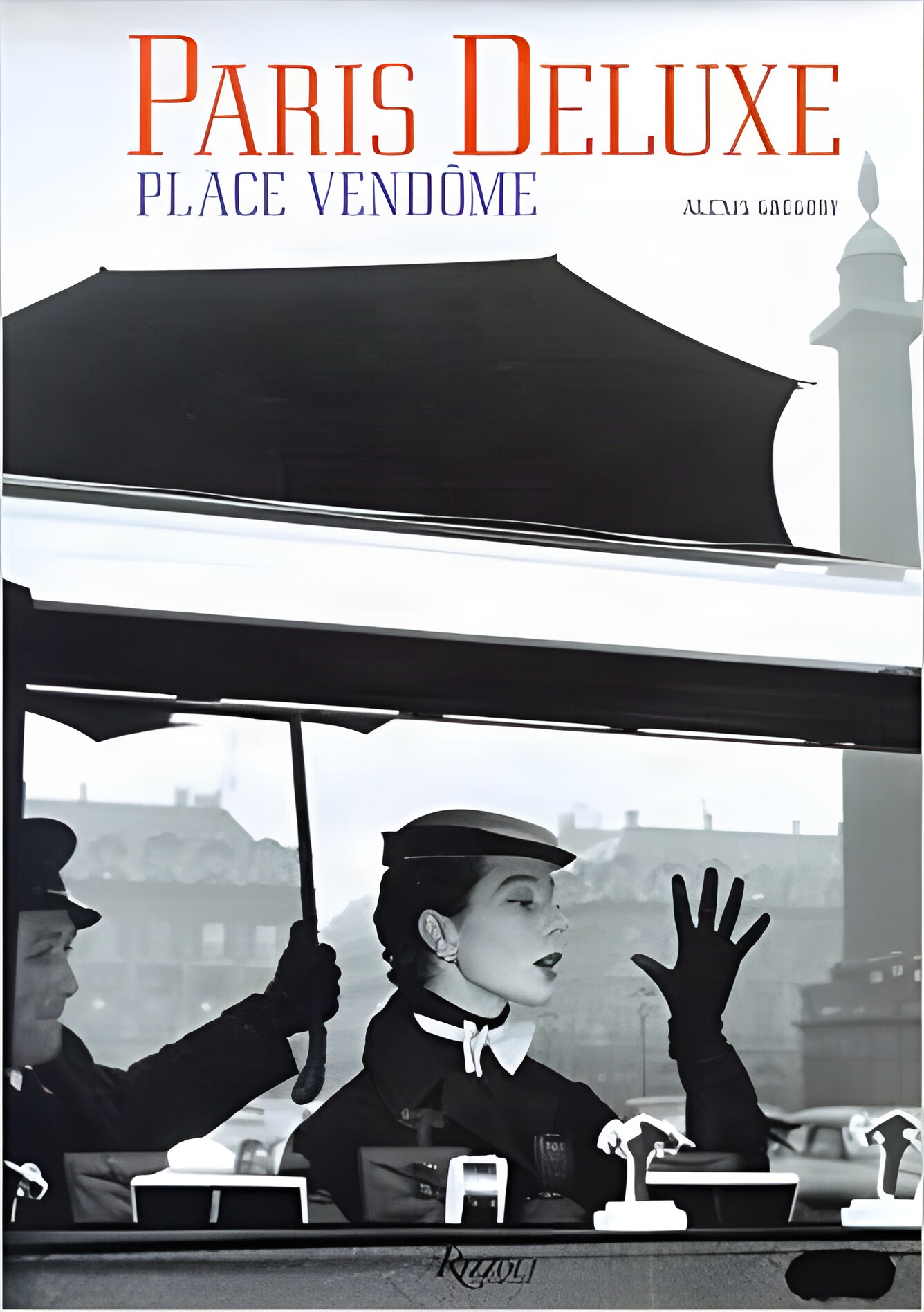
Hardcover. NY, Rizzoli, 1st, 1997, Book: Very Good, Dust Jacket: Very Good, Hardcover, 240 pages. In text and photographs, Paris Deluxe traces the history of the Place Vendome, from the square's beginnings as a high-risk property speculation, to its life in the twentieth century as Paris's center of fashion, jewelry, high finance, and art, a playground for international society that converges at the Paris Ritz, undoubtedly still the most elegant, expensive, and comfortable hotel in the world. The cast of extraordinary personalities who have left their marks on the square covers the spectrum from fashion and jewelry-- names like Coco Chanel, Elsa Schiaparelli, Frederic Worth, Cartier, Boucheron-- to financiers J.P. Morgan and John Law, and every prominent name in art and high society-- Edward, Prince of Wales, the Vanderbilts, Baroness Guy de Rothschild, Lillie Langtry, Rene Lalique and the Crozats, whose art collection was bought by Diderot for Catherine the Great.
Hardcover. London, printed by C. & R. Baldwin for Thomas Payne, 1st, 1808, Book: Very Good, Dust Jacket: None, Hardcover, polished brown calf, 253 pages. A clean copy of the First Edition of Samuel Johnson's tract on the Corn Laws written in 1766 for the use of his friend William Gerard Hamilton - an important politician of the period who achieved a brilliant reputation as an orator - despite his nickname of 'Single Speech Hamilton' The volume was edited by Malone, who found the tract among Hamilton's papers and contributed a long preface. 8vo., xlvi, 253, [1]p colophon.; Stipple engraved frontispiece portrait. Previous owner's bookplate on inside front cover, edgewear/rubbing to calf along gilt ruled border on covers, spine with gilt decoration, red morroco label on spine. Front cover hinge tender, but holding.
Hardcover. New York , Museum of Modern Art , 1st, 1988, Book: Very Good, Dust Jacket: Very Good, 151 pages, Hardcover with dust jacket. B&w illustrations. Unclipped dust jacket with minor edgewear.
Hardcover. NY, Knopf, 1st, 1997, Book: Very Good, Dust Jacket: Very Good, Hardcover in a bright, unclpped dust jacket. New York City in the boomtown '80s, where fortunes are made with the drop of a dime. The lucrative construction rackets are in the hands of the Irish mob, sparking the envy of the Mafia, the attention of the feds, and all-out war. Two brothers are caught in the cross fire. Paddy Adare, a failed boxer turned enforcer for the Irish gangs, and Billy, a college graduate toiling in the tunnels as a sandhog before going to law school. As greed and hatred fuel the fight that is blazing in the streets, honor and loyalty will be put to the ultimate test.
Softcover. Washington and Lee University, 1st, 2005, Book: Very Good, Dust Jacket: None, Softcover, 100 pages. The 2005 issue, Volume 12, of Perspectives in Vernacular Architecture: The Journal of the Vernacular Architecture Forum contains the articles: "Selling Domestic Space: The Boarding House in the Southern Mountains" by Michael Ann Williams; "La Casa Alamense: The Mexican Hacienda as Urban Dwelling" by John Messina; "Unraveling the Benjamin Deyerle Legend: An Analysis of Mid-Nineteenth-Century Brickwork in the Roanoke Valley of Virginia" by Michael J. Pulice; "Orson S. Fowler and a Home for All: The Octagon House in the Midwest" by Rebecca Lawin McCarley; and "Roadside Shrines and Granite Sketches: Diversifying the Vernacular Landscape of Memory" by David Charles Sloane.
Hardcover. Hillsdale NJ, Lawrence Erlbaum, 1st, 1982, Book: Very Good, Dust Jacket: None, Hardcover, green cloth covers with light blue stamping, 422 pages. This highly readable translation of the major works of the 18th- century philosopher Etienne Bonnot, Abbe de Condillac, a disciple of Locke and a contemporary of Rousseau, Voltaire, and Diderot, shows his influence on psychiatric diagnosis as well as on the education of the deaf, the retarded, and the preschool child. Published two hundred years after Condillac's death, this translation contains treatises which were, until now, virtually unavailable in English: A Treatise on Systems, A Treatise of the Sensations, Logic. Name on front fly leaf, light bumps to cover corners.
Hardcover. NY, The Viking Press, 1st, 1936, Book: Good, Dust Jacket: None, Hardcover, bound in black cloth with design of a phoenix on the front cover. No dust jacket. First edition with Published in October 1936 on copyright page and no additional printings noted. Fading to the spine. 852 pages. A complete collection of D H Lawrence's unpublished essays. Discoloration to black cloth along bottom of front cover and spine, Interior is bright and clean.
Hardcover. NY, Museum of Modern Art, 1st, 2015, Book: Very Good, Dust Jacket: Very Good, Hardcover in a bright dust jacket, 367 pages, color and b&w illustrations. This publication comprises a comprehensive catalogue of the collection post-1960s and brings much-needed new critical perspective on the most prominent artists working with the photographic medium of the late twentieth and early twenty-first centuries. At a moment when photography is undergoing fast-paced changes and artists are seeking to redefine its boundaries in new and exciting ways, Photography at MoMA serves as an excellent resource for understanding the expanded field of contemporary photography today. The book is organized with an in-depth introductory chapter and eight chapters of full-colour plates, each introduced by a short essay, and features work by over 250 artists, including Diane Arbus, John Baldessari, Jan Dibbets, Rineke Dijkstra, William Eggleston, Lee Friedlander, Louise Lawler, Zoe Leonard, Helen Levitt, Sigmar Polke, Cindy Sherman, Wolfgang Tillmans, Jeff Wall, Carrie Mae Weems, Hannah Wilke and Garry Winogrand, among many others. Clean copy. DOMESTIC SHIPPING ONLY.
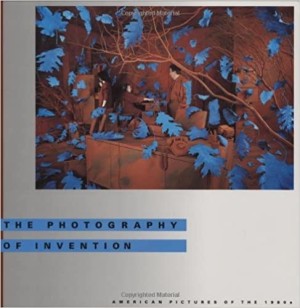
Hardcover. Cambridge, MA, MIT Press, 1st, Book: Very Good, Dust Jacket: Very Good, Hardcover, 208 pages. Pictures that are made, not taken, are the focus of this exciting collection of works by 90 American artists who are using appropriation, computer technology, performance, and numerous other sources of inspiration to stretch the limits and expand the possibilities of photographic art. "Perhaps in the future," Man Ray suggested to Duchamp, "photography would replace all art." The Photography of Invention hints at that future by documenting a decade of startling new work in American photography: work that challenges the accepted hierarchy of the arts and, arguably, establishes photography as the equal of the other arts. Pictures that are made, not taken, are the focus of this exciting collection of works by 90 American artists who are using appropriation, computer technology, performance, and numerous other sources of inspiration to stretch the limits and expand the possibilities of photographic art. The selection of nontraditional pictures includes works by some of the decade's most interesting experimenters-Cindy Sherman, Sherrie Levine, Richard Prince, Barbara Kruger, William Christenberry, Louise Lawler, Stefan Roloff, and others who create or manipulate the subject photographed.
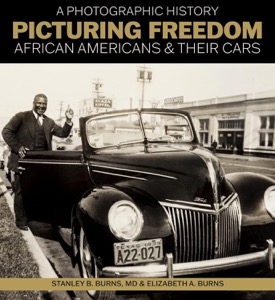
Softcover. NY, Burns Archive Press, 1st, 2022, Book: Very Good, Dust Jacket: None, Softcover, 272 pages. SIGNED BY STANLEY BURNS on title page. Picturing Freedom chronicles and celebrates the photographic history of African Americans and their cars by focusing on personal images of the pride and joy of car ownership (1900-1980+). Owning a car was a significant life-changing achievement. It offered special freedoms--the freedom to travel, the freedom to work further from home, the freedom to visit family and friends, the freedom to avoid Jim Crow laws, and the freedom to migrate. The car was unequivocal evidence of Black success and an important symbol of status in a country that had long fought their advancement in every area. Car ownership was purposely and proudly photographed. All of the photographs were taken in Black communities by a family member or a friend and reveal how African Americans represented themselves. This 2022 IPPY award-winning compilation of over 450 unique photographs is an inspiring visual narrative of American life. Clean, bright copy.
Softcover. UK, Oxford University Press, 1st pbk., 2004, Book: Very Good, Dust Jacket: None, Softcover, 643 pages. An illuminating reappraisal of Plato's later works, which reveals radical changes in his ethical and political theory. Christopher Bobonich argues that in these works Plato both rethinks and revises important positions which he held in his better-known earlier works such as the Republic and the Phaedo. Bobonich analyses Plato's shift from a deeply pessimistic view of non-philosophers in the Republic, where he held that only philosophers were capable of virtue and happiness, to his far more optimistic position in the Laws, where he holds that the constitution and laws of his ideal city of Magnesia would allow all citizens toachieve a truly good life. Name on front fly leaf, otherwise clean.
Hardcover. UK, Oxford University Press, 1st, 2008, Book: Very Good, Dust Jacket: Very Good, Hardcover in a bright dust jacket, 238 pages. The Laws is Plato's last and longest dialogue. Although it has been neglected (compared to such works as the Republic and Symposium), it is beginning to receive a great deal of scholarly attention. Book 10 of the Laws contains Plato's fullest defence of the existence of the gods, and his last word on their nature, as well as a presentation and defence of laws against impiety (e.g. atheism). Plato's primary aim is to defend the idea that the gods exist and that they are good - this latter meaning that they do not neglect human beings and cannot be swayed by prayers and sacrifices to overlook injustice. As such, the Laws is an important text for anyone interested in ancient Greek religion, philosophy, and politics generally, and the later thought of Plato in particular. Robert Mayhew presents a new translation, with commentary, of Book X of the Laws. His primary aim in the translation is fidelity to the Greek. His commentary focuses on philosophical issues (broadly understood to include religion and politics), and deals with philological matters only when doing so serves to better explain those issues. Knowledge of Greek is not assumed, and the Greek that does appear has been transliterated. It is the first commentary in English of any kind on Laws X for nearly 140 years. Light pencil notations to about 15 pages.
Softcover. Chicago, Playboy Press, 1997, Book: Very Good, Single issue. Soft cover. Very Good. Minor wear to bottom of rear cover 10 pages in rear. Centerfold intact. Binding tight, pages clean. Pictorial wraps with Claudia Schiffer on cover. Full of beautiful women as always including supermodels.Highlights: Lynn Thomas as Miss May, Donald Trump Article, Saul Bellow interview, 20 Questions for Lucy Lawless, and more.
Hardcover. New York, William Morrow, 1st, 1999, Book: Very Good, Dust Jacket: Very Good, Hardcover, 192 pages, SIGNED BY AUTHOR on title page. Spotless and tight, It's as if Raymond Carver were still alive and living in the Deep South. Or, imagine a world created by Jim Harrison and Cormac McCarthy and plunk it down in the woods of southern Alabama, where emotions run as raw as moonshine. Tom Franklin's eloquent deceptively simple prose evokes a world of hunting and fishing, shotgun shacks and trailer parks, poachers, and lawmen, factory workers, poor white trash, and bucket-o-'blood boozers. His stories are laced with naked violence, hot food, and the ever bitter sweat and tears of human relationships.


 "ORIGINAL VINTAGE MAGAZINE COVER: New Yorker Aug. 7 1978 - Lawn sprinklersby: Eugene Mihaesco (Illust.)")
 "Out On the Cutting Edge (SIGNED COPY)by: Block, Lawrence")


 "Outline of a Phenomenology of Rightby: Kojeve, Alexandre")
 "Over the Line: The Art and Life of Jacob Lawrenceby: Elizabeth Hutton Turner, Patricia Hills, et al.")




 "Paul Cezanne: The Basel Sketchbooksby: Gowing, Lawrence")
 "Paybackby: Kelly, Thomas")

 "Philosophical Writings of Etienne Bonnot, Abbe De Condillac:by: Franklin Philip/ Harlan Lane")

 "Photography at MoMA: 1960 to Now-Volume II by: Quentin Bajac (Ed.)")



 "Poachers: Stories (SIGNED COPY)by: Franklin, Tom")