Hardcover. Gutersloh GR, C. Bertelsmann,, 1st, 1955, Book: Very Good, Dust Jacket: Good, Hardcover, 438 pages, chipped dust jacket. GERMAN TEXT. JULIA CHILD'S COPY with her signature, address and 1956 on the front fly leaf.
Softcover. Madison WI, University of Wisconsin Press, reprint, 1972, Book: Very Good, Dust Jacket: None, Softcover, 469 pages."One of the first histories to treat non-whites as active self conscious protagonists in twentieth-century South African affairs rather than as a dark acquiescent host before which the really important story of white South Africa unfolds. The new edition has been corrected and eight new chapters extend the coverage to the end of 1963. It is an important addition to the literature about South Africa."--The Historian. C;ean copy.
Softcover. New York, New American Library of World Literature, 1st, 1955, Book: Very Good, Dust Jacket: None, 142 pages. Paperback. Signet Book #1241. Light reading crease to spine. Light crease to rear wrapper.
Hardcover. New York, Macmillan, 1st, 1933, Book: Very Good, Dust Jacket: None, 161 pages. Blue cloth hardcover. Black & white illustrations by Marguerite Davis. Short stories selected by the Literature Committee of the Association for Childhood Education. Previous owners bookplate on inside front cover. Light foxing to foredge. Clean, tight copy.
Hardcover. UK, Oxford University Press , 1st, 2019, Book: Very Good, Dust Jacket: Very Good, Hardcover in a bright dust jacket, 310 pages. Tolkien's Lost Chaucer uncovers the story of an unpublished and previously unknown book by the author of The Lord of the Rings. Tolkien worked between 1922 and 1928 on his Clarendon edition Selections from Chaucer's Poetry and Prose, and though never completed, its 160 pages of commentary reveals much of his thinking about language and storytelling when he was still at the threshold of his career as an epoch-making writer of fantasy literature. Drawing upon other new materials such as his edition of the Reeve's Tale and his Oxford lectures on the Pardoner's Tale, this book reveals Chaucer as a major influence upon Tolkien's literary imagination. Clean copy.
Hardcover. NY, Charles Scribner's Sons, 1st US, 1985, Book: Very Good, Dust Jacket: Very Good, Two hardcover volumes with dust jackets in a cardboard slip case. Volume 1: 1847-1894, 396 pages. Vol. 2: 1895-1910, 397-755 pages. All bright and clean except for fading to dj spines. DOMESTIC SHIPPING ONLY.
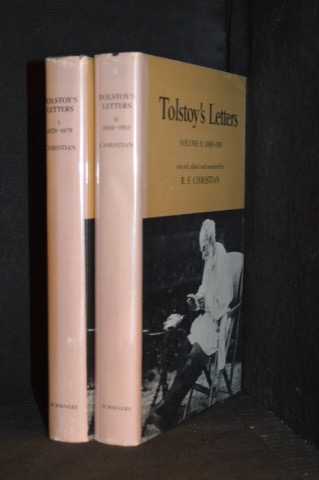
Hardcover. NY, Charles Scribner's Sons, 1st, 1978, Book: Very Good, Dust Jacket: Very Good, Two hardcovers in dust jackets. 737 pages. Index. The dust jackets are faded on the spine. Edited by R.F. Christian. Vol. 1 1828-1879. Vol. 2 1880-1910. In a cardboard slipcase. Clean, bright set.
Hardcover. NY, Crown, 1st, 1995, Book: Very Good, Dust Jacket: Very Good, Hardcover in a bright, unclipped dust jacket, 644 pages, b&w illustrations. After a protracted squabble over private papers with the playwright's estate, Leverich delivers this hefty first volume of a projected two-volume life of Tennessee Williams (1911-1983). In it, Leverich, who produced several of Williams's plays and calls himself Williams's "chosen biographer", covers the years through 1945, when The Glass Menagerie opened on Broadway. Treated are Williams's youth in Mississippi and St. Louis; the college years at the universities of Missouri and Iowa; bumming around (but always writing) in New Orleans and Greenwich Village; the disaster of his first Broadway play (it closed in Boston); script writing, or avoiding it, at MGM's Hollywood mill; and, finally, the evolution of Menagerie, a wonderfully detailed and dramatic case history in itself. Leverich's overworked conceit, which he restates at intervals, is that this is the life of Tom Williams, a "repressed puritan" poet, who in time created a more flamboyant public persona called Tennessee. A few matters are set straight. Leverich maintains his subject's active homosexual life started in his late 20s, later than Williams stated in his memoirs, and that his sister's infamous lobotomy came later than his mother claimed. Although the accumulation of information is impressive, the lower Leverich keeps his own profile and editorial commentary the better his book is, which means it is at its best when it simply reproduces Williams's sporadically kept journal. If you believe that all the details of a life are but preparation for a single event, in this case, the opening of a remarkable play, this is an impressively argued biography.
Hardcover. NY, Alfred A. Knopf, 1st, 1966, Book: Very Good, Dust Jacket: Good, Hardcover in an unclipped, lightly soiled dust jacket. Yellow cloth stamped in purple and black; 370 pages, illustrated with drawings by Leslie Saalburg. Here Gingrich, the publisher of Esquire, shares his feelings on food, automobiles, smoking pipes, violins, haberdashery and a litany of other esoteric subjects.
Hardcover. NY, G.K.Hall, reprint, 1997, Book: Very Good, Dust Jacket: Very Good, 243 pages. Hardcover with dust jacket. Reproduced from their work pub. in the 1930s. Clean, tight copy.
Softcover. Salt Lake City, Gibbs Smith, 1st, 2002, Book: Very Good, Dust Jacket: None, Softcover, pictorial wrappers, 160 pages, illustrated in color and b&w. Trailer Travel showcases the rich visual history of America's enduring fascination with life on the road. Beautifully reproduced color and black-and-white images culled from public archives and the private collections of passionate trailerites vividly document the travel trailer?s storied past. This engaging volume offers a look at motor-camping trips in the early 1900s, the unparalleled innovations in trailer design during the thirties, rare and unique trailer models and interiors, and an extensive array of bold and graphic promotional material, literature, and postcards that illustrate the undeniable attraction of living on wheels.
Softcover. NY, Archipelago Books, 1st, 2008, Book: Very Good, Dust Jacket: None, Softcover in pictorial wrappers, 292 pages. Tranquility, the acclaimed third novel by Hungarian Attila Bartis, is simultaneously a private psychodrama and a portrait of the end of the Communist era. Reading it, "we arrive at ourselves, at our own obsessions, in our own silence," writes Ilma Rakusa. A thirty-six-year-old writer struggles to escape his hellish, Oedipal inter dependency with his actress mother as Hungary's Communist infrastructure collapses around him. One of the most psychologically dark and ironic novels to have emerged from contemporary Hungarian literature, it is also, as far as human psychology and political farce are concerned, one of the most illuminating. Clean, bright copy.
Hardcover. Leipzig, Bernard Tauchnitz, 1860, Book: Very Good, Dust Jacket: None, A very handsome edition of The Marble Faun, otherwise known as Transformation: Or The Romance of Monte Beni. The work was written on the eve of the American Civil War and is set in Italy. The work combines gothic literature, travel guides and fables. Two matching volumes, 292 + 280 pages. Title page states 1860. Bound in full vellum with leather ties, gilt-ruled and gilt-lettered parchment. Copyright Edition stated on title page of each volume and Printing Office of the Publisher on page 292 of volume one. twenty-six albumen photographic plates of contemporary Rome to 'Volume One' and twenty three to 'Volume Two'. Covers splayed as is common with this edition. Clean copies.
Softcover. DeKalb IL, Northern Illinois University Press, 1st pbk, 1996, Book: Very Good, Dust Jacket: None, Softcover, 232 pages. From the time of the first written sacred texts in the West, taboo has proscribed the act and art of translation. So argues the author of this book, exploring the age-old prohibition of translation of sacred texts. Clean copy.
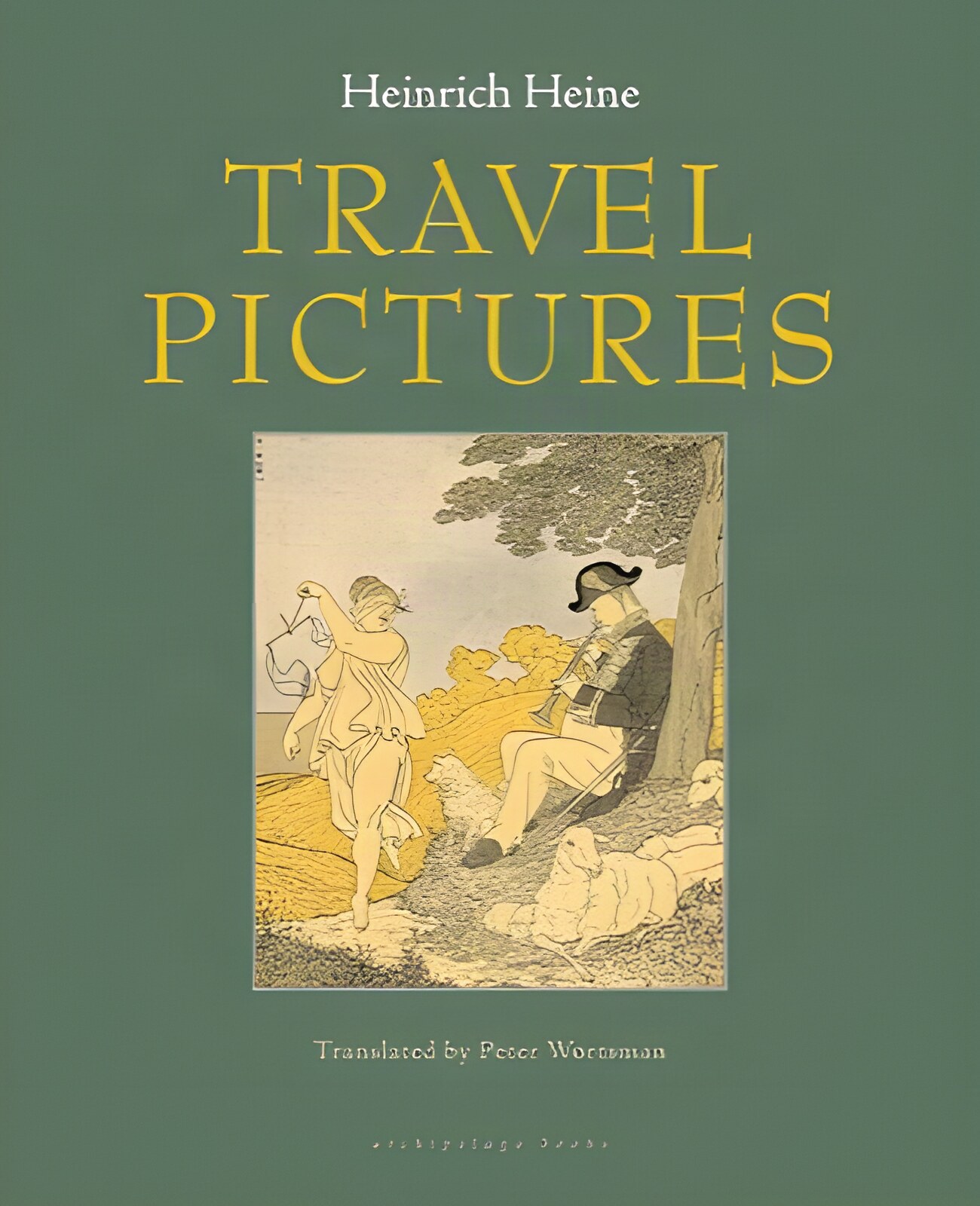
Softcover. NY, Archipelago Books , 1st, 2008, Book: Very Good, Dust Jacket: None, Softcover in pictorial wrappers, 223 pages. Heinrich Heine (1797-1856), one of Germany's most revered poets, is equally well-known for his idiosyncratic prose, the vibrant voice of which feels astonishingly modern in its familiar tone and thematic acrobatics. Travel Pictures comprises the accounts of four journeys taken at different times in his life. The opening "Harz Journey," a quirky chronicle of his walking tour in the Harz Mountains, is the text that first made him famous. But in all four accounts, Heine, seasoned by the skepticism of a born outsider, does more than climb mountains, ford streams and cross borders. In this remarkable book, Heine propels German letters into the Modern mindset. Freud cites a few of Travel Pictures' most humorous passages in Jokes and Their Relation to the Unconscious. Heine's incomparable lyric vision lifts the book into the transcendent realm of great journey literature. Clean, bright copy.
Hardcover. NY, Farrar, Straus & Giroux, 1st US, 2012, Book: Very Good, Dust Jacket: Very Good, Hardcover in a bright, unclipped dust jacket. Full number line down to and including 1. In grey boards with blue type to spine. Searching for an inn, the enigmatic traveler Hans stops in a small city on the border between Saxony and Prussia. The next morning, Hans meets an old organ-grinder in the market square and immediately finds himself enmeshed in an intense debate-on identity and what it is that defines us-from which he cannot break free. Indefinitely stuck in Wandernburg until his debate with the organ-grinder is concluded, he begins to meet the various characters who populate the town, including a young freethinker named Sophie. Though she is engaged to be married, Sophie and Hans begin a relationship that defies contemporary mores about female sexuality and what can and cannot be said about it. Traveler of the Century is a deeply intellectual novel, chock-full of discussions about philosophy, history, literature, love, and translation. It is a book that looks to the past in order to have us reconsider the conflicts of our present. The winner of Spain's prestigious Alfaguara Prize and the National Critics Prize, Traveler of the Century marks the English-language debut of Andres Neuman, a writer described by Roberto Bolano as being "touched by grace." Clean copy.
Hardcover. NY, Harcourt Brace Jovanovich, 1st, 1986, Book: Very Good, Dust Jacket: Very Good, Hardcover, pages. In a bright dust jacket. Eco displays in these essays the same wit, learning, and lively intelligence that delighted readers of The Name of the Rose and Foucault's Pendulum. His range is wide, and his insights are acute, frequently ironic, and often downright funny. Translated by William Weaver.
Hardcover. NY, Farrar Straus Giroux, 1st, 2007, Book: Very Good, Dust Jacket: Very Good, Hardcover in a bright, unclipped dust jacket. Named A Best Book of the Year by Time, The Washington Post, The Boston Globe, Chicago Tribune, San Francisco Chronicle, Salon, Slate, The National Book Critics Circle, The Christian Science Monitor. Tree of Smoke is the story of William "Skip" Sands, CIA--engaged in Psychological Operations against the Vietcong--and the disasters that befall him. It is also the story of the Houston brothers, Bill and James, young men who drift out of the Arizona desert and into a war where the line between disinformation and delusion has blurred away. In the words of Michiko Kakutani in The New York Times, Tree of Smoke is "bound to become one of the classic works of literature produced by that tragic and uncannily familiar war." Clean, bright copy.
Hardcover. NY, Simon & Schuster, 1st, 2001, Book: Very Good, Dust Jacket: Very Good, Hardcover in a bright dust jacket with light sticker residue, 203 pages. The travel author and historian journeys to the beguiling city of Trieste, Italy, which has enchanted her for more than fifty years, to explore issues of patriotism, decency, wildness, and sex. In this love letter to Trieste a city she has grown to love over the years and never got tired of exploring Morris looks back on her life. She recalls first coming to Trieste as a soldier [male] in World War II and discusses the impact the city's way of life has had on her own philosophy of life. Each chapter begins with a philosophical quote stating its theme and setting the atmosphere. Morris is not only skilled at vividly describing townspeople and buildings in a way that brings Trieste to life, but she also successfully balances the personal with the historical by providing references to both history and literature. Clean copy.
Hardcover. NY, Grove Press, 2nd pr., 1961, Book: Very Good, Dust Jacket: Good, Hardcpver in green boards with dark green cloth spine, titles stamped in gilt. Dust jacker shows edgewear and chipping, with $7.50 on flap. Top edge stained green. Framed gilt facsimile of Miller's signature to front of green boards. Clean, tight, bright. 348 pp. First published in 1939 in France, it took over 20 years to be cleared for publishing in the United States. Despite the ban, Miller has been one of the most influential figures in American literature. "The completion of his seven-volume autobiography, if it fulfills the promise of what he has already given us, will put his name amongst the three or four great figures of the age."
Softcover. Los Angeles, Getty Conservation Institute, 1st, 2006, Book: Very Good, Dust Jacket: None, Softcover, 138 pages illustrated in color. As the Roman Empire expanded its African settlements in the early centuries of the common era, thousands of mosaic floor pavements were fashioned to adorn the townhouses and rural estates of the African upper classes. Between the second and sixth centuries, mosaic art blossomed, particularly in Africa Proconsularis, the region comprising modern Tunisia. In contrast to the official art of imperial Rome, mosaics generally expressed the worldviews of private citizens. These artworks are remarkable for the intricate beauty of their polychromatic geometric and floral designs, as well as for figural scenes depicting the interests and activities of the patrons who commissioned them--scenes of daily life, athletic contests, gladiator spectacles, and classical literature and mythology. Abundantly illustrated throughout, Tunisian Mosaics: Treasures from Roman Africa offers the general reader a lively introduction to this extraordinary ancient art. Initial chapters survey the historical background of Roman Africa and discuss the development of mosaic art in the Mediterranean. Subsequent chapters profile Tunisia's major mosaic sites and tour the collections of important museums. A final chapter surveys current initiatives to preserve this heritage for future generations. Clean copy.
Hardcover. NY, Random House, 1st US, 1978, Book: Very Good, Dust Jacket: Very Good, Hardcover in a bright, unclipped dust jacket, 382 pages. A biography of Ivan Turgenev, 19th-century Russian writer. The book is not a critical examination of Turgenev's literary output, but, of the man himself - enigmatic and unknown - and the world in which he lived, and the people he knew and associated with. Clean copy.
Softcover. Madison, MN, The Seventies Press, 1st pbk, 1977, Book: Very Good, Dust Jacket: Very Good, Softcover, 81 pages. Translated. by Lewis Hyde and Robert Bly.Edited by Lewis Hyde. Winner of the 1977 Nobel Prize for Literature. Mild fade to edges of dust jacket.

 "Till Eulenspiegel (Julia Child's copy)by: Hauptmamm / Julia Child, Gerhart")
 "Time Longer than Rope: A History of the Black Man's Struggle for Freedom in South Africa by: Roux, Edward")

 "Told under the Blue Umbrella - New Stories for New Childrenby: Baruch, Dorothy/Katherine Reeves/Alice Dalgliesh/Alice Day Pratt/Marguerite Davis (illustrator)/and mor")




 "Tom: The Unknown Tennessee Williams by: Lyle Leverich")
 "Toward the Poetics of Surrealismby: Matthews, J. H.")




 "Transformation: Or The Romance of Monte Beni (Two volumes)by: Nathaniel Hawthorne")

 "Traveler of the Centuryby: Neuman, Andres")
 "Travels in Hyperreality: Essaysby: Eco, Umberto")
 "Tree of Smokeby: Denis Johnson")

 "Tropic of Capricorn by: Henry Miller")


 "Twenty Poemsby: Aleixandre, Vicente")