Hardcover. London, Macmillan & Co, reprint, 1956, Book: Good, Dust Jacket: Good, Hardcover, 530 pages, dust jacket edge wear and small tears, price clipped. Pencil markings and underlining on some pages, foxing on edges, and previous owner's signature on front fly leaf, otherwise, clean and tight copy.
Hardcover. Springer, 1st, 2021, Book: Very Good, Dust Jacket: None, Hardcover, glazed pictorial boards, 894 pages. INSCRIBED BY BOTH AUTHORS on front fly leaf. This work is a large, powerfully illustrated interdisciplinary natural sciences volume, the first of its kind to examine the critically important nature of ecological paradox, through an abundance of lenses: the biological sciences, taxonomy, archaeology, geopolitical history, comparative ethics, literature, philosophy, the history of science, human geography, population ecology, epistemology, anthropology, demographics, and futurism. The ecological paradox suggests that the human biologicaland from an insular perspective, successful struggle to exist has come at the price of isolating H. sapiens from life-sustaining ecosystem services, and far too much of the biodiversity with which we find ourselves at crisis-level odds. It is a paradox dating back thousands of years, implicating millennia of human machinations that have been utterly ruinous to biological baselines. Clean copy. DUE TO WEIGHT, DOMESTIC SHIPPING ONLY.
Hardcover. UK, Cambridge University Press, 1st, 2013, Book: Very Good, Dust Jacket: Very Good, Hardcover in a bright dust jacket, 249 pages. Plato's late dialogues have often been neglected because they lack the literary charm of his earlier masterpieces. Charles Kahn proposes a unified view of these diverse and difficult works, from the Parmenides and Theaetetus to the Sophist and Timaeus, showing how they gradually develop the framework for Plato's late metaphysics and cosmology. The Parmenides, with its attack on the theory of Forms and its baffling series of antinomies, has generally been treated apart from the rest of Plato's late work. Kahn shows that this perplexing dialogue is the curtain-raiser on Plato's last metaphysical enterprise: the step-by-step construction of a wider theory of Being that provides the background for the creation story of the Timaeus. This rich study, the natural successor to Kahn's earlier Plato and the Socratic Dialogue, will interest a wide range of readers in ancient philosophy and science. Name and date on front fly leaf otherwise clean.
Hardcover. UK, Oxford University Press, 1st, 2008, Book: Very Good, Dust Jacket: Very Good, Hardcover in a bright dust jacket, 238 pages. The Laws is Plato's last and longest dialogue. Although it has been neglected (compared to such works as the Republic and Symposium), it is beginning to receive a great deal of scholarly attention. Book 10 of the Laws contains Plato's fullest defence of the existence of the gods, and his last word on their nature, as well as a presentation and defence of laws against impiety (e.g. atheism). Plato's primary aim is to defend the idea that the gods exist and that they are good - this latter meaning that they do not neglect human beings and cannot be swayed by prayers and sacrifices to overlook injustice. As such, the Laws is an important text for anyone interested in ancient Greek religion, philosophy, and politics generally, and the later thought of Plato in particular. Robert Mayhew presents a new translation, with commentary, of Book X of the Laws. His primary aim in the translation is fidelity to the Greek. His commentary focuses on philosophical issues (broadly understood to include religion and politics), and deals with philological matters only when doing so serves to better explain those issues. Knowledge of Greek is not assumed, and the Greek that does appear has been transliterated. It is the first commentary in English of any kind on Laws X for nearly 140 years. Light pencil notations to about 15 pages.
Softcover. UK, Oxford University Press, Revised Ed., 2001, Book: Very Good, Dust Jacket: None, Softcover, 384 pages. Published here for the first time is much of a final and long-anticipated work on the philosophy of history by the great Oxford philosopher and historian R. G. Collingwood (1889-1943). The original text of this uncompleted work has only recently been discovered and is accompanied here by Collingwood's shorter writings on historical knowledge and inquiry. Besides containing entirely new ideas, these incredible writings discuss many of the issues which Collingwood famously raised in The Idea of History and in his Autobiography. This book also includes two conclusions written by Collingwood, which were eventually revised and published as The Idea of Nature. and a lengthy editorial introduction that puts Collingwood's writings in their context and discusses the philosophical questions they initiate. A landmark publication, this work will appeal not only to those studying Collingwood but also to anyone broadly curious about philosophy of history. Clean copy.
Hardcover. Ithaca, Cornell University Press, 1st, 1990, Book: Very Good, Dust Jacket: None, Hardcover, 260 pages. No dust jacket. John Locke's untitled manuscript "Questions concerning the Law of Nature" (1664) was his only work focused on the subject of natural law, a circumstance that is especially surprising since his published writings touch on the subject frequently, if inconclusively. Containing a substantial critical apparatus, this new edition of Locke's manuscript is faithful to Locke's original intentions and to the format he chose for his discourse on the law of nature-a late-Scholastic quaestio disputata, the form through which in 1664 the young Locke debated questions with his students as moral censor of Christ Church. For this volume, Robert Horwitz provides an introduction summarizing the history of the manuscript and analyzing Locke's role in the development of thinking on natural law. Jenny Strauss Clay offers a superb critical edition of the Latin text, for which she has supplemented the Latin text of Manuscript B, written by an amanuensis, with Manuscript A, a first draft in Locke's own hand. Diskin Clay's precise English translation-with the Latin presented on facing pages-is accompanied by annotations identifying Locke's references and allusions and explaining difficulties of translation. In the view of Horwitz, Clay, and Clay, Questions concerning the Law of Nature shows a tension between several opposing conceptions of natural law. In developing this view, the editors break with W. von Leyden, who prepared the first edition of the text and who interpreted Locke's understanding of natural law squarely within a Christian framework. The editors here present a fresh interpretation of Locke as a thinker who posed a series of subtle challenges to traditional natural law doctrine. That Locke was aware of the political danger of this challenge is evident from his refusal to publish the work during his lifetime and from the care he took to conceal these manuscripts among his possessions. Clean, tight copy.
Hardcover. NY/London, Oxford University Press, 1st, 2013, Book: Very Good, Dust Jacket: Very Good, Hardcover in a bright, unclipped dust jacket, 450 pages. The essays in Religion and Public Reasons seek to argue for, and illustrate, a central element of John Finnis' theory of natural law: that the main tenets of personal and political morality, and of a good legal order, are taught both by reason (arguments accessible to everyone) and by authentic divine revelation (teachings accessible to all who have a reasonable faith in its witnesses). The author's main books each include arguments for rejecting atheism and agnosticism; several papers here take up these arguments and indicate ways in which they open onto the reasonable grounds for accepting that more about God's nature, and about the meaning of Creation (including ongoing natural evolution), is disclosed by the revelation carried far forward among the Jewish people, and given definitive form by the Jews and Greeks who assembled in the universal Church, as witnesses of Christ, to carry forward that revelation into our present. Several papers argue that "public reason" properly includes such a religion, and that Humeian, Nietzschean, Deweyian, Rawlsian or other atheistically or deistic understandings of a reasonable secularism are badly mistaken. Many substantial papers record the author's position in controversies within Catholicism since the 1960's: on social justice, contraception and abortion; nuclear deterrence; Newman on conscience before pope; Maritain's hopes for a new Christendom and von Balthasar's for a hell empty of human persons; and on "proportionalism" and Lonerganian "historical consciousness" as moral-theological methods. Previously unpublished papers include several University and college sermons, and a substantial introduction.
Hardcover. Oxford UK, Oxford University Press, 1st, 2015, Book: Very Good, Dust Jacket: Very Good, Hardcover in a bright dust jacket, 184 pages. Alexander X. Douglas offers a new understanding of Spinoza's philosophy by situating it in its immediate historical context. He defends a thesis about Spinoza's philosophical motivations and then bases an interpretation of his major works upon it. The thesis is that much of Spinoza's philosophy was conceived with the express purpose of rebutting a claim about the limitations of philosophy made by some of his contemporaries. They held that philosophy is intrinsically incapable of revealing anything of any relevance to theology, or in fact to any study of direct practical relevance to human life. Spinoza did not. He believed that philosophy reveals the true nature of God, and that God is nothing like what the majority of theologians, or indeed of religious believers in general, think he is. The practical implications of this change in the concept of God were profound and radical. As Douglas shows, many of Spinoza's theories were directed towards showing how the separation his opponents endeavored to maintain between philosophical and non-philosophical (particularly theological) thought was logically untenable.
Hardcover. NY, Oxford University Press, 1st, 1998, Book: Very Good, Dust Jacket: Very Good, Hardcover in a very good dust jacket with fading to spine, 403 pages. The concept of the atom is very near scientific bedrock, touching first causes, fundamental principles, our conception of the nature of reality. This book is a translation from the French of a history of atomic thought and theory, from ancient Greece to the present day. Pullman grounds his coverage of scientific theory always in the religious and philosophical context of the times, covering the whole period of Western civilization, including in passing the major scientific philosophies of the Muslim world and India. The transition of atomism from a philosophical position to an experimental science, in the mid-19th century, is well handled, and the coverage is nicely rounded out by a treatment of the first visual proof of atoms' material existence by direct microscopic imaging of individual atoms about 10 years ago. Name on front fly leaf otherwise clean.
Hardcover. NY, St. Martin's Press, 1st, 1963, Book: Very Good, Dust Jacket: None, Hardcover, blue cloth with gold lettering on spine, 272 pages. The nine essays compiled in this work deal with the nature of philosophical arguments and the degree to which they are linguistic; the possibility and status of private experience; the criteria of personal identity and the relation between mind and body; the interplay of the referential and descriptive functions of language; the criteria of truth; the interpretation of judgments of probability; the distinction between generalizations of law and generalizations of fact; and the status of judgments about the future and the question of free will and determinism. New theories are advanced and old theories are criticized. Bright, clean copy, lacks dust jacket.
Hardcover. UK, Cambridge at the University Press, 2nd pr., 1926, Book: Very Good, Dust Jacket: None, Hardcover, dark blue cloth with gilt lettering on spine, 202 pages. When The Concept of Nature by Alfred North Whitehead was first published in 1920 it was declared to be one of the most important works on the relation between philosophy and science for many years, and several generations later it continues to deserve careful attention. This is the second printing published six years later. Whitehead explores the fundamental problems of substance, space and time, and offers a criticism of Einstein's method of interpreting results while developing his own well-known theory of the four-dimensional 'space-time manifold'. Name on front fly leaf, light pencil notations to 15 pages.
Hardcover. NY/London, Routledge, 1st, 1993, Book: Very Good, Dust Jacket: Very Good, Hardcover in a bright dust jacket, 283 pages, b&w illustrations. " Richard Schechner explores the nature of ritualised behavior and its relationship to performance and politics. A brilliant and uncontainable examination of cultural expression and communal action, THE FUTURE OF RITUAL asks pertinent questions about art, theatre and the changing meaning of 'culture' in today's intercultural world. It is richly illustrated with over 50 photos of pereformances and public events." Clean copy.
Softcover. Cambridge UK, Cambridge University Press, 1st pbk., 2002, Book: Very Good, Dust Jacket: None, Softcover, 359 pages. In this major reevaluation of Isaac Newton's intellectual life, Betty Jo Teeter Dobbs shows how his pioneering work in mathematics, physics, and cosmology was intertwined with his study of alchemy. Professor Dobbs argues that to Newton those several intellectual pursuits were all ways of approaching Truth, and that Newton's primary goal was not the study of nature for its own sake but rather an attempt to establish a unified system that would have included both natural and divine principles. She also argues that Newton's methodology was much broader than modern scholars have previously supposed, and she traces the evolution of his thought on the intertwined problems of the microcosmic "vegetable spirit" of alchemy and the "cause" of the cosmic principle of gravitation. Clean, bright copy.
Hardcover. Bristol UK, Thoemmes Press, reprint, 1995, Book: Very Good, Dust Jacket: None, Hardcover, red cloth with gilt lettering on the spine, 535 pages. This work contains Shaftesbury's philosophical notebooks from 1698 to 1712. It includes reflections on such topics as the natural affections, good and evil, God, self, the passions, pleasure and pain, nature, life, and philosophy, as well as a brief Life of the 3rd Earl of Shaftesbury, by his son. A reprint of the 1900 edition. Name on front fly leaf, otherwise clean.
Hardcover. NY, Garland Publishing, reprint, 1977, Book: Very Good, Dust Jacket: None, Seven hardcover volumes, orange cloth covers, A reprint of the 1805 edition published in London. Name on front fly leafs, light pencil marking to many text pages. DUE TO WEIGHT, DOMESTIC SHIPPING ONLY.
Hardcover. Oxford UK, Clarendon Press, 1st, 1993, Book: Very Good, Dust Jacket: Very Good, Hardcover in a bright dust jacket, Maurice Wiles was Regius Professor of Divinity at the University of Oxford from 1970-1991. To celebrate his seventieth birthday, a group of distinguished friends and colleagues have written this important series of original and perceptive essays on the twin themes of making and remaking Christian doctrine. The topics covered in this thought-provoking collection range from the notion of divine action in Hebrew Wisdom literature to reflections on the nature of the ministry, from the concept of God and the doctrines of Christology and of the Trinity to the character of theological reflection, and from revelation and tradition to the "lex orandi," the nature of interpretation in religion and the historical basis of theological understanding. Clean copy.
Hardcover. NY, Charles Scribner's Sons, 1st thus, 1953, Book: Good, Dust Jacket: None, Hardcover, green cloth with gilt stamping, First one-volume edition, 300 and 332 pages. Spine lettering faded. Good sound copy, but pencil marking throughout.
Hardcover. Oxford UK, Oxford University Press, 2nd Ed., 1939, Book: Good, Dust Jacket: None, Blue cloth covers with gilt lettering on spine. Ex-library copy with light stamping, label on spine. 182 pages. Except for library stamping text pages are clean, firm binding. Originally published in 1906, this with a new preface by author.
Softcover. NY/London, Palgrave , 2nd Ed., 2002, Book: Very Good, Dust Jacket: None, Softcover, 244 pages. Taking into account recent developments in historical and ecological criticism, and incorporating fresh research into poetry and politics in the 1790s, the second edition of The Politics of Nature enlarges and updates Nicholas Roe's acclaimed study of Romanticism. Hitherto marginal figures are restored to prominence, and there is new material on William Wordsworth's radical years.
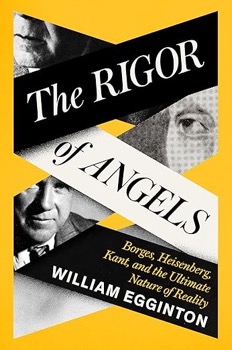
Hardcover. NY, Pantheon, 6th pr., 2023, Book: Very Good, Dust Jacket: Very Good, Hardcover in a bright dust jacket, 338 pages. Argentine poet Jorge Luis Borges was madly in love when his life was shattered by painful heartbreak. But the breakdown that followed illuminated an incontrovertible truth-that love is necessarily imbued with loss, that the one doesn't exist without the other. German physicist Werner Heisenberg was fighting with the scientific establishment on the meaning of the quantum realm's absurdity when he had his own epiphany-that there is no such thing as a complete, perfect description of reality. Prussian philosopher Immanuel Kant pushed the assumptions of human reason to their mind-bending conclusions, but emerged with an idea that crowned a towering philosophical system-that the human mind has fundamental limits, and those limits undergird both our greatest achievements as well as our missteps. Through fiction, science, and philosophy, the work of these three thinkers coalesced around the powerful, haunting fact that there is an irreconcilable difference between reality "out there" and reality as we experience it. Clean copy.
Hardcover. Ithaca NY, Cornell University Press, 2nd pr., 2005, Book: Very Good, Dust Jacket: Very Good, Hardcover in a bright dust jacket, 261 pages, previous owner's signature on front fly leaf. "Evil is the most serious of our moral problems. All over the world cruelty, greed, prejudice, and fanaticism ruin the lives of countless victims. Outrage provokes outrage. Millions nurture seething hatred of real or imagined enemies, revealing savage and destructive tendencies in human nature. Understanding this challenges our optimistic illusions about the effectiveness of reason and morality in bettering human lives. But abandoning these illusions is vitally important because they are obstacles to countering the threat of evil. The aim of this book is to explain why people act in these ways and what can be done about it." The first part of this book is a detailed discussion of six horrible cases of evil: the Albigensian Crusade of about 1210; Robespierre's Terror of 1793?94; Franz Stangl, who commanded a Nazi death camp in 1943?44; the 1969 murders committed by Charles Manson and his "family"; the "dirty war" conducted by the Argentinean military dictatorship of the late 1970s; and the activities of a psychopath named John Allen, who recorded reminiscences in 1975. John Kekes includes these examples not out of sensationalism, but rather to underline the need to hold vividly in our minds just what evil is. The second part shows why, in Kekes's view, explanations of evil inspired by Christianity and the Enlightenment fail to account for these cases and then provides an original explanation of evil in general and of these instances of it in particular.
Hardcover. Lanham MD, Lexington Books, 1st, 2022, Book: Very Good, Dust Jacket: None, Hardcover, pictorial boards, 143 pages. American nature writing characteristically embodies an appreciative, lyrical evocation of the natural world. But often, too, green-disposed authors have been moved to dramatize diverse, anthropogenic perils to environmental health. John Gatta freshly reveals how this dark yet graced and hopeful strain of environmental literature enlarges upon a jeremiad tradition of prophecy inherited from Puritan New England. Across successive historical periods, such expression has assumed a rich variety of American form--as creative nonfiction, poetry, fiction, or film documentary. In the spirit of ancient Hebrew prophecy, jeremiads--unlike diatribes--reach beyond effusions of doom and gloom toward the prospect of change through a conversion of heart. Accordingly, the new climate fiction and much other writing steeped in what Gatta terms this "Green Jeremiad" tradition not only warn of material threats to life's flourishing, but may also look to stir spiritual understanding and renewal. Clean copy.
Hardcover. NY, Cambridge University Press, 1st, 2013, Book: Very Good, Dust Jacket: Very Good, Hardcover in a bright dust jacket, 227 pages. Emily Brady takes a fresh look at the sublime and shows why it endures as a meaningful concept in contemporary philosophy. In a reassessment of historical approaches, the first part of the book identifies the scope and value of the sublime in eighteenth-century philosophy (with a focus on Kant), nineteenth-century philosophy and Romanticism, and early wilderness aesthetics. The second part examines the sublime's contemporary significance through its relationship to the arts; its position with respect to other aesthetic categories involving mixed or negative emotions, such as tragedy; and its place in environmental aesthetics and ethics. Far from being an outmoded concept, Brady argues that the sublime is a distinctive aesthetic category which reveals an important, if sometimes challenging, aesthetic-moral relationship with the natural world. Clean, bright copy.
Hardcover. Seattle, University of Washington Press, 1st, 1990, Book: Very Good, Dust Jacket: Very Good, Hardcover in a bright dust jacket, 113 pages, b&w illustrations. When architects create a landscape or building, when artists depict a landscape, and when poets write of nature, they recreate certain aesthetic elements observed in nature. Jay Appleton asserts in an insightful analysis that these aesthetic values in landscape are not found in an elevated philosophy of aesthetics or in a culturally bound artistic symbolism but in the biological and behavioral needs that we share with other animals. Thus, the aesthetics of landscape may be approached through other areas of human experience and science, especially the natural and behavioral sciences. They are expressed in symbolism drawn from a primal habitat in which all animals seek survival. Clean copy.

 "Nature, Man and God: Being the Gifford Lectures Delivered in the University of Glasgow in the Academical Years 1932-1933 and 1933-1934by: Temple, William")

 "Questions Concerning the Law of Natureby: Locke, John")
 "Spinoza and Dutch Cartesianism: Philosophy and Theology by: Douglas, Alexander X.")

 "The Concept of Nature: Tarner Lectures Delivered in Trinity College November 1919.by: Alfred North Whitehead")
 "The Future of Ritual: Writings on Culture and Performanceby: Richard Schechner")

 "The Life, Unpublished Letters, and Philosophical Regimen of Anthony, Earl of Shaftesburyby: Rand, Benjjamin (editor)")
 "The Light Of Nature Pursued (British Philosophers and Theologians of The 17th and 18th Centuries, Vol 60) (7 Volumes)by: Tucker, Abraham")

 "The Nature and Destiny of Man; A Christian Interpretation; I. Human Nature; II. Human Destiny; Gifford Lectures by: Reinhold Niebuhr")
 "The Nature of Truth: An Essayby: Harold H. Joachim")

 "The Saving Grace of America's Green Jeremiad by: John Gatta")