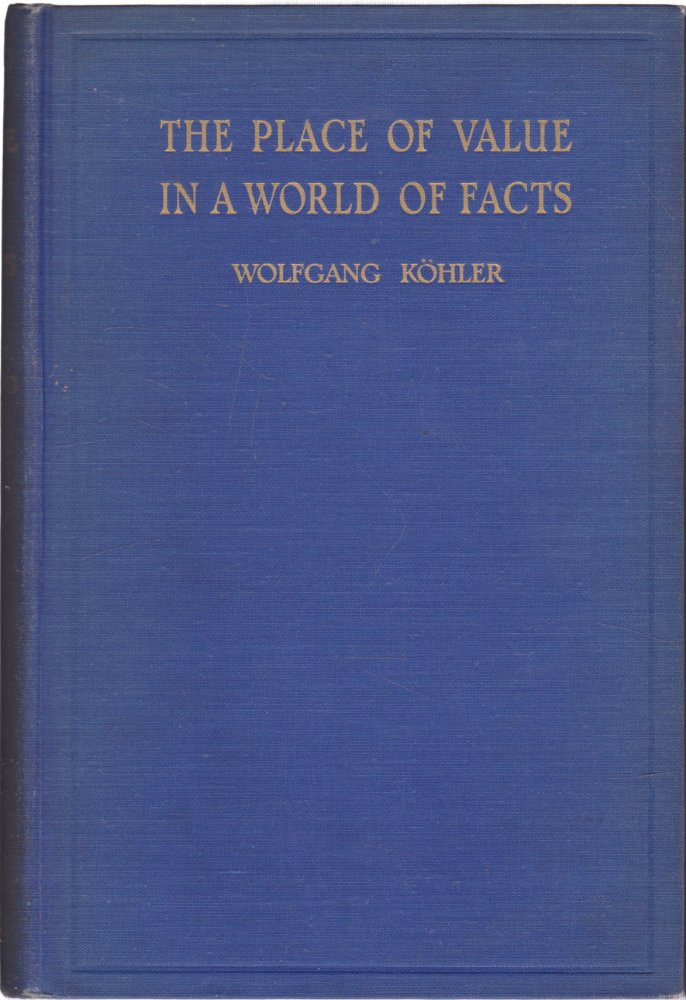
Hardcover. NY, Liveright Publishing, 1st, 1938, Book: Very Good, Dust Jacket: None, Hardcover, blue cloth with gilt lettering, 418 pages. In this important and challenging book, Wolfgang Kohler's subject is value, or what he calls the "requiredness" of an object or activity. Starting with a descriptive account of values as we become aware of them, he finds that, inside certain contexts, parts of such structures do not appear as indifferent facts. They are experienced as belonging there intrinsically or, also, as being out of place in their contexts. Kohler's closely reasoned analysis, drawing on the fields of psychology, biology, and physics, centers around this concept of requiredness. Clean copy. No dust jacket.
Softcover. Oxford UK, Blackwell, 1st, 1999, Book: Very Good, Dust Jacket: None, Softcover, 332 pages. The Zizek Reader - which includes a Foreword by Zizek and a new, previously unpublished essay on cyberspace - provides a comprehensive and accessible introduction to the flamboyant work of a figure who has been variously described as 'one of the most arresting, insightful and scandalous thinkers in recent memory' and 'the Giant of Ljubljana'. His work is an extraordinary mix of Hegel and Hitchcock, Schelling and science fiction, Kant and courtly love, Stalin and Stephen King, all of which is strongly seasoned with Lacanian psychoanalysis. Divided into three parts - Culture, Woman and Philosophy - the Reader not only provides careful explications of the individual extracts within each section but also connects these extracts in a general introduction, mapping the shiftings of Zizek's thought within the Lacanian framework. The essays on woman offer feminism ammunition from unexpected sources, within a reading of Lacan that goes counter to his ambiguous reception by feminists. In fact, at this collection dazzlingly demonstrates, Zizek provides us with one of the most limpid and persuasive readings so far produced of Lacan's difficult thought. Name on inside of front cover, otherwise clean.
Softcover. UK, Cambridge University Press, 8th pr., 2008, Book: Very Good, Dust Jacket: None, Softcover, 751 pages. -In this wide-ranging book, based on her Gifford Lectures, philosopher Nussbaum draws on philosophy, psychology, anthropology, music and literature to illuminate the role emotions play in thoughts about important goals. Clean, bright copy.
Softcover. Lanham MD, Rowman & Littlefield , 1st, 2003, Book: Very Good, Dust Jacket: None, Softcover, 349 pages. In Vergil's Empire, Eve Adler offers an exciting new interpretation of the political thought of Vergil's Aeneid. Adler argues that in this epic poem, Vergil presents the theoretical foundations of a new political order, one that resolves the conflict between scientific enlightenment and ancestral religion that permeated the ancient world. The work concentrates on Vergil's response to the physics, psychology, and political implications of Lucretius' Epicurean doctrine expressed in De Rerum Natura. Proceeding by a close analysis of the Aeneid, Adler examines Vergil's critique of Carthage as a model of universal enlightenment, his positive doctrine of Rome as a model of universal religion, and his criticism of the heroism of Achilles, Odysseus, and Epicurus in favor of the heroism of Aeneas. Beautifully written and clearly argued, Vergil's Empire will be of great value to all interested in the classical world. Clean copy.
Softcover. Cambridge MA, MIT Press, 1972, Book: Very Good, Dust Jacket: None, Softcover, 277 pages. A look at the human sense of time, a biological rhythm that may follow a different beat from that dictated by external, "official," "objective" timepieces. Time and Place-Timeplace-is a continuum of the mind, as fundamental as the spacetime that may be the ultimate reality of the material world.


 "Upheavals of Thought: The Intelligence of Emotionsby: Martha C. Nussbaum")

 "What Time is This Place? by: Lynch, Kevin")