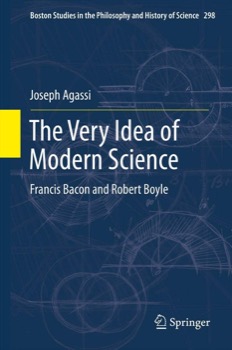
Hardcover. London/NY, Springer , 1st, 2013, Book: Very Good, Dust Jacket: None, Hardcover in glossy boards, 315 pages. This book is a study of the scientific revolution as a movement of amateur science. It describes the ideology of the amateur scientific societies as the philosophy of the Enlightenment Movement and their social structure and the way they made modern science such a magnificent institution. It also shows what was missing in the scientific organization of science and why it gave way to professional science in stages. In particular the book studies the contributions of Sir Francis Bacon and of the Hon. Robert Boyle to the rise of modern science. The philosophy of induction is notoriously problematic, yet its great asset is that it expressed the view of the Enlightenment Movement about science. This explains the ambivalence that we still exhibit towards Sir Francis Bacon whose radicalism and vision of pure and applied science still a major aspect of the fabric of society. Finally, the book discusses Boyle's philosophy, his agreement with and dissent from Bacon and the way he single-handedly trained a crowd of poorly educated English aristocrats and rendered them into an army of able amateur researchers. Clean, bright.
Softcover. Indianapolis, Hackett Publishing, reprint, 1989, Book: Very Good, Dust Jacket: None, Softcover, 358 pages. This volume includes Whewell's seminal studies of the logic of induction (with his critique of Mill's theory), arguments for his realist view that science discovers necessary truths about nature, and exercises in the epistemology and ontology of science. The book sets forth a coherent statement of a historically important philosophy of science whose influence has never been greater: every one of Whewell's fundamental ideas about the philosophy of science is presented here. Clean, bright copy.
Hardcover. Cambridge MA, Belknap Press / Harvard University Press, 1st, 1979, Book: Very Good, Dust Jacket: Very Good, Hardcover in a lightly worn dust jacket, 896 pages. This masterly study has a grand sweep. It ranges over centuries, with a long look backward over several millennia. Yet the history it unfolds is primarily the story of individuals: thinkers and dreamers who envisaged an ideal social order and described it persuasively, leaving a mark on their own and later times. The roster of utopians includes men of all stripes in different countries and eras--figures as disparate as More and Fourier, the Marquis de Sade and Edward Bellamy, Rousseau and Marx. Fascinating character studies of the major figures are among the delights of the book. 1980 National Book Award winner. Name on front fly leaf, otherwise clean.
Softcover. Cambridge MA, Harvard University Press, 1st pbk, 2014, Book: Very Good, Dust Jacket: None, Softcover, 755 pages. Walter Benjamin is one of the twentieth century's most important intellectuals, and also one of its most elusive. His writings-mosaics incorporating philosophy, literary criticism, Marxist analysis, and a syncretistic theology-defy simple categorization. And his mobile, often improvised existence has proven irresistible to mythologizers. His writing career moved from the brilliant esotericism of his early writings through his emergence as a central voice in Weimar culture and on to the exile years, with its pioneering studies of modern media and the rise of urban commodity capitalism in Paris. That career was played out amid some of the most catastrophic decades of modern European history: the horror of the First World War, the turbulence of the Weimar Republic, and the lengthening shadow of fascism. Now, a major new biography from two of the world's foremost Benjamin scholars reaches beyond the mosaic and the mythical to present this intriguing figure in full. Clean copy.



 "Walter Benjamin: A Critical Lifeby: Eiland, Howard; /Jennings, Michael W.")