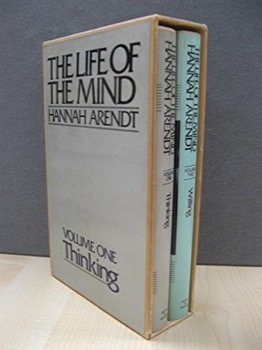
Hardcover. NY, Harcourt Brace Jovanovich, 1st, 1978, Book: Very Good, Dust Jacket: None, Two hardcover volumes in a slipcase, light gray and light green jackets over beige cloth. 258, 277 numbered pages. The Life of the Mind is the final work by the political theorist, philosopher, and feminist thinker. This fascinating book investigates thought itself as it exists in contemplative life. In a shift from Arendt's previous writings, most of which focus on the world outside the mind, this is an exploration of the mind's activities she considered to be the most fundamental. The result is a rich, challenging analysis of human mental activity in terms of thinking, willing, and judging. Stated First Editions with 2 as lowest number. Jacket spines sunned and faded. Light spotting to text block edges. Clean, no markings.
Hardcover. NY, Doubleday and Company, 1st, 1983, Book: Very Good, Dust Jacket: Very Good, Hardcover in a lightly chipped dust jacket. The writers of the Bible, like any other authors, were dependent on a vast array of literary sources from their time-the ancient world. Many of these documents are tragically lost, but what remains provides insight into the voluminous, fascinating, complex, and dynamic literary world that shaped the expressions of faith found in the Old and New Testaments. Part of these extant sources are known as the Pseudepigrapha. This collection of Jewish and Christian writings shed light on early Judaism and Christianity and their doctrines. Volume 1 only (of a 2-volume set). 995 pages. Clean copy.
Hardcover. NY, Doubleday and Company, 1st, 1985, Book: Very Good, Dust Jacket: Very Good, Hardcover in a lightly chipped dust jacket. The writers of the Bible, like any other authors, were dependent on a vast array of literary sources from their time-the ancient world. Many of these documents are tragically lost, but what remains provides insight into the voluminous, fascinating, complex, and dynamic literary world that shaped the expressions of faith found in the Old and New Testaments. Part of these extant sources are known as the Pseudepigrapha. This collection of Jewish and Christian writings shed light on early Judaism and Christianity and their doctrines. Volume 2 only (of a 2-volume set). 1006 pages. Clean copy.
Hardcover. Oxford UK, Clarendon Press, reprint, 2006, Book: Very Good, Dust Jacket: None, Hardcover, black glossy boards, 363 pages. This volume belongs to the first new critical edition of the works of Francis Bacon (1561-1626) to have been produced since the nineteenth century. The edition presents the works in broadly chronological order and according to the best principles of modern textual scholarship. The seven works in the present volume belong to the final completed stages (Parts III-V) of Bacon's hugely ambitious six-part sequence of philosophical works, collectively entitled Instauratio magna (1620-6). All are presented in the original Latin with new facing-page translations. Three of the seven texts (substantial works in two cases, and all sharing a startlingly improbable textual history) are published and translated here for the first time: these are an early version of the Historia densi, the 'lost' Abecedarium, and the Historia de animato & inanimato. Another--the Prodromi sive anticipationes philosphiae secundae--has likewise never been translated before. Together with their commentaries and the introduction they open the way to important new understandings of Bacon's mature philosophical thought. Clean copy.
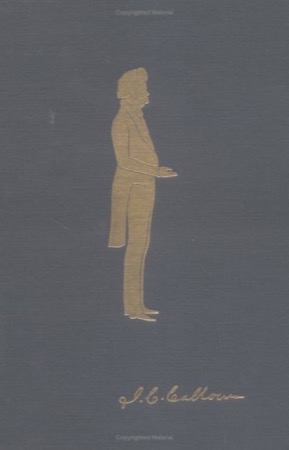
Hardcover. Columbia, University of South Carolina Press, reprint, 2003, Book: Very Good, Dust Jacket: None, Hardcover, blue cloth wth gilt lettering on spine, gilt silhouette of Calhoun on cover. 244 pages with index. The Papers of John C. Calhoun, Volume XXVIII is the final volume in a distinguished documentary edition, the first volume of which was published more than fifty years ago. While identical to others in the series in terms of typeface, binding, and letterpress printing, this volume does not contain any of John C. Calhoun's personal papers, rather it features Calhoun's only formal, scholarly writings on political science and political philosophy. A Disquisition on Government is an examination of the first principles of political science, much in the model of Aristotle's Politics or Baron Montesquieu's Spirit of the Laws. It examines basic principles of politics, including concepts of sovereignty and personal liberty and the relationships between states and nations. A Discourse on the Constitution and Government of the United States is a focused study of American political thought and constitutional history since the ratification of the Constitution. It pays particular attention to antifederalist views of the Constitution, the Virginia and Kentucky Resolutions of the 1790s, and the Bill of Rights, the first ten amendments to the Constitution. Clean copy.
Hardcover. Chicago, Open Court, 1st, 1921, Book: Very Good, Dust Jacket: None, Hardcover, blue cloth with gilt lettering on front cover and spine, 245 pages. Top edge gilt. Pencil notations to about 20 pages.
Hardcover. NY, Pellegrini & Cudahy, 1st, 1949, Book: Very Good, Dust Jacket: None, Hardcover, black cloth with silver stamping, 241 pages, b&w illustrations. Limited to 1500 copies. John Marin was one of the most important American artists of the 20th century, known for his luminous watercolors and bold, expressive style. In this beautifully curated collection, Dorothy Norman presents a selection of Marin's most important writings, offering insights into his creative process and philosophy. Clean copy.
Hardcover. Ithaca NY, Cornell University Press, 1st, 2004, Book: Very Good, Dust Jacket: Very Good, Hardcover in a bright dust jacket, 180 pages. Using his intimate knowledge of John Locke's writings, John W. Yolton shows that Locke comprehends "human understanding" as a subset of a larger understanding of other intelligent Beings-angels, spirits, and an omniscient God. Locke's books on Christianity (The Reasonableness of Christianity and Paraphrases of St. Paul's Epistles) have received extensive analysis and commentary, but little attention has been given to the place of his Essay Concerning Human Understanding in his religious and theological beliefs. Yolton shows that Locke's account of what it is to be human in that work is profoundly religious. Yolton's book opens with an attempt to sort out several important terms basic to Locke's account of identity: man, self, person, and soul. A number of rarely examined components of Locke's thought emerge: the nature of man, the nature of a human being, and the place of man in the universe among the other creatures. Some will be surprised to learn that the domain of God, angels, and spirits is a part of Locke's universe, where it is considered the hoped-for destination of the just. Name, date on front fly leaf, otherwise clean.
Hardcover. UK, Oxford University Press, 1st, 2012, Book: Very Good, Dust Jacket: Very Good, This is the first volume in the four-volume edition of The Works of Lucy Hutchinson, the first-ever collected edition of the writings of the pioneering author and translator. Hutchinson (1620-81) had a remarkable range of her interests, from Latin poetry to Civil War politics and theology. In two parts, two volumes: 797 total pages. This edition of her translation of Lucretius's De rerum natura offers new biographical material, demonstrating the changes and unexpected continuities in Hutchinson's life between the work's composition in the 1650s and its dedication in 1675. Hers is the first complete surviving English translation of one of the great classical epics, a challenging text at the borderlines of poetry and philosophy. For the first time, the Lucretius translation is made available alongside the Latin text Hutchinson used, which differs in innumerable ways from versions known today. The commentary, the fullest in any edition of a literary translation, provides multiple ways into further understanding of the translation and its contexts. Written at a momentous period in political and literary history, Hutchinson's Lucretius throws light on the complex transition between 'ancient' and 'modern' conceptions of the classical canon and of natural philosophy. It offers a case study in the history of reading, and more specifically of reading by a woman. Name on front fly leaves, pencil notations to front fly leaf, a dozen pages in Part 1. DUE TO WEIGHT, DOMESTIC SHIPPING ONLY.
Hardcover. Bristol UK, Thoemmes Press, reprint, 1998, Book: Very Good, Dust Jacket: None, Hardcover, maroon cloth, 537 pages. Gilt lettering on a green band on the spine. A reprint of the 1830 edition. Clean copy.
Hardcover. New Haven CT, Yale University Press, 1st, 2001, Book: Very Good, Dust Jacket: None, Hardcover in burgundy cloth boards with gilt lettering to front panel and spine, as issued w/out dj. Short inscription on front fly leaf, otherwise clean. This book gathers together for the first time an important body of texts written between 1672 and 1686 by the great German philosopher and polymath Gottfried Leibniz. These writings, most of them previously untranslated, represent Leibniz's sustained attempt on a problem whose solution was crucial to the development of his thought, that of the composition of the continuum. The volume begins with excerpts from Leibniz's Paris writings, in which he tackles such problems as whether the infinite division of matter entails "perfect points," whether matter and space can be regarded as true wholes, whether motion is truly continuous, and the nature of body and substance. Comprising the second section is Pacidius Philalethi, Leibniz's brilliant dialogue of late 1676 on the problem of the continuity of motion. In the selections of the final section, from his Hanover writings of 1677-1686, Leibniz abandons his earlier transcreationism and atomism in favor of the theory of corporeal substance, where the reality of body and motion is founded in substantial form or force. Leibniz's texts (one in French, the rest in Latin) are presented with facing-page English translations, together with an introduction, notes, appendixes containing related excerpts from earlier works by Leibniz and his predecessors, and a valuable glossary detailing important terms and their translations.
Hardcover. Princeton NJ, Princeton University Press, 1st, 2012, Book: Very Good, Dust Jacket: Very Good, Hardcover in a bright dust jacket, 759 pages, b&w illustrations. A sweeping intellectual history of the role of wealth in the church in the last days of the Roman Empire Jesus taught his followers that it is easier for a camel to go through the eye of a needle than for a rich man to enter heaven. Yet by the fall of Rome, the church was becoming rich beyond measure. Through the Eye of a Needle is a sweeping intellectual and social history of the vexing problem of wealth in Christianity in the waning days of the Roman Empire, written by the world's foremost scholar of late antiquity. Peter Brown examines the rise of the church through the lens of money and the challenges it posed to an institution that espoused the virtue of poverty and called avarice the root of all evil. Drawing on the writings of major Christian thinkers such as Augustine, Ambrose, and Jerome, Brown examines the controversies and changing attitudes toward money caused by the influx of new wealth into church coffers, and describes the spectacular acts of divestment by rich donors and their growing influence in an empire beset with crisis. He shows how the use of wealth for the care of the poor competed with older forms of philanthropy deeply rooted in the Roman world, and sheds light on the ordinary people who gave away their money in hopes of treasure in heaven. Clean copy.
Hardcover. NY, Oxford University Press, 1st, 2008, Book: Very Good, Dust Jacket: Very Good, Hardcover in a bright dust jacket, 323 pages. Although Buddhism is often depicted as a religion of meditators and philosophers, some of the earliest writings extant in India offer a very different portrait of the Buddhist practitioner. In Indian Buddhist narratives from the early centuries of the Common Era, most lay religious practice consists not of reading, praying, or meditating, but of visually engaging with certain kinds of objects. These visual practices, moreover, are represented as the primary means of cultivating faith, a necessary precondition for proceeding along the Buddhist spiritual path. In Thus Have I Seen: Visualizing Faith in Early Indian Buddhism, Andy Rotman examines these visual practices and how they function as a kind of skeleton key for opening up Buddhist conceptualizations about the world and the ways it should be navigated. Clean copy.
Softcover. Cambridge MA, Harvard University Press, 1st pbk, 2014, Book: Very Good, Dust Jacket: None, Softcover, 755 pages. Walter Benjamin is one of the twentieth century's most important intellectuals, and also one of its most elusive. His writings-mosaics incorporating philosophy, literary criticism, Marxist analysis, and a syncretistic theology-defy simple categorization. And his mobile, often improvised existence has proven irresistible to mythologizers. His writing career moved from the brilliant esotericism of his early writings through his emergence as a central voice in Weimar culture and on to the exile years, with its pioneering studies of modern media and the rise of urban commodity capitalism in Paris. That career was played out amid some of the most catastrophic decades of modern European history: the horror of the First World War, the turbulence of the Weimar Republic, and the lengthening shadow of fascism. Now, a major new biography from two of the world's foremost Benjamin scholars reaches beyond the mosaic and the mythical to present this intriguing figure in full. Clean copy.
Softcover. Berkeley CA, University of California Press, 1st, 1994, Book: Very Good, Dust Jacket: None, Softcover, 316 pages. Few twentieth-century thinkers have proven as influential as Walter Benjamin, the German-Jewish philosopher and cultural and literary critic. Richard Wolin's book remains among the clearest and most insightful introductions to Benjamin's writings, offering a philosophically rich exposition of his complex relationship to Adorno, Brecht, Jewish Messianism, and Western Marxism. Wolin provides nuanced interpretations of Benjamin's widely studied writings on Baudelaire, historiography, and art in the age of mechanical reproduction. In a new Introduction written especially for this edition, Wolin discusses the unfinished Arcades Project, as well as recent tendencies in the reception of Benjamin's work and the relevance of his ideas to contemporary debates about modernity and postmodernity. Clean, bright copy.
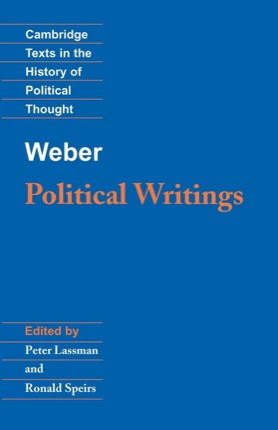
Softcover. UK, Cambridge University Press, reprint, 2008, Book: Very Good, Dust Jacket: None, Softcover, 390 pages. A selection of Max Weber's most important political writings. Weber examines constitutional questions, problems of democracy, socialism, and economic policy, always with careful attention to the moral claims of political antagonists and their intellectual basis. The texts show his power as an analyst of politics and make clear that a serious consequentialist understanding of political life requires subtlety and historical understanding. Clean copy.
Hardcover. Middletown CT, Wesleyan University Press, 1st, Book: Very Good, Dust Jacket: Very Good, Hardcover in a bright, unclipped dust jacket, 204 pages. Composer John Luther Adams makes his home in the boreal forest near Fairbanks, Alaska, where he has created a unique musical world grounded in the elemental landscapes and indigenous cultures of the North. Winter Music, a collection of Adams's essays, journal entries, and other writings is poetic and inspirational and delves into the environmental and cultural awareness that creates his reflective, almost spiritual, approach to music. The accompanying audio CD includes two previously unrecorded works by Adams. Adams's music explores natural phenomena from the songs of birds, to the complex nature of chaos, fractal geometry, and elemental noise. Similarly, his writings explore "that region between place and culture, between environment and imagination," reflecting a philosophy of deep awareness that makes him one of the most original composers working today. Clean copy.



 "The Oxford Francis Bacon XIII: The Instauratio Magna: Last Writingsby: Bacon, Francis, and Rees, Graham (Edited and translated by)")
 "The Philosophical Writings of Richard Burthoggeby: Richard Burthogge; Margaret W. Landes (editor)")





 "Thus Have I Seen: Visualizing Faith in Early Indian Buddhismby: Andy Rotman")
 "Walter Benjamin: A Critical Lifeby: Eiland, Howard; /Jennings, Michael W.")
 "Walter Benjamin: An Aesthetic of Redemptionby: Richard Wolin")