Softcover. Dekalb IL, Northern Illinois University Press, reprint, 2006, Book: Very Good, Dust Jacket: None, Softcover, 342 pages, b&w illustrations. Prostitutes, shoplifters, vagrants, murderesses -- Dodge tracks the history of such "improper" women as she explores the history of female incarceration in Illinois from 1835 to the present. In court and in prison, these women - some who are considered beyond all hope of reformation - have received vastly different treatment than their male counterparts. A woman's fate in court often hung on officials' estimates of her moral and sexual reputation. Alleged promiscuity, illegitimate births, venereal disease, interracial relationships, or use of alcohol could condemn her in the eyes of judge and jury. Ethnic and social prejudice played a role, too, as most incarcerated women poor, working-class, immigrants, or members of a racial minority. Highly readable yet theoretically sophisticated, Whores and Thieves of the Worst Kind provides a striking collective portrait of incarcerated women. Drawn from extensive primary sources, the voices of female prisoners emerge powerfully and poignantly as individuals tell their stories. Clean copy.
Hardcover. New York, Smithsonian Books, 1st, 2010, Book: Very Good, Dust Jacket: Very Good, 253 pages. Hardcover with dust jacket. Very clean, inside and out. Tight binding, sharp corners, illustrations in bw, a nice copy.
Softcover. Tucson, AZ, Southwest Parks , 1st, 1999, Book: Very Good, Dust Jacket: None, 88 pages. Softcover. Yellowing to front and back covers. An otherwise clean, unmarked copy with minor edgewear. Color photographs throughout.
Hardcover. Boston, Little, Brown and Company, 1st, 1948, Book: Good, Dust Jacket: None, Hardcover, beige cloth hardcover book in good condition. McWilliams examines the growth of discrimination and persecution of Jews in America from 1877 to 1948 and the "myths with which the anti-semite surrounds his position." Light shelfwear, no dust jacket. Clean copy.
Hardcover. Hoboken NJ, Wiley, 1st, 2009, Book: Very Good, Dust Jacket: Very Good, Hardcover in a bright, unclipped dust jacket, 508 pages.Take a dazzling journey through the Gilded Age, the period from roughly the 1870s to 1914, when bluebloods from older, established families met the nouveau riche headlong-railway barons, steel magnates, and Wall Street speculators-and forged an uneasy and glittering new society in New York City. The best of the best were Caroline Astor's 400 families, and she shaped and ruled this high society with steel. A Season of Splendor is a panoramic sweep across this sumptuous landscape, presenting the families, the wealth, the balls, the clothing, and the mansions in vivid detail-as well as the shocking end of the era with the sinking of the Titanic. Clean copy.
Hardcover. Chicago, University of Chicago Press, 1st, 1994, Book: Very Good, Dust Jacket: Very Good, Hardcover in a bright dust jacket, 485 pages, b&w illust. How do we come to trust our knowledge of the world? What are the means by which we distinguish true from false accounts? Why do we credit one observational statement over another? In A Social History of Truth, Shapin engages these universal questions through an elegant recreation of a crucial period in the history of early modern science: the social world of gentlemen-philosophers in seventeenth-century England. Steven Shapin paints a vivid picture of the relations between gentlemanly culture and scientific practice. He argues that problems of credibility in science were practically solved through the codes and conventions of genteel conduct: trust, civility, honor, and integrity. These codes formed, and arguably still form, an important basis for securing reliable knowledge about the natural world.
Softcover. Minneapolis MN, University Of Minnesota Press, 1st, 1998, Softcover, 303 pages. The Subaltern Studies Collective, founded in 1982, was begun with the goal of developing a new critique of both colonialist and nationalist perspectives in the historiography of colonized countries. Its most famous members - Gayatri Spivak, Partha Chatterjee, and others - were instrumental in establishing the discipline best known as postcolonial studies. A selection of the definitive and most influential work from the collective's eponymous journal, these essays chart the course of subaltern history from an early concentration on peasant revolts and popular insurgency to an engagement with the more complex processes of domination and subordination in a variety of the changing institutions and practices of evolving modernity. Clean copy.
Softcover. London, Cassell, 1st, 2002, Book: Very Good, Dust Jacket: None, Softcover, 336 pages. This book unravels the secrets and workings of the English parish and its effect on English society. There are 13,000 parishes in England, each with its parish church, covering the country in a network which gives identities to local communities. Two-thirds of English parishes are ancient, probably a thousand years old; one-third have been founded in the last 150 years, largely to meet the enormously increased numbers of people in big towns. One of the major themes of the book is the changing social fabric. Clean copy.
Hardcover. Cambridge MA, Harvard University Press, 1st, 2009, Book: Very Good, Dust Jacket: Very Good, Hardcover in a bright dust jacket, 200 pages. Drawing on psychiatric epidemiology, addicts' autobiographies, treatment studies, and advances in behavioral economics, Heyman makes a powerful case that addiction is voluntary. He shows that drug use, like all choices, is influenced by preferences and goals. But just as there are successful dieters, there are successful ex-addicts. In fact, addiction is the psychiatric disorder with the highest rate of recovery. But what ends an addiction? At the heart of Heyman's analysis is a startling view of choice and motivation that applies to all choices, not just the choice to use drugs. The conditions that promote quitting a drug addiction include new information, cultural values, and, of course, the costs and benefits of further drug use. Most of us avoid becoming drug dependent, not because we are especially rational, but because we loathe the idea of being an addict. Clean copy.
Hardcover. NY, Free Press, 1st, 1991, Book: Very Good, Dust Jacket: Very Good, Hardcover, 322 pages, b&w illustrations, in a bright dust jacket. This book examines the issue of racial stereotyping and with the issue of skin color as seen by such radio show broadcasts as Amos 'N' Andy. Some Blacks did not like the show when released, while others saw it as a humane portrayal of African-American Life. Overall, the show became the most popular radio show of all time. Later, it was touted by the Civil Rights Movement as offensive and racist.
Hardcover. UK, Cambridge University Press, 1st, 1973, Book: Very Good, Dust Jacket: Very Good, Hardcover in a bright dust jacket, 215 pages. This was the first anthropological monograph to have dealt at length with the labour force of a major East African industry. It is a study of the African employees of the East African Railways and Harbours stationed at Kampala, Uganda, and living on the Railway-owned Nsambya housing estate. Name on front fly leaf, otherwise clean.
Softcover. Stanford CA, Stanford University Press, 1st pbk., 2008, Book: Very Good, Dust Jacket: None, Softcover, 298 pages. The essays assembled in Agnotology show that ignorance is often more than just an absence of knowledge; it can also be the outcome of cultural and political struggles. Ignorance has a history and a political geography, but there are also things people don't want you to know ("Doubt is our product" is the tobacco industry slogan). Individual chapters treat examples from the realms of global climate change, military secrecy, female orgasm, environmental denialism, Native American paleontology, theoretical archaeology, racial ignorance, and more. The goal of this volume is to better understand how and why various forms of knowing do not come to be, or have disappeared, or have become invisible. Clean copy.
Softcover. San Francisco, Chronicle Books, 1st, 2018, Softcover, 128 pages. Includes essays by Ai Weiwei, Cheryl Haines, Jasmine Heiss, and David Spalding. Renowned artist Ai Weiwei engaged nearly 900,000 visitors in a conversation about human rights with his art installation @Large: Ai Weiwei on Alcatraz. In one participatory piece, Yours Truly, visitors sent 92,829 postcards to prisoners of conscience around the world. This book delves into those postcards' lasting impact. Five former prisoners and their loved ones reflect on the experience of receiving hundreds of postcards while imprisoned. Essays and a statement by Ai Weiwei contextualize this extraordinary project. And photographs taken during the exhibition show visitors and the messages they wrote. The book also includes four pre-addressed, tear-out postcards, inviting readers-whether art lovers or activists-to send hope to individuals still imprisoned for defending human rights. Clean copy.
Hardcover. NY, St Martins Press, 1st, 1998, Book: Very Good, Dust Jacket: Very Good, Hardcover in a bright, unclipped dust jacket. 707 pages, b&w illustrations. Born in poverty, and self-educated while working in a print shop, William Lloyd Garrison was one of the United States' greatest crusading editors, putting out a weekly anti-slavery newspaper, The Liberator, for 35 years, beginning in 1831. A product of the rough and tumble political journalism of the day, Garrison wrote with extreme passion and from an uncompromising point of view. Yet the man who emerges from the pages of All on Fire is a deeply thoughtful person who, despite barely escaping lynch mobs himself, had a great sense of humor and a very polite demeanor. Historians have tended to minimize Garrison's impact on America, and some consider him a fringe character. But Henry Meyer, in this hefty biography, places Garrison at the center of his century, noting that Garrison's thought and tactics influenced not only the country's changing view of slavery, but also inspired the incipient feminist movement. The Lincoln administration noted Garrison's influence by inviting him to help raise the flag over the recaptured Fort Sumter. All on Fire goes into great detail on Garrison's life and work, providing the close and copious examination this activist's life fully deserves. Clean copy.
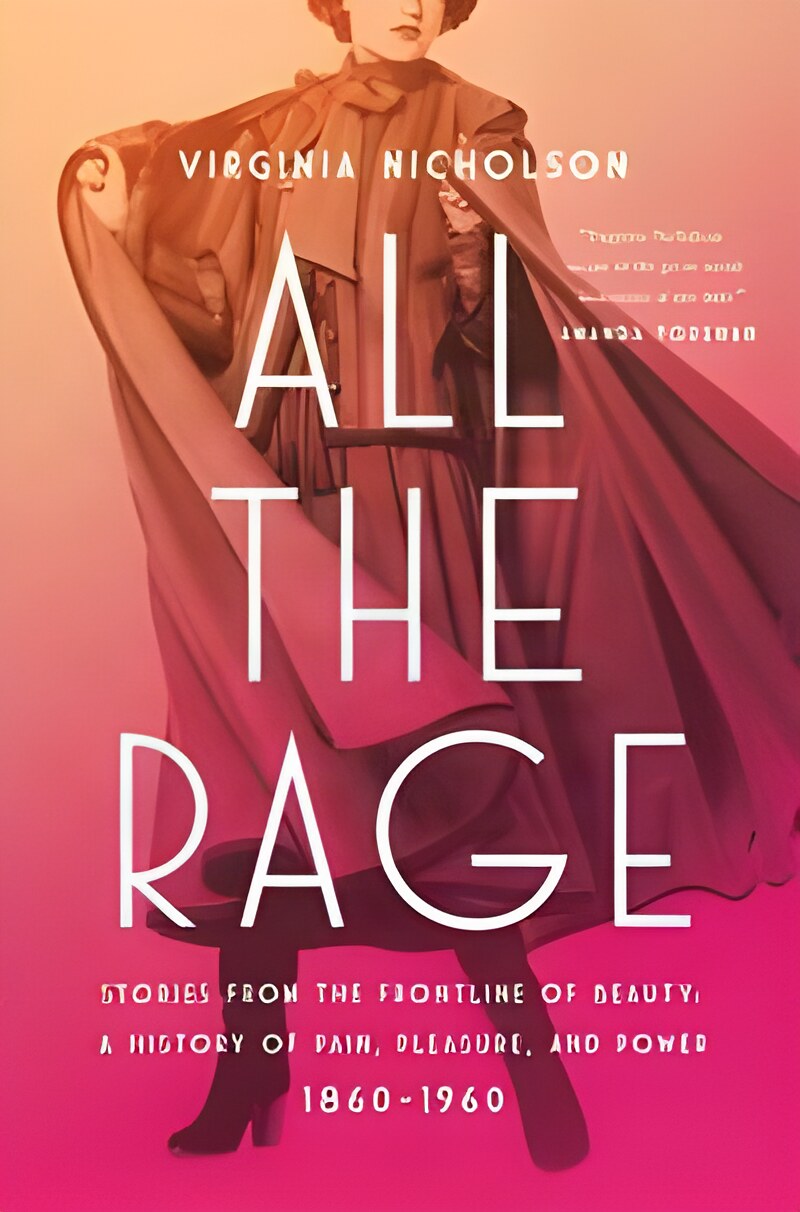
Hardcover. NY, Pegasus Books, 1st, 2024, Book: Very Good, Dust Jacket: Very Good, Hardcover in a bright, unclipped dust jacket, 519 pages. At the heart of this history is the female body. The century-span between the crinoline and the bikini witnessed more mutations in the ideal western woman's body shape than at any other period. In this richly detailed account, Virginia Nicholson, described as 'one of the great social historians of our time.' (Amanda Foreman) and a truly brilliant researcher has produced a most remarkable social history revealing the power, the pain and the pleasure involved in adorning the female body. She asks how custom, colour, class and sex fit into the picture, and shrewdly charts how the advances made by feminism collided with the changing shape of desirability. Full of surprising facts - the feminist plastic surgeon, the radioactive corset - alongside stories of the 'New Women' who discovered freedom by bobbing their hair, those who were the early adopters of trousers, and early Black beauty entrepreneurs, this book chronicles the codes, the contradictions, the lies and the highs of beauty.
Hardcover. NY, Pegasus Books, 1st, 2024, Hardcover in a bright, unclipped dust jacket, 519 pages. At the heart of this history is the female body. The century-span between the crinoline and the bikini witnessed more mutations in the ideal western woman's body shape than at any other period. In this richly detailed account, Virginia Nicholson, described as 'one of the great social historians of our time.' (Amanda Foreman) and a truly brilliant researcher has produced a most remarkable social history revealing the power, the pain and the pleasure involved in adorning the female body. She asks how custom, colour, class and sex fit into the picture, and shrewdly charts how the advances made by feminism collided with the changing shape of desirability. Clean copy.
Hardcover. Boston, Little Brown, 1st, 1986, Book: Very Good, Dust Jacket: Good, Hardcover, 129 pages. The 'upper class' in America might also be called the hidden class. To be born into wealth in America is to belong to a world apart, a world most of us never glimpse. This group -- whose wealth is several generations old -- has been envied, castigated, and mythologized, but rarely documented or photographed. Barbara Norfleet, photographer and sociologist, depicts this hidden world through a series of candid images at once fascinating and unsettling, combined with interviews. Norfleet captures her subjects in context: at social gatherings, athletic events, in their exclusive clubs and vast private estates. Dust jacket has some sun-fade along spine edge otherwise clean, very good.
Hardcover. Raleigh NC, TwoMorrows Publishing, 1st, 2024, Book: Very Good, Dust Jacket: None, Hardcover in glossy pictorial boards, 263 pages illustrated in color. This 1945-49 volume covers the comic book industry during the aftermath of World War II, when scores of writers and artists returned from foreign battlefields to resume their careers. It was a period when readers began turning away from the escapist entertainment offered by super-heroes in favor of other genres, like the grittier, more brutal crime comics. It was a time when Joe Simon and Jack Kirby created Young Romance, inaugurating a golden age of romance comics. And it was during this five-year period that Timely and National Comics capitalized on the popularity of Westerns, that Bill Gaines plotted a new course for EC Comics in the wake of his father's death, and that Jerry Siegel and Joe Shuster first sued for the rights to Superman. These are just a few of the events chronicled in this exhaustive, full-color hardcover, further documenting the ACBC series' cohesive, linear overview of the entire landscape of comics history! Like new.
Softcover. Middletown CT, Wesleyan University Press, 2nd pr., 2006, Book: Very Good, Dust Jacket: None, Softcover, 252 pages. How does a Middle Eastern community create a modern image through its expression of heritage and authenticity? In Among the Jasmine Trees: Music and Modernity in Contemporary Syria, Jonathan H. Shannon investigates expressions of authenticity in Syria's musical culture, which is particularly known for embracing and preserving the Arab musical tradition, and which has seldom been researched in depth by Western scholars. Music plays a key role in the process of self-imaging by virtue of its ability to convey feeling and emotion, and Shannon explores a variety of performance genres, Sufi rituals, song lyrics, melodic modes, and aesthetic criteria. Clean copy.
Hardcover. Princeton NJ, Princeton University Press, 1st, 1995, Book: Very Good, Dust Jacket: Very Good, Hardcover in a bright dust jacket. 327 pages, clean copy. Few diseases have exercised the Western imagination as chronically as hysteria--from the wandering womb of ancient Greek medicine, to the demonically possessed witch of the Renaissance; from the "vaporous" salon women of Enlightenment Paris, through to the celebrated patients of Sigmund Freud, with their extravagant, erotically charged symptoms. In this fascinating and authoritative book, Mark Micale surveys the range of past and present readings of hysteria by intellectual historians; historians of science and medicine; scholars in gender studies, art history, and literature; and psychoanalysts, psychiatrists, clinical psychologists, and neurologists. In so doing, he explores numerous questions raised by this ever-growing body of literature: Why, in recent years, has the history of hysterical disorders carried such resonance for commentators in the sciences and humanities? What can we learn from the textual traditions of hysteria about writing the history of disease in general? What is the broader cultural meaning of the new hysteria studies? In the second half of the book, Micale discusses the many historical "cultures of hysteria." He reconstructs in detail the past usages of the hysteria concept as a powerful, descriptive trope in various nonmedical domains, including poetry, fiction, theater, social thought, political criticism, and the arts. His book is a pioneering attempt to write the historical phenomenology of disease in an age preoccupied with health, and a prescriptive remedy for writing histories of disease in the future.
Hardcover. Boston/NY, Houghton Mifflin, 1st, 2007, Book: Very Good, Dust Jacket: Very Good, Hardcover in a bright dust jacket, 262 pages. Offers a compelling study that compares modern-day America to the rise and fall of ancient Rome, offering a series of warnings, nuanced lessons, and thought-provoking strategies designed to avoid the Roman Empire's fate. Clean copy.
Softcover. UK, Cambridge University Press, 1st, 2000, Book: Very Good, Dust Jacket: None, Softcover, 306 pages, b&w illustrations. This book is an introduction to the history of work in general and of artisans in particular in Europe from 1300 to 1914. It focuses on many aspects of artisan culture, including economic and guild life, and discusses social, rebellious, ceremonial and leisure experience as well. Women, masters, journeymen, apprentices, and non-guild workers all receive substantial treatment, and the text is illuminated with fascinating illustrations. Mild crease to first 8 pages. Clean copy.
Softcover. London, Bloomsbury, reprint, 2008, Book: Very Good, Softcover, 692 pages. Coursing through Austerity Britain is an astonishing variety of voices - vivid, unselfconscious, and unaware of what the future holds. A Chingford housewife endures the tribulations of rationing; a retired schoolteacher observes during a royal visit how well-fed the Queen looks; a pernickety civil servant in Bristol is oblivious to anyone's troubles but his own. An array of working-class witnesses describe how life in post-war Britain is, with little regard for liberal niceties or the feelings of their 'betters'. Many of these voices will stay with the reader in future volumes, jostling alongside well-known figures like John Arlott (here making his first radio broadcast, still in police uniform), Glenda Jackson (taking the 11+) and Doris Lessing, newly arrived from Africa, struck by the levelling poverty of postwar Britain. David Kynaston weaves a sophisticated narrative of how the victorious 1945 Labour government shaped the political, economic and social landscape for the next three decades.Deeply researched, often amusing and always intensely entertaining and readable, the first volume of David Kynaston's ambitious history offers an entirely fresh perspective on Britain during those six momentous years. Clean copy.
Softcover. Montreal/NY, Black Rose Books, reprint, 1990, Book: Very Good, Dust Jacket: None, Softcover, 453 pages. A selection of writings by one of the most important practitioners of social revolution. "The best available in English. Bakunin's insights into power and authority, and the conditions of freedom, are refreshing, original and still unsurpassed in clarity and vision. I read this selection with great pleasure." --Noam Chomsky. Clean copy.


 "97 Orchard: An Edible History of Five Immigrant Families in One New York Tenementby: Ziegelman, Jane")
 "A Guide to Contemporary Southwest Indians (SIGNED) by: Fontana, Bernard L.")

 "A Social History of Truth: Civility and Science in Seventeenth-Century Englandby: Steven Shapin")
 "A Subaltern Studies Reader, 1986-1995by: Ranajit Guha (Ed.)")


 "Adventures of Amos 'N' Andy: A Social History of an American Phenomenon by: Ely, Melvin Patrick")





 "All the Right Peopleby: Norfleet, Barbara")



 "Are We Rome?: The Fall of an Empire and the Fate of America by: Cullen Murphy")