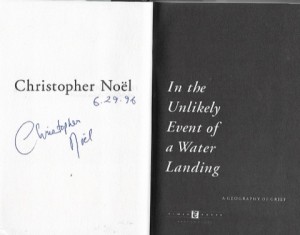
Hardcover. New York , Times Books, 1st, 1996, Book: Very Good, Dust Jacket: Very Good, 273 pages. Hardcover with dust jacket. SIGNED BY NOEL on title-page. Clean, unmarked copy with only minor wear to dust jacket.
Hardcover. Cincinnati, OH, J.A. Brainerd, 1st, 1853, Book: Fair, Dust Jacket: None, 304 pages. Hardcover with no dust jacket. Heavy wear to bottom spine, fabric cover frayed. Corners heavy rubbing and bumped. Gutter cracked in multiple places. Previous owner's name on front fly leaf. Light pencil markings.
Softcover. West Danville VT, United Methodist Church, 1st, 1976, Book: Very Good, Dust Jacket: None, Softcover booklet, stapled wrappers, 16 pages. Indian Joe was a Native American guide active in the early conflicts and settlement of Vermont in the 1700s. B&w illustrations, photo of his tomb in the Oxbow cemetery in Newbury, Vermont. Clean copy.
Softcover. The MIT Press , reprint, 2005, Book: Very Good, Dust Jacket: None, Softcover, The first publication documenting the work of Brooks Stevens, one of America's most influential twentieth-century designers. A long overdue introduction to the work of visionary industrial designer Brooks Stevens (1911-1995). Believing that an industrial designer "should be a businessman, an engineer, and a stylist, in that order," Stevens created thousands of ingenious and beautiful designs for industrial and household products--including a clothes dryer with a window in the front, a wide-mouthed peanut butter jar, and the Oscar Mayer Wienermobile. ("There's nothing more aerodynamic than a wiener," he explained.) He invented a precursor to the SUV by turning a Jeep into a station wagon after World War II, and streamlined steam irons so that they resembled aircraft. It was Brooks Stevens who, in 1954, coined the phrase "planned obsolescence," defining it as "instilling in the buyer the desire to own something a little newer, a little better, a little sooner than is necessary." This concept has since been blamed for everything from toasters that stop working to today's throwaway culture, but Stevens was simply recognizing the intentionally ephemeral nature of a designer's work. Asked once to name his favorite design, he replied, "none, because every one would have to be restudied for the tastes of tomorrow." Clean copy still in publisher's shrinkwrap.
Hardcover. London, W.H. Allen, 1st, 1963, Book: Very Good, Dust Jacket: Very Good, Hardcover, 303 pages, b&w photos. Previous owner's signature on fly leaf otherwise very good in a similar dust jacket. The filmmaker of Nanook of the North.
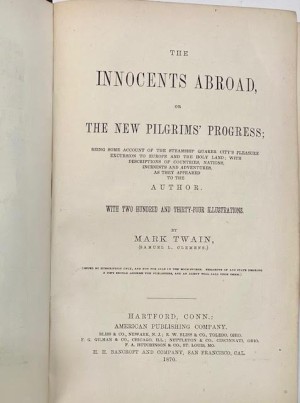
Hardcover. Hartford, CT, American Publishing Company, 1st Edition, 1870, Book: Good, Dust Jacket: None, 651 pages plus publisher's ads. Hardcover. Front and back hinges cracked, binding tight otherwise. Frontispieces with tissue guard. Tanning to edges. Pages clean with just a touch of tanning. Spine straight. Cover boards bound in black cloth, gilt title on spine and design on front cover board. Borders and decoration blind-stamped to front and back cover boards. Some agewear to boards: fraying/chipping at top and bottom of spine and corners, rubbing. "Being some account of the steamship Quaker City's pleasure excursion to Europe and the Holy Land; with descriptions of countries, nations, incidents and adventures, as they appeared to the author." Perfect for any collector's bookshelf.
Hardcover. NY, Harcourt Brace , 1st, 1994, Book: Very Good, Dust Jacket: Very Good, Hardcover in a bright, unclipped dust jacket. Illustrated with 16 pages of black and white photographs, 338 pages. With wry humor and sharp observation, playwright Pifer elegantly mixes memory and research to reconstruct the world of his South African boyhood from 1933 to 1945. Pifer's father, an idealistic mining engineer in search of challenge and stability during the Depression, found it in Africa, but his earnest American egalitarianism soon put him in conflict with Afrikaner mine overseers, and his career under magnate Sir Ernest Oppenheimer stalled. The author deftly evokes his family--"my mother had the freedom of a disobedient daughter"--and the isolation of the desert town of Oranjemund. The book is even more resonant in its snapshots of mid-century Southern Africa: the still-simmering enmity between Afrikaners and the English; the ripples from Hitler's war in what prior to WW I had been the German territory of South West Africa (currently Namibia). Pifer's knowing account of the travails of servants--"the chasm that exists between white mistress and African maid"--still rings true today. Clean copy.
Softcover. Emeryville CA, Seal Press, 1st pbk, 2006, Softcover, 549 pages, b&w illustrations. Set amidst the political upheaval of the McCarthy trials, the Vietnam War, and the rise of the women's movement, Intimate Politics is a courageous and uncompromising account of one woman's personal and political transformation, and a fascinating portrayal of a key chapter in our nation's history. At eight years old, Bettina Aptheker watched her family's politics play out in countless living rooms across the country when her father, historian and U.S. Communist Party leader Herbert Aptheker, testified on television in front of the House on Un-American Activities Committee in 1953. Born into one of the most influential U.S. Communist families whose friends included W. E. B. Du Bois, Paul Robeson, and Elizabeth Gurley Flynn, Bettina lived her parents' politics witnessing first-hand one of the most dramatic upheavals in American history. She also lived with a terrible secret: incest at the hands of her famous father and a frightening and lonely life lived inside a home wrought with family tensions. Light marking to ten pages, otherwise a clean, bright copy.
Hardcover. NY, Dey Street Books, 1st, 2022, Book: Very Good, Dust Jacket: Very Good, Hardcover in a bright, unclipped dust jacket, 655 pages, b&w illustrations. During his lifetime, Buckminster Fuller was hailed as one of the greatest geniuses of the twentieth century. As the architectural designer and futurist best known for the geodesic dome, he enthralled a vast popular audience, inspired devotion from both the counterculture and the establishment, and was praised as a modern Leonardo da Vinci. To his admirers, he exemplified what one man could accomplish by approaching urgent design problems using a radically unconventional set of strategies, which he based on a mystical conception of the universe's geometry. His views on sustainability, as embodied in the image of Spaceship Earth, convinced him that it was possible to provide for all humanity through the efficient use of planetary resources. From Epcot Center to the molecule named in his honor as the buckyball, Fuller's legacy endures to this day, and his belief in the transformative potential of technology profoundly influenced the founders of Silicon Valley. Inventor of the Future is the first authoritative biography to cover all aspects of Fuller's career. Drawing on meticulous research, dozens of interviews, and thousands of unpublished documents, Nevala-Lee has produced a riveting portrait that transcends the myth of Fuller as an otherworldly generalist. It reconstructs the true origins of his most famous inventions, including the Dymaxion Car, the Wichita House, and the dome itself; his fraught relationships with his students and collaborators; his interactions with Frank Lloyd Wright, Isamu Noguchi, Clare Boothe Luce, John Cage, Steve Jobs, and many others; and his tumultuous private life, in which his determination to succeed on his own terms came at an immense personal cost. In an era of accelerating change, Fuller's example remains enormously relevant, and his lessons for designers, activists, and innovators are as powerful and essential as ever. Remainder mark to top edge, otherwise clean.
Hardcover. Seattle, WA, Fantagraphics Books, 1st, 2015, Book: Very Good, Dust Jacket: Very Good, 208 pages. Hardcover with dust jacket. Black and white comics. Clean, unmarked copy with only minor wear to dust jacket. Invisible Ink unfolds like a detective story, alternating between past and present, as Griffith recreates the quotidian habits of suburban Levittown and the professional and cultural life of mid-century Manhattan in the 1950s and '60s as seen through his mother's and his own then-teenage eyes.
Hardcover. Boston, Houghton Mifflin Co , 1st, 1928, Book: Good, Dust Jacket: None, Set of two hardcover volumes. 1113 pages total. Illustrated frontispiece. B&w illustrations throughout. Includes extensive appendix. With worn, decorative slipcase. Light edge wear to dust jacket otherwise clean, unmarked copy with only minor wear to dust jacket.
Hardcover. NY, W. W. Norton & Company, 1st, 2001, Book: Very Good, Dust Jacket: Very Good, Hardcover in a bright, unclipped dust jacket. Drawing on hundreds of interviews, letters, and diaries, an authorized biography of the critically acclaimed philosopher and novelist traces her personal life and literary and philosophical career, from her student days at Oxford, through her marriage to John Bayley, to Murdoch's remarkable influence on literary England, from 1940 to the present day.
Softcover. Boston, David R. Godine, reprint, 2004, Book: Very Good, Dust Jacket: None, Softcover in pictorial wrappers, 368 pages. Eagerly exchanging an existence of idle privilege and social intrigue for one of hard work and literary distinction, Origo led a life characterized by vitality and commitment. Born in 1902 into a wealthy American family, she and her British mother permanently left the U.S. after the untimely death of her father in 1910. Traveling extensively throughout Europe, they eventually settled outside of Florence, becoming prominent members of the stuffy Anglo-Florentine community of expatriates. Asserting her trademark independence, she married Antonio Origo, the illegitimate son of a cavalry officer-sculptor. Together Antonio and Iris purchased and totally revitalized an arid Tuscan valley and renovated a crumbling estate. With virtually no experience and few practical skills, they transformed themselves into agrarian pioneers and their extensive acreage into a prosperous working community supporting more than 200 people. During the war years, they quietly supported the Allies, offering refuge to countless numbers of partisans and prisoners of war. In addition to these accomplishments, Iris also buried one child and raised two more, conducted several heart-wrenching extramarital affairs, and distinguished herself as both a biographer and a literary critic. Clean copy.
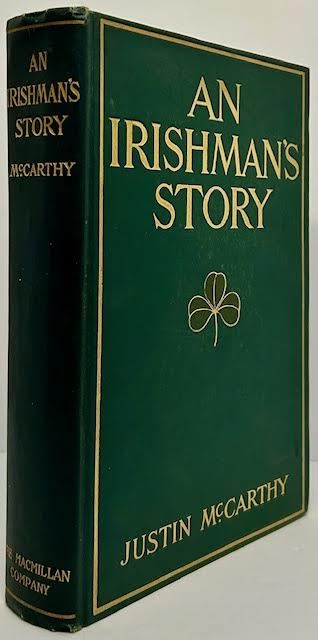
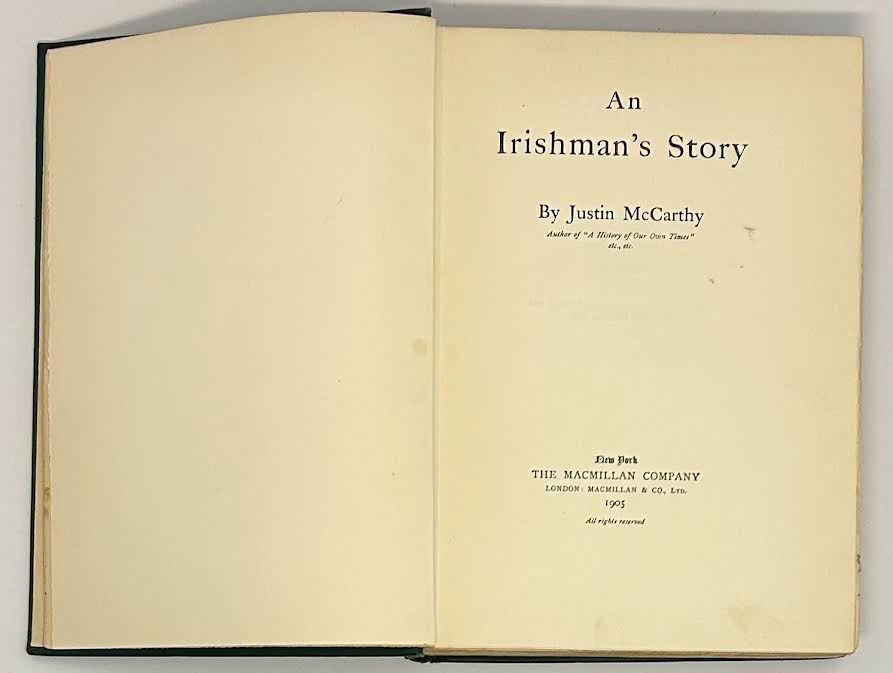
Hardcover. New York, Macmillan Company, 1st Edition, 1905, Book: Very Good, Dust Jacket: None, 436 pages. Hardcover. Green cloth cover boards, gilt title on spine and front cover with decoration. Tanning to pages and edges (agewear). Top edge gilt (faded). Binding good, spine straight. The autobiography of Justin McCarthy (1830-1912), who was an Irish politician, journalist, novelist, and historian.
Hardcover. New York, Harry N. Abrams, 1st, 2005, Book: Very Good, Dust Jacket: Very Good, Hardcover, 240 pages, illustrated throughout in color and b&w. Light edgewear to dust jacket, else a clean, tight copy.
Hardcover. NY, G.P. Putman's Sons, 1st, 1989, Book: Very Good, Dust Jacket: Very Good, Hardcover in a nice, unclipped dust jacket, 447 pages. B&w photos. Although he aspired to Princeton, Irwin Gilbert Shamforoff (aka Shaw) had to settle for local Brooklyn College, where he seems to have enjoyed football more than his studies. From his mid-20s, however, Shaw (1913-1984) was a highly regarded New Yorker short story writer ("The Girls in Their Summer Dresses") and left-wing playwright ( Bury the Dead ), and later became a successful Hollywood script writer and novelist ( The Young Lions ; Rich Man, Poor Man ). This sympathetic, objective biography, by a Vanity Fair contributing editor, convincingly shows how Shaw's career, character and fiction, influenced more by Hemingway's lifestyle than by his writing, were marked by incongruities. Far from abating with age, his romantic and alcoholic appetites overwhelmed him. Years of high living in Europe, surrounded by adoring friends, softened his self-judgment, and he took to writing "fluffy essays for swells." The New Yorker dropped him, and "serious" critics panned his novels. Shnayerson capably contrasts Shaw's inclinations and personality with his subject matter and literary output, and is especially astute at explaining the complications of being a commercially successful midcentury American writer. Clean copy.
Hardcover. New Brunswick NJ, Rutgers University Press, 1st, 1968, Book: Very Good, Dust Jacket: Very Good, Hardcover in a bright, unclipped dust jacket, 242 pages, b&w illustrations. Collins conducted business in Trenton and Burlington and founded New Jersey's first regular newspaper, the "New-Jersey Gazette". Clean, bight copy.
Hardcover. New Haven CT, Yale University Press, 1st, 2023, Book: Very Good, Dust Jacket: Very Good, Hardcover in a bright dust jacket, 192 pages. Isaac Murphy, born enslaved in 1861, still reigns as one of the greatest jockeys in American history. Black jockeys like Murphy were at the top of the most popular sport in America at the end of the nineteenth century. Black jockeys were internationally famous - the first African American superstar athletes--and with wins in three Kentucky Derbies and countless other prestigious races, Murphy was the greatest of them all. At the same time, he lived through the seismic events of Emancipation and Reconstruction and formative conflicts over freedom and equality in the United States. And inevitably he was drawn into those conflicts, with devastating consequences. Katherine C. Mooney uncovers the history of Murphy's troubled life, his death in 1896 at age thirty-five, and his afterlife. Clean copy.
Hardcover. Leiden, The Netherlands, Brill, 1st edition, 2012, Book: Near Fine, Dust Jacket: None, 352 pages. Hardcover. Decorated cover boards, excellent. Very clean pages, edges. Biding tight. Spine straight. Like new. most remembered for his biblical criticism, Vossius played a central role in the early modern European world of learning.
Hardcover. US, University Of Chicago Press, 1st, 1991, Book: Very Good, Dust Jacket: Very Good, 229 pages. Light edgewear to dust jacket, else a clean, tight copy. Isaiah Berlin: A Celebration gathers tributes, reflections, and commentaries on the great thinker and his philosophy, politics, and life-including contributions from Michael Ignatieff, Leon Wieseltier, Ronald Dworkin, Stephen Spender, and many others.
Hardcover. New York & London, G. P. Putnam's Sons, reprint, 1905, Book: Good, Dust Jacket: None, Hardcover, 442 pages, b&w illustrations. Maroon cloth, gilt titles to front and spine. Light wear to edges and boards, faint foxing to a few pages. Neat, tight copy.
Hardcover. Seattle, Fantagraphics, 1st, 2016, Book: Very Good, Dust Jacket: Very Good, Hardcover in a bright dust jacket, 304 pages. In 1976, the critic Paul Nelson spent several weeks interviewing his literary hero, legendary detective writer Ross Macdonald. Beginning in the late 1940s with his shadowy creation, ruminating private eye Lew Archer, Macdonald had followed in the footsteps of Dashiell Hammett and Raymond Chandler, but ultimately elevated the form to a new level. "We talked about everything imaginable," Nelson wrote-including Macdonald's often meager beginnings; his dual citizenship; writers, painters, music, books, and movies he admired; how he used symbolism to change detective writing; his own novels and why Archer was not the most important character-"my God, everything." It's All One Case provides an open door to Macdonald at his most unguarded. The book is far more than a collection of never-before-published interviews, though. Published in a handsome, oversized format, it is a visual history of Macdonald's professional career, illustrated with rare and select items from one of the world's largest private archives of Macdonald collectibles. Featuring in full color the covers of the various editions of Macdonald's more than two dozen books, facsimile reproductions of pages from his manuscripts, magazine spreads, and many never before seen photos of Macdonald and his friends (such as Kurt Vonnegut), including those by celebrated photojournalist Jill Krementz. It's All One Case is an intellectual delight and a visual feast, a fitting tribute to Macdonald's distinguished career. Full-color illustrations throughout
Hardcover. Chicago, University of Chicago Press, 1st, 2003, Book: Very Good, Dust Jacket: Very Good, Hardcover in a bright dust jacket, 202 pages. Natalia Ginzburg, arguably the most important woman writer of postwar Italy, always spoke of herself with irrepressible modesty. Yet the woman who claimed she "never managed to climb up mountains" in fact wrote the history of twentieth-century Italy with her sparse and captivating prose, chronicling Fascism, war, and the Nazi occupation as well as the intimacies of family life. Intensely reserved, Ginzburg said that she "crept toward autobiography stealthily like a wolf." But she did openly discuss her life and her work in an extraordinary series of interviews for Italian radio in 1990. Never before published in English, It's Hard to Talk about Yourself presents a vivid portrait of Ginzburg in her own words on the forces that shaped her remarkable life-politics, publishing, literature, and family. This fluid translation will join Ginzburg's autobiography, Family Sayings, as one of the most important records of her life and, as the editors write in their preface, "the last, unexpected, original book by Natalia Ginzburg."

 "In the Unlikely Event of a Water Landing - A Geography of Grief (SIGNED COPY)by: Noel, Christopher")

 "India and its Inhabitantsby: Wright, Caleb")
 "Indian Joe: The Friendly Indian Guideby: William Parker Neal")
 "Industrial Strength Design: How Brooks Stevens Shaped Your World by: Glenn Adamson / David Gordon (Preface)")
 "Infants of the Spring: The Memoirs of Anthony Powell by: Anthony Powell")
 "Innocent Eye, The: The Life of Robert J. Flahertyby: Calder-Marshall, Arthur")
 "Innocents Abroad, The: or the New Pilgrims' Progressby: Twain, Mark (Samuel Clemens)")

 "Innocents In Africa: An American Family's Storyby: Pifer, Drury")
 "Intimate Politics: How I Grew Up Red, Fought for Free Speech, and Became a Feminist Rebelby: Bettina F. Aptheker")
 "Inventor of the Future: The Visionary Life of Buckminster Fullerby: Nevala-Lee, Alec")
 "Invisible Ink: My Mother's Secret Love Affair with a Famous Cartoonist: A Graphic Memoirby: Griffith, Bill")
 "Ira Allen: Founder of Vermont by: Wilbur , James Benjamin")
 "Iris Murdoch: A Life by: Conradi, Peter J.")
 "Iris Origo: Marchesa of Val d'Orcia by: Moorehead, Caroline")
 "Irishman's Story, Anby: McCarthy, Justin")
 "Irving Berlin's Show Business: Broadway - Hollywood - Americaby: Leopold, David")
 "Irwin Shaw: A Biographyby: Michael Shnayerson")
 "Isaac Collins: A Quaker Printer in 18th Century Americaby: Hixson, Richard F.")
 "Isaac Murphy: The Rise and Fall of a Black Jockeyby: Katherine C. Mooney")
 "Isaac Vossius (1618-1689): Between Science and Scholarshipby: Jorink, Eric (Editor), Dirk Van Miert (Editor)")


 "Isaiah Berlin: A Celebrationby: Ullmann-Margalit, Edna")
 "Israel Putnam: Poineer, Ranger and Major-General 1718-1790by: Livingston, William Farrand")
 "It's All One Case: The Illustrated Ross Macdonald Archivesby: Kevin Avery , Paul Nelson, et al.")
 "It's Hard to Talk about Yourself by: Ginzburg, Natalia, Translator: Quirke, Louise")