Hardcover. Baltimore, Genealogical Publishing Company, 2nd pr., 1997, Book: Very Good, Dust Jacket: None, Hardcover, blue cloth stamped with gilt lettering, 608 pages. After the Revolutionary War, the federal government awarded bounty lands to citizens and soldiers for services rendered. In its simplest form, this involved the exchange of free land for military service. Federal records of these Revolutionary War bounty land awards are well known and readily accessible to genealogists. But the federal government was not alone in rewarding its citizens and soldiers with bounty lands. Nine state governments adopted similar policies, generating even more records. Unlike the federal bounty land records, however, these state records are not centralized; instead, they are found in the various states in the form of manuscript records and printed books and are all but inaccessible to the researcher. Until now, that is! Because with this work by Lloyd Bockstruck we now have a master index to state bounty land records, a Revolutionary War resource unparalleled for freshness, originality, and research potential. The nine states that awarded bounty lands in their western reserves or on their western borders (directly affecting the future states of Indiana, Kentucky, Maine, Ohio, and Tennessee) are Connecticut, Georgia, Maryland, Massachusetts, New York, North Carolina, Pennsylvania, South Carolina, and Virginia. (The basis for the Connecticut and Georgia awards, by the way, differ from the norm.) Clean, bright copy.
Hardcover. NY, Time Life, reprint, 1983, Book: Very Good, Dust Jacket: None, 389 pages. Hardcover with no dust jacket. Dark blue leather bound with gilt titles to front cover and spine. Embossed decoration on front cover. Gilt text block edges, red ribbon marker. Clean, tight copy. The commander of a Georgia regiment through much of the Civil War mused later in his memoirs that the heaviest burden fell not upon the man at the front, but upon the woman who waited and prayed for victory: "While the men were carried away with the drunkenness of the war, she dwelt in the stillness of her desolate home." Sallie Brock Putnam spoke for Southern womanhood. She was a native of Madison County, Virginia, and seems to have come from a family of good social standing. The book contains an unexpectedly full history of the Civil War; the author exhibits a strong grasp of strategy and tactics. But at its heart is an incisive eyewitness account of life in a capital that was swollen to four times its normal population by the exigencies of war. Brock's descriptions of Jefferson Davis' inauguration and the Richmond Bread Riot of 1863 are dramatic, but no more so than her accounts of nameless refugees, race relations, opportunistic merchants and blockade runners. Confederate prisons and family matters. In contrast to other female Southern writers of the period, she was more sober and factual, less gossipy and speculative. She wrote with shrewdness and maturity, and with a remarkable lack of self-pity and exaggeration. Yet the reader cannot miss her courage, sacrifice and suffering. Sallie Brock Putnam died in 1911.
Hardcover . New York, Blue Sky Press, 1st, 1997, Book: Very Good, Dust Jacket: Very Good, 111 pages. Hardcover. Extensive color illustrations by Barry Moser throughout. Gilt titles on spine and cover. Some edge wear to dust jacket, otherwise clean, tight copy.
Hardcover. New York, Harcourt Brace, 1st, 1934, Book: Good, Dust Jacket: None, Hardbound, red cloth with faded gilt lettering on spine, 237 pages. Black & white and color illustrations by Frank E. Schoonover. Mild soil to edges, covers. Historical fiction for young adults based on the life of Roland, warrior of France, nephew of Emperor Charlemagne. Clean copy.
NY, Scribners, 1st, 1937, Book: Good, Dust Jacket: None, Black & white illustrations. Black & white Illustrated frontispiece. Illustrated end papers. Light edgewear and soil to covers.
Hardcover. Berryville, VA, Rockbridge Publishing Company, 1st, 1994, Book: Very Good, Dust Jacket: Very Good, 300 pages. Hardcover. B/w illustrations throughout. Very clean inside and out. Buff fabric covered with gilt title on spine. From the back cover: "Season of Fire is the most complete and dramatic study to date of Early's invasion of the north and battle of Monocacy--an engagement that may well have saved the Nation's Capitol from capture."
Hardcover. Stanford CA, Stanford University Press, 1st, 1993, Book: Very Good, Dust Jacket: Very Good, Hardcover in a bright dust jacket, 308 pages including index. Friendship between the sexes is notoriously difficult to describe. Seeing Together examines the efforts of some of England's key writers - from poets to propagandists - during a period when 'mere friendship' came to seem intensely important and when discussion of professional relations between men and women came to touch upon a troubling network of sexual, social and political dynamics. Among the authors discussed are John Stuart Mill, Robert Browning, George Eliot, Thomas Hardy, Henry James, Joseph Conrad, D. H. Lawrence and Virginia Woolf. Small name on fly leaf otherwise a bright, clean copy.
Softcover. Charlottesville, Va., University of Virginia Press, 1st, 1997, Book: Very Good, Dust Jacket: None, Softcover, 123 pages. Exhibition catalog. Illustrated throughout in color and b&w. Light wear/crease to spine, else a clean, tight copy.
Softcover. Charlottesville, Va., University of Virginia Press, 1st, 1997, Book: Very Good, Dust Jacket: None, Softcover, 123 pages. Exhibition catalog. Illustrated throughout in color and b&w. Light wear/crease to spine, else a clean, tight copy.
Hardcover. Urbana IL, University of Illinois Press, 1st, 1964, Book: Very Good, Dust Jacket: Good, Hardcover in a dust jacket with two small holes to front cover, 227 pages with index. "Slavery was a social and an economic institution of such power that it sustained and extended an economic system whose demands went far to determine the domestic and foreign policy of the "agrarian" party in our early history. For the agrarian politics of Jefferson, while possibly benefiting the small freeholder, very closely served the interests of the plantation system, at least as the planters conceived their interests." Name on front fly leaf, otherwise clean.
Hardcover. NY, Abrams, 1st, 1994, Book: Very Good, Dust Jacket: Very Good, Hardcover in a bright dust jacket, 160 pages, b&w plates. An accomplished photographer of the American scene presents a unique artistic record that captures a vanishing part of our country, the main streets, barber shops, schoolhouses, and inhabitants of our small towns. In his 19th book on the American scene, Plowden has focused on what epitomizes small towns-before this endangered species disappears altogether. The well-produced images, arranged roughly by topic (e.g., schools, theaters, churches, home interiors, restaurants, stores, and grain elevators) and representing towns in many states (including Iowa, Kansas, West Virginia, New York, Minnesota, and Idaho), speak eloquently of small-town life. Even more so, they speak of change; by the time Plowden photographed these towns, most had been cut off from their rural heritages. Nevertheless, the photographs convey order, calm, and congeniality; the best of them evoke the work of Walker Evans, who, like Plowden, left scenes unaltered when he photographed them. Clean copy.
Hardcover. NY, Abrams, 1st, 1994, Book: Very Good, Dust Jacket: Very Good, Hardcover in a bright dust jacket, 160 pages, b&w plates. An accomplished photographer of the American scene presents a unique artistic record that captures a vanishing part of our country, the main streets, barber shops, schoolhouses, and inhabitants of our small towns. In his 19th book on the American scene, Plowden has focused on what epitomizes small towns-before this endangered species disappears altogether. The well-produced images, arranged roughly by topic (e.g., schools, theaters, churches, home interiors, restaurants, stores, and grain elevators) and representing towns in many states (including Iowa, Kansas, West Virginia, New York, Minnesota, and Idaho), speak eloquently of small-town life. Even more so, they speak of change; by the time Plowden photographed these towns, most had been cut off from their rural heritages. Nevertheless, the photographs convey order, calm, and congeniality; the best of them evoke the work of Walker Evans, who, like Plowden, left scenes unaltered when he photographed them. Clean copy.
Hardcover. NY, Houghton Mifflin Company, reprint, 2000, Book: Very Good, Dust Jacket: Very Good, Hardcover in a bright dust jacket. Originally published in 1947, this is a quality reprint of that Caldecott Honor book. Silver medal on dj, clean copy. 123 pages with fifteen original ballads of Robin Hood with exquisitely detailed b&w illustrations by Virginia Lee Burton.
Hardcover. New York, Philomel, 1st, 1982, Book: Very Good, Dust Jacket: Very Good, 215 pages. Hardcover with dust jacket. Light soil spot on bottom of page block. Dust jacket is protected in plastic, but has light abrasion to paper near bottom spine front. Clean, tight copy.
Hardcover. NY, Farrar Straus Giroux, 4th pr., 2003, Book: Very Good, Dust Jacket: Very Good, Hardcover in a bright, lightly worn dust jacket, 199 pages. A tale set in the 1950s hill country of Virginia. Clean copy.
Hardcover. NY, G. P. Putnam's Sons, 1st, 1930, Book: Very Good, Dust Jacket: None, Hardcover, black cloth with green and gilt stamping. A story of love, murder and suicide, described by one critic as "atmospheric to the verge of mystical." The novel concerns a woman named Felicia Lissell, who travels to Rhodesia with her aunt, to visit the farm of Dick Cardross, but she doesn't suspect that "dangerous social complications awaited her in the gay English colony nearby." The author, born Lilian Julian Webb in London in 1862, was a resident of Rhodesia (now Zimbabwe) from 1896. She achieved international recognition with the publication of her story collection "Virginia of the Rhodesians" in 1904, and went on to great success as the author of numerous novels. Owner's signature inside front cover otherwise clean. No dust jacket.
Hardcover. NY, Free Press, 1st, 1991, Book: Very Good, Dust Jacket: Very Good, Hardcover, 219 pages. B&W photos. The twentieth-century rise of the automobile collided head on with Victorian prescriptions for the proper role and place of women in society. Gender conventions cast women as too weak, dependent, and flighty to manage the fiery motored beast. Overcoming that stereotype was as difficult for women as gaining access to the vote, the professions, and education, yet their personal feats of driving in both war and peace demolished the gender barriers against their taking the road. After women proved once and for all that they could drive under the worst conditions in World War I, they adapted the automobile to their domestic roles in urban society during the 1920s. Written with flair and verve, this volume displays Scharff's erudition in social, cultural, gender, and technological history.
Hardcover. Montreal, Drawn and Quarterly, 1st, 2009, Book: Very Good, Dust Jacket: Very Good, Hardcover in an acetate dust jacket, 272 pages. A graphic short story collection that ruminates on such topics as nuclear weapons, war, wiretapping, Christopher Columbus, Leo Tolstoy, William Shakespeare and Virginia Woolf. Clean, very good.
Hardcover. San Francisco, Chronicle Books, 1st, 1995, Book: Very Good, Dust Jacket: Very Good, Hardcover in a bright dust jacket. First work of longer fiction (although still a brief one) by this Virginia-born poet and short story writer. A moving story of jazz and an old muscian brought back to the United States as a 'museum project' to capture his creative process and preserve his music. Clean copy.
Hardcover. NY, Doubleday, Page and Co., 1st, 1908, Book: Very Good, Dust Jacket: None, Hardcover, red cloth stamped with gilt design and lettering, 485 pages. Ellen Glasgow (1873-1945) was an American author from Virginia and recipient of the Pulitzer Prize for the Novel in 1942. She published over twenty books and received much critical acclaim. During Reconstruction, Glasgow's writings were notable for diverging from the norm and portraying a changing South when it was popular to idealize Southern life before the Civil War. The Ancient Law follows the life of a financier who tries to redeem himself after going to prison for fraud. Pencil name on front fly leaf, gilt on spine lightly faded otherwise clean.
Softcover. London, Tate Gallery, 1999, Book: Very Good, Dust Jacket: None, Softcover, 296 pages, illustrated in color and b&w. Wonderfully written and illustrated account of the work of the Bloomsbury artists, Vanessa Bell, Duncan Grant and Roger Fry. Contains detailed chronologies of their lives. Catalogue entries on two hundred works, all illustrated in color, bring out the chief characteristics of Bloomsbury painting--domestic, contemplative, sensuous, and essentially pacific. These are seen in landscapes, portraits, and still lifes set in London, Sussex, and the South of France, as well as in the abstract painting and applied art that placed these artists at the forefront of the avant-garde before the First World War. Portraits of family and friends--from Virginia Woolf and Maynard Keynes to Aldous Huxley and Edith Sitwell--highlight the cultural and social setting of the group. Essays by leading scholars provide further insights into the works and the changing critical reaction to them, exploring friendships and relationships both within and outside of Bloomsbury, as well as the movement's wider social, economic, and political. Clean, bright copy.
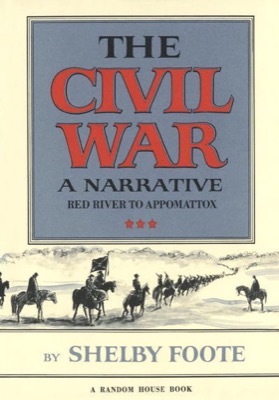
Hardcover. NY, Random House, reprint, 1974, Book: Very Good, Dust Jacket: Very Good, Hardcover in a bright, unclipped dust jacket. The Civil War: A Narrative. In the third -- and last -- volume of this vivid history, Foote brings to a close the story of four years of turmoil and strife which altered American life forever. Here, told in vivid narrative and as seen from both sides, are those climactic struggles, great and small, on and off the field of battle, which finally decided the fate of this nation. "Red River to Appomattox" opens with the beginning of the two final, major confrontations of the war: Grant against Lee in Virginia, and Sherman pressing Johnston in North Georgia. While the Virginia-Georgia fighting is in progress, Kearsarge sinks the Alabama and Forrest gains new laurels at Brice's Crossroads.With Grant and Lee deadlocked at Petersburg, Sherman takes Atlanta -- assuring Lincoln's reelection, together with the certainty that the war will be fought (not negotiated) to a finish. These events are followed by Hood's bold northward strike through middle Tennessee while Sherman sets out on his march to the sea, to be opposed at its end by the ghost of the Army of Tennessee. Endpaper maps. First published in 1974, this appears to be a reprint (no price on dust jacket). Newspaper obituary of Foote laid in. Clean copy.
Softcover. Lexington KY, University Press of Kentucky, 2nd Ed., 2001, Softcover, 377 pages. The first part of the book deals with the production code as it existed from 1922-34 with the introduction of figures such as Will Hays, Mae West and Joe Breen. The second part deals with the administration of the production code from 1934-66. Specific detail is given on the movies Dead End; Gone With the Wind; The Outlaw and The Postman Always Rings Twice; The Bicycle Thief; Detective Story and A Streetcar Named Desire; The Moon is Blue and The French Line; Lolita and Who's Afraid of Virginia Woolf. This second edition is updated to include the introduction of the PG-13 and NC-17 ratings of the 1990s. Mild wear to covers, clean.

 "Revolutionary War Bounty Land Grants Awarded by State Governmentsby: Bockstruck, Lloyd DeWitt")
 "Richmond During the War; Four Years of Personal Observation By a Richmond Lady (Leather Bound Hardcover) by: Putnam, Sallie B.")
 "ring of tricksters, A: animal tales from America, the West Indies, and Africaby: Hamilton, Virginia and Barry Moser")
 "Roland the Warriorby: Collier/Frank Schoonover, Virginia M. and Jeanette Eaton")
 "Saga Of The Comstock Lode, The - Boom Days In Virginia Cityby: Lyman, George D.")
 "Season of Fire: The Confederate Strike on Washingtonby: Judge, Joseph")
 "Second Cousinsby: Virginia Hamilton")

 "Shaping the Landscape Image, 1865-1910: John Douglas Woodwardby: Rainey, Sue")
 "Small Town Americaby: Plowden, David")

 "Sweet Whispers, Brother Rushby: Hamilton, Virginia")
 "Tagati by: Stockley, Cynthia")
 "Taking the Wheel - Women and the Coming of the Motor Ageby: Scharff, Virginia")
 "Talking Linesby: Blechman, R.O.")
 "The Ancient Lawby: Glasgow, Ellen")
 "The Art of Bloomsburyby: Shone, Richard")