Hardcover. NY, Henry Holt and Company, 1st, 2002, Book: Very Good, Dust Jacket: Very Good, Hardcover in a bright dust jacket. Stated First Edition. Illustrations. 18 maps. The liberation of Europe and the destruction of the Third Reich is a story of miscalculation and incomparable courage, of calamity and enduring triumph. In this first volume of the Liberation Trilogy, Rick Atkinson focuses on 1942 and 1943, showing how central the great drama that unfolded in North Africa was to the ultimate victory of the Allied powers and to America's understanding of itself.Opening with the daring amphibious invasion in November 1942, An Army at Dawn follows the American and British armies as they fight the French in Morocco and Algiers, and then take on the Germans and Italians in Tunisia.
Softcover. NY, Cambridge University Press, 1st pbk, 2009, Book: Very Good, Dust Jacket: None, Softcover, 309 pages. An Empire of Facts presents a fascinating account of the formation of French conceptions of Islam in France's largest and most important colony. During the period from 1870 to 1914, travelers, bureaucrats, scholars, and writers formed influential and long-lasting misconceptions about Islam that determined the imperial cultural politics of Algeria and its interactions with republican France. Narratives of Islamic mysticism, rituals, gender relations, and sensational crimes brought unfamiliar cultural forms and practices to popular attention in France, but also constructed Algerian Muslims as objects for colonial intervention. Personal lives and interactions between Algerian and French men and women inflected these texts, determining their style, content, and consequences. Drawing on sources in Arabic and French, this book places such personal moments at the heart of the production of colonial knowledge, emphasizing the indeterminacy of ethnography, and its political context in the unfolding of France's empire and its relations with Muslim North Africa. Clean copy.
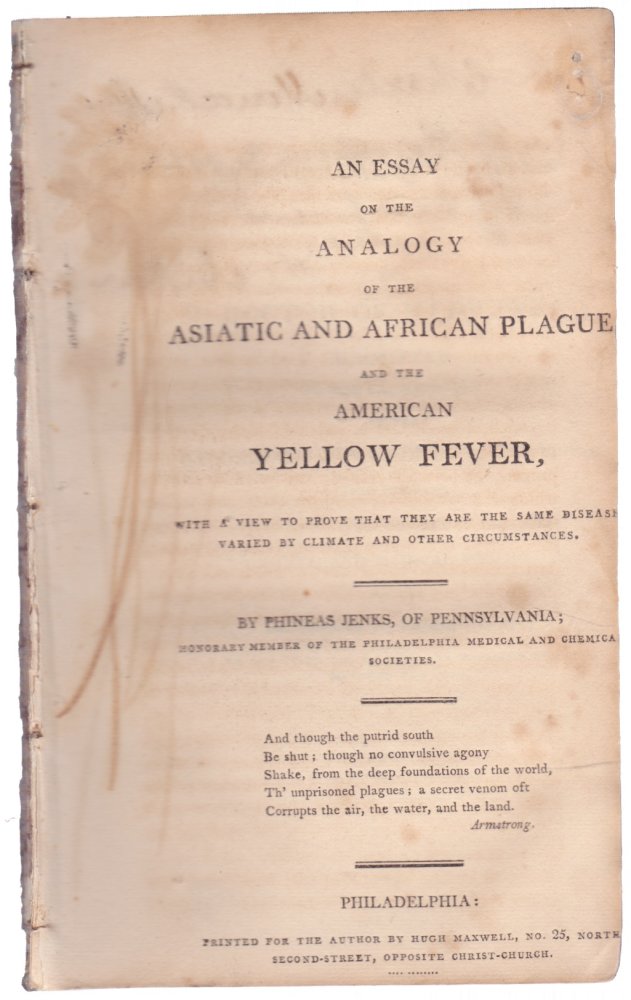
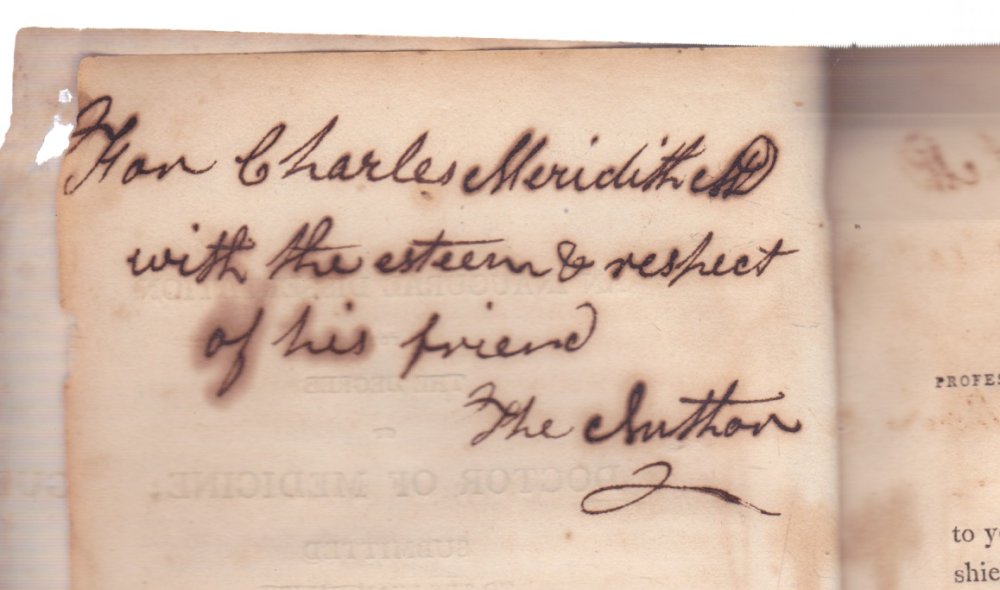
Softcover. Philadelphia, Printed for the author by Hugh Maxwell, 1st, 1804, Book: Very Good, Dust Jacket: None, Disbound paper pamphlet. 52 pages. With a view to prove that they are the same disease varied by climate and other circumstances. Jenks studied medicine with Dr. Benjamin Rush, graduating in 1804 with a diploma from the University of Pennsylvania. He began the practice of medicine under Dr. Isaac Chapman of Wrightstown Township. He was elected a junior member of the Philadelphia Medical Society in 1803. This was his thesis for his degree. Light foxing, this is the original printing extracted from a bound volume. INSCRIBED BY "THE AUTHOR" on a blank prelim page. Clean copy.
Softcover. University Park, Pennsylvania State University Press, 2nd pr., 2023, Book: Very Good, Dust Jacket: None, Softcover, 266 pages, b&w illustrations. INSCRIBED BY KELLEY on the title page. Lydia Hamilton Smith (1813-1884) was a prominent African American businesswoman in Lancaster, Pennsylvania, and the longtime housekeeper, life companion, and collaborator of the state's abolitionist congressman Thaddeus Stevens. In his biography of this remarkable woman, Mark Kelley reveals how Smith served the cause of abolition, managed Stevens's household, acquired property, and crossed racialized social boundaries. In the last years of Stevens's life, as his declining health threatened to short-circuit his work, Smith risked her own well-being to keep him alive while he led the drive to end slavery, impeach Andrew Johnson, and push for the ratification of the Thirteenth, Fourteenth, and Fifteenth Amendments. Clean copy.
Hardcover. NY, George Braziller , 1st, 1987, Book: Very Good, Dust Jacket: Very Good, Hardcover in a bright, unclipped dust jacket. A history of apartheid traces the institution back to its roots in the 17th century, and shows how it developed along with Afrikaner nationalism, as well as the response from the Africans.
Hardcover. Washington DC, Smithsonian Books, 1st, 2003, Book: Very Good, Dust Jacket: Very Good, Hardcover, 292 pages, color and b&w photos. The famous, the infamous, and the never-before-seen are here in a remarkable 'democracy of images' Amelia Earhart, Abraham Lincoln, P.T. Barnum and Tom Thumb, John Brown, Frederick Douglass, Lucille Ball, Greta Garbo, Babe Ruth; the earliest views of the moon and the earliest panoramic view of Damascus; rare Native American photography; views of Asia, Africa, and the American West; photographs of early flight, and much, much more. In a bright dust jacket.
Hardcover. Washington, Smithsonian Books, 1st, 2003, Book: Very Good, Dust Jacket: Very Good, 292 pages. Hardcover with dust jacket. Color and black and whote photos throughout. Clean, tight copy. The Smithsonian holds more than 13 million images spanning over 150 years of taking and collecting photographs. This largely unknown body of photography (most never before published) represents nothing less than the Smithsonian's effort, in the name of all Americans, to describe and comprehend the world. Open anywhere in these pages to be plunged into the history of our modernity, and see what the Smithsonian deemed important to document and preserve. The famous, the infamous, and the never-before-seen are here in a remarkable "democracy of images": Amelia Earhart, Abraham Lincoln, P.T. Barnum and Tom Thumb, John Brown, Frederick Douglass, Lucille Ball, Greta Garbo, Babe Ruth; the earliest views of the moon and the earliest panoramic view of Damascus; rare Native American photography; views of Asia, Africa, and the American West; photographs of early flight, and much, much more. By recording the act of seeing, and of what was seen, both photography and the Smithsonian have shaped our sense of ourselves, as individuals, as a people, and as a country.
Hardcover. Philadelphia, Lea & Blanchard, reprint, 1851, Book: Very Good, Dust Jacket: None, Hardcover, maroon boards with brown calf spine, title label on front cover. 21 double-page maps detailing the geography of ancient nations, featuring color country borders, extensive index. Maps include: Orbis Veteribus Notus; Britannia; Hispania; Gallia; Germania; Vindelicia; Italia, Pars I; Italia, Pars II; Macedonia; Graecia extra Pelo; Peloponnesus; Insulae Maris Aegaei; Asia Minor; Oriens; Syria; Palaestina; Armenia; Africa; Mauritania, Numidia and Africa Propria; and Aegyptus. Spine neatly re-inforced with clear tape, clean, bright copy.
Softcover. London, Bloomsbury, reprint, 2008, Book: Very Good, Softcover, 692 pages. Coursing through Austerity Britain is an astonishing variety of voices - vivid, unselfconscious, and unaware of what the future holds. A Chingford housewife endures the tribulations of rationing; a retired schoolteacher observes during a royal visit how well-fed the Queen looks; a pernickety civil servant in Bristol is oblivious to anyone's troubles but his own. An array of working-class witnesses describe how life in post-war Britain is, with little regard for liberal niceties or the feelings of their 'betters'. Many of these voices will stay with the reader in future volumes, jostling alongside well-known figures like John Arlott (here making his first radio broadcast, still in police uniform), Glenda Jackson (taking the 11+) and Doris Lessing, newly arrived from Africa, struck by the levelling poverty of postwar Britain. David Kynaston weaves a sophisticated narrative of how the victorious 1945 Labour government shaped the political, economic and social landscape for the next three decades.Deeply researched, often amusing and always intensely entertaining and readable, the first volume of David Kynaston's ambitious history offers an entirely fresh perspective on Britain during those six momentous years. Clean copy.
Softcover. NY, Franklin Watts, 1st, 1995, Book: Very Good, Dust Jacket: None, Softcover, 176 pages, b&w photos. The Contents are: Gentleman's Agreement - African Americans and Baseball's Beginning; A Ballplayer from Cooperstown - Post Reconstruction America and the Strange Career of Bud Fowler; False Spring - Fleet Walker and the Grudging Integration of the 1880s; Jim Crow Wins - Cap Anson Gets the Save; War Paint and Feathers - Jim Crow and Chief Tokohama; Second Class Immortals - Satchel Paige and the Black Babe Ruth; The Badge of Martyrdom - The Myth of Rickey and Robinson; and They Never Had It Made - from 1947 to Today; followed by Appendix: Professional Baseball Leagues Chronology; Glossary of Team Names; and an index. Clean copy.
Hardcover. 5 Continents, 1st, 2001, Book: Very Good, Dust Jacket: Very Good, Hardcover, 10" x 11.5", together with dust jacket, new, still in shrinkwrap. 196 pages, illustrated in color. Ceil Pulitzer started her journey as a collector of African art more than thirty years ago. Her artistic spirit has drawn her to all forms of culture and human expression across time and space. As a dedicated painter, she has relentlessly exercised her eye in the study of art and art history. As a collector of modern art first, she understood that African art shaped the trajectory of twentieth-century art. Later, in Paris, she met the venerable expert and legendary dealer of African art, Charles Ratton. In one brief meeting, he said to her: "You have a good eye." This encounter distilled her passion and pursuit of excellence in classical African art. The Ceil and Michael Pulitzer Foundation has developed and supported a number of philanthropic endeavors in Africa, and in major institutions that promote the art of Africa and humanitarian efforts there.
Hardcover. Princeton NJ, Princeton University Press, 1st, 2011, Book: Very Good, Dust Jacket: Very Good, Hardcover in a bright dust jacket. Small ink notation on front fly leaf otherwise clean. 320 pages with extensive notes and index. This book tracks the dramatic outcomes of the federal government's growing involvement in higher education between World War I and the 1970s, and the conservative backlash against that involvement from the 1980s onward. Using cutting-edge analysis, Christopher Loss recovers higher education's central importance to the larger social and political history of the United States in the twentieth century, and chronicles its transformation into a key mediating institution between citizens and the state. Framed around the three major federal higher education policies of the twentieth century--the 1944 GI Bill, the 1958 National Defense Education Act, and the 1965 Higher Education Act--the book charts the federal government's various efforts to deploy education to ready citizens for the national, bureaucratized, and increasingly global world in which they lived. Loss details the myriad ways in which academic leaders and students shaped, and were shaped by, the state's shifting political agenda as it moved from a preoccupation with economic security during the Great Depression, to national security during World War II and the Cold War, to securing the rights of African Americans, women, and other previously marginalized groups during the 1960s and '70s. Along the way, Loss reappraises the origins of higher education's current-day diversity regime, the growth of identity group politics, and the privatization of citizenship at the close of the twentieth century. At a time when people's faith in government and higher education is being sorely tested, this book sheds new light on the close relations between American higher education and politics.
Softcover. NY, Viking Press, reprint, 1971, Book: Very Good, Dust Jacket: None, Softcover, 306 pages, b&w illustrations. This book tries to tell where the Negroes came from, how they were enslaved in Africa, how they were purchased by sea captains, how they were packed into the hold like other merchandise (though with greater losses in transit), and how the survivors were sold in West Indian and American markets. Clean copy.
Softcover. Washington DC, Howard University Press, 1994, Book: Very Good, Dust Jacket: None, Softcover, 365 pages. Maps, illustrations, bibliography, index. A comparative social overview of slavery in Britain, America, and the Caribbean during the colonial period. Walvin carefully examines the external pressures exerted on coastal communities in Africa for slaves, the gradual development of a slave trading system within Africa, and the transport of over twelve million Africans across the seas. Clean copy. Several pages with dog-ear creases.
Softcover. Cambridge MA, Harvard University Press, reprint, 1998, Book: Very Good, Dust Jacket: None, Softcover, 310 pages, b&w illustrations. Few Americans, black or white, recognize the degree to which early African American history is a maritime history. W. Jeffrey Bolster shatters the myth that black seafaring in the age of sail was limited to the Middle Passage. Seafaring was one of the most significant occupations among both enslaved and free black men between 1740 and 1865. Tens of thousands of black seamen sailed on lofty clippers and modest coasters. They sailed in whalers, warships, and privateers. Some were slaves, forced to work at sea, but by 1800 most were free men, seeking liberty and economic opportunity aboard ship.Bolster brings an intimate understanding of the sea to this extraordinary chapter in the formation of black America. Because of their unusual mobility, sailors were the eyes and ears to worlds beyond the limited horizon of black communities ashore. Sometimes helping to smuggle slaves to freedom, they were more often a unique conduit for news and information of concern to blacks.But for all its opportunities, life at sea was difficult. Blacks actively contributed to the Atlantic maritime culture shared by all seamen, but were often outsiders within it. Capturing that tension, Black Jacks examines not only how common experiences drew black and white sailors together-even as deeply internalized prejudices drove them apart-but also how the meaning of race aboard ship changed with time. Bolster traces the story to the end of the Civil War, when emancipated blacks began to be systematically excluded from maritime work. Rescuing African American seamen from obscurity, this stirring account reveals the critical role sailors played in helping forge new identities for black people in America.
Hardcover. Boston, Little, Brown & Company, 1st, 1961, Book: Very Good, Dust Jacket: None, Hardcover, light mauve cloth with white lettering on spine, 311 pages with index. B&w illustrations, maps. Spine with light fading, book is clean, tight copy. Stated First Edition.
Hardcover. NY, Atheneum, 3rd pr., 1999, Book: Very Good, Dust Jacket: Very Good, Hardcover in a bright, unclipped dust jacket. In a clear, straightforward style, Katz describes the settlement of the Ohio and Mississippi Valleys (covering Ohio, Indiana, Illinois, Michigan, Wisconsin, Minnesota, Iowa, Kansas, and Missouri) by African Americans seeking freedom, including biographical sketches of men and women who formed churches, started schools, or were politically active in their region. Some of these settlers were fugitive slaves; several set up stations on the Underground Railroad with the aid of the Quakers; others were farmers, poets, and soldiers. In several states, they helped form black regiments in the Civil War. Chronologically arranged, the book introduces many lesser-known personages not found in most collective biographies and places them in a broader context of U.S. history as a whole.
Hardcover. NY, Atheneum, 3rd pr., 1999, Book: Very Good, Dust Jacket: Very Good, Hardcover in a bright, unclipped dust jacket. In a clear, straightforward style, Katz describes the settlement of the Ohio and Mississippi Valleys (covering Ohio, Indiana, Illinois, Michigan, Wisconsin, Minnesota, Iowa, Kansas, and Missouri) by African Americans seeking freedom, including biographical sketches of men and women who formed churches, started schools, or were politically active in their region. Some of these settlers were fugitive slaves; several set up stations on the Underground Railroad with the aid of the Quakers; others were farmers, poets, and soldiers. In several states, they helped form black regiments in the Civil War. Chronologically arranged, the book introduces many lesser-known personages not found in most collective biographies and places them in a broader context of U.S. history as a whole.
Hardcover. New York, Fox Duffield & Co., 1st, 1904, Book: Good, Dust Jacket: None, 350 pages, 13 pages of b&w photographs (12 African American portraits by A.L. Coburn). Textured blue cloth covers with dark blue lettering and ruled design. Some light soiling and wear to covers and spine. Internally clean, a few dog-eared pages.
Hardcover. NY, Norton, 1st, 2019, Book: Very Good, Dust Jacket: Very Good, Hardcover in a bright, unclipped dust jacket, 339 pages, b&w illustrations. The little-known story of an iconic photographer, whose work captured--and influenced--a critical moment in American history. Ernest Withers took some of the most legendary images of the 1950s and '60s: Martin Luther King, Jr., riding a newly integrated bus in Montgomery, Alabama; Emmett Till's uncle pointing an accusatory finger across the courtroom at his nephew's killer; scores of African-American protestors carrying a forest of signs reading "i am a man." But at the same time, Withers was working as an FBI informant. In this gripping narrative history, Preston Lauterbach examines the complicated political and economic forces that informed Withers's seeming betrayal of the people he photographed, and "does a masterful job of telling the story of civil rights in Memphis in the 1960s" (Ed Ward, Financial Times), including the events surrounding Dr. King's tumultuous final march in Memphis. Small remainder dot to top edge.
Softcover. Oxford UK, James Currey, 1st pbk, Book: Good, Dust Jacket: None, Softcover, 214 pages. This book explores the style and values of youth gangs in the Soweto area from the 1930s until the 1976 student-led uprising. It also tells the story of how the ANC, PAC, and Black Consciousness movement tried, and ultimately failed, to draw the volatile gangs into disciplined political activity. Mild shelf wear, clean copy.
Hardcover. Stichting Kunstboak , 1st, 2014, Book: Very Good, Dust Jacket: Very Good, Hardcover, 144 pages. Like new in publisher's shrink-wrap. Photography offers a thousand possible ways of looking at the society we live in. Foremost among the talents that have brought Calvin Dondo international recognition is the ability to put into his work all the respect he has for the individual identities of those he captures on film. This artist who reveals the nature of Zimbabwe today freely tells us of his country and the history concealed within it. This book presents a new world in which images are an essential component. This first monograph to be devoted to a contemporary Zimbabwean photographer will encourage others, for the excellent reason that it is time to look at Africa through the clearsighted viewfinder of those working on its development. Text in English, French, Dutch and German.
Hardcover. NY, Dodd, Mead & Company, 2nd pr., 1929, Book: Good, Dust Jacket: None, Hardcover, green cloth with gilt and black decoration, 321 pages. Illustrated with decorated endpapers (map) and vintage black and white photographs. Carl Than Akeley (1864-1926) was a taxidermist, naturalist and inventor was born near Clarendon, New York. Akeley would make five expeditions to Africa collecting specimens, first for the Field Museum in Chicago, and then for the American Museum of Natural History in New York. In 1911 he proposed to Henry Fairfield Osborn, president of the museum, a plan to present animal groups against painted backgrounds that would faithfully recreate the habitat which the animals lived. He had many adventures on the trips to Africa, including one where he was attacked by a leopard. Akeley died on his last expedition in his camp, near Mount Mikeno. This book is an account of Akeley's last expedition, and has a foreword by Henry Fairfield Osborn. The book is shaken and binding a little loose but holding, no loose pages. Previous owner's inscription on blank pelim page otherwise clean.
Hardcover. Berkeley CA, University of California Press, 1st, 2000, Book: Very Good, Dust Jacket: Very Good, Hardcover in a bright dust jacket, 112 pages. Schell, Orville [Foreword]; Parks, Gordon [Commentary]; Stepto, Robert B. [Commentary]. Shortly before the end of the Second World War, Wayne Miller was awarded a grant from the Guggenheim Foundation to photograph 'The Way of Life of the Northern Negro'." This project documented the wartime migration of African Americans northward, specifically looking at the black community on the south side of Chicago, covering all the emotions in daily life. The people depicted are mostly ordinary people, but some celebrities appear, such as Lena Horne, Ella Fitzgerald, Duke Ellington and Paul Robeson. He was a contributor to Magnum Photos beginning in 1958. Stamped name on front fly leaf, otherwise clean copy.