Hardcover. Washington DC, Smithsonian, 1st, 2003, Book: Very Good, Dust Jacket: Very Good, Hardcover, 260 pages. Working for the government's Farm Security Administration in the 1930s, photographers set out across the country to capture the human face of the Depression. Walker Evans' portraits of sharecroppers and Dorothea Lange's images of migrant families today stand as the most popular images from the FSA's project. Yet, in their own time, the pictures functioned as urgent, powerful reminders that one-third of the nation was in a real crisis. Focusing on these and other well-known FSA photographs, Finnegan examines how popular magazines constructed complex and often contradictory messages about poverty. Picturing Poverty also explores a moment in American history when visual images took center stage as the nation struggled with economic, political, and social strife. By striving to understand the original context of the photographs, Finnegan shines new light on the meanings of poverty, the Depression, and the various roles of the media. At once a persuasive analysis of FSA images and a balanced commentary on the role of the media, Picturing Poverty is above all a look into the difficult issue of how the mass media presents social issues to Americans.
Hardcover. New York, D. Appleton and Company, 1st, 1916, Book: Very Good, Dust Jacket: Very Good, 135 pages. Hardcover. Front cover and spine with black and white vertical stripes, and Black & white pastedown illustration. Features 6 black & white illustrations by E. W. Kemble. First edition with (1) at end of text. Dust jacket with light chipping, creasing along edges - jacket now protected with clear plastic cover. Clean, unmarked copy.
Softcover. Princeton Architectural Press, 1st, 2005, Book: Very Good, Dust Jacket: None, Softcover, 160 pages. The blue plate special, meatloaf, a cheeseburger deluxe, a milkshake in a frosty mixing canister, a hot cup of joe--all served by a friendly face in a well-lighted aluminum tube. Such are the special joys of the American diner. And it was just these pleasures that photographer Stephan Schacher set out to document when he left New York on a journey through North America that would test both his stomach and his resolve. Schacher's mission: to feed his hunger only at diners, and to photograph both his meal and his server every time. The result is a unique and deeply human story--quirky and nostalgic and generous--of one man's quest to discover North America's diner culture and his own place in it. Traveling from a Jersey diner to the Canadian Rockies to a shoreside clambake shack on the Pacific Ocean, Schacher's culinary adventure is documented here with a wealth of visual materials. The author's arresting photographs of succulent steaks and greasy fries, of smiling waitresses in uniforms or jeans, and brightly colored plastic dishes and table mats are supplemented by maps showing the photographer's route across the continent.
Softcover. New York, Princeton Architectural Press, 1st, 2005, Book: Very Good, Dust Jacket: None, 160 pages, color plates throughout. The blue plate special, meatloaf, a cheeseburger deluxe, a milkshake in a frosty mixing canister, a hot cup of joe--all served by a friendly face in a well-lighted aluminum tube. Such are the special joys of the American diner. And it was just these pleasures that photographer Stephan Schacher set out to document when he left New York on a journey through North America that would test both his stomach and his resolve. Schacher's mission: to feed his hunger only at diners, and to photograph both his meal and his server every time. The result is a unique and deeply human story--quirky and nostalgic and generous--of one man's quest to discover North America's diner culture and his own place in it. Traveling from a Jersey diner to the Canadian Rockies to a shoreside clambake shack on the Pacific Ocean, Schacher's culinary adventure is documented here with a wealth of visual materials. The author's arresting photographs of succulent steaks and greasy fries, of smiling waitresses in uniforms or jeans, and brightly colored plastic dishes and table mats are supplemented by maps showing the photographer's route across the continent.
Hardcover. NP, University of Alaska Press, 1st, 2009, Book: Very Good, Dust Jacket: Very Good, Hardcover, 204 pages, 192 b&w plates, map. This book is a window to the daily life and the environment of the Tikigaq, the Inupiaq people of Point Hope, Alaska, as seen in photographs taken by young Norwegian artist Berit Arnestad Foote from 1959 to 1962. In Berit Foote's days in Point Hope fifty years ago, the ice covered the sea in October and did not clear until July. In recent years, however, the Arctic ice has been changing rapidly, and so are the lives of people in Point Hope and across the North. This book--a call to action as well as a work of art--provides powerful documentation of how profoundly the entire fabric of a community's life and culture is affected by the ice that surrounds it.
Hardcover. New Haven CT, Yale University Press, 1st, 2008, Book: Very Good, Dust Jacket: Very Good, Hardcover, 192 pages. Reaching its pinnacle during the era of Marilyn Monroe and James Bond, Haight-Ashbury and Swinging London, Pop art reflected the ideals and aspirations of a generation. By the 1960s the movement's bold imagery and style had become inseparable from the new consumer culture. This important book looks at British and American Pop art through the lens of portraiture, providing a fresh perspective on the movement and its innovative artists. Blurring the boundaries between "high" and "low" culture, Pop artists including Andy Warhol, Roy Lichtenstein, Richard Hamilton, and Peter Blake elevated portraiture to a new position. Author Paul Moorhouse explores the artists' engagement with portraits; their shared fascination with fame; their use of images from advertisements, rock music, films, and print sources; and the ways in which the British and American schools of Pop evolved and influenced one another. Bringing together key works from the peak years of Pop, this extensively illustrated book demonstrates how the conventions of portraiture were redefined as Pop artists transformed familiar images into transcendent works of art.
Softcover. NY, Museum of Modern Art, 1st, 1999, Book: Very Good, Dust Jacket: None, Softcover, 136 pages. From the early 1960s through the early 70s, Pop Art swept the industrialized world. Iconoclastic, rebellious, and immediately popular, the new movement found its roots in an unprecedentedly prosperous consumer society. Encouraged by galleries and publishers who catered to a new collectors' market, many Pop artists were drawn to the creation of editions on paper and in multiples. 60 vibrant examples by such American icons as Andy Warhol and Roy Lichtenstein, and by such European artists as Richard Hamilton, Niki de Saint Phalle, Gerhard Richter, Eduardo Paolozzi, and Sigmar Polke, are organized according to the themes of mass media consumer culture, politics, erotica and more. All of the works included herein are from The Prints and Illustrated Books Collection at The Museum of Modern Art, New York, an exceptionally rich repository of such work.
Softcover. New York, Stewart, Tabori & Chang, 2nd printing, 1991, Book: Very Good, Dust Jacket: None, Softcover, 208 pages. Illustrated with black & white photographs by Charles Moore. Clean, tight copy.
Softcover. New York, Stewart, Tabori & Chang, 2nd printing, 1991, Book: Very Good, Dust Jacket: None, Softcover, 208 pages. Illustrated with black & white photographs by Charles Moore. Clean, tight copy.
Hardcover. NY, Zone Books, 1st, 2022, Book: Very Good, Dust Jacket: Very Good, Hardcover in a bright dust jacket, 214 pages. The philosopher and literary and cultural critic Samuel Weber returns to past narratives of plagues and pandemics to reproduce the myriad ways individual and collective, historical and actual, intentional and unintentional forces converge to reveal how cultures and societies deal with their vulnerability and mortality. The "preexisting conditions"-a phrase taken from the American healthcare industry-of these very cultures converge and collide with the urgent situations of individuals confronting the plague. Texts drawn from the Bible, Sophocles, Thucydides, Boccaccio, Luther, Defoe, Kleist, Holderlin, Artaud, and Camus demonstrate how in the process of narration individuals come to reconsider their relationship to others, to themselves, and to the collectives to which they belong and on which they depend. Clean copy.
Softcover. New York, Perigee Books, Reprint, 1981, Book: Very Good, Dust Jacket: None, 446 pages. Softcover with only light shelf wear to covers. Light marginal foxing to top edge. Clean, unmarked copy.
Hardcover. Los Angeles, J. Paul Getty Museum, 1st, 2012, Book: Very Good, Dust Jacket: Very Good, 164 pages. Like new in publisher's shrink-wrap. The high school prom is an American tradition, a rite of passage, and one of the most important rituals of youth in this country. The internationally recognized documentary photographer Mary Ellen Mark took on the extraordinary challenge of working with the Polaroid 20x24 Land camera to produce this fascinating look at dozens of young people from a diverse range of backgrounds on this memorable night in their lives. Traveling across the United States to complete the project from 2006 to 2009, Mark photographed prom-goers at thirteen schools from New York City to Charlottesville, Virginia, to Houston to Los Angeles. Mark's husband, the filmmaker Martin Bell, collaborated with her on the project to produce and direct a film, also called Prom, featuring interviews with the students about their lives, dreams, and hopes for the future. A DVD of the film is packaged with the book. The 127 large-format photographs are reproduced in rich detail, and quotations from the student interviews punctuate the book. Some of the students' statements are comical, while others are deeply touching. The result is a captivating and revealing document of American youth at the beginning of the twenty-first century.
Hardcover. Los Angeles, J. Paul Getty Museum, 1st, 2012, Book: Very Good, Dust Jacket: Very Good, 164 pages. Like new in publisher's shrink-wrap. The high school prom is an American tradition, a rite of passage, and one of the most important rituals of youth in this country. The internationally recognized documentary photographer Mary Ellen Mark took on the extraordinary challenge of working with the Polaroid 20x24 Land camera to produce this fascinating look at dozens of young people from a diverse range of backgrounds on this memorable night in their lives. Traveling across the United States to complete the project from 2006 to 2009, Mark photographed prom-goers at thirteen schools from New York City to Charlottesville, Virginia, to Houston to Los Angeles. Mark's husband, the filmmaker Martin Bell, collaborated with her on the project to produce and direct a film, also called Prom, featuring interviews with the students about their lives, dreams, and hopes for the future. A DVD of the film is packaged with the book. The 127 large-format photographs are reproduced in rich detail, and quotations from the student interviews punctuate the book. Some of the students' statements are comical, while others are deeply touching. The result is a captivating and revealing document of American youth at the beginning of the twenty-first century.
Hardcover. Chicago, Albert Whitman & Co., 1st, 1938, Book: Good, Dust Jacket: None, 64 pages. Hardcover. Full color and black & white illustrations by Carol Nay. Some light library stamping and notation - endpapers and at bottom right corner of page 25. Light wear. Clean, unmarked text.
Hardcover. New York, Sterling Publishing, 1st, 2005, Book: Very Good, Dust Jacket: Very Good, 183 pages. Hardcover. Full color illustrations. Light wear. Clean, tight copy. The term pulp fiction has always had a certain resonance; but it is the artwork--bold, energized, dramatic, garishly colorful, and frequently grotesque--that has made pulp magazines memorable to so many people. Pulp Art is the groundbreaking--and ultimate--book on one of America's most important and spectacular forms of illustration art. At last, preserved in this volume are most of the still-existing originals created for the pulp covers, never before seen in all their sharply focused, vibrantly colored brilliance. Robert Lesser, a pioneering collector of this work and an expert on American popular culture, has assembled a gallery of these now-priceless originals. The dynamically pulp-flavored text is a complete historical survey of the pulps and their most important cover artists--Virgil Finlay, J. Allen St. John, Rafael de Soto, Hannes Bok, George and Jerome Rozen, Frank R. Paul, and many others. Also offered are critical discussions of individual paintings, as well as the major themes of the pulp magazines.
Hardcover. NY, W W Norton & Co, 1st, 2003, Book: Very Good, Dust Jacket: Very Good, Hardcover in a bright dust jacket, 608 pages. A startling anecdotal history of gay life in twentieth-century New York explores the confluence of historical and social factors that made Manhattan a mecca for homosexuals in the second half of this century.
Hardcover. Seattle, WA, Fantagraphics, 1st, 2016, Book: Very Good, Dust Jacket: Very Good, 256 pages. Hardcover with dust jacket. Clean, unmarked copy with only minor wear to dust jacket. Black and white pictures throughout. Founded by Paul Krassner, "The Realist" was a satirical magazine that took aim at American culture during the period of 1958 to 2001. Paul Krassner collaborates with Fantagraphics to create a collection of the best of "The Realist" drawings with contributions by R. Crumb, Art Spiegelman, S. Clay Wilson, Jay Lynch, Wallace Wood and others. Illustrated front board, 291 pages plus annotations, black/white and 2-color images. Volume numbers and year published accompanies each cartoon.
Hardcover. Hampton, VA, Hampton Institute Press, 1st, 1927, Book: Very Good, Dust Jacket: Poor, Hardcover, dark blue cloth with gilt lettering on front cover and spine, 236 pages plus appendix. A scarce collection of traditional hymns, gospel, folk songs and "Songs of Tribulation" of the American Negro. An historical document of African-American culture and the history of slavery. Songs in musical score with lyrics. A tight, generally unmarked and clean volume with nice cloth and clear gilt, In a poor dust jacket with chipping and tape repairs. Name on front fly leaf otherwise clean.
Hardcover. Madison WI, University of Wisconsin Press, 1st, 1989, Book: Very Good, Dust Jacket: Good, Hardcover in a lightly worn dust jacket with fading to the spine. "Cary Nelson performs an invaluable service to the reader by recovering the work of dozens of forgotten poets, especially women, blacks, and writers on the left, while making it clear that the texts we recover inevitably gain new meaning from their positioning within contemporary culture." Nicely illustrated in b&w and some color, mostly book jackets and title pages of books discussed. Some light pencil marking in margins.
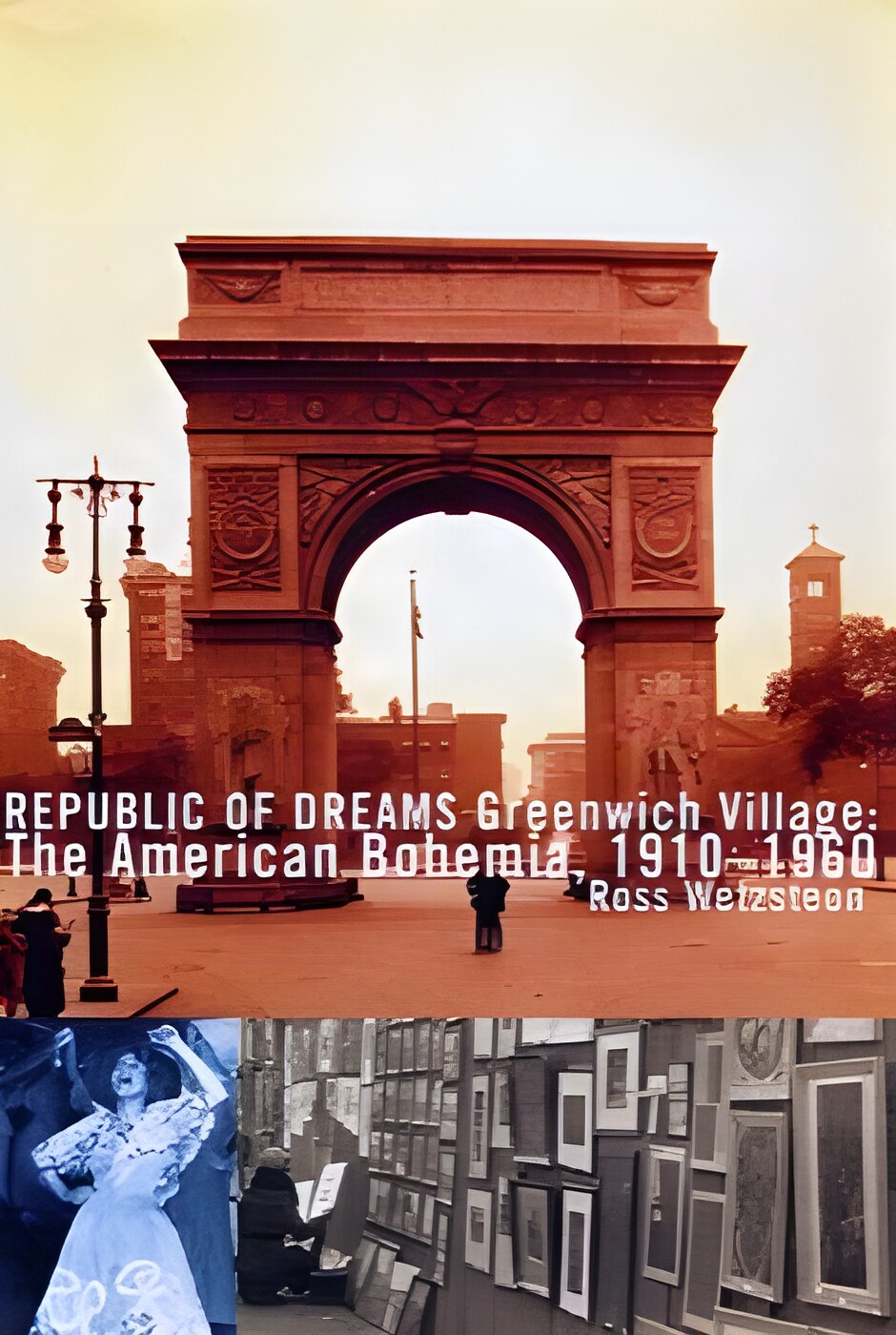
Hardcover. NY, Simon & Schuster, 1st, 2002, Book: Very Good, Dust Jacket: Very Good, Hardcover in a bright, unclipped dust jacket. A thoughtful history of the legendary New York City neighborhood chronicles the Village's role as a bohemian enclave that became the home of and transformed the lives of such individuals as Edna St. Vincent Millay, Emma Goldman, Eugene O'Neill, Margaret Sanger, and Thomas Wolfe, who came to the neighborhood to pursue individual artistic, personal, and political dreams. Clean copy.
Softcover. NY, Thunder's Mouth Press, reprint, 2005, Book: Very Good, Dust Jacket: None, Softcover, 259 pages. While the supremely popular Steal This Book is a guide to living outside the establishment, Revolution for the Hell of It is a chronicle of Abbie Hoffman's radical escapades that doubles as a guidebook for today's social and political activist. Hoffman pioneered the use of humour, theatre, and shock value to drive home his points, and in Revolution for the Hell of It he gives firsthand accounts of his legendary adventures, from the activism that led to the founding of the Youth International Party,or Yippies!, to the 1968 Democratic National Convention protests ("a Perfect Mess") that resulted in his conviction as part of the Chicago Seven. Clean. bright copy.
NY, Abrams Press, 1st, 2020, Book: Very Good, Dust Jacket: Very Good, Hardcover in a bright dust jacket. 380 pqges, color and b&w photos. An action-packed memoir that takes readers on the road with rock and roll's hardest-working photographer. Bob Gruen is one of the most well-known and connected photographers in rock and roll. For almost 50 years, he has documented the music scene in pictures that have captured the world's attention. Right Place, Right Time is Gruen's first written account of his winding, adventure-filled journey. He takes us on visits to John and Yoko's apartment, on a cross-country road trip with the Ike and Tina Turner band, to Glasgow with Debbie Harry, backstage with KISS, inside CBGB, and on the bus as he swaps steel-toed boots with Sid Vicious. In wildly entertaining stories and iconic images, Gruen gives the reader a unique window into the evolution of American music culture over the last five decades.
Hardcover. New York, Simon & Schuster, 1st, 1983, Book: Very Good, Dust Jacket: Very Good, SIGNED BY JOAN DIDION on front flyleaf. 108 pages. Hardcover with dust jacket. Clean, unmarked copy with some slight shelfwear. Corner fold on dust jacket front inside flap.Otherwise tight copy. Salvador is a 1983 book-length essay by Joan Didion on American involvement in El Salvador.
Hardcover. NY, Little, Brown and Company, 1st, 2015, Book: Very Good, Dust Jacket: Very Good, Hardcover in a bright, unclipped dust jacket, 763 pages, b&w illustrations. From the author of the critically acclaimed Elvis Presley biography: Last Train to Memphis brings us the life of Sam Phillips, the visionary genius who singlehandily steered the revolutionary path of Sun Records. The music that he shaped in his tiny Memphis studio with artists as diverse as Elvis Presley, Ike Turner, Howlin' Wolf, Jerry Lee Lewis, and Johnny Cash, introduced a sound that had never been heard before. He brought forth a singular mix of black and white voices passionately proclaiming the vitality of the American vernacular tradition while at the same time declaring, once and for all, a new, integrated musical day. With extensive interviews and firsthand personal observations extending over a 25-year period with Phillips, along with wide-ranging interviews with nearly all the legendary Sun Records artists, Guralnick gives us an ardent, unrestrained portrait of an American original as compelling in his own right as Mark Twain, Walt Whitman, or Thomas Edison.

 "Picturing Poverty: Print Culture and FSA Photographsby: Cara A. Finnegan")
 "Plantation Songsby: Stuart, Ruth McEnery")

 "Plates and Dishes: The Food and Faces of the Roadside Dinerby: Schacher, Stephan")
 "Point Hope, Alaska: Life on Frozen Waterby: Foote, Berit Arnestad")

 "Pop Impressions Europe/USA: Prints and Multiples from the Museum of Modern Artby: Wendy Weitman")
 "Powerful Days - The Civil Rights Photography of Charles Mooreby: Moore, Charles/Michael S. Durham")


 "Primal Scream, The - Priamal Therapy - The Cure for Neurosisby: Janov, Arthur")
 "Promby: Mark, Mary Ellen/ Martin Bell (Contributor)")
 "Promby: Mark, Mary Ellen")
 "Pueblo Playmatesby: Brown, Marjorie Webber/Carol Nay")
 "Pulp Art - Original Cover Paintings for the Great American Pulp Magazinesby: Lesser, Robert")
 "Queer Street: The Rise and Fall of an American Culture, 1947-1985by: McCourt, James")
 "Realist Cartoons, Theby: Persoff, Ethan (Editor)")
 "Religious Folk Songs of the Negro as Sung at Hampton Institute by: Dett, R. Nathaniel")
 "Repression And Recovery: Modern American Poetry & Politics Of Cultural Memory 1910-1945by: Cary Nelson")

 "Right Place, Right Time: The Life of a Rock & Roll Photographerby: Bob Gruen")


 "Salvador (SIGNED COPY)by: Didion, Joan")
 "Sam Phillips: The Man Who Invented Rock 'n' Rollby: Peter Guralnick")