Hardcover. Germany , Steidl, 1st, 2010, Book: Very Good, Dust Jacket: None, 156 pages. Hardcover with no dust jacket. Very clean, unmarked copy with only minor edgewear. Color photographs throughout. In the early 1970s, the workers at a steel smelting factory east of Havana wrote to Fidel Castro describing their housing needs. Out of this exchange a new city called Alamar was born, conceived by the same workers who would build it and live there. Today it is abandoned; Mauro D'Agati's photographs examine its eccentric spaces.
Hardcover. Edition Stemmle, 1st, 2001, Book: Very Good, Dust Jacket: Very Good, Hardcover, 136 pages. Bauhaus photography is well served by this first monograph on Max Baur, with many of the previously unpublished photographs also serving as a new source for Bauhaus studies. Working in Germany, at first providing images for postcards, Baur expanded his efforts to encompass landscape, portrait, and architectural images. In each of these genres, his work reflects the cool, objective approach of the Bauhaus style combined with the artist's elegant handling of light and perspective. In photos of stairways and colonnades, factories, and everyday objects, Baur was able to eliminate the extraneous and offer the essential nature of his subject. The book covers a period of vast changes in the world and in the life of the artist, but throughout there is a consistency of vision. An essay by William Ewing, director of the Mus e de l'Elys e (which specializes in photography), gives a brief description of the life and career of Baur with enthusiasm and warmth, while Edelmann-Pomplitz writes movingly about her experience as his student. In a letter to her, Baur expresses his credo most eloquently: "it is with light alone that we create images." This lovely work is a fine example of excellent printing and composition in harmony with content.
Softcover. Munich, Germany, Saint Louis Art Museum, 1st, 1984, Book: Near Fine, Dust Jacket: None, Softcover exhibition catalog, 482 pages, many illustrations, over 100 in color. Extensive survey of paintings, drawings, watercolors and prints. Includes biography, bibliography and the index of names and paintings. Published on the occasion of the exhibition from the Haus der Kunst, Munich February 25-April 23, 1984 which moved on to St. Louis and Los Angeles. Clean. bright copy.
Hardcover. Potsdam, Germany, H.F. Ullmann, 1st, 2012, Book: Very Good, Dust Jacket: Very Good, Hardcover in a bright dust jacket, 512 pages, illustrated in color, b&w. Like new in publisher's shrink-wrap. A retrospective of the most important developments and highlights in design of the past 100 years, beginning with the latest trends for 2011. Concise texts accompanying the individually featured designs, as well as excurses on selected themes and styles written by experts, round off this benchmark illustrated book. PLEASE NOTE: DUE TO WEIGHT, DOMESTIC SHIPPING ONLY.
Hardcover. New Haven CT, Yale University Press, 1st, 2020, Book: Very Good, Dust Jacket: None, Hardcover, Original black lettered cloth quarter laid on pictorial boards, 184 pages. A fascinating exploration of how photography, graphic design, and popular magazines converged to transform American visual culture at mid-century. This dynamic study examines the intersection of modernist photography and American commercial graphic design between 1930 and 1960. Avant-garde strategies in photography and design reached the United States via European emigres, including Bauhaus artists forced out of Nazi Germany. The unmistakable aesthetic made popular by such magazines as Harper's Bazaar and Vogue--whose art directors, Alexey Brodovitch and Alexander Liberman, were both immigrants and accomplished photographers--emerged from a distinctly American combination of innovation, inclusiveness, and pragmatism. Beautifully illustrated with more than 150 revolutionary photographs, layouts, and cover designs, Modern Look considers the connections and mutual influences of such designers and photographers as Richard Avedon, Lillian Bassman, Herbert Bayer, Robert Frank, Lisette Model, Gordon Parks, Irving Penn, Cipe Pineles, and Paul Rand. Essays draw a lineage from European experimental design to innovative work in American magazine design at mid-century and offer insights into the role of gender in fashion photography and political activism in the mass media.
Hardcover. Munch/London/NY, Prestel, 1st, 2022, Book: Very Good, Dust Jacket: Very Good, Hardcover in a bright dust jacket. Still in publisher's shrinkwrap. 656 pages. Published on the twentieth anniversary of the founding of Neue Galerie New York, this stunning volume celebrates the varied achievements of modern art history in the German-speaking world by examining historical developments in Austria and Germany from 1890 to 1940. Illustrated throughout with exquisite reproductions of the museum's holdings, this book considers the influence of Friedrich Nietzsche and his writings on the fine arts and examines the founding of the Secessionist artists' organizations in Germany and Austria. Insightful essays trace the emergence of Expressionism and abstraction, as well as the development of such movements as Dada and New Objectivity. Evolutions in architecture and design are appraised through the legacy of the Arts and Crafts movement, as well as the establishment of the Darmstadt Artists' Colony and the Wiener Werkstatte. The book also examines the role of the German Werkbund and the founding of the Bauhaus school. Finally, the book briefly addresses the horrific impact of the National Socialists' degenerate art campaign, which resulted in incalculable damage and led to the exile and death of artists and designers of the era. From well-known artists such as Otto Dix, Josef Hoffmann, Vasily Kandinsky, Gustav Klimt, and Egon Schiele, to lesser recognized but equally important figures, including Albert Birkle, Alfred Kubin, Felix Nussbaum, and Dagobert Peche, this book offers an authoritative and kaleidoscopic look at a crucial moment in history and a portrait of radical thought that changed forever the way we experience art in our lives. DOMESTIC SHIPPING ONLY.
Hardcover. New Haven CT, Yale University Press, 1st, 2011, Book: Very Good, Dust Jacket: Very Good, Hardcover in a bright, unclipped dust jacket, 336 pages. Despite the apparent incompatibility between Mozart's humanitarian and cosmopolitan outlook and Nazi ideology, the Third Reich tenaciously promoted the great composer's music to further the goals of the fascist regime. In this revelatory book, Erik Levi draws on period articles, diaries, speeches, and other archival materials to provide a new understanding of how the Nazis shamelessly manipulated Mozart for their own political advantage. The book also explores the continued Jewish veneration of the composer during this period while also highlighting some of the disturbing legacies of Mozart reception that resulted from Nazi appropriation of his work. Augmented by rare contemporary illustrations, Mozart and the Nazis will be widely welcomed by readers with interests in music, German history, Holocaust studies, propaganda, and politics in the twentieth century. Clean copy.
Softcover. Middlebury, VT, Middlebury College Museum of Art, 1st, 2015, Book: Very Good, Dust Jacket: None, 116 pages. Softcover. A very clean, unmarked copy with only minor edgewear. Color illustrations throughout.
Hardcover. Germany, Moderne Kunst Nurnberg, 1st, 2011, Book: Very Good, Dust Jacket: None, 168 pages. Hardcover no dust jacket. Like new in publisher's shrink-wrap. The animated films of Nathalie Djurberg (born 1978) won the artist a Silver Lion at the 2009 Venice Biennale. Her films animate figurines made of cloth and plasticine in a puppet/marionette theater of macabre sexual intrigue. Here, Djurberg's films are accompanied by Hans Berg's musical compositions.
Hardcover. Germany, Moderne Kunst Nurnberg, 1st, 2011, Book: Very Good, Dust Jacket: None, 168 pages. Hardcover no dust jacket. Like new in publisher's shrink-wrap. The animated films of Nathalie Djurberg (born 1978) won the artist a Silver Lion at the 2009 Venice Biennale. Her films animate figurines made of cloth and plasticine in a puppet/marionette theater of macabre sexual intrigue. Here, Djurberg's films are accompanied by Hans Berg's musical compositions.
Hardcover. Ostfildern GR, Hatje Cantz, 1st, 2005, Book: Very Good, Dust Jacket: None, Hardcover in pictorial boards. 60 pages, 15 color and 1 b&w illustration. Text in German and English. With a chronology. This is the hardbound catalogue published in conjunction with noted Leipzig-based artist Neo Rauch's 2004 exhibition of recent large scale works on paper held at Vienna's Albertina. Essay by Harald Kunde.
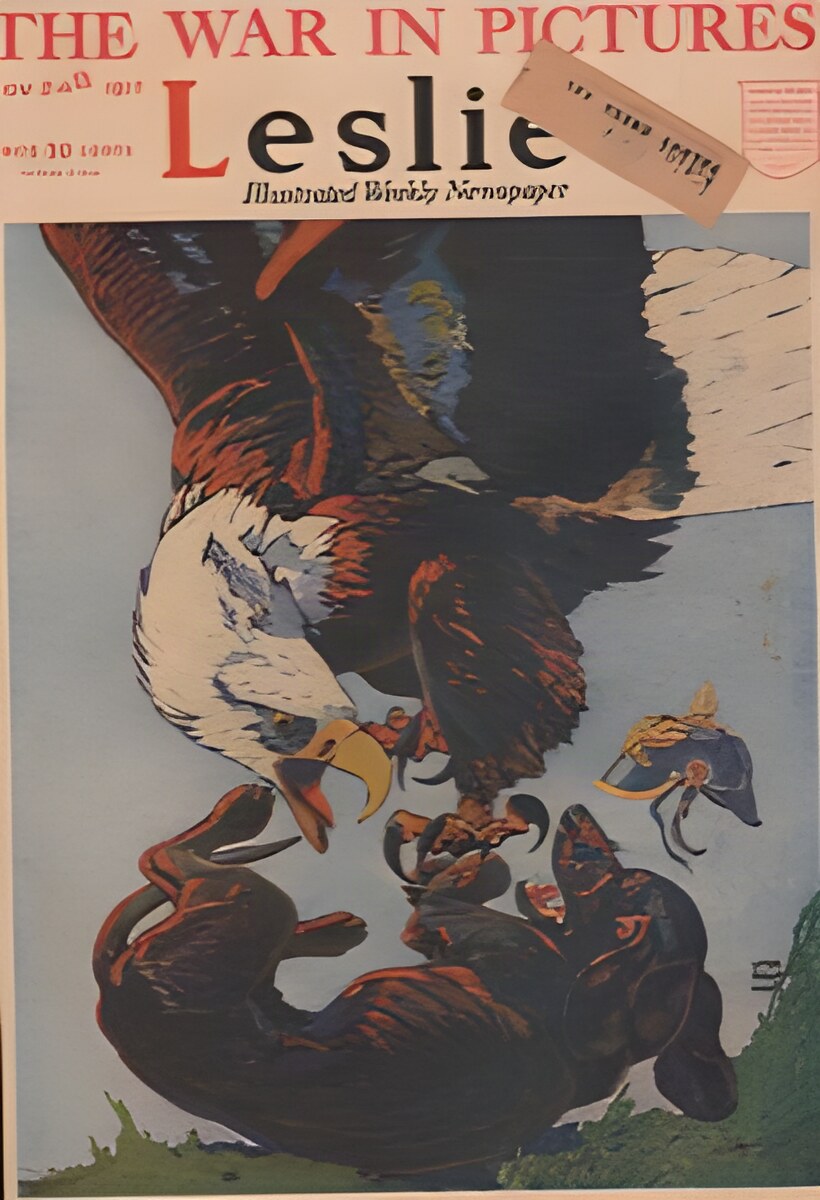
Eagle attacking dachshund, America vs, Germany WW1 allegory. Art by Lynn Bogue Hunt, 10.5 x 14", very good. Mailing label. PLEASE NOTE: The image shown is a scan of the actual product you are purchasing. What you see is what you get. The sheet may have some imperfections beyond the cropped area shown. You are buying THIS PAGE ONLY- not the entire magazine. Your order will be placed carefully between stiff paper and an acetate overlay, then packed in a rigid cardboard sleeve to prevent bending.
Hardcover. Germany, Hatje Cantz Publishers, 1st, 2000, Book: Very Good, Dust Jacket: Very Good, 303 pages. Hardcover with dust jacket. Clean, unmarked copy with only minor wear to dust jacket. Color and Black and white pictures throughout. This catalogue raisonne of Picasso's lithographic work contains 855 pieces with entries for every printed sheet as an individual work, including test and state printings, and unpublished sheets. Scholarly essays from various contributors. Light fraying to bottom spine cover.
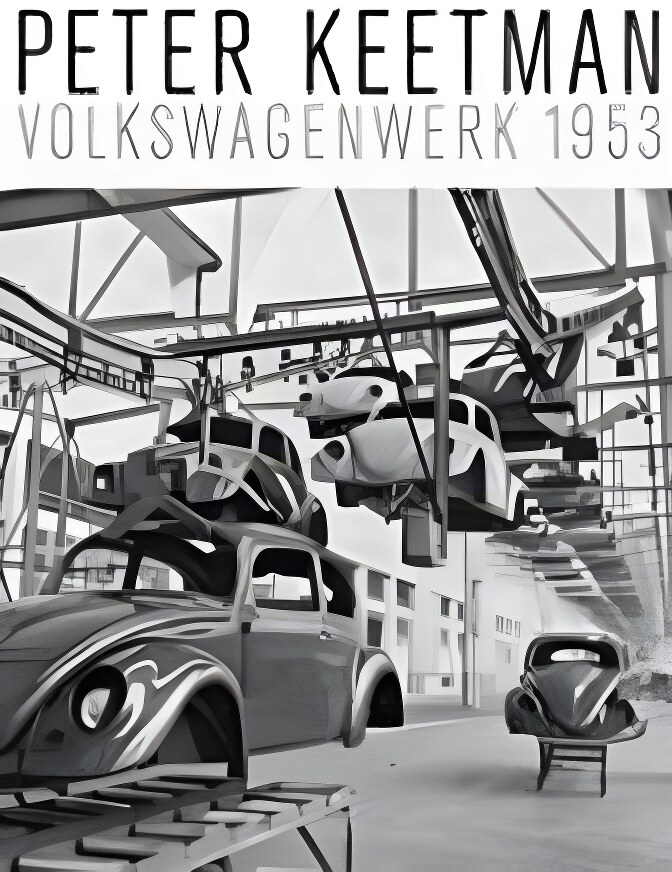
Hardcover. Kerber, 1st, 2004, Book: Very Good, Dust Jacket: Very Good, Hardcover, 176 pages. In 1953, Peter Keetman spent a week at the Volkswagen plant in Wolfsburg. The result was a series of exceptionally clear, almost abstractly detailed photographs that document the entire production process of the VW Beetle. Storage stacks of shiny metal bumpers look like so many Modernist sculptures; car bodies hovering above the assembly line retrospectively form a surreal Pop art montage. This oversize publication reproduces the Volkswagenwerk series in full, in their original size, together with texts that refer both to this series and to Keetman's greater oeuvre. Keetman was known throughout his career as photographer of systemically conceived picture series on themes that included close-ups of water and oil drops, a style of working he developed as a member of Fotoform. Fotoform, a German movement of the 1950s of which Keetman was a primary proponent, was critical in the development of German photography as it is today: the group's "subjective photography" combined scientific objectivity with abstraction. PLEASE NOTE: DUE TO SIZE & WEIGHT, DOMESTIC SHIPPING ONLY.
Hardcover. Cambridge MA, The MIT Press, 1st, 1990, Book: Very Good, Dust Jacket: Very Good, 362 pages, hardcover in a bright dust jacket. Generously illustrated account [435 b/w photo reproductions] of the photogrphy produced by various well-known Bauhaus associates such as Laszlo Moholy-Nagy, Lucia Moholy, T. Lux Feininger, Florence Henri, Herbert Bayer, and others during the mid-1920s and early 1930s. An invaluable compilation of images and information about the work of this dynamic group of artists, designers, photographers and their students who had such an important impact on Western aesthetics and culture throughout the subsequent decades of the 20th century.
Hardcover. Lexington KY, University Press of Kentucky, 1st, 2014, Book: Very Good, Dust Jacket: Very Good, Hardcover, 320 pages, in a bright unclipped dust jacket, b&w illustrations. Pola Negri (1897-1987) rose from an impoverished childhood in Warsaw, Poland, to become one of early Hollywood's greatest stars. After tuberculosis ended her career as a ballerina in 1912, she turned to acting and worked under legendary directors Max Reinhardt and Ernst Lubitsch in Germany. Negri preceded Lubitsch to Hollywood, where she quickly became a fan favorite thanks to her beauty, talent, and diva personality. Known for her alluring sexuality and biting artistic edge, she starred in more than sixty films and defined the image of the cinematic femme fatale. Author Mariusz Kotowski brings the screen siren's story to English-speaking audiences for the first time in this fascinating biography. At the height of her fame, Negri often portrayed exotic and mysterious temptresses, headlining in such successes as The Spanish Dancer (1923) and Forbidden Paradise (1924), before returning to Europe in the 1930s. The devastating effects of World War II soon drove her back to the United States, where she starred in Hi Diddle Diddle (1943) and pursued her vaudeville career before retiring from the entertainment industry. Kotowski also illuminates Negri's dramatic personal life, detailing her numerous love affairs-including her engagement to Charlie Chaplin and her romance with Rudolph Valentino-as well as her multiple marriages. This long-overdue biography not only paints a detailed portrait of one classic Hollywood's most intriguing stars and the film industry's original Jezebel, but also explores the link between Hollywood and European cinema during the interwar years.
Softcover. New York, Rizzoli, 1st US, 1983, Book: Very Good, Dust Jacket: Very Good, Hardcover, 302 pages. Blue cloth cover with gilt lettering to spine, color illustrated dust jacket, 405 b&w and 80 color illustrations, stapled cardboard slipcase. Bottom right corner of cover slightly bumped. Very light wear to dust jacket edges; a very clean, tight copy. This book is the first to survey the whole i development of porcelain n Europe between the Napoleonic era and the First World War. The nineteenth century was a period of technological change and of artistic innovation: both these strands came together in the development of porcelain, which industrialization brought within the reach of the burgeoning middle classes of industrial Europe. While early in the century Neoclassicism had brought about a new purity of line and decoration, in Germany and in England taste demanded more elaborate styles and resulted in the emergence of the 'new Rococo' and later in the development of revived styles of decoration such as Minton's 'Majolica' and the work of studio potters. This book covers not only the great factories, Sevres, Limoges, Copenhagen, Meissen, but also the smaller producers in Holland, Italy and Spain and extends to the birth of Art Nouveau.
Hardcover. Germany, Steidl Publishers, 1st, 2008, Book: Very Good, Dust Jacket: None, 295 pages. Hardcover with no dust jacket. A clean, unmarked copy with only minor edgewear. Minor yellowing to textblock edges. Black and white photographs throughout. Richard Avedon, America's preeminent portraitist and fashion photographer, photographed the many faces of politics throughout his career. Portraits of Power brings together Avedon's political portraits for the first time. Juxtaposing images of elite government, media and labor officials with counter-cultural activists, writers and artists, as well as ordinary citizens caught up in national debates, it offers a five-decade taxonomy of politics and power by one of America's best-known artists. The book features several of Avedon's extended projects addressing these themes, including coverage of the civil rights debate in the early 1960s (published in 1964 in Nothing Personal); the American anti-war movement and the war in Vietnam from 1969-1971; portraits of the American power elite in 1976, produced for his groundbreaking Rolling Stone portfolio "The Family;" "Exiles: The Kennedy Court at the End of the American Century," a retrospective homage to the Camelot generation published in the New Yorker in 1993; and his final photo-essay, "Democracy," surveying the national mood during the politically fractious period prior to the 2004 presidential elections (published posthumously in the New Yorker in 2004).
Softcover. London, Imperial War Museums, 1st, 2014, Book: Very Good, Dust Jacket: None, 96 pages. Softcover. Very clean, unmarked copy with only minor edgewear. Posters of the First World War collects more than one hundred posters from America, Britain, France, Germany, and Italy that showcase renewed concern among the warring nations with national character and conduct.
Softcover. Germany, Steidl, 1st, 2015, Book: Very Good, Dust Jacket: None, 224 pages. Softcover. Very clean, unmarked copy still in publishers shrink-wrap. Adieu Saigon covers a varied range of imagery from Saigon, where Depardon photographed two wars and, on visits as recent as 2014, the unrecognizable, globalized city now called Ho Chi Minh. Depardon's work bears witness to a city in transition.
Softcover. Germany, Steidl, 1st, 2015, Book: Very Good, Dust Jacket: None, 224 pages. Softcover. Very clean, unmarked copy still in publishers shrink-wrap. Adieu Saigon covers a varied range of imagery from Saigon, where Depardon photographed two wars and, on visits as recent as 2014, the unrecognizable, globalized city now called Ho Chi Minh. Depardon's work bears witness to a city in transition.
Softcover. Durham NH, University of New Hampshire, 1st, 1995, Book: Very Good, Dust Jacket: None, Softcover, original publisher's sewn paperback, pictorial frontcover, square format, 78 pages, 13 text-illustrations, catalogue of 72 items depicted and described, credits.
Hardcover. Zurich, Scalo, 1st, 2000, Book: Very Good, Dust Jacket: Very Good, Hardcover in a bright dust jacket, 104 pages. In 1999, acclaimed German multimedia artist Rebecca Horn created Concert for Buchenwald, a large-scale, two-part installation in Weimar/Germany commemorating the horrors of genocide and emigration. This darkly intense work evokes both the shoah and the mass murders in former Yugoslavia. The first part of the installation is set in an abandoned train depot. Its walls are lined with glass panes behind whose shiny surfaces you can make out layer upon layer of ashes. Running alongside one of the walls, railroad tracks are blocked up by densely entangled heaps of various stringed instruments, reminiscent of the piles of corpses that were discovered in Buchenwald. The second part of Concert for Buchenwald is installed in Schloss Ettersburg, an 18th century palatial residence. Here, the humming sound of panicked bees is audible from hives suspended from the ceiling of an opulent ballroom, and suggests memories of expulsion and escape. This book includes several essays that explore various aspects and interpretations of Horn's installation, as well as her own notes tracing the origins of the installation's prominent metaphors. Essays by Doris von Drahten, Boris Groys, Rebecca Horn, Bernd Kauffmann, and Martin Mosebach. Clean copy.

 "Mauro D'Agati: Alamarby: D'Agati, Mauro (Photographer)")
 "Max Baur: In the Bauhaus Spirit: Photographs 1925-1960by: Stephan Steins")
 "Max Beckmann")
 "Mel Ramos: I Love Womenby: Gardner, Belinda")

 "Modern Look: Photography and the American Magazine by: Klein, Mason")
 "Modern Worlds: Austrian and German Art, 1890-1940by: Price, Renee / Lauder, Ronald S./Peters, Olaf/ Staggs, Janis")


 "Mozart and the Nazis: How the Third Reich Abused a Cultural Iconby: Erik Levi")
 "Naked Truth: The Body in Early Twentieth-Century German-Austrian Artby: Garrison, Eliza")
 "Nathalie Djurberg & Hans Berg: Snakes Knows It's Yogaby: Fonnesbach, Pernille")
 "Nathalie Djurberg & Hans Berg: Snakes Knows It's Yogaby: Fonnesbach, Pernille")
 "Neo Rauch: Works on Paper 2003-2004/Arbeiten auf Papier by: Neo Rauch and Klaus Albrecht Schroder, Harald Kunde")
 "Pablo Picasso: The Lithographsby: Reusse, Felix (Compiler)")
 "Photography at The Bauhausby: Fiedler, Jeannine")
 "Pola Negri: Hollywood's First Femme Fataleby: Kotowski, Mariusz")
 "Porcelain of the Nineteenth Centuryby: Fay-Halle, Antoinette and Barbara Mundt")
 "Portraits of Powerby: Richard Avedon")
 "Posters of the First World Warby: Slocombe, Richard")
 "Raymond Depardon: Adieu Saigonby: Depardon, Raymond")
 "Raymond Depardon: Adieu Saigonby: Depardon, Raymond")
 "Realism and Invention in the Prints of Albrecht Durerby: David R Smith, Liz Guenther")


 "Rebecca Horn: Concert for Buchenwald by: Horn, Rebecca")