Hardcover. Princeton NJ, Princeton University Press, 1st, 2020, Book: Very Good, Dust Jacket: Very Good, Hardcocer in a bright dust jacket, 257 pages plus 143 b&w pages of photographs in the front of the book. Walker Evans (1903-75) was a great American artist photographing people and places in the United States in unforgettable ways. He is known for his work for the Farm Security Administration, addressing the Great Depression, but what he actually saw was the diversity of people and the damage of the long Civil War. In Walker Evans, renowned art historian Svetlana Alpers explores how Evans made his distinctive photographs. Delving into a lavish selection of Evans's work, Alpers uncovers rich parallels between his creative approach and those of numerous literary and cultural figures, locating Evans within the wide context of a truly international circle. Alpers demonstrates that Evans's practice relied on his camera choices and willingness to edit multiple versions of a shot, as well as his keen eye and his distant straight-on view of visual objects. Illustrating the vital role of Evans's dual love of text and images, Alpers places his writings in conversation with his photographs. She brings his techniques into dialogue with the work of a global cast of important artists--from Flaubert and Baudelaire to Elizabeth Bishop and William Faulkner--underscoring how Evans's travels abroad in such places as France and Cuba, along with his expansive literary and artistic tastes, informed his quintessentially American photographic style.
Hardcover. New York , Basic Books, 1st, 1999, Book: Very Good, Dust Jacket: Very Good, Hardcover, 651 pages, landmark biography of photographer Walker Evans, once labeled a propagandist, but in reality, was an observer of the true nature of things. Based on unrestricted access to all of Evan's diaries, letters, work logs and contact sheets as well as the diaries of Lincoln Kirstein. Clean copy in an unclipped dust jacket.
Hardcover. NY, PowerHouse Books, 1st, 2007, Book: Very Good, Dust Jacket: Very Good, Hardcover in a bright dust jacket, 263 pages. Personal history and intimate memoir by the wife of the great American artist. 50 duotone photographs and over a dozen by Walker Evans. Storey's memoir of her ten-year marriage to Walker Evans, is the story of an elegant young woman's infatuation with a great American artist--with the man himself, with what he stood for aesthetically, and with his artistic and social circle--and how her initial passion gradually cooled into disenchantment. Isabelle and Walker were married in 1960. Evans, already a prominent figure in the world of photography, introduced Isabelle to Robert Frank, Lee Friedlander, Helen Levitt, Robert Penn Warren, Alfred Kazin, William H. Whyte, and a host of other luminaries. Clean copy.
Hardcover. Tucson AZ, HP Books, 1st, 1985, Book: Very Good, Dust Jacket: Very Good, Hardcover, 96 pages. A pictorial biography of one of Disney's most popular creations. Color and b&w illustrations, filmography and bibliography. Clean in a bright dust jacket.
Hardcover. New York, Times Books, 1st, 1988, Book: Very Good, Dust Jacket: Very Good, 259 pages. Hardcover with dust jacket. A very clean, unmarked copy with only minor dust jacket wear. Black and white images throughout. SIGNED AND INSCRIBED BY AUTHOR OFFEN ON FRONT FLYLEAF.
Hardcover. NY, Simon and Schuster, 2nd pr., 1980, Book: Very Good, Dust Jacket: Very Good, Hardcover in a bright, unclipped dust jacket. Whitman's genius, passions, poetry, and androgynous sensibility entwined to create an exuberant life amid the turbulent American mid-nineteenth century. In vivid detail, Kaplan examines the mysterious selves of the enigmatic man who celebrated the freedom and dignity of the individual and sang the praises of democracy and the brotherhood of man. Clean copy.
Softcover. Cambridge MA, Harvard University Press, 1st pbk, 2014, Book: Very Good, Dust Jacket: None, Softcover, 755 pages. Walter Benjamin is one of the twentieth century's most important intellectuals, and also one of its most elusive. His writings-mosaics incorporating philosophy, literary criticism, Marxist analysis, and a syncretistic theology-defy simple categorization. And his mobile, often improvised existence has proven irresistible to mythologizers. His writing career moved from the brilliant esotericism of his early writings through his emergence as a central voice in Weimar culture and on to the exile years, with its pioneering studies of modern media and the rise of urban commodity capitalism in Paris. That career was played out amid some of the most catastrophic decades of modern European history: the horror of the First World War, the turbulence of the Weimar Republic, and the lengthening shadow of fascism. Now, a major new biography from two of the world's foremost Benjamin scholars reaches beyond the mosaic and the mythical to present this intriguing figure in full. Clean copy.
Hardcover. Boston, Little Brown, 1st, 1926, Book: Good, Dust Jacket: None, Hardcover. 238 pages. Introduction by E. K. Hall. Black & white illustrations. Corners a bit bumped. Spine sunned. Spine slightly cocked. Some markings to covers.
Hardcover. London/NY, Thames & Hudson, 1st, 2019, Book: Very Good, Dust Jacket: None, Hardcover, pictorial cloth, 112 pages illustrated in color, b&w. Jenny Uglow narrates the story of Walter Crane, an intriguing and most prolific figure not only in illustration, but in political culture more broadly. Uglow expertly weaves a fascinating study of how Crane's art and politics developed from his childhood love of Pre-Raphaelite painting to the influences of Morris and William Blake on the journals, books, banners, pamphlets and postcards he went on to create as he forged a new style for the international socialist movement. Comprising a staggering range of visual material, Crane's images became a symbolic code that leapt over linguistic boundaries. This book is a brilliant record of an artist who blended styles and influences like no one before him. An exploration of the life and work of Walter Crane, the pioneering British socialist artist who transformed the illustration of children's books. Clean copy.
Hardcover. Boston, Houghton Mifflin, 1st, 1918, Book: Very Good, Dust Jacket: None, Hardcover, slate gray boards. Paper label on spine, 64 pages with b&w plates. Walter James Dodd (1869 -1916) was a physician and one of the first radiologists in the United States. He was an early innovator in the use of X-rays in medicine, and suffered the consequences. He underwent over 50 surgical procedures to treat X-ray damage to his skin and had several appendages amputated. He ultimately died from X-ray induced cancer. Related clippings laid in. Clean copy.
Hardcover. NY, St. Martins Press, 1st, 1984, Book: Very Good, Dust Jacket: Very Good, Hardcover in a bright dust jacket, 208 pages, b&w photos. Here is his vivid and surprising story: his tough childhood in New York; his early jobs as boxing instructor, basketball coach, and filing clerk; his lifelong (and very expensive) addition to gambling; his heart attack; and many others. Clean.
Hardcover. NY, Alfred A. Knopf, 2nd pr., 1967, Book: Very Good, Dust Jacket: Very Good, Hardcover in a bright, unclipped dust jacket, 302 pages. A follow-up to Margaret Murie's classic Two in the Far North about their earlier life in Alaska, this book set in and around Jackson Hole was co-authored with her husband Olaus, who died before its publication. In alternating chapters, Olaus, a renown wildlife biologist, writes about his animal studies, especially of elk (wapiti), and Margaret writes more generally about "their life together, on the trail, in the various camps, and nature adventures in the wilderness during four seasons." The Muries were pivotal in the wilderness movement and lived at the base of the Tetons in Moose, Wyoming. Their home is now the Murie Center in the National Park. Margaret has been called "the grandmother of the conservation movement." With photographs and illustrations by Olaus. Clean copy.
Hardcover. New York, Prestel Publishing, 1st, 2011, Book: Very Good, Dust Jacket: Very Good, Hardcover, 214 pages, color plates. Like new in publisher's shrink-wrap. Catalog of an exhibition held at the National Gallery of Art, Washington, D.C., and three other institutions between Sept. 25, 2011 and Jan. 6, 2013.
Hardcover. New York, HarperCollins Publishers, First Edition, 2008, Book: Very Good, Dust Jacket: Very Good, 845 pages. Hardcover SIGNED BY AUTHOR to title page. Brown cloth covers with orange titles to spine. Black & white illustrations throughout. Bright dust jacket with only marginal wear. Clean & unmarked. A nice copy.
Hardcover. Chicago, University of Chicago Press, 1st, 1948 , Book: Very Good, Dust Jacket: Very Good, 234 pages. Green cover with small gilt head silhouette to cover and lettering to spine, acetate-protected dust jacket, "Sally and Rockwell Kent" bookplate - formerly owned by the famous illustrator Rockwell Kent. Color frontispiece, 59 b&w plates of Allston's paintings. Light wear and chipping evident to dust jacket under acetate cover; overall, a clean, tight copy.
Hardcover. NY, Crown, 1st, 1999, Book: Very Good, Dust Jacket: Good, Hardcover, 218 pages, b&w illustrations. SIGNED BY DUNNE on title page. Mesmerizing, revelatory text combines with more than two hundred photographs -- most of them taken by the author -- in a startling illustrated memoir that will both astonish and move you. He partied with all the stars and big shots. Each weekend he carefully arranged his snapshots along with the week's invitations, telegrams, and news-clippings into a set of scrapbooks. In a bright dust jacket with sticker on front panel.
Hardcover. NY, Crown, 1st, 1999, Book: Very Good, Dust Jacket: Very Good, Hardcover, 218 pages, b&w illustrations. Mesmerizing, revelatory text combines with more than two hundred photographs -- most of them taken by the author -- in a startling illustrated memoir that will both astonish and move you. He partied with all the stars and big shots. Each weekend he carefully arranged his snapshots along with the week's invitations, telegrams, and news-clippings into a set of scrapbooks. In a bright dust jacket with sticker residue on rear panel.
Hardcover. NY, Crown, 1st, 1999, Book: Very Good, Dust Jacket: Very Good, Hardcover, 218 pages, b&w illustrations. Mesmerizing, revelatory text combines with more than two hundred photographs -- most of them taken by the author -- in a startling illustrated memoir that will both astonish and move you. He partied with all the stars and big shots. Each weekend he carefully arranged his snapshots along with the week's invitations, telegrams, and news-clippings into a set of scrapbooks. In a bright dust jacket with sticker residue on rear panel.
Softcover. Lake Front Editions, 1st, 2002, Book: Very Good, Dust Jacket: None, Memoirs of Vermont's own "Big" Joe Burrell with inscription by Big Joe on front fly leaf. Illustrated with photos in b&w. Light wear and rubbing to covers and spine, else a very nice, tight, clean copy.
Hardcover. NY, Skira Rizzoli, 1st, 2010, Book: Very Good, Dust Jacket: Very Good, Hardcover, 224 pages. Illustrated in color and b&w. The most comprehensive book on the artist to date, offering an insightful look into the legendary musician and his enormous impact on the development of jazz. Miles Davis explores the life and art of one of the greatest visionaries in jazz history--through photographs, handwritten musical scores, album covers, posters, and more--cementing his reputation as the embodiment of cool, both on- and offstage. To examine his extraordinary career is also to examine the history of jazz from the mid-1940s through the early 1990s, as Davis was crucial in almost every important innovation and stylistic development during that time. His genius paved the way for these changes, both with his own performances and recordings, and by choosing collaborators with whom he forged new directions. Miles Davis--trumpeter, bandleader, and composer--was one of the most important figures in jazz history. He was born in a well-to-do family in St. Louis in 1926 and died in a Los Angeles hospital in 1991. He was at the forefront of several major developments in jazz music, including cool jazz, hard bop, free jazz, and fusion. Davis worked with many of the greatest jazz musicians of all time, including Ron Carter, John Coltrane, Chick Corea, Herbie Hancock, Quincy Jones, Charlie Parker, and Max Roach, among numerous others.
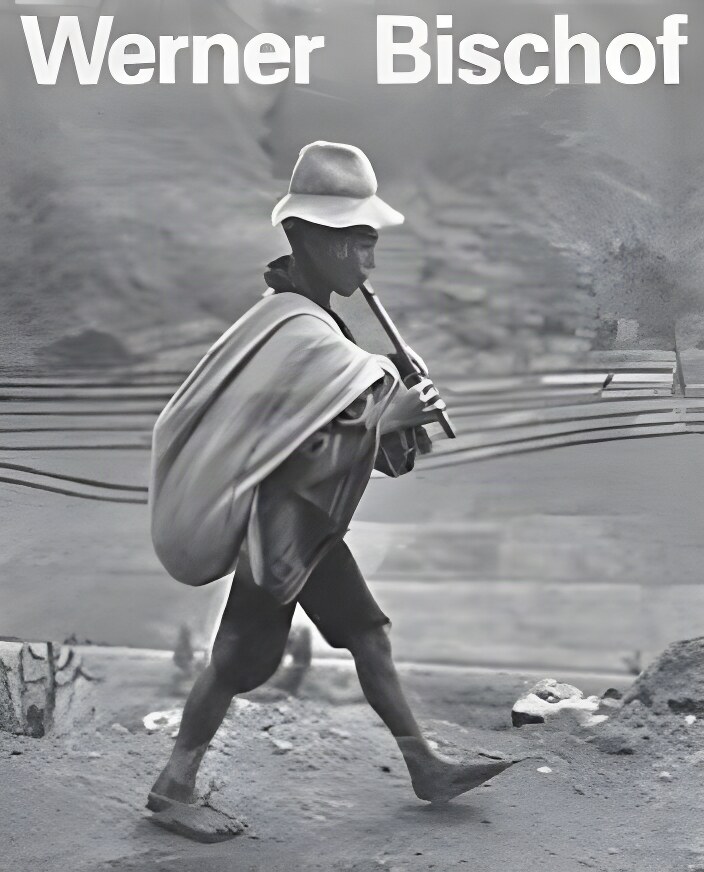
Hardcover. New York , Thames & Hudson, 1st, 1990, Book: Very Good, Dust Jacket: Very Good, 255 pages, clean hardcover in a bright, unclipped dust jacket. B&w photographs throughout by Bischof. His images were influenced by the major photo-movements of his time: the formal concepts of Das Neues Sehen (New Vision), the surrealism of Man Ray, and the documentary tradition of photojournalism. From the 1940s through the early 1950s, he covered World War II, the bombing of Hiroshima, and the Korean War for Life , Paris-Match , and other publications; his most famous series, "Famine in India," appeared in Life in 1951. This first major compilation of Bischof's work is nicely complemented by the text, a joint effort by son Marco and Swiss art historian Magnaguagno that vividly integrates biography and history. Dust jacket with minor edgewear, short closed tear to rear panel.
Hardcover. New York , Thames & Hudson, 1st, 1990, Book: Very Good, Dust Jacket: Very Good, 255 pages, clean hardcover in a bright, unclipped dust jacket. B&w photographs throughout by Bischof. His images were influenced by the major photo-movements of his time: the formal concepts of Das Neues Sehen (New Vision), the surrealism of Man Ray, and the documentary tradition of photojournalism. From the 1940s through the early 1950s, he covered World War II, the bombing of Hiroshima, and the Korean War for Life , Paris-Match , and other publications; his most famous series, "Famine in India," appeared in Life in 1951. This first major compilation of Bischof's work is nicely complemented by the text, a joint effort by son Marco and Swiss art historian Magnaguagno that vividly integrates biography and history.






 "Walker Evansby: Mellow, James R.")


 "Walt Frazier: One Magic Season and a Basketball Life (SIGNED COPY)by: Offen, Neil")
 "Walt Whitman: A Lifeby: Justin Kaplan")
 "Walter Benjamin: A Critical Lifeby: Eiland, Howard; /Jennings, Michael W.")
 "Walter Camp: The Father of American Footballby: Powel, Harford")
 "Walter Crane: The Illustrators by: Jenny Uglow")

 "Walter Matthau by: Hunter, Allan")
 "Wapiti Wildernessby: Margaret & Olaus Murie Murie")
 "Warhol: Headlinesby: Donovan, Molly")



 "Washington Allston: The Biography of a Pioneer of American Art and a Study of Romantic Art in Americaby: Richardson, Edgar P.")
 "Way We Lived Then, The: Recollections of a Well-Known Name Dropperby: Dunne, Dominick")
 "We call him \"Big\" Joe!: Big horn, big soul, big man: a musician's odyssey, memoirs of \"Big\" Joe Burrell (SIGNED COPY)by: Burrell, Big Joe")