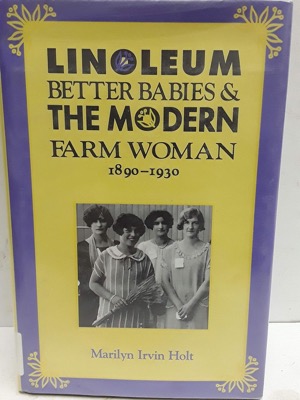
Hardcover. Albuquerque, University of New Mexico Press, 1st, 1995, Book: Very Good, Dust Jacket: Very Good, Hardcover in a bright dust jacket. 250 pages. b&w illustrations. The Progressive Era promoted a vision of America united by an emphasis on science and progressive reform. The zeal to modernize business, government and social relations extended to farm families and the ways women defined their roles. In this study of the expert advice offered by the domestic economy movement, Holt argues that women were not passive receptors of these views. Seeing their place in agriculture as multi-faceted and important, they eagerly accepted improved education and many modern appliances but often rejected suggestions conflicting with their own views of the rewards and values of farm life. Progressive reform inevitably left a mixed legacy; science and technology did not perfect rural society. But many programs such as 4-H and Master Homemaker still exist and are still shaped by women's desire to preserve and pass on the possibilities of rural life. Clean copy.
Hardcover. Oxford UK, The Voltaire Foundation, 1st, 1991, Book: Very Good, Dust Jacket: None, Hardcover in blue cloth, gilt lettering on spine, 251 pages. As France moved from the seventeenth to the eighteenth century, it found itself in the grip of anglomanie - a fascination with new English ideas in the domains of science and philosophy. Chief among the English thinkers it enthusiastically embraced was John Locke. On his visits to France and in his personal correspondence, Locke interacted with prominent French thinkers, scientists and savants of the day, such as Charles Barbeyrac and Pierre Magnol, and his works engaged in a critical dialogue with those of Descartes. However, Locke has been feted to such an extent that his position in the history of ideas in France is often overlooked. In Locke in France 1688-1734, Ross Hutchison re-examines and re-contextualises the precise nature and extent of Locke's influence in France by exploring how his ideas were incorporated into contemporary French debates and controversies in the transitional period from the seventeenth to the eighteenth century. Hutchison highlights the various channels of dissemination which brought Locke to the attention of the French, including translations of his major works and his personal friendships with French Protestant exiles. Hutchison also presents case studies of interactions in which Lockean ideas played a dominant role in the evolution of French thought, ranging from political theory to the nature of language, theories of education, and the relation between soul and matter. Clean copy, no dust jacket.
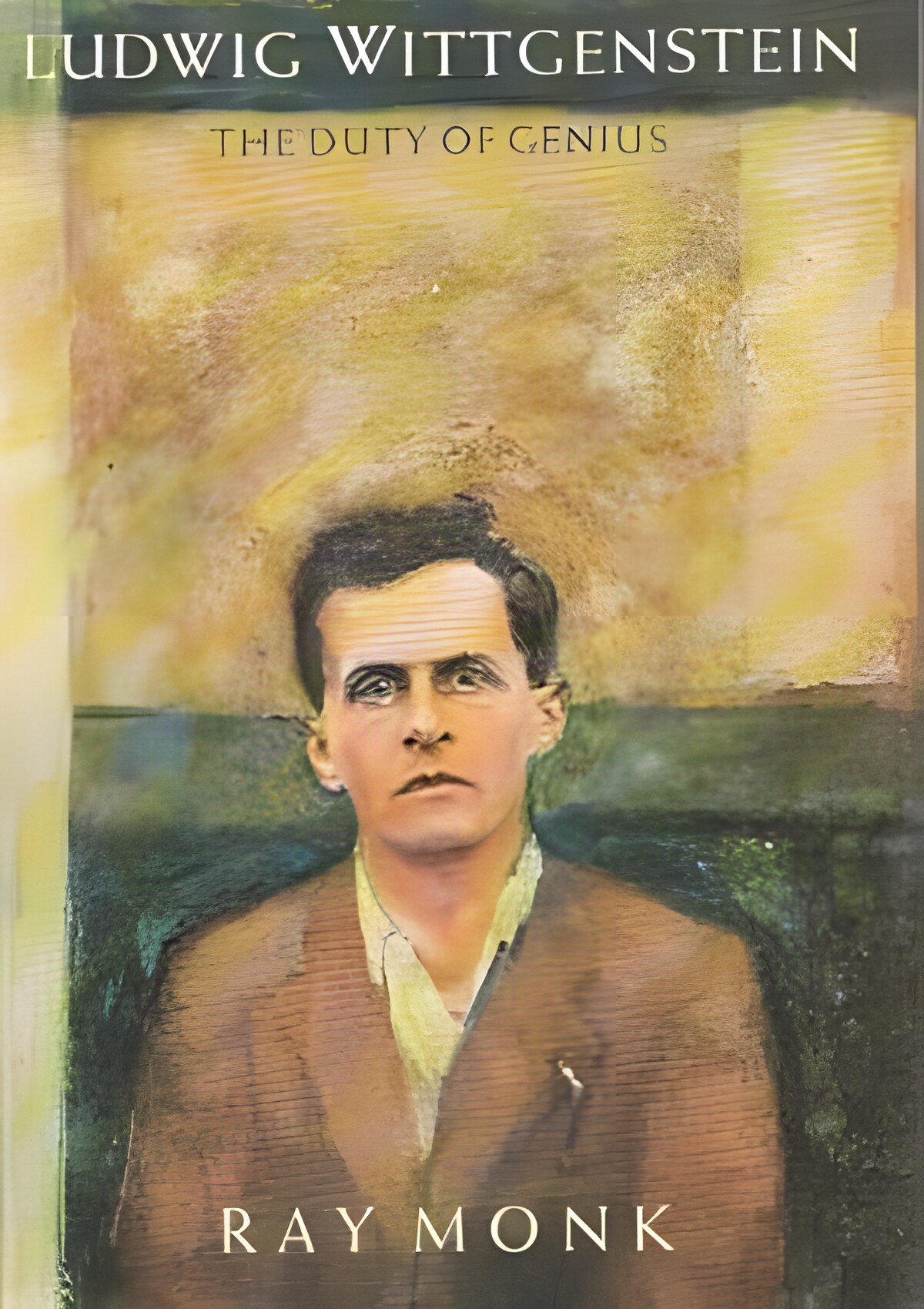
Hardcover. NY, The Free Press, 2nd pr., 1990, Book: Very Good, Dust Jacket: Very Good, Hardcover in a bright, unclipped dust jacket, 654 pages, b&w illustrations. A portrait of one of the twentieth-century's most influential philosophers draws on previously unpublished letters and writings to describe Wittgenstein's youth, education, private life, and major works. Clean copy.
Hardcover. Boston, Lee and Shepard, 1st, 1904, Book: Good, Dust Jacket: None, 332 pages. Hardcover. Previous owners name on front endpaper. Black & white illustrations by Charles Copeland. Titles on cover and spine in gilt. Fading to spine with beginning of fraying at top and bottom. Clean, unmarked text.Phillips Exeter Series.
Softcover. Chapel Hill, University of North Carolina Press, 1st pbk, 2002, Book: Very Good, Dust Jacket: None, Softcover, 411 pages, b&w illustrations. Tracing the erosion of white elite paternalism in Jim Crow Virginia, Douglas Smith reveals a surprising fluidity in southern racial politics in the decades between World War I and the Supreme Court's 1954 Brown v. Board of Education decision. Smith draws on official records, private correspondence, and letters to newspapers from otherwise anonymous Virginians to capture a wide and varied range of black and white voices. African Americans emerge as central characters in the narrative, as Smith chronicles their efforts to obtain access to public schools and libraries, protection under the law, and the equitable distribution of municipal resources. This acceleration of black resistance to white supremacy in the years before World War II precipitated a crisis of confidence among white Virginians, who, despite their overwhelming electoral dominance, felt increasingly insecure about their ability to manage the color line on their own terms. Exploring the everyday power struggles that accompanied the erosion of white authority in the political, economic, and educational arenas, Smith uncovers the seeds of white Virginians' resistance to civil rights activism in the second half of the twentieth century. Light marking to 10 pages, otherwise clean, very good.
Hardcover. New Haven CT, Yale University Press, 1st, 2022, Book: Very Good, Hardcover, pictorial boards, Photographer Marcia Resnick (b. 1950) earned recognition as part of the legendary Downtown New York art scene of the 1970s and 1980s. Her portraits of the era's major cultural figures, such as Jean-Michel Basquiat, John Belushi, and Susan Sontag, have contributed to the scene's mythic status. Against this backdrop, Resnick also produced a significant body of work that engaged with the history of art, took a humorous approach to conceptual art and feminism, and proposed new ideas for what photography could be. Spanning the artist's career, this richly illustrated volume explores Resnick's early influences and education at Cooper Union and CalArts; discusses her series and photobooks such as See and Re-visions; and situates the artist's work within the history of contemporary art. An afterword by Laurie Anderson speaks to the very personal vision of Resnick's photography. Still in publisher's shrinkwrap.
Hardcover. Ostfildern, Hatje Cantz, 1st, 2007, Book: Very Good, Dust Jacket: None, Hardcover in a white cardboard slipcase, 352 pages. One of the best-known Japanese artists of the international scene, Mariko Mori, born in 1967 in Tokyo, envisions fantastical worlds and beings in spectacular photographs and videos--frequently casting herself amid these scenarios as a Bjork-esque avatar in biomorphic and technological symbiosis. Mori studied fashion design in Tokyo, worked briefly as a model and later studied fine art in England, and this early education is visible in her elaborately produced photographs, videos and sculpture that are as reminiscent of Hollywood as they are of contemporary art. Her recent work involves exotic landscapes, computer-generated images and choreographed performances for which the artist designs her own costumes and plays the central characters.This extraordinary and substantial publication offers a retrospective of Mori's entire oeuvre, and is the first to present the complete Beginning of the End: Past, Present, Future, a photographic cycle produced over a period of 11 years, in which Mori presents herself as a time traveler in a plexiglass capsule at significant symbolic locations, from Giza to New York to Shanghai.
Hardcover. Boston, Roberts Brothers, 1st US, 1870, Book: Good, Dust Jacket: None, Hardcover, terra-cotta cloth with embossed design, gilt lettering on spine. Translated from the French by Virginia Vaughan. Ex-lib with markings, reside to front endpapers. Mild dampstain to bottom of last 100 pages. An attractive reading copy despite faults. Mauprat is a novel by the French novelist George Sand about love and education. It was published in serial form in April and May 1837. Like many of Sand's novels, Mauprat borrows from various fictional genres- the Gothic novel, chivalric romance, the Bildungsroman, detective fiction, and the historical novel.
Softcover. NY, Seven Stories Press, reprint, 2012, Book: Very Good, Dust Jacket: None, Softcover, 431 pages. A fascinating document of an extraordinary life, Memoirs of A Breton Peasant reads with the liveliness of a novel and bristles with the vigor of an opinionated autodidact from the very lowest level of peasant society. Brittany during the nineteenth century was a place seemingly frozen in the Middle Ages, backwards by most French standards; formal education among rural society was either unavailable or dismissed as unnecessary, while the church and local myth defined most people's reasoning and motivation. Jean-Marie Deguignet is unique not only as a literate Breton peasant, but in his skepticism for the church, his interest in science, astronomy and languages, and for his keen--often caustic--observations of the world and people around him. Born into rural poverty in 1834, Deguignet escapes Brittany by joining the French Army in 1854, and over the next fourteen years he fights in the Crimean war, attends Napoleon III's coronation ceremonies, supports Italy's liberation struggle, and defends the hapless French puppet emperor Maximilian in Mexico. He teaches himself Latin, French, Italian and Spanish and reads extensively on history, philosophy, politics, and literature. He returns home to live as a farmer and tobacco-seller, eventually falling back into dire poverty. Throughout the tale, Deguignet's freethinking, almost anarchic views put him ahead of his time and often (sadly, for him) out of step with his contemporaries. Deguignet's voluminous journals (nearly 4,000 pages in total) were discovered in a farmhouse in Brittany a century after they were written. This narrative was drawn from them and became a surprise bestseller when published in France in 1998. Clean copy.
Softcover. Princeton Architectural Press, 1st, 2001, Book: Very Good, Dust Jacket: None, Softcover, 234 pages, color illustrations. David Miller and Robert Hull created the Pacific Northwest style which is energy-conscious, structural expressive and uses local materials. This book has 29 projects. Miller/Hull's energy-conscious designs combine with a love of local materials and structural expressiveness to define the essence of the Pacific Northwest style. Here, where climate plays such a critical role, each Miller/Hull building responds with simple but inventive forms, straightforward plans, sensible siting, and careful detailing. Miller/Hull is the only comprehensive monograph of the architects' practice, which spans civic buildings, office and retail structures, educational and institutional projects, and their award-winning houses. Clean copy.
Hardcover. NY, William Morrow & Co., 1st, 1995, Book: Very Good, Dust Jacket: Very Good, Hardcover in a bright dust jacket. Wondering at her mother's stories that her father, who deserted the family when she was a baby, was a leather-clad hero, fourteen-year-old Jessie Wells becomes determined to learn the truth and meet the man she has never known. Clean copy.
Hardcover. Mankato MN, Creative Education, 1st, 1993, Book: Very Good, Dust Jacket: None, Hardcover, pictorial glossy boards, 32 pages illustrated in color by Delessert. Includes four brief stories, each accompanied by a factual segment. Yok-Yok is a little boy and is based on a series of animated films created for television, Switzerland. Clean, bright copy.
Hardcover. NY, Harper and Brothers, reprint, 1836, Book: Good, Dust Jacket: None, Hardcover, blue textured cloth with decorative gilt title on spine. Vol. 2 ONLY of a ten volume set. This book combines the 3rd and 4th volumes in the original 18 volume set. 213 + 238 pages. Frontis. engraving and illustrated title page reprinted from the 1832 edition. This collection of moral tales written by Maria Edgeworth explores themes of education, family relationships, and social issues in 19th century Ireland. The stories are entertaining and engaging while also providing valuable lessons about life and morality. Edgeworth was a significant figure in the development of the novel as a literary form and her work is still widely read and admired today. Solid binding, mild foxing. Previous owner's name on title page.
Hardcover. New York , Henry Holt and Company, 1st, 1907, Book: Very Good, Dust Jacket: None, 471 pages. Black cloth cover with gilt lettering on spine. Cover has some faint smudges, and some fraying to corners and edges. Previous owner's inscription on front flyleaf. Some foxing on front and rear endpapers. Otherwise, inside is bright and clean with many b&w illustrations and educational diagrams throughout.
Hardcover. Chicago, Scott, Foresman and Company, Reprint, 1951, Book: Very Good, Dust Jacket: None, 160 pages. Hardcover. Full color illustrations by Keith Ward and Eleanor Campbell. "Public School 201, 155 St. & 65 Avenue, Flushing, N. Y." stamped at top right left corner of title page. Light rubbing, surface soiling to covers. Clean, unmarked pages.
Hardcover. NY, Quadrangle/ NY Times, 1st, 1974, Book: Very Good, Dust Jacket: Very Good, Hardcover in a bright dust jacket, 206 pages. Purple top-stain. An interesting account of what it's like to work erecting multi-story high rise buildings in a city like New York. Clean copy.
Hardcover. Lawrence KS, University Press of Kansas, 1st, 1994, Book: Very Good, Dust Jacket: Very Good, Hardcover with a bright dust jacket. B&w vintage photos throughout. The Midwest's one-room schools were, Fuller observes, the most democratic in the nation. Located in small, independent school districts, these schools virtually wiped out illiteracy, promoted democratic values, and opened up new vistas beyond the borders of their students' lives. Entire communities, Fuller shows, revolved around these schools. At various times they were used as churches, polling places, sites of political caucuses, and meeting halls for local organizations. But as America urbanized and the movement to consolidate took hold in rural counties, these little centers of learning were left at the margins of the educational system. Some were torn down, some left to weather away, some sold at auction, and still others transformed into museums.
Hardcover. Burlington, VT, Burlington High School, 1st, 1907, Book: Very Good, Dust Jacket: None, 125 pages. 1907 yearbook for Burlington High School. Tan cloth covers, with dark brown stamped titles and pictorial, profusely illustrated with b&w photographic portraits and illustrations. Slight soiling to covers, pages crisp and unmarked, stiff binding; overall, a very clean, tight copy in great condition.
NY, Harper and Brothers, 1913, Book: Very Good, Dust Jacket: None, Color illustration of a stern male teasher looking down on a laughing boy. Art by Chas. A. MacLellan. Approx. 10 X 13". PLEASE NOTE: The image shown is a scan of the actual product you are purchasing. What you see is what you get. The sheet may have some imperfections beyond the cropped area shown. You are buying THIS PAGE ONLY- not the entire magazine. Your order will be placed carefully between stiff paper and an acetate overlay, then packed in a rigid cardboard sleeve to prevent bending.
1940, Book: Very Good, Dust Jacket: None, Female chemistry student, art by John Hyde Phillips. 10 1/2 X 13 1/2", very good. PLEASE NOTE: The image shown is a scan of the actual product you are purchasing. What you see is what you get. The sheet may have some imperfections beyond the cropped area shown. You are buying THIS PAGE ONLY- not the entire magazine. Your order will be placed carefully between stiff paper and an acetate overlay, then packed in a rigid cardboard sleeve to prevent bending.
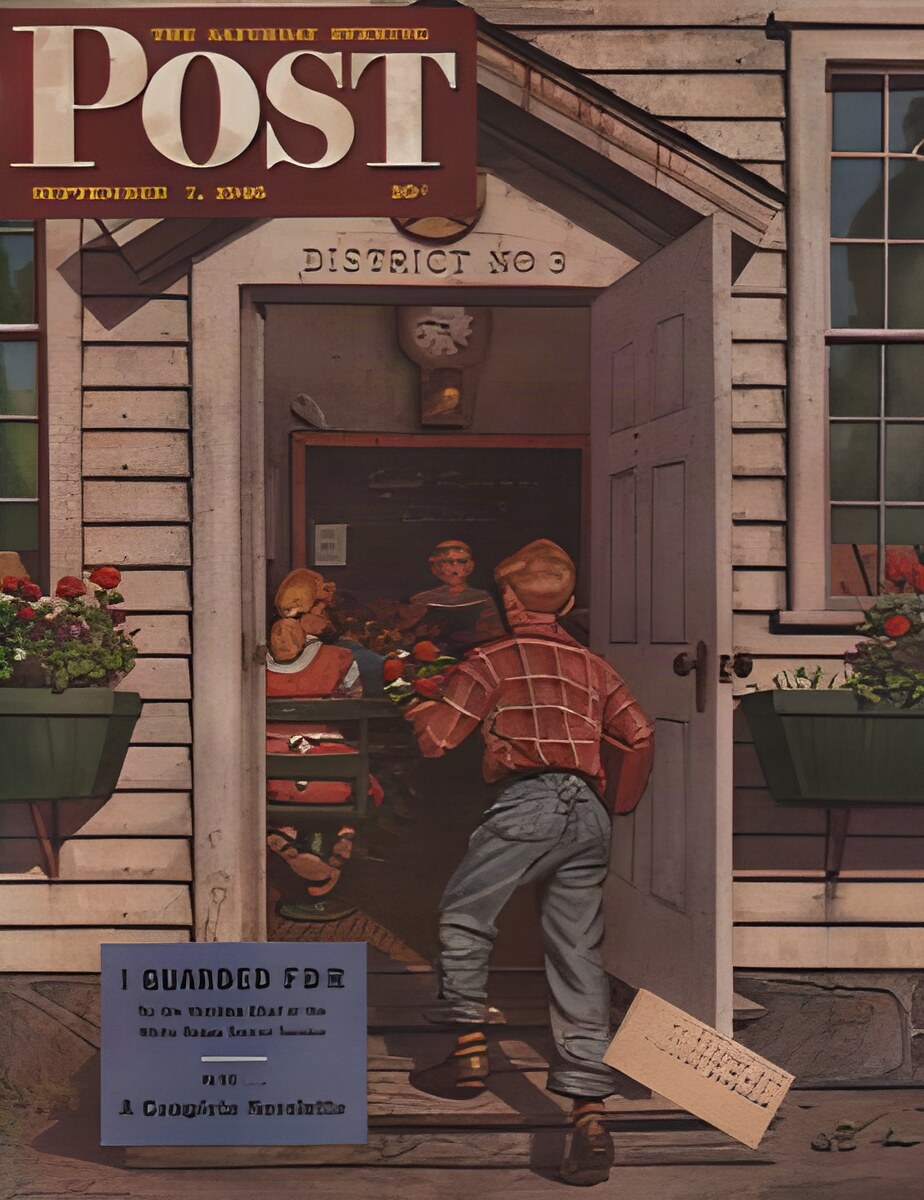
Late schoolboy carrying flowers, art by Stevan Dohanos. 11 x 13.5", light tanning to masthead, otherwise very good. Mailing label. Dohanos realized his love of art fairly early in life, selling calendars and illustration copies for $1.00 to $3.00 apiece while he worked in a grocery store and later at an office job. He began his formal education by taking correspondence classes through the International Correspondence School. Soon after, the artist took night classes at the Cleveland School of Art where he received a scholarship to complete his formal art studies. He is best known for his Saturday Evening Post covers, and responsible for several of the Don't Talk set of World War II propaganda posters.
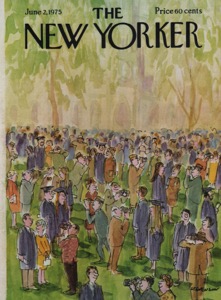
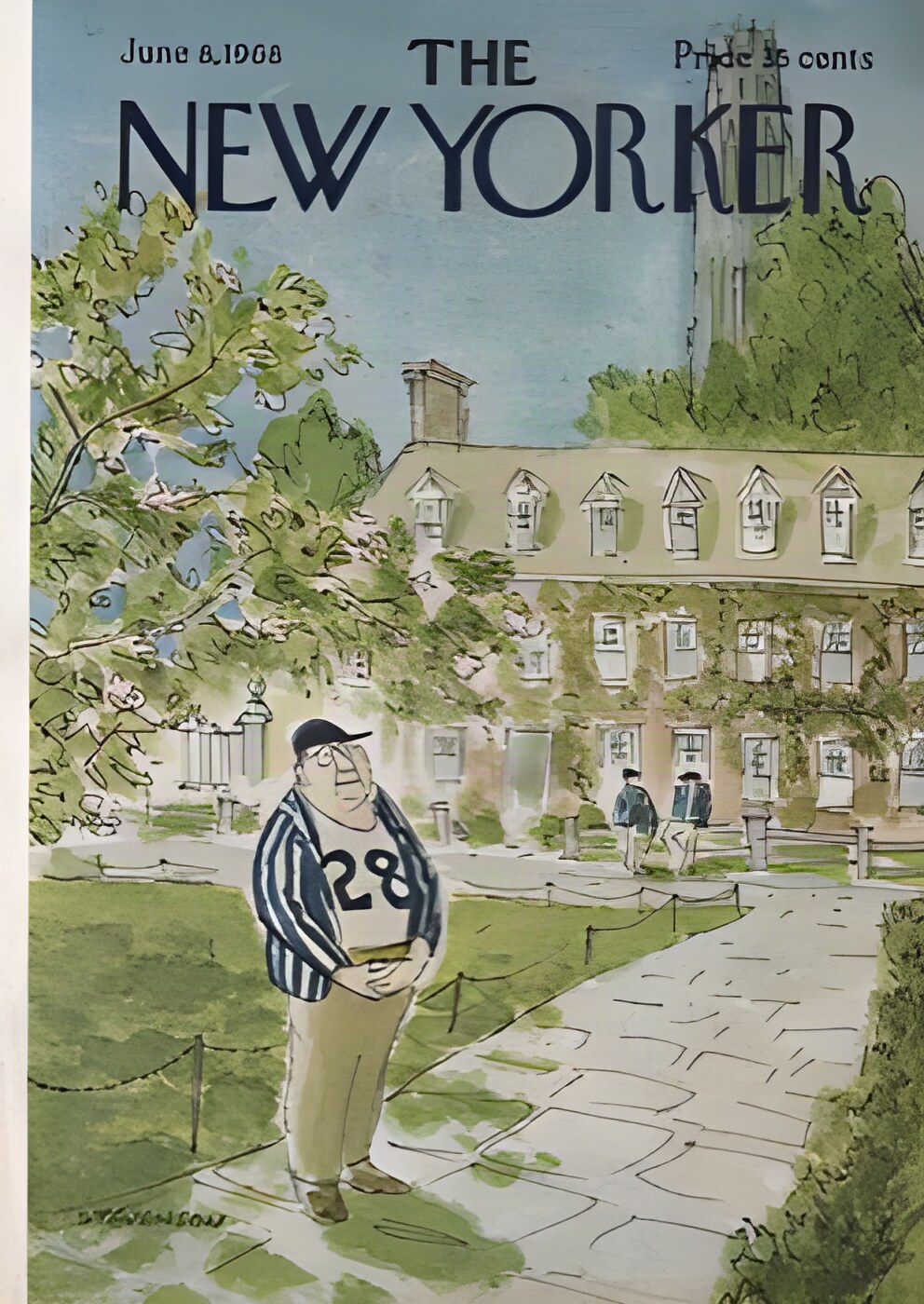
Graduation scene by James Stevenson. 8.5 x 11", very good. Stevenson attended Yale University, majoring in English with the intention of becoming a writer. His first success was with art rather than writing, however; he was selling ideas for cartoons to the New Yorker magazine, while still a student at Yale. In the end, Stevenson was a prolific poet, writer, illustrator, and cartoonist, publishing more than 100 children's books and contributing 79 covers and 1,988 cartoons to The New Yorker, where he was a cartoonist for over 50 years.
1968, Book: Very Good, Color cartoon of Class of 28 graduate remembering his college days. 8 3/4 X 12", very good. PLEASE NOTE: The image shown is a scan of the actual product you are purchasing. What you see is what you get. The sheet may have some imperfections beyond the cropped area shown. You are buying THE COVER ONLY- not the entire magazine. Your order will be placed carefully between stiff paper in clear plastic envelope, then packed in a rigid cardboard sleeve to prevent bending.








 "Memoirs of a Breton Peasant, 1834-1905by: Jean-Marie D?©guignet")






 "Nature and Development of Plantsby: Curtis, A.M., Ph.D., Carlton C.")

 "Old Public Schools of England by: John Rodgers")



 "Oread '07, The: Published by the Students of The Burlington High School in the year nineteen hundred and sevenby: Burlington High School")