Softcover. Cambridge MA, Harvard University Press, reprint, 2011, Book: Very Good, Dust Jacket: None, Softcover, 997 pages, color and b&w illustrations. A deadly continental struggle, the Thirty Years War devastated seventeenth-century Europe, killing nearly a quarter of all Germans and laying waste to towns and countryside alike. Peter Wilson offers the first new history in a generation of a horrifying conflict that transformed the map of the modern world. When defiant Bohemians tossed the Habsburg emperor's envoys from the castle windows in Prague in 1618, the Holy Roman Empire struck back with a vengeance. Bohemia was ravaged by mercenary troops in the first battle of a conflagration that would engulf Europe from Spain to Sweden. The sweeping narrative encompasses dramatic events and unforgettable individuals-the sack of Magdeburg; the Dutch revolt; the Swedish militant king Gustavus Adolphus; the imperial generals, opportunistic Wallenstein and pious Tilly; and crafty diplomat Cardinal Richelieu. In a major reassessment, Wilson argues that religion was not the catalyst, but one element in a lethal stew of political, social, and dynastic forces that fed the conflict. By war's end a recognizably modern Europe had been created, but at what price? The Thirty Years War condemned the Germans to two centuries of internal division and international impotence and became a benchmark of brutality for centuries. As late as the 1960s, Germans placed it ahead of both world wars and the Black Death as their country's greatest disaster. Clean, bright copy.
Hardcover. NP, Somogy Art Publishers, 1st, 2006, Book: Very Good, Dust Jacket: Very Good, Hardcover, 96 pages. This fascinating collection of photographs documents a relatively unknown episode of Jewish history in Eastern Europe. Illustrating how the 1920s and 1930s saw the creation and development of "Jewish agricultural colonies" in the Soviet Union, Lithuania, Latvia, Poland, and Romania, this history shows that the aim was to "normalize" Jews by teaching them "productive" professional skills. These recently discovered photographs offer a unique and moving insight into the Jewish experience in central and Eastern Europe before World War II. This edition includes English, French, and Yiddish.
Hardcover. NY, Wiley, 2nd pr., 2001, Book: Very Good, Dust Jacket: Very Good, Hardcover in a bright, unclipped dust jacket. The long-awaited, untold, inside story of the rise of the legendary actor, singer, scholar, and activist. The first volume of this major biography breaks new ground. The greatest scholar-athlete-performing artist in U.S. history, Paul Robeson was one of the most compelling figures of the twentieth century. Now his son, Paul Robeson Jr., traces the dramatic arc of his rise to fame, painting a definitive picture of Paul Robeson's formative years. His father was an escaped slave; his mother, a descendent of freedmen; and his wife, the brilliant and ambitious Eslanda Cardozo Goode. With a law degree from Columbia University; a professional football career; title roles in Eugene O'Neill's plays and in Shakespeare's Othello; and a concert career in America and Europe, Robeson dominated his era. 383 pages, b&w illustrations. Clean copy.
Hardcover. NY, Houghton Mifflin Harcourt, 1st, 2021, Book: Very Good, Dust Jacket: Very Good, Hardcover in a bright, unclipped dust jacket. From a New York Times best-selling historian and Pulitzer Prize finalist, a sweeping epic of how the Vikings and their descendants have shaped history and America. Scandinavia has always been a world apart. For millennia Norwegians, Danes, Finns, and Swedes lived a remote and rugged existence among the fjords and peaks of the land of the midnight sun. But when they finally left their homeland in search of opportunity, these wanderers--including the most famous, the Vikings--would reshape Europe and beyond. Their ingenuity, daring, resiliency, and loyalty to family and community would propel them to the gates of Rome, the steppes of Russia, the courts of Constantinople, and the castles of England and Ireland. But nowhere would they leave a deeper mark than across the Atlantic, where the Vikings' legacy would become the American Dream. Clean copy.
Hardcover. Hartford, Joel Barlow, 1st, 1787, Book: Very Good, Dust Jacket: None, 258 pages. Red leather covers with gilt lines along cover edges, and decorations on spine. Covers with light rubbing to edges and at corners. Title on spine in gilt on black. Marbled endpapers. Previous owners name on preliminary page and at top of title page. Includes Dedication to The King of France, and Introduction. All edges gilt.
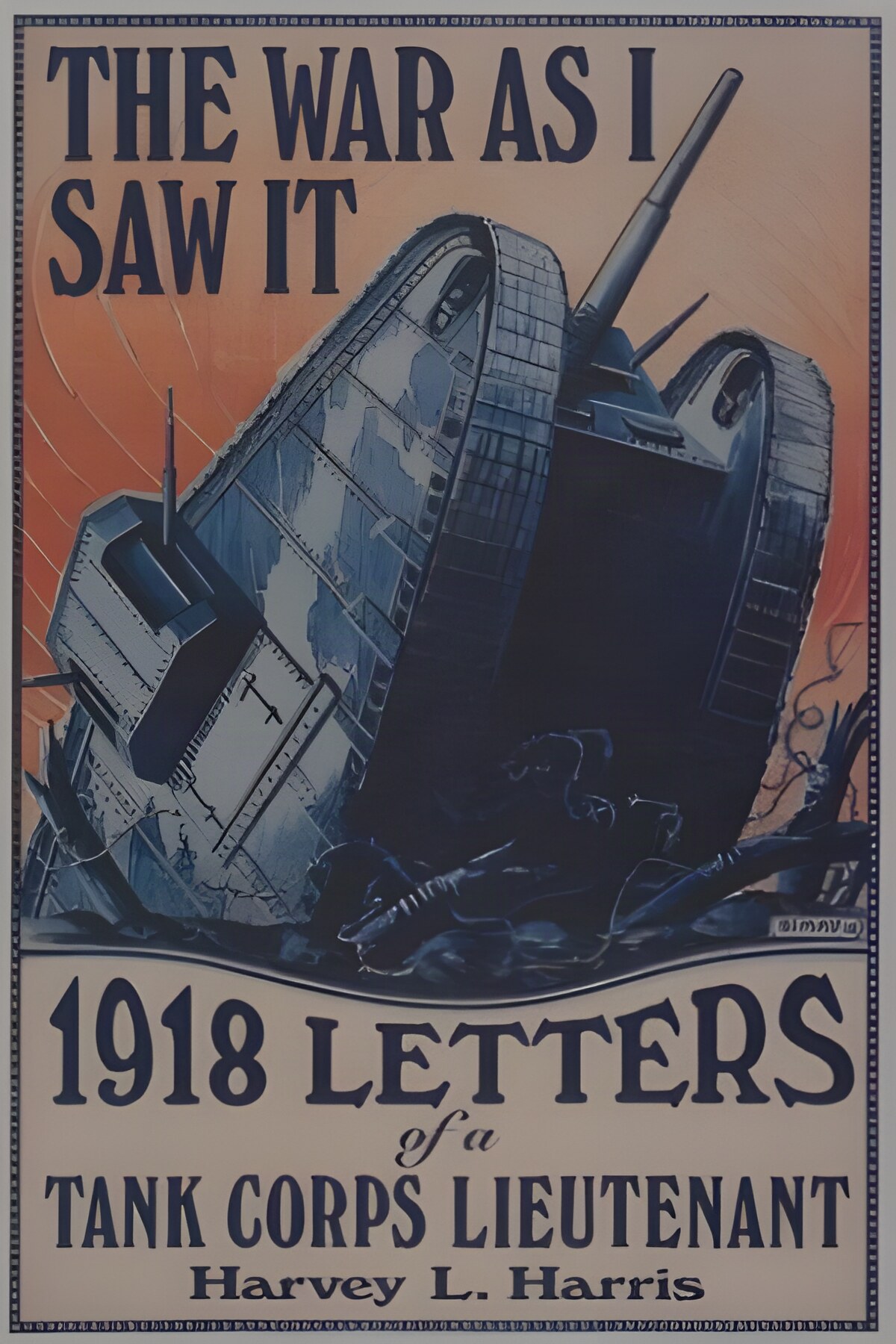
Softcover. St. Paul MN, Pogo Press, 1st, 1998, Book: Very Good, Dust Jacket: None, Softcover, 158 pages, b&w illustrations. During World War I, soldiers in the American Expeditionary Force rarely fought in the newly developed tank, and those who did manned British and French tanks since American models did not become available until after the war. Harris joined the Tank Corps because it was considered the elite unit of the ground forces and had a certain amount of romance connected with it. Initially assigned as a driving instructor, he later saw action at the St. Mihiel salient and on the Meuse-Argonne front. This book, which offers an extensive preface, summarizing Harris's life before, during, and after the war, along with some penetrating insights into his character, collects 46 letters he wrote home while in service. As they show, Harris saw war as a game not unlike the football games he played in his youth. Although he spent only 18 months in Europe, he looked upon it as a bold adventure, surviving the bad periods and enjoying the better moments. He returned from war apparently unscathed in both body and mind. The letters provide an entertaining if hardly probing portrayal of World War I from a tank officer's point of view. Clean copy.
Hardcover. NY, Random House, 1st, 2013, Book: Very Good, Dust Jacket: Very Good, Hardcover in a bright, lightly worn dust jacket. 739 pages, index, b&w illustrations. The War That Ended Peace brings vividly to life the military leaders, politicians, diplomats, bankers, and the extended, interrelated family of crowned headsacross Europe who failed to stop the descent into war: in Germany, the mercurial Kaiser Wilhelm II and the chief of the German general staff, Von Moltke the Younger; in Austria-Hungary, Emperor Franz Joseph, a man who tried, through sheer hard work, to stave off the coming chaos in his empire; in Russia, Tsar Nicholas II and his wife; in Britain, King Edward VII, Prime Minister Herbert Asquith, and British admiral Jacky Fisher, the fierce advocate of naval reform who entered into the arms race with Germany that pushed the continent toward confrontation on land and sea. Clean copy.
Softcover. Princeton NJ, Princeton University Press, reprint, 1978, Book: Very Good, Dust Jacket: None, Softcover, 464 pages. Richard Stites views the struggle for liberation of Russian women in the context of both nineteenth-century European feminism and twentieth-century communism. The central personalities, their vigorous exchange of ideas, the social and political events that marked the emerging ideal of emancipation--all come to life in this absorbing and dramatic account. The author's history begins with the feminist, nihilist, and populist impulses of the 1860s and 1870s, and leads to the social mobilization campaigns of the early Soviet period. Spine with light fading, otherwise a clean, tight copy.
Softcover. London/NY, Routledge, reprint, 2001, Book: Very Good, Dust Jacket: None, Softcover, 328 pages. This unique collection of essays, published together for the first time, not only elucidates the complexity of ancient Greek thought, but also reveals Karl Popper's engagement with Presocratic philosophy and the enlightenment he experienced in his reading of Parmenides. As Karl Popper himself states himself in his introduction, he was inspired to write about Presocratic philosophy for two reasons - firstly to illustrate the thesis that all history is the history of problem situations and secondly, to show the greatness of the early Greek philosophers, who gave Europe its philosophy, its science and its humanism. Light pencil marking to 8 pages.
Hardcover. New Haven CT, Yale University Press, reprint, 1991, Book: Very Good, Dust Jacket: None, Hardcover in a dust jacket with fading to some areas, 338 pages. Margaret Fuller - journalist, critic, radical feminist, and political activist - traveled in Europe between 1846 and 1850 as a foreign correspondent for the New York Tribune. Her letters from England, France, and Italy, which began as engaging travel sketches, soon became moving accounts of the most widespread revolutionary upheaval within modern history. These dispatches are now reproduced in their entirety for the first time. Clean copy.
Softcover. Atlanta, High Museum of Art, 1st, 1992, Book: Very Good, Dust Jacket: None, Softcover. Like new in publisher's shrink-wrap. The catalogue of a traveling exhibition organized by the High Museum of Art, Atlanta, examining the significant interrelationships between sports, photography, and culture in the US, Europe, and Russia since the late 19th century. The 141 works featured (32 color, 109 duotone) by 120 photographers (including such masters as Stieglitz, Adams, Cartier-Bresson, and Arbus) are drawn from American and European public and private collections and the archives of Life and Sports Illustrated . Includes essays by Harvey Green, John M. Hoberman, and Peter Schjeldahl.
Softcover. Atlanta, High Museum of Art, 1st, 1992, Book: Very Good, Dust Jacket: None, Softcover. Like new in publisher's shrink-wrap. The catalogue of a traveling exhibition organized by the High Museum of Art, Atlanta, examining the significant interrelationships between sports, photography, and culture in the US, Europe, and Russia since the late 19th century. The 141 works featured (32 color, 109 duotone) by 120 photographers (including such masters as Stieglitz, Adams, Cartier-Bresson, and Arbus) are drawn from American and European public and private collections and the archives of Life and Sports Illustrated . Includes essays by Harvey Green, John M. Hoberman, and Peter Schjeldahl.
Hardcover. Baltimore MD, Johns Hopkins University Press , 1st, 1995, Book: Very Good, Dust Jacket: Very Good, Hardcover in a bright dust jacket. 219 pages, endpapers map. Describes Jefferson's European journeys during his time as minister to the court of Louis XVI between 1784 and 1789, and explores the significance of his travels to American culture. Illustrated with some 60 b&w images from the period, and drawing on Jefferson's account books and correspondence, shows how his experiences shaped his intellectual and aesthetic development. Clean copy.
Hardcover. Philadelphia, Childs & Peterson , 1st, 1860, Book: Very Good, Dust Jacket: None, Hardcover, embossed brown cloth, 245 pages plus publishers ads. Gilt on spine faded. A fascinating work of history by Francis J. Grund, exploring the link between Europe and the United States of America. Very scarce. An interesting work of world history, explore the current state of Europe in the mid-19th century and the subsequent impact on the United States of America. This work of global history is written by Francis J. Grund, the noted journalist who published numerous works in relation to the socio-politcal climate of America. Bookplate on inside front cover, otherwise tight and clean.
Hardcover. NY, Oxford University Press, 1st, 2011, Book: Very Good, Dust Jacket: Very Good, Hardcover in a bright, unclipped dust jacket. 336 pages, b&w illustrations. Author Larry Hamberlin guides us through this large but oft-forgotten repertoire of operatic novelties, and brings to life the rich humor and keen social criticism of the era. In the early twentieth-century, when new social forces were undermining the view that our European heritage was intrinsically superior to our native vernacular culture, opera-that great inheritance from our European forebearers-functioned in popular discourse as a signifier for elite culture. Tin Pan Opera shows that these operatic novelty songs availed this connection to a humorous and critical end. Combining traditional, European operatic melodies with the new and American rhythmic verve of ragtime, these songs painted vivid images of immigrant Americans, liberated women, and upwardly striving African Americans, striking emblems of the profound transformations that shook the United States at the beginning of the American century. Clean copy.
Softcover. Boston, Museum of Fine Arts, 1st, 2009, Book: Very Good, Dust Jacket: None, Softcover, 315 pages. Color illustrations. For nearly four decades in the sixteenth century, the careers of Venice's three greatest painters-, Titan, Tintoretto and Veronese, overlapped, producing mutual influences and bitter rivalries that changed art history. Venice was then among Europe's richest cities, and its plentiful commissions fostered an exceptionally fertile and innovative climate. In it, the three artists, brilliant, ambitious and fiercely competitive, vied with one another for primacy, employing such new media as oil on canvas, with its unique expressive possibilities, and such new approaches as a personal and identifiable signature style. They also pioneered the use of easel painting, a newly portable format that led to unprecedented fame in their lifetimes. With more than 150 stunning examples by the three masters and their contemporaries, this volume elucidates the technical and aesthetic innovations that helped define the uniquely rich "Venetian style," as well as the social, political and economic context in which it flourished. Essays range from examinations of seminal new techniques to such crucial institutions as state commissions and the patronage system. Most of all, by concentrating on the lives and careers of Venice's three greatest painters, Titian, Tintoretto, Veronese paints a vibrant human portrait--one brimming with savage rivalry, one-upmanship, humor and passion. Clean copy. DOMESTIC SHIPPING ONLY.
Hardcover. New York , Penguin Putnam Inc, 1st, 1993, Book: Very Good, Dust Jacket: Very Good, Hardcover, 158 pages, illustrated throughout with photos in b&w. Clean, unmarked copy with only minor wear to dust jacket. Elie Wiesel provides the preface to a master photographer's record of eastern Europe's Jewish communities in the years just before World War II with 160 photographs that capture the ordinary lives of Jews before the Holocaust.
Softcover. Berkeley CA, University of California Press, 1st pbk., 1990, Book: Very Good, Dust Jacket: None, Softcover, 273 pages, b&w illustrations. The first in-depth analysis of the rich spiritual and artistic traditions of the Carib-speaking Yekuana Indians of Venezuela, who live in the dense rain forest of the upper Orinoco. Within their homeland of Ihuruna, the Yekuana have succeeded in maintaining the integrity and unity of their culture, resisting the devastating effects of acculturation that have befallen so many neighboring groups. Yet their success must be attributed to more than natural barriers of rapids and waterfalls, to more than lack of "contact" with our "modern" world. The ethnographic history recounted here includes not only the Spanish discovery of the Yekuana but detailed indigenous accounts of the entire history of Yekuana contact with Western culture, revealing an adaptive technique of mythopoesis by which the symbols of a new and hostile European ideology have been consistently defused through their incorporation into traditional indigenous structures. Clean copy.
Hardcover. Westport CT, Greenwood Press, 1st, 2003, Book: Very Good, Dust Jacket: None, Hardcover, maroon cloth covers stamped in silver, 242 pages. Previous owner's inscription on front fly leaf, otherwise clean. Over the course of the American Occupation of Japan, the U.S. attitude toward the Japanese Communist Party (JCP) gradually shifted from one of friendly cooperation to one of mutual opposition. This new study examines the initial approach toward communism in Japan; internal and external factors that affected American attitudes; the various phases of the relationship; and how Japan ultimately became a democratic nation. Oinas-Kukkonen investigates American information gathering techniques used at the time to determine possible links with the Soviet Union. He also discusses the possibility that Nosaka Sanzo, one of the main leaders of the JCP, was an American spy. Using previously secret records of General MacArthur's intelligence staff and plentiful archival materials on the Occupation, this study explores how the United States originally sought to utilize the JCP to assist in the democratization process. It identifies the perceived threat of a revolution in March 1947 as a key turning point in U.S. attitudes. Involved in a delicate balancing act with multiple Japanese interests, some American officials feared that elements of the extreme left might even evolve into extreme right-wing terrorists. In this comprehensive account, Oinas-Kukkonen includes information on the indirect role of the Europeans in this affair, as well as the roles of outsider groups such as the outcaste burakumin and the Koreans residing in Japan.
Hardcover. Glencoe IL, The Free Press, 1st, 1957, Book: Good, Dust Jacket: None, Hardcover, brown cloth, 382 pages. Dust jacket flaps laid in, name inside front cover. Light pencil marking to about 10 pages. Ancient civilizations and medieval Europe had no "economies" -- no fixed prices for commodities, no production for markets. People have always exchanged goods, of course, but in the pre-modern world, exchange between individuals was most often done through social networks, always with a non-economic motivation. Scarcity, "entrepreneurship", the universal self-regulating market with fixed prices for goods, and the system of trade as we know it, and economics as the fundamental driving sector for all of society --- are all unique to the modern West.
Hardcover. New York, Michael Sullivan, 1st, 1886, Book: Good, Dust Jacket: None, Hardcover, 87 pages, in green cloth covers with black and gilt design. A brief first-hand account of a seven week trip to Europe, principally England, Ireland and Scotland. Uncommon. A bit worn with cracked hinges.
Softcover. Lincoln NE, Bison Books, reprint, 2004, Book: Very Good, Dust Jacket: None, Softcover, 368 pages. Documents the generations of Native peoples who for twelve millennia have moved through and eventually settled along the rocky coast, rivers, lakes, valleys, and mountains of a region now known as Maine. Arriving first to this area were Paleo-Indian peoples, followed by maritime hunters, more immigrants, then a revival of maritime cultures. Beginning in the sixteenth century, Native peoples in northern New England became tangled in the far-reaching affairs of European explorers and colonists. Twelve Thousand Years reveals how Penobscots, Abenakis, Passamaquoddies, Maliseets, Micmacs, and other Native communities both strategically accommodated and overtly resisted European and American encroachments. Clean copy.
NY, US Camera Publishing, 1st, 1953, Book: Very Good, Dust Jacket: Very Good, Hardcover with a bright dust jacket, 424 pages. Catagories of photos include post-war European photography, the year's best pictures American-International, Elisofon's Africa-in color, combat in Korea, The News in Pictures. Clean copy.
Hardcover. Hartford, Canfield and Robins, 1st, 1836, Book: Fair, Dust Jacket: None, 610 pages. Hardcover with brown leather covers. Heavy soil and wear to the leather. Moderate foxing throughout. Black and white illustrations/engraved plates. Iceland to New Zealand, including the Americas, Europe, Asia, and Africa. Water stain to first 40 pages, about one sixth of page. Previous owner's signature on front fly leaf. Sound binding.

 "The Thirty Years War: Europe")
 "The Tradesmen and the Farmers of Yiddishland: 1921-1938by: Pollack, Emmanuelle (Editor)")
 "The Undiscovered Paul Robeson , An Artist's Journey, 1898-1939by: Paul Robeson Jr.")
 "The Viking Heart: How Scandinavians Conquered the Worldby: Arthur Herman")


 "The Women's Liberation Movement in Russia: Feminism, Nihilism, and Bolshevism, 1860-1930by: Richard Stites")


 "This Sporting Life, 1878-1991by: Dugan, Ellen")
 "This Sporting Life, 1878-1991by: Dugan, Ellen")
 "Thomas Jefferson's Travels in Europe, 1784-1789by: Shackelford, George Green")



 "Tin Pan Opera: Operatic Novelty Songs in the Ragtime Eraby: Larry Hamberlin")
 "To Give Them Light: Legacy of Roman Vishniacby: Vishniac, Roman")

 "Tolerance, Suspicion, and Hostility: Changing U.S. Attitudes toward the Japanese Communist Movement, 1944-1947by: Oinas-Kukkonen, Henry")

 "Trials and Triumphs of a Summer Vacationby: K.A.M.")
 "Twelve Thousand Years: American Indians in Maine by: Bruce J. Bourque")
 "U.S. Camera 1954by: Maloney (Ed.), Tom")
 "Universal Traveller: Designed to introduce Readers at home to an Acquaintance with the Arts, Customs and Manners of the Principal Modern Nations on the Globe...by: Go")