Softcover. Atlanta, High Museum of Art, 1st, 1992, Book: Very Good, Dust Jacket: None, Softcover. Like new in publisher's shrink-wrap. The catalogue of a traveling exhibition organized by the High Museum of Art, Atlanta, examining the significant interrelationships between sports, photography, and culture in the US, Europe, and Russia since the late 19th century. The 141 works featured (32 color, 109 duotone) by 120 photographers (including such masters as Stieglitz, Adams, Cartier-Bresson, and Arbus) are drawn from American and European public and private collections and the archives of Life and Sports Illustrated . Includes essays by Harvey Green, John M. Hoberman, and Peter Schjeldahl.
Softcover. Atlanta, High Museum of Art, 1st, 1992, Book: Very Good, Dust Jacket: None, Softcover. Like new in publisher's shrink-wrap. The catalogue of a traveling exhibition organized by the High Museum of Art, Atlanta, examining the significant interrelationships between sports, photography, and culture in the US, Europe, and Russia since the late 19th century. The 141 works featured (32 color, 109 duotone) by 120 photographers (including such masters as Stieglitz, Adams, Cartier-Bresson, and Arbus) are drawn from American and European public and private collections and the archives of Life and Sports Illustrated . Includes essays by Harvey Green, John M. Hoberman, and Peter Schjeldahl.
Hardcover. Washington, D.C., Smithsonian Institution Press, rep, 1993, Book: Very Good, Dust Jacket: Very Good, Catalogue of the works of Thomas Eakins. Includes 49 large color plates with accompanying black/white and color illustrations and notes for each. Also contains reproductions of Eakins's lesser-known black/white photographs and biographical text about the artist. Very good condition; cloth bound book has virtually no flaws, dust jacket has few small tears near the edges.
Hardcover. Baltimore MD, Johns Hopkins University Press , 1st, 1995, Book: Very Good, Dust Jacket: Very Good, Hardcover in a bright dust jacket. 219 pages, endpapers map. Describes Jefferson's European journeys during his time as minister to the court of Louis XVI between 1784 and 1789, and explores the significance of his travels to American culture. Illustrated with some 60 b&w images from the period, and drawing on Jefferson's account books and correspondence, shows how his experiences shaped his intellectual and aesthetic development. Clean copy.
Softcover. NY, Blood Moon, 1st, 2013, Book: Very Good, Dust Jacket: None, Softcover, 752 pages, b&w illustrations. Born in Central Europe during the twilight of the Austro-Hungarian Empire, three "vonderful vimmen"--Zsa Zsa, Eva, and Magda Gabor--transferred their glittery dreams and gold-digging ambitions to Hollywood. They supplemented America's most Imperial Age with "guts, glamour, and goulash," and reigned there as the Hungarian equivalents of Helen of Troy, Madame du Barry, and Madame de Pompadour. More effectively than any army, these Bombshells from Budapest conquered kings, dukes, and princes, always with a special passion for millionaires, as they amassed fortunes, broke hearts, and amused sophisticated voyeurs on two continents. With their wit, charm, and beauty, thanks to training inspired by the glittering traditions of the Imperial Habsburgs, they became famous for being famous. Clean copy.
Hardcover. Philadelphia, Childs & Peterson , 1st, 1860, Book: Very Good, Dust Jacket: None, Hardcover, embossed brown cloth, 245 pages plus publishers ads. Gilt on spine faded. A fascinating work of history by Francis J. Grund, exploring the link between Europe and the United States of America. Very scarce. An interesting work of world history, explore the current state of Europe in the mid-19th century and the subsequent impact on the United States of America. This work of global history is written by Francis J. Grund, the noted journalist who published numerous works in relation to the socio-politcal climate of America. Bookplate on inside front cover, otherwise tight and clean.
Hardcover. NY, Oxford University Press, 1st, 2011, Book: Very Good, Dust Jacket: Very Good, Hardcover in a bright, unclipped dust jacket. 336 pages, b&w illustrations. Author Larry Hamberlin guides us through this large but oft-forgotten repertoire of operatic novelties, and brings to life the rich humor and keen social criticism of the era. In the early twentieth-century, when new social forces were undermining the view that our European heritage was intrinsically superior to our native vernacular culture, opera-that great inheritance from our European forebearers-functioned in popular discourse as a signifier for elite culture. Tin Pan Opera shows that these operatic novelty songs availed this connection to a humorous and critical end. Combining traditional, European operatic melodies with the new and American rhythmic verve of ragtime, these songs painted vivid images of immigrant Americans, liberated women, and upwardly striving African Americans, striking emblems of the profound transformations that shook the United States at the beginning of the American century. Clean copy.
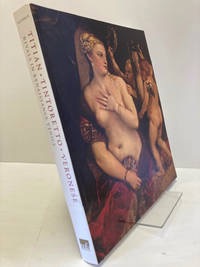
Softcover. Boston, Museum of Fine Arts, 1st, 2009, Book: Very Good, Dust Jacket: None, Softcover, 315 pages. Color illustrations. For nearly four decades in the sixteenth century, the careers of Venice's three greatest painters-, Titan, Tintoretto and Veronese, overlapped, producing mutual influences and bitter rivalries that changed art history. Venice was then among Europe's richest cities, and its plentiful commissions fostered an exceptionally fertile and innovative climate. In it, the three artists, brilliant, ambitious and fiercely competitive, vied with one another for primacy, employing such new media as oil on canvas, with its unique expressive possibilities, and such new approaches as a personal and identifiable signature style. They also pioneered the use of easel painting, a newly portable format that led to unprecedented fame in their lifetimes. With more than 150 stunning examples by the three masters and their contemporaries, this volume elucidates the technical and aesthetic innovations that helped define the uniquely rich "Venetian style," as well as the social, political and economic context in which it flourished. Essays range from examinations of seminal new techniques to such crucial institutions as state commissions and the patronage system. Most of all, by concentrating on the lives and careers of Venice's three greatest painters, Titian, Tintoretto, Veronese paints a vibrant human portrait--one brimming with savage rivalry, one-upmanship, humor and passion. Clean copy. DOMESTIC SHIPPING ONLY.
Hardcover. New York , Penguin Putnam Inc, 1st, 1993, Book: Very Good, Dust Jacket: Very Good, Hardcover, 158 pages, illustrated throughout with photos in b&w. Clean, unmarked copy with only minor wear to dust jacket. Elie Wiesel provides the preface to a master photographer's record of eastern Europe's Jewish communities in the years just before World War II with 160 photographs that capture the ordinary lives of Jews before the Holocaust.
Softcover. Berkeley CA, University of California Press, 1st pbk., 1990, Book: Very Good, Dust Jacket: None, Softcover, 273 pages, b&w illustrations. The first in-depth analysis of the rich spiritual and artistic traditions of the Carib-speaking Yekuana Indians of Venezuela, who live in the dense rain forest of the upper Orinoco. Within their homeland of Ihuruna, the Yekuana have succeeded in maintaining the integrity and unity of their culture, resisting the devastating effects of acculturation that have befallen so many neighboring groups. Yet their success must be attributed to more than natural barriers of rapids and waterfalls, to more than lack of "contact" with our "modern" world. The ethnographic history recounted here includes not only the Spanish discovery of the Yekuana but detailed indigenous accounts of the entire history of Yekuana contact with Western culture, revealing an adaptive technique of mythopoesis by which the symbols of a new and hostile European ideology have been consistently defused through their incorporation into traditional indigenous structures. Clean copy.
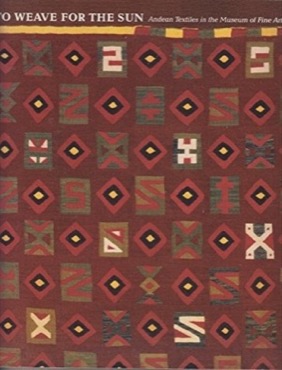
Softcover. Boston, Museum of Fine Arts, 1st, 1992, Book: Very Good, Dust Jacket: None, Softcover, 271 pages illustrated in color and b&w. Textiles were the Incas' most prized possessions. Their first gifts to European strangers were made not of gold and silver, but of camelid fibre and cotton. They believed that the highest form of weaving was created expressly for the sun, which they considered the greatest of the celestial powers. This book uses this image to symbolize Andean tradition as a whole and documents the collection of ancient and Colonial Andean textiles in the Museum of Fine Arts, Boston, which is among the most comprehensive of its kind in the world. Described and illustrated here, in many cases for the first time are the finest examples from the collection: weavings of astonishing virtuosity with striking geometric designs, elaborate carpets and covers, mantles, tunics, featherwork, woven shoes with metal decoration and intriguing figural sculptures with tapestry faces - representing the major cultures of the pre-Columbian period as well as the achievements of Spanish Colonial times. Mild wear to outer wraps, otherwise a clean, bright copy.
Hardcover. Westport CT, Greenwood Press, 1st, 2003, Book: Very Good, Dust Jacket: None, Hardcover, maroon cloth covers stamped in silver, 242 pages. Previous owner's inscription on front fly leaf, otherwise clean. Over the course of the American Occupation of Japan, the U.S. attitude toward the Japanese Communist Party (JCP) gradually shifted from one of friendly cooperation to one of mutual opposition. This new study examines the initial approach toward communism in Japan; internal and external factors that affected American attitudes; the various phases of the relationship; and how Japan ultimately became a democratic nation. Oinas-Kukkonen investigates American information gathering techniques used at the time to determine possible links with the Soviet Union. He also discusses the possibility that Nosaka Sanzo, one of the main leaders of the JCP, was an American spy. Using previously secret records of General MacArthur's intelligence staff and plentiful archival materials on the Occupation, this study explores how the United States originally sought to utilize the JCP to assist in the democratization process. It identifies the perceived threat of a revolution in March 1947 as a key turning point in U.S. attitudes. Involved in a delicate balancing act with multiple Japanese interests, some American officials feared that elements of the extreme left might even evolve into extreme right-wing terrorists. In this comprehensive account, Oinas-Kukkonen includes information on the indirect role of the Europeans in this affair, as well as the roles of outsider groups such as the outcaste burakumin and the Koreans residing in Japan.
Hardcover. Glencoe IL, The Free Press, 1st, 1957, Book: Good, Dust Jacket: None, Hardcover, brown cloth, 382 pages. Dust jacket flaps laid in, name inside front cover. Light pencil marking to about 10 pages. Ancient civilizations and medieval Europe had no "economies" -- no fixed prices for commodities, no production for markets. People have always exchanged goods, of course, but in the pre-modern world, exchange between individuals was most often done through social networks, always with a non-economic motivation. Scarcity, "entrepreneurship", the universal self-regulating market with fixed prices for goods, and the system of trade as we know it, and economics as the fundamental driving sector for all of society --- are all unique to the modern West.
Hardcover. New York, Viking Press, Reprint, 1967, Book: Very Good, Dust Jacket: Very Good, Hardcover, 80 pages. Color illustrations by Feodor Rojankovsky. Ex-library copy with minimal stamping on endpapers. Library tape strip at bottom of dust jacket. Clean, bright copy. A modern European story with the flavor of folk tale, wonderfully illustrated. Set in a Russian country village where peasants still live by habits and traditions. Two orphans, 12-year-old Anna and younger brother Peterkin live on their own. One day they look for cranberries in Wandering Swamp, and they argue about which trail to take. Their one day becomes a tapestry of experiences past the Blind Break Quagmire.
Hardcover. New York, Michael Sullivan, 1st, 1886, Book: Good, Dust Jacket: None, Hardcover, 87 pages, in green cloth covers with black and gilt design. A brief first-hand account of a seven week trip to Europe, principally England, Ireland and Scotland. Uncommon. A bit worn with cracked hinges.
Softcover. Chicago, Ludowici-Celadon Co., 1st, 1929-1932, Book: Very Good, Dust Jacket: None, 26 softcover brochures, approx. 24 pages each. Illustrated with b&w photographs and drawings. Issues from 1929 to 1932. Very good condition.
Hardcover. NY, William Morrow , 1st, 1995, Book: Very Good, Dust Jacket: Very Good, Hardcover in a bright, unclipped dust jacket, color illustrations by Winslow Pels. The beautiful but cold-hearted Princess Turandot decrees that in order to win her, suitors must answer three riddles or be executed. A Persian prince, Calaf, smitten after one look at the young woman, determines to try his luck. Though he answers her riddles correctly, she still refuses to marry him. Because he adores her, he offers her a way out. If she can guess his name, he will leave Peking. This story was introduced by the Venetian playwright Carlo Gozzi (1720-1806), whose dramatized fairy tales were enormously popular during his lifetime. His version, said to be drawn from a tale he found in The Arabian Nights, widely impressed European romantics. Clean, bright copy.
Softcover. Lincoln NE, Bison Books, reprint, 2004, Book: Very Good, Dust Jacket: None, Softcover, 368 pages. Documents the generations of Native peoples who for twelve millennia have moved through and eventually settled along the rocky coast, rivers, lakes, valleys, and mountains of a region now known as Maine. Arriving first to this area were Paleo-Indian peoples, followed by maritime hunters, more immigrants, then a revival of maritime cultures. Beginning in the sixteenth century, Native peoples in northern New England became tangled in the far-reaching affairs of European explorers and colonists. Twelve Thousand Years reveals how Penobscots, Abenakis, Passamaquoddies, Maliseets, Micmacs, and other Native communities both strategically accommodated and overtly resisted European and American encroachments. Clean copy.
NY, US Camera Publishing, 1st, 1953, Book: Very Good, Dust Jacket: Very Good, Hardcover with a bright dust jacket, 424 pages. Catagories of photos include post-war European photography, the year's best pictures American-International, Elisofon's Africa-in color, combat in Korea, The News in Pictures. Clean copy.
Hardcover. Hartford, Canfield and Robins, 1st, 1836, Book: Fair, Dust Jacket: None, 610 pages. Hardcover with brown leather covers. Heavy soil and wear to the leather. Moderate foxing throughout. Black and white illustrations/engraved plates. Iceland to New Zealand, including the Americas, Europe, Asia, and Africa. Water stain to first 40 pages, about one sixth of page. Previous owner's signature on front fly leaf. Sound binding.
Hardcover. Rockport MA, Protean Pree, 1st, 2008, Book: Very Good, Dust Jacket: Very Good, Hardcover in a bright, unclipped dust jacket, b&w illustrations. In 1943, the author was on track to become a doctor like his parents when he flunked organic chemistry at Harvard and enlisted in the army, finding himself heading off to fight in Europe with the 45th Infantry Division (in which famed editorial cartoonist Bill Mauldin also served). Garland chronicles the division's journey from the landing at Sicily through the liberation of Dachau and then, some 60 years later, also seeks to come to terms with his experiences and those of his comrades. Part personal and collective memoir and part history, Garland's book is loaded with recollections compiled from interviews, diaries, drawings, and photographs that he neatly fits into the historical framework. His writing is highly engaging and shares the story of the 45th and its 511 days in combat and four amphibious landings, providing an excellent narrative history of the division during World War II, as well as a personal reckoning.
Softcover. Paris, ACAER/GPC, 1st, 1994, Book: Very Good, Dust Jacket: None, 68 pages. Softcover. Exhibition catalog. French and English text. Black & white photographs. From the introduction: "This catalogue has been re-edited by advanced reading copy wraps en reve architecture centre with the Georges Pompidou Centre, for the presentation in France of the exhibition "Warchitecture-Sarajevo, a wounded city". The exhibition and the catalogue were prepared by the architects of the Sarajevo association, members of the associations of Architects of Bosnia-Herzegovina DAS-SABIH". Light rubbing to cover edges, minor creases at corners. Clean, unmarked text.
Hardcover. US, Gestalten, 1st, 2010, Book: Very Good, Dust Jacket: None, 144 pages. Like new in publisher's shrink-wrap. The Valley of the Shadow is a collection of photography by Miron Zownir that documents a world of unconditional authenticity, dire ecstasy, and demonical possession that exists in the shadows of urban areas in New York, Berlin, and post-Communist Eastern Europe. As controversial as they are uncompromising and poetic, Zownir's expressionistic black and white portraits capture the morbid dignity of society's misfits, freaks, and the homeless. Miron Zownir is a German-Ukrainian photographer, filmmaker, and author whose critically acclaimed work has been featured in international solo and group exhibitions as well as renowned The Valley of the Shadow is not a book for the faint-hearted.
Hardcover. London, Allen Lane, 1st, 2011, Book: Very Good, Dust Jacket: Very Good, Hardcover in a bright dust jacket, 830 pages. Europe's history is littered with kingdoms, duchies, empires and republics which have now disappeared but which were once fixtures on the map of their age - 'the Empire of Aragon' which once dominated the western Mediterranean; the Grand Duchy of Lithuania, for a time the largest country in Europe; the successive kingdoms (and one duchy) of Burgundy, much of whose history is now half-remembered - or half-forgotten - at best. This book shows the reader how to peer through the cracks of mainstream history writing and listen to the echoes of lost realms across the centuries. Illustrated in color and b&w. Clean copy.

 "This Sporting Life, 1878-1991by: Dugan, Ellen")
 "This Sporting Life, 1878-1991by: Dugan, Ellen")
 "Thomas Eakinsby: Wilmerding, Ed., John")
 "Thomas Jefferson's Travels in Europe, 1784-1789by: Shackelford, George Green")




 "Tin Pan Opera: Operatic Novelty Songs in the Ragtime Eraby: Larry Hamberlin")
 "To Give Them Light: Legacy of Roman Vishniacby: Vishniac, Roman")

 "Tolerance, Suspicion, and Hostility: Changing U.S. Attitudes toward the Japanese Communist Movement, 1944-1947by: Oinas-Kukkonen, Henry")

 "Treasure Trove of the Sun, Theby: Prishvin/Feodor Rojankovsky, M.")
 "Trials and Triumphs of a Summer Vacationby: K.A.M.")
 "Tuileries Brochures, The - A Series of Monographs on European Architecture with Special Reference to Roofs of Tile (26 issues)by: V/A")

 "Twelve Thousand Years: American Indians in Maine by: Bruce J. Bourque")
 "U.S. Camera 1954by: Maloney (Ed.), Tom")
 "Universal Traveller: Designed to introduce Readers at home to an Acquaintance with the Arts, Customs and Manners of the Principal Modern Nations on the Globe...by: Go")
 "Unknown Soldiers: Reliving World War II in Europeby: Joseph E. Garland")
 "Urbicide - Sarajevo - Sarajevo, Une Ville Blesseeby: Curic, Borislav/Nedzad Delija/Igor Grozdanic/Nazif Hasanbegovic/Boran Hrelja/Nedzad Hrelja/Aida Kalauzovic-Mandic")
 "Valley of the Shadow, The: The Photography of Miron Zownirby: Zownir, Miron")