Hardcover. New Haven, CT, Yale University Press, 1st, 2015, Book: Very Good, Dust Jacket: None, 440 pages. Hardcover in purple slipcase. Very clean, unmarked copy still in shrink wrap. Gilt lettering on spine. Profusely illustrated with over 200 color plates. Tight copy. Prior to the invention of photography, European and American magazines used colorful prints to depict the latest fashion trends. These illustrations, known as "fashion plates," conveyed the cutting-edge styles embraced by the fashion-conscious elite and proved inspirational to the upwardly mobile. This lavishly illustrated book provides a comprehensive survey of 200 color plates from publications dating from 1778 to the early 20th century, accompanied by authoritative and fascinating texts. Organized chronologically and featuring both men's and women's garments, these lively and colorful vignettes not only are beautiful, but also deftly illustrate the evolution of fashion over time.
Hardcover. London, Routledge & Kegan Paul, 1961, Book: Very Good, Dust Jacket: None, Hardcover, blue cloth with gilt lettering on spine, 498 pages, b&w illustrations. I: The Growth of Ties of Independence. II: Social Classes and Political Organization. Translated from the French by L. A. Manyon. Foreword by M. M. Postan. In this outstanding and magisterial work, which has introduced generations of readers to the feudal period, Marc Bloch treats feudalism as living, breathing force in Western Europe from the ninth to the thirteenth century. Bloch said that his goal in writing Feudal Society was to go beyond the technical study a medievalist would typically write and 'dismantle a social structure.' For Bloch, history is a process of constant evolution and he brilliantly describes the slow process by which feudal societies turned into what would become nation states. A tour de force of historical writing, Feudal Society is essential reading for anyone interested in both Western Europe's past and present. Mild soil to covers otherwise a clean, tight copy.
Hardcover. Princeton NJ, Princeton University Press, 1st, 1984, Book: Very Good, Dust Jacket: Very Good, Hardcover, 353 pages, illustrated throughout in color and b&w. Light edgewear and two tiny closed tears to pictorial dust jacket and faint foxing to edges of textblock. Otherwise, a clean, tight copy.
Hardcover. St. Paul MN, Voyageur Press, 1st, 2007, Book: Very Good, Dust Jacket: Very Good, Hardcover in a bright dust jacket, 208 pages. The days of full service gas stations are a thing of the past, but it will never be forgotten in the minds of many petroliana enthusiasts. Catchy slogans, architecture and color schemes of the station itself, incentives and giveaways, stamps, and clever advertising from the first few decades of the twentieth century until today's fully stocked convenience stores are covered in this book. The highly detailed text also offers a glimpse of what was happening to the gas stations in Europe and serves wonderfully as a comparison with the gas stations in North America at the time. Vintage photography and advertisements provide a wonderful visual trip back in time to the days of being greeted by a smiling attendant every time you pulled into the gas station. Clenn copy.
Hardcover. NY, Da Capo Press, 1st, 2012, Book: Very Good, Dust Jacket: Very Good, Hardcover in a bright, unclipped dust jacket. When the wartime 1944 presidential election campaign geared up late that spring, Franklin D. Roosevelt had already occupied the White House years longer than any other president. Sensing likely weakness, the Republicans mounted an energetic and expensive campaign, hitting hard at FDR's liberal domestic policies and the war's ongoing cost. Despite gravely deteriorating health, FDR and his feisty running mate, the unexpected Harry Truman, campaigned vigorously against young governor Thomas E. Dewey of New York and old-line Ohio governor John Bricker. Roosevelt's charm and wit, as well as the military successes in Europe and the Pacific, contributed to his sweeping electoral victory. But the hard-fought campaign would soon take its toll on America's only four-term president. Preeminent historian and biographer Stanley Weintraub recaptures FDR's striking "last campaign" and the year's momentous events, from the rainy city streets where Roosevelt, his legs paralyzed by polio since 1922, rode in an open car, to the battlefronts where the commander-in-chief's forces were closing in on Hitler and Hirohito.
Hardcover. London, Frances Lincoln, 1st, 2015, Book: Very Good, Dust Jacket: None, Hardcover, 10 x 12", 304 pages. Over 300 color plates. A comprehensive document of the talent and artistry that went into the design and making of European fashion images from the second half of the sixteenth century to the first half of the twentieth century. No dust jacket issued.
Hardcover. Boston, Little, Brown and Company, 1st, 1970, Book: Good, Dust Jacket: Fair, 272 pages. Hardcover. Red cloth cover with gilt titles. Black & white illustrations. Dust jacket with tears, creasing along edges. Clean, unmarked pages.
Hardcover. NY, St. Martin's Press, 1st, 2023, Book: Very Good, Dust Jacket: Very Good, Hardcover in a bright, unclipped dust jacket, 381 pages. From the beginning of World War II through the early days of Vietnam, groundbreaking female photojournalist and war correspondent Dickey Chapelle chased dangerous assignments her male colleagues wouldn't touch, pioneering a radical style of reporting that focused on the humanity of the oppressed. She documented conditions across Eastern Europe in the wake of the Second World War. She marched down the Ho Chi Minh Trail with the South Vietnamese Army and across the Sierra Maestra Mountains with Castro. She was the first reporter accredited with the Algerian National Liberation Front, and survived torture in a communist Hungarian prison. She dove out of planes, faked her own kidnapping, and endured the mockery of male associates, before ultimately dying on assignment in Vietnam with the Marines in 1965, the first American female journalist killed while covering combat. Small remainder dot on bottom edge otherwise clean.
Hardcover. Montreal, Drawn & Quarterly, 1st, 2003, Book: Very Good, Dust Jacket: None, 140 pages. Hardcover NO dust jacket. Black and white comic. Clean, unmarked copy with minor wear to boards. Award-winning comix-journalist Joe Sacco goes behind the scene of war correspondence to reveal the anatomy of the big scoop. He begins by returning us to the dying days of Balkan conflict and introduces us to his own fixer; a man looking to squeeze the last bit of profit from Bosnia before the reconstruction begins. Thanks to a complex relationship with the fixer Joe discovers the crimes of opportunistic warlords and gangsters who run the countryside in times of war. But the west is interested in a different spin on the stories coming out of Bosnia. Almost ten years later, Joe meets up with his fixer and sees how the new Bosnian government has "dealt" with these criminals and Joe ponders who is holding the reins of power these days...
Hardcover. London, Collins, 1st , 1948, Book: Very Good, Dust Jacket: Very Good, Hardcover, translated from French by D.I. Wilton. 20 tipped-in color plates, 131 black & white plates. Front hinge cracked otherwise very good in a very good dust jacket.
Softcover. New York, Hastings House Publishers, 1st, 1976, Book: Near Fine, Dust Jacket: Near Fine, Beautifully illustrating the folk art of Europe in two parts, Part one containing textile such as fabrics, rugs and embroidery, while part two deals with ceramics, metals, wood and other materials. Color and b&w illustrations throughout. Brown cloth, gilt lettering to spine, nice pictorial dust jacket, all in very nice, clean and crisp condition. Plain cardboard slipcase.
Hardcover. Bloomingdale, Indiana University Press, reprint, 1991, Book: Very Good, Dust Jacket: Very Good, 290 pages. Hardcover with dust jacket. Clean and tight copy with only light edgewear to dust jacket and very light foxing to top text block. This classic work, first published in 1956, is now available in English. Along with Luthi's The European Folktale and Propp's The Morphology of the Folktale, Rohrich's Marchen und Wirklichkeit is considered a key text in folklore scholarship.
Hardcover. London, Thames and Hudson , 1st, 2008, Book: Very Good, Dust Jacket: None, Hardcover, pictorial cloth stamped with gilt lettering. Color photos throughout. These captivating landscapes by the Magnum photographer Stuart Franklin provide a visual document of Europe in the midst of a growing environmental crisis. Technically flawless, cool, detached, yet highly analytical, Franklin's photos reveal the irrefutable proof of humans' effect on Europe and the vulnerability we face as a result, from the Arctic Circle to the Peloponnese. Footprint brings together a singular photographic perspective with a powerful environmental message to present an engaging picture of the vulnerability of Europe's landscape and population in the wake of ominous change. Features photographs that provide a visual document of Europe in the midst of an environmental crisis.
Hardcover. NY, Harcourt Brace and Company, 1st US, 1939, Book: Very Good, Dust Jacket: Good, Hardcover in a lightly worn and faded dust jacket, 366 pages. A collection of speeches by the Right Hon. Anthony Eden in the House of Commons and elsewhere through 1938, which offers a criticism on British foreign policy. Previous owner's inscription on front fly leaf, otherwise clean.
Hardcover. New York , Arno Press, reprint, 1976, Book: Very Good, Dust Jacket: None, 295 pages, green cloth covers with gilt lettering. Previous owner's stamp on front fly leaf, otherwise clean, very good. Facsimile reprint of the 1933 edition. Scarce in hardcover.
Hardcover. Canberra/London, Australian Institute of Aboriginal Studies/Gerald Duckworth and Co., 1st, 1977, Book: Very Good, Dust Jacket: Very Good, Oblong hardcover in a lightly worn dust jacket. 486 pages with illustrations in b&w and color. From Papers presented to a symposium at the 1974 meeting of the Australian Institute of Aboriginal Studies. A look at the art works of Aboriginal Australia from the past & present, as seen in the context of the art of prehistoric Europe. An attempt at an ethnographic juxtaposition of prehistoric art. Clean copy.
Hardcover. New Haven, CT, Yale University Press, 1st, 2015, Book: Very Good, Dust Jacket: Very Good, 224 pages. Hardcover with dust jacket. Very clean, like new copy still in publishers shrink wrap. Over 200 duotone images throughout. Tight copy. Born in Cork, Ireland, Frank Browne (1880-1960) was both a distinguished Jesuit and an accomplished photographer. At age 17, before commencing his studies for the priesthood, he embarked on a tour of Europe armed with a camera. Browne quickly discovered a strong affinity for photography, and continued to take photographs throughout his life. It was not until 1985, however-when Father Edward O'Donnell SJ discovered a large trunk in the Irish Jesuit Provincial's House and found it packed with negatives and photographs-that Browne was catapulted to international fame. Father Browne's remarkable life is recorded in the superb selection of images presented in this book. With wit and a sharp eye, he observed 20th-century Ireland; life as a Jesuit priest; his experience as a passenger on the first leg of the voyage of the Titanic in 1912; and his later travels throughout Europe, Egypt, Yemen, Ceylon, and Australia. This handsome, copiously illustrated volume offers a complete survey of the photographic work of an exceptional man.
London, National Gallery, 1st, 2013, Book: Very Good, Dust Jacket: None, Softcover, 71 pages illustrated in color. A key member of the Hudson River School, Frederic Church (1826-1900) rose to fame as the creator of some of America's most iconic landscape paintings. He also traveled abroad extensively, making trips to Jamaica, South America, Europe, and the Middle East. At home and away, Church made numerous plein air oil sketches of the landscapes he saw, some magnificent, some humble, many of them later subjects for his full-scale paintings. Frederic Church and the Landscape Oil Sketch features some thirty sketches Church executed during his career. Many of these wonderful works come from Olana, the artist's magnificent home overlooking the Hudson River. As Andrew Wilton's essay explains, these informal and often spontaneous sketches played a vital role in the practice and pedagogy of landscape painting in American art just as they did in European art of the 19th century. Clean copy.
hardcover. London, Sinclair-Stevenson , 1st, 1994, Book: Very Good, Dust Jacket: Very Good, 293 pages. Hardcover. INSCRIBED BY AUTHOR on title page. Gilt titles on spine. Illustrated end papers and paste downs. Clean, unmarked copy with only minor wear to dust jacket. Novel based on a true piece of colonial history when 25 European radicals met on Lamu planning to travel inland & set up a Utopia on Mount Kenya.
Hardcover. NY, Simon & Schuster, 1st, 2022, Book: Very Good, Dust Jacket: Very Good, Hardcover in a bright dust jacket, When Bill Browder's young Russian lawyer, Sergei Magnitsky, was beaten to death in a Moscow jail, Browder made it his life's mission to go after his killers and make sure they faced justice. The first step of that mission was to uncover who was behind the $230 million tax refund scheme that Magnitsky was killed over. As Browder and his team tracked the money as it flowed out of Russia through the Baltics and Cyprus and on to Western Europe and the Americas, they were shocked to discover that Vladimir Putin himself was a beneficiary of the crime. As law enforcement agencies began freezing the money, Putin retaliated. He and his cronies set up honey traps, hired process servers to chase Browder through cities, murdered more of his Russian allies, and enlisted some of the top lawyers and politicians in America to bring him down. Putin will stop at nothing to protect his money. As Freezing Order reveals, it was Browder's campaign to expose Putin's corruption that prompted Russia's intervention in the 2016 US presidential election. Clean copy.
NY/Paris, Hachette/French & European Publications, 1st US, 1965, Book: Very Good, Dust Jacket: Very Good, Hardcover, 530 photos. 40 in color. 341 pages. This is the English translation of Verlets' 1963 masterpiece "Les Ebenistes du XVIIIe Siecle Francais". Written by the Chief Curator of decorative arts at the Louvre, this classic text discusses each of the known French cabinet-makers active during the 18th century. This involves over 30 individuals, who were influential in determining the styles of the Regency, through Louis XV & XVI. Sections on each figure or firm with numerous examples of their furniture. Excellent 12 page appendice on maker marks, with thumbnail sketches of individuals and firms, business locations, etc.
Chicago, University of Chicago Press, 1st, 1989, Book: Very Good, Dust Jacket: Very Good, Hardcover, 256 pages. Lavishly illustrated, this volume is the first complete catalog of the French daguerreotype collection of the International Museum of Photography at George Eastman House. Janet E. Buerger uses this remarkable collection of images to produce a cultural history of the daguerreotype's most learned following--an elite group of mid-nineteenth-century intellectuals who sought to understand and develop the usefulness, potential, and beauty of this camera image. This varied group, including entrepreneurs, painters, scientists, and historians, enables Buerger to trace the influence of photography into virtually every area of nineteenth-century European intellectual life.
Softcover. NY, Hard Case Crime, reprint, 2007, Book: Very Good, Dust Jacket: None, Softcover, 254 pages. A man. A woman. A kiss in the dark. That is how it begins. But before his nightmare ends, Prescott Marshall will learn that kisses and darkness can both hide evil intent - and that the worst darkness of all may be lurking inside him. Lost for more than half a century and never before published under Cornell Woolrich's real name, FRIGHT is a breathtaking noir crime novel worthy of the writer who has been called "the Hitchcock of the written word" and "one of the giants of mystery fiction." Nowhere is this better demonstrated than in Fright, a novel set in 1915. A year from Woolrich's childhood but one he recreates with an astonishing attention to detail. (Slang, music, fashion, the distant echoes of the war being waged in Europe, etc.) Fright is very much a period piece albeit one that is timeless in its treatment of guilt and paranoia. Two emotional states the author had more than a passing familiarity with. Clean copy.
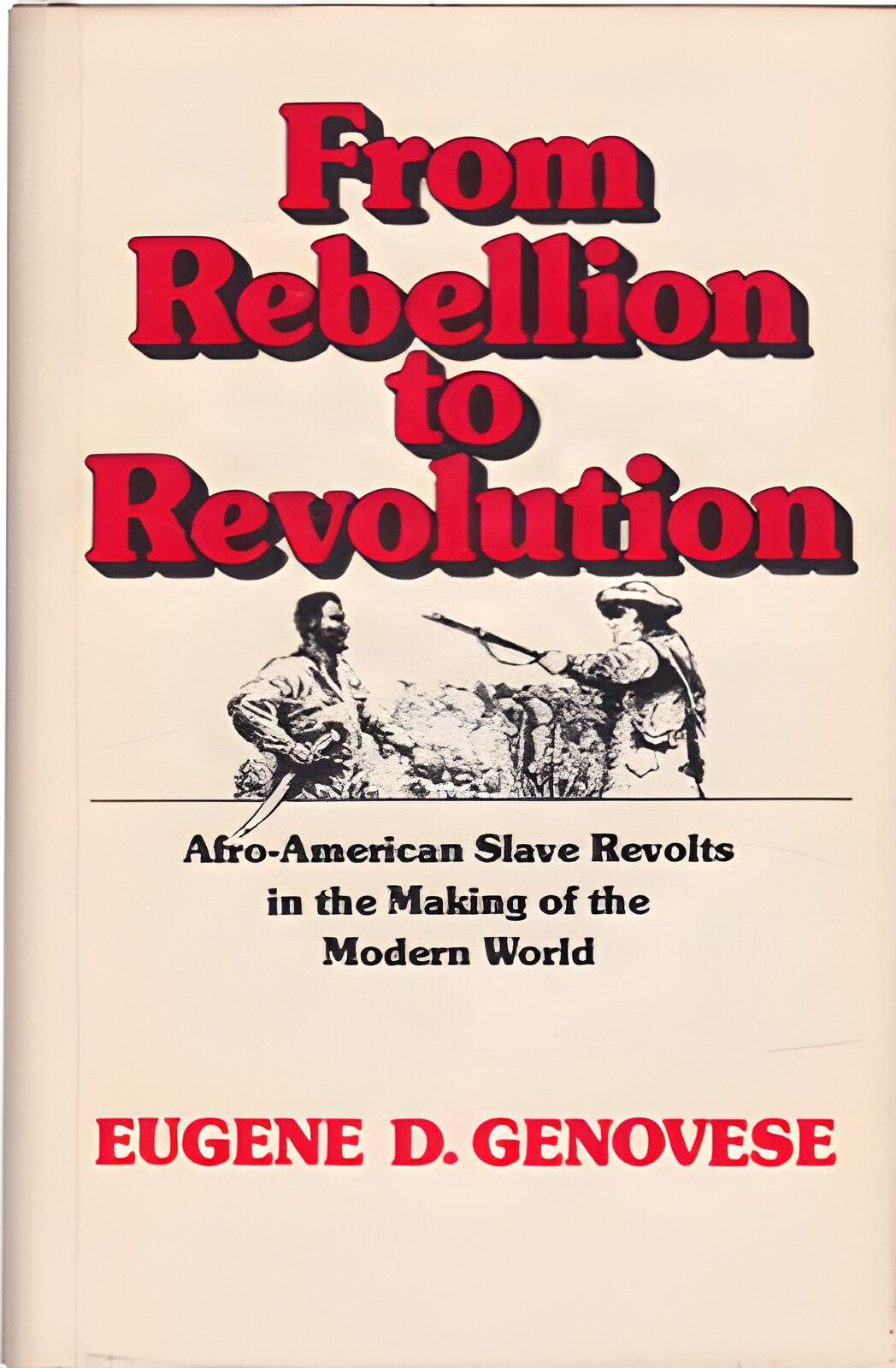
Hardcover. Baton Rouge, Louisiana State University , 1st, 1979, Book: Very Good, Dust Jacket: Very Good, Hardcover in a bright dust jacket, 173 pages. This work is a brief look at worldwide slave revolts in the 17th through 19th centuries, emphasizing their interrelations with European power struggles, which gave rebels hope of finding weak spots in the defenses of the slave powers. The French Revolution also had an influence on slave revolts, but the canny European powers used indigenous peoples to suppress slave revolts (e.g., native Americans) and took advantage of African ethnic divisions as well. American slaves stood little chance of revolt and were under constant surveillance from Southerners, who coward in fear after the successful rebellions in the Caribbean, particularly in Hispaniola, and after Nat Turner and John Brown's efforts. Genovese also brings up religion's double-edged sword: one side used to pacify slaves and the other side to inspire them to break their chains. In short, this scholarly treatise is thought-provoking as well as informative and ends with an inspirational quote from one of Frederick Douglass's lectures. Name on front fly leaf, otherwise a clean copy.

 "Fashion Plates: 150 Years of Styleby: Calahan, April")

 "Field Guide to Birds of the USSR, A : Including Eastern Europe and Central Asiaby: Flint, V. E. and others")
 "Fill'er Up!: The Great American Gas Station by: Tim Russell")
 "Final Victory: FDR's Extraordinary World War II Presidential Campaignby: Stanley Weintraub")
 "Fine Art of Fashion Illustration, The by: Robinson, Julian and Gracie Calvey")
 "First Lady of the Renaissance - A Biography of Isabella d'Esteby: Meyer, Edith Patterson")
 "First to the Front: The Untold Story of Dickey Chapelle Trailblazing Female War Correspondent by: Lorissa Rinehart")
 "Fixer, The: A Story from Sarajevo by: Sacco, Joe")
 "Flemish Primitives, Theby: Van Puyvelde, Leo")
 "Folk Art of Europeby: Bossert, Helmut Th.")
 "Folktales and Realityby: Rohrich, Lutz")
 "Footprint: Our Landscape in Fluxby: Stuart Franklin")

 "Foreign Bonds; An Autopsy - A Study of Defaults and Repudiations of Government Obligationsby: Winkler, Max")
 "Form in Indigenous Art. Schematisation in the art of Aboriginal Australia and prehistoric Europeby: Ucko, Peter J. (Ed.)")
 "Frank Browne: A Life through the Lensby: Davison, Edwin (Editor)")

 "Freeland (SIGNED COPY)by: Jones, J. D. F.")



 "French Cabinetmakers of the Eighteenth Centuryby: Verlet, Pierre")
 "French Daguerreotypesby: Buerger, Janet E.")