Hardcover. New Haven CT, Yale University Press, 1st, 2016, Book: Very Good, Dust Jacket: Very Good, Hardcover in a bright dust jacket. 528 pages, b&w illustrations. A groundbreaking and comprehensive history of the Roman Peace from one of the leading historians of the ancient world, Clean copy
Hardcover. Westport CT, Greenwood Press, reprint, 1981, Book: Very Good, Dust Jacket: None, Hardcover, black cloth with gilt lettering on spine, 210 pages. Professor Dunn presents an account of the making of the Japanese peace treaty. He discusses the international environment from the outbreak of World War II to 1950, the San Francisco conference of September 1951 and the security arrangements which the United States helped to create in the Pacific and Asian area. Originally published in 1963 by Princeton. Name on front fly leaf, otherwise clean.
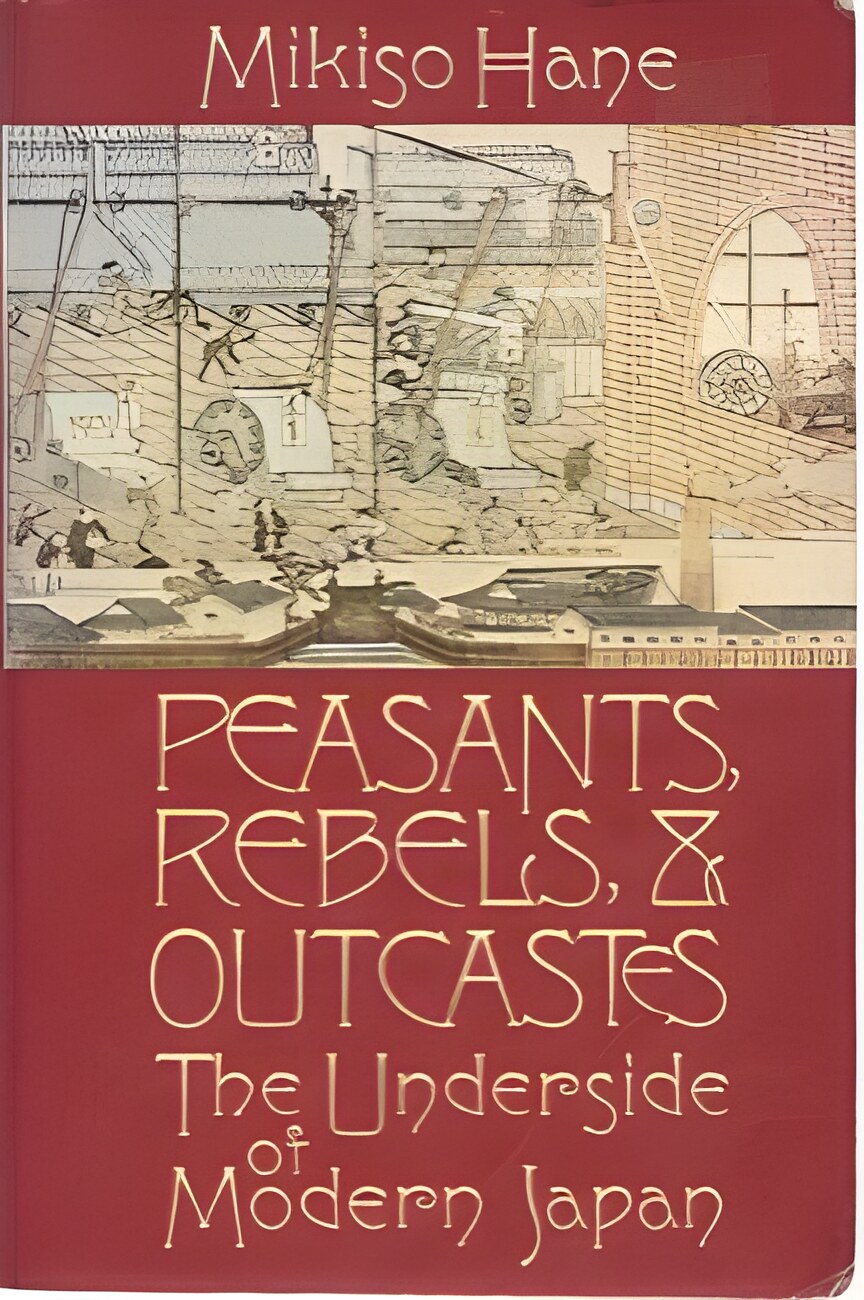
Softcover. NY, Pantheon Books, 1st, 1982, Book: Very Good, Dust Jacket: None, Softcover, 297 pages. This compelling social history uses diaries, memoirs, fiction, trial testimony, personal recollections, and eyewitness accounts to weave a fascinating tale of what ordinary Japanese endured throughout their country's era of economic growth. Through vivid, often wrenching accounts of peasants, miners, textile workers, rebels, and prostitutes, Mikiso Hane forces us to see Japan's "modern century" (from the beginnings of contact with the West to World War II) through fresh eyes. In doing so, he mounts a formidable challenge to the success story of Japan's "economic miracle." Starting with the Meiji restoration of 1868, Hane vividly illustrates how modernization actually widened the gulf, economically and socially, between rich and poor, between the mo-bo and mo-ga ("modern boy" and "modern girl") of the cities and their rural counterparts. He interlaces his scholarly narrative with sharply etched individual stories that allow us see Japan from the bottom up. Clean copy.
Hardcover. New Haven CT, Yale University Press, 1st, 2000, Book: Very Good, Dust Jacket: Very Good, Hardcover in a bright dust jacket, 234 pages, b&w illustrations. Nicolas-Claude Fabri de Peiresc (1580-1637) was, during his lifetime, one of Europe's most famous men. A friend of Pope Urban VIII and Galileo, of Peter-Paul Rubens and Hugo Grotius, of Tommaso Campanella and Marin Mersenne, Peiresc played an important role in the intellectual culture of his time. This book is the first study in English of this extraordinary man, as well as a vivid portrait of his whole circle. Looking through the lens of Peiresc's life, Peter N. Miller brings into focus the early-seventeenth-century world of learning-its people, places, and ideas. Drawing on the extensive Peiresc archive (more than 50,000 pieces of paper), Miller brilliantly evokes the lives of antiquaries, philosophers, theologians, and politicians of Peiresc's day, only some of whom remain known today. He explores the age in which Peiresc's toleration and sociability, his political action and cosmopolitanism, and his serious scholarship without dogmatism were identified as a set of virtues and practices by which to live. Peiresc's notion of scholarship as a moral exercise, the sweep of his interests, and the cross-Continental reach of his intellectual life show with new clarity what it meant to be a man of learning during the decades around 1600. Name on front fly leaf, otherwise clean copy.
Softcover. London, Tate Gallery, 1st, 2007, Book: Very Good, Dust Jacket: None, Softcover, 216 pages. A key figure in the history of British Pop Art, Blake is one of the most influential and original artists working in Britain today. Central to Blake's work since the 1950s has been his fascination with popular culture, ranging from music to Hollywood icons and wrestling stars. Perhaps his most famous engagement with Pop came with his design for the cover of The Beatles' album Sgt Pepper's Lonely Hearts Club Band. With this and other works he helped create a specifically British pop aesthetic that defined an era. A prolific artist, he has utilised a variety of media including painting, drawing, collage, sculpture and printmaking; this study focuses principally on his two-dimensional works and provides the first thorough survey of his paintings from the 1950s through to the present. It will include major icons of twentieth-century art, such as Self-Portrait with badges (1961), and Have a Nice Day, Mr Hockney (1981-3), but will also feature many lesser-known works including his recent, major work The Marcel Duchamp World Series.
Hardcover. Damiani, 1st, 2008, Book: Very Good, Dust Jacket: None, Hardcover, 162 pages. Part of a whole gang of street artists--from Barry McGee to Swoon--who have broken into the art world in the last decade or so, Phil Frost's signature style is a funky tribalism--Hawaii by way of New York City--infused with a quirky sense of art history and design. In the 1990s, Frost honed his skills by painting walls, found objects and street detritus with his intricate, compulsive and highly evolved form of tagging. Frost's gallery exhibitions are crowded affairs, filled with wildly patterned totemic objects and baseball bats while the walls are stacked with colorful mixed media paintings. He crafts his painstaking paintings by collaging layers of found imagery on grounds of symmetrical black-and-white patterning, which he paints with correction fluid, and that often morph into language-like glyphs or symbols. Frost states, "I believe [my work] is indigenous to myself. I believe that within every person there is an indigenous expression of themselves." Including an essay by New York journalist Carlo McCormick and notorious lowbrow artist Pusshead, this is Frost's first monograph, and an invaluable introduction to the evolution of his style.
London, Hutchinson, 1st UK, 1969, Book: Very Good, Dust Jacket: Very Good, Hardcover with dust jacket. Black & white photos. Very small closed tear on spine of dust jacket. An account of his life and work. Ponting became the official photographer of Scott's second expedition to the South Pole. With 77 black and white photographs taken on his travels.
Softcover. Duke University Press, 1st, 2017, Book: Very Good, Dust Jacket: None, Softcover, 381 pages, color and b&w illustrations. Photography is one of the principal filters through which we engage the world. The contributors to this volume focus on Walter Benjamin's concept of the optical unconscious to investigate how photography has shaped history, modernity, perception, lived experience, politics, race, and human agency. In essays that range from examinations of Benjamin's and Sigmund Freud's writings to the work of Kara Walker and Roland Barthes's famous Winter Garden photograph, the contributors explore what photography can teach us about the nature of the unconscious. They attend to side perceptions, develop latent images, discover things hidden in plain sight, focus on the disavowed, and perceive the slow. Of particular note are the ways race and colonialism have informed photography from its beginning. The volume also contains photographic portfolios by Zoe Leonard, Kelly Wood, and Kristan Horton, whose work speaks to the optical unconscious while demonstrating how photographs communicate on their own terms. The essays and portfolios in Photography and the Optical Unconscious create a collective and sustained assessment of Benjamin's influential concept, opening up new avenues for thinking about photography and the human psyche. Clean, bright copy.
Softcover. NY/London, Routledge, reprint, 2007, Book: Very Good, Dust Jacket: None, Softcover, 470 pages. Forty of the world's most active art historians and theorists, including Victor Burgin, Joel Snyder, Rosalind Krauss, Alan Trachtenberg, Geoffrey Batchen, Carol Squiers, Margaret Iversen and Abigail Solomon-Godeau in animated debate on the nature of photography. Photography has been around for nearly two centuries, but we are no closer to understanding what it is. For some people, a photograph is an optically accurate impression of the world, for others, it is mainly a way of remembering people and places. Some view it as a sign of bourgeois life, a kind of addiction of the middle class, whilst others see it as a troublesome interloper that has confused people's ideas of reality and fine art to the point that they have difficulty even defining what a photograph is. For some, the whole question of finding photography's nature is itself misguided from the beginning. This provocative second volume in the Routledge The Art Seminar series presents not one but many answers to the question what makes a photograph a photograph? Clean copy.
Hardcover. Princeton University Press, 1st, 1997, Book: Very Good, Dust Jacket: Very Good, Hardcover, 208 pages. The Victoria and Albert Museum (V&A) has one of the finest and oldest collections of photography in the world. In this fascinating book, Mark Haworth-Booth, Curator of Photographs at the V&A, offers the first comprehensive introduction to this extensive and impressive collection. In the process, he provides the reader with a general history of photography from its beginnings as a scientific curiosity, through its international commercialization, to its coming of age as an art form in its own right. The V&A's Victorian holdings are outstanding, with major photographs by Roger Fenton, David Octavius Hill, Robert Adamson, Julia Margaret Cameron, Gustave Le Gray, Camille Silvy, and Lady Hawarden. In recent years, the museum has acquired significant works by such twentieth-century master photographers as Bill Brandt, Henri Cartier-Bresson, Paul Martin, Walker Evans, Paul Strand, Manuel Alvarez Bravo, and Cecil Beaton. A number of these photographs are published here for the first time
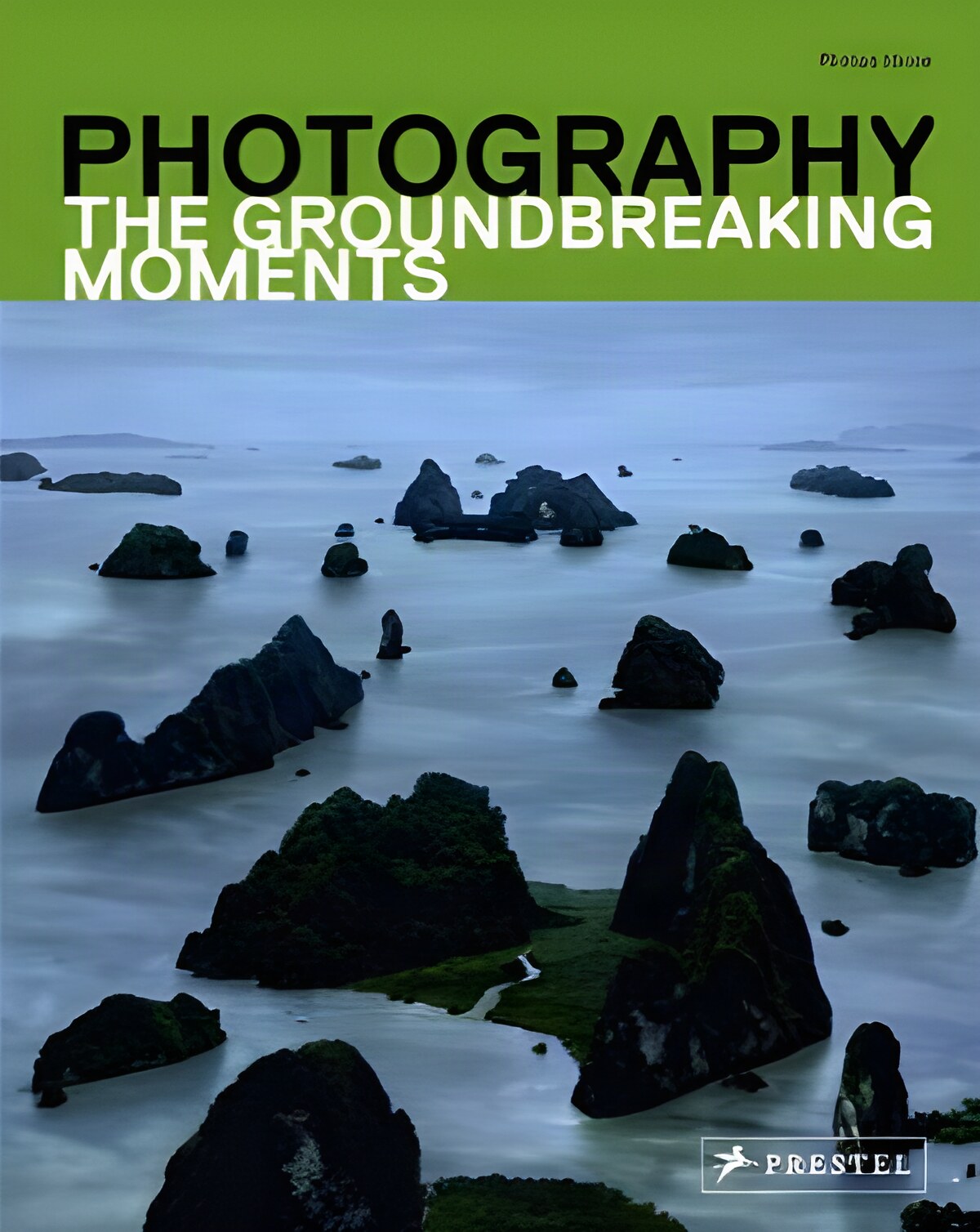
Softcover. Munich , Prestel, 1st, 2012, Book: Very Good, Dust Jacket: None, Softcover, 192 pages. Chronologically arranged, each chapter focuses on a particular work or idea that changed the course of photography. Presented in beautiful spreads and with informative text, the book opens with photography's genesis in the form of the camera obscura. Centuries later, Daguerre, Niepce, and Talbot invented their own means of capturing light on paper. The book covers groundbreaking genres such as still life, landscape, portraiture, and nudes. Sections on the role of photography in journalism illustrate how the camera's presence on battlefields, on city streets, and in factories helped inform and reform the modern world. Fashion, animals, Surrealism, and staged portraits are also explored. Perfect for perusing or reading from cover to cover, this book illustrates how photography developed from a concept to a world-changing force--one that attempted to shed light on truth yet can also obscure and alter reality in dazzling ways. Clean copy.
Hardcover. Prestel Publishing, 1st, Book: Very Good, Dust Jacket: Very Good, Hardcover in a bright dust jacket, 576 pages. Unlike many other artistic media, photographys origins are well documented, as are its ever-changing technologies and applications. Written by an international team of experts, this definitive history of photography looks at every step of the fields dynamic evolution, period by period and movement by movement. Each key genre is chronologically presented within its social, economic, and political context, along with close analysis of specially selected works that best exemplify the characteristics of the period. With more than 500 gorgeous examples in black and white and color, the book explores in-depth virtually every aspect of the medium since its first public demonstration in 1839 to the latest innovations: from early portraits and the birth of photojournalism to travel photography and the mapping of the world; from the Pictorialists to the avant-garde; from celebrity and fashion to documentary and landscape. Along the way readers will learn why some photographs are considered iconic, and why the medium as an art form continues to challenge and enthrall us. DUE TO WEIGHT, DOMESTIC SHIPPING ONLY.
Hardcover. NY, Farrar Straus & Giroux, 1st US, 2023, Book: Very Good, Dust Jacket: Very Good, Hardcover in a bright, unclipped dust jacket, 588 pages, several color plates. Before Picasso became Picasso-the iconic artist now celebrated as one of France's leading figures-he was constantly surveilled by the French police. Amid political tensions in the spring of 1901, he was flagged as an anarchist by the security services-the first of many entries in an extensive case file. Though he soon emerged as the leader of the cubist avant-garde, and became increasingly wealthy as his reputation grew worldwide, Picasso's art was largely excluded from public collections in France for the next four decades. The genius who conceived Guernica in 1937 as a visceral statement against fascism was even denied French citizenship three years later, on the eve of the Nazi occupation. In a country where the police and the conservative Academie des Beaux-Arts represented two major pillars of the establishment at the time, Picasso faced a triple stigma-as a foreigner, a political radical, and an avant-garde artist. Picasso the Foreigner approaches the artist's career and art from an entirely new angle, making extensive use of fascinating and long-overlooked archival sources. In this groundbreaking narrative, Picasso emerges as an artist ahead of his time not only aesthetically but politically, one who ignored national modes in favor of contemporary cosmopolitan forms. Remainder dot to top edge, otherwise a bright, clean copy.
Softcover. NY, The Museum of Modern Art, 1st, 2002, Book: Very Good, Dust Jacket: None, Softcover, 192 pages. Selected from 17 million prints preserved in the archives of The New York Times, the spectacular photographs in this book provide a spellbinding sample from the rich archive that is the twentieth century, as seen through the eyes of a great newspaper. Revealed is the extraordinary and omnivorous breadth of photography's gaze: vivid pictures of both World Wars; of presidents, mayors, dictators and celebrities; of Beatles fans and Halley's comet; of victims and perpetrators, riots and disasters; of Bill Bradley on the court and Willie Mays sliding into home--and a great many more. Underlying them all is the gripping immediacy that makes news photography not only an indispensable presence in the daily paper but a vital part of history. This book includes an illustrated chronology that traces the evolution of the technology and business of news photography, with special attention to the role of The New York Times and to the recent rise of digital technologies in newspaper production. Originally published to accompany an exhibition at The Museum of Modern Art, New York.
Hardcover. NY, Harry N Abrams, 1st, 1995, Book: Very Good, Dust Jacket: Very Good, Hardcover in a bright dust jacket, 232 pages. The first photographic record of the Manhattan Project--the U.S. Government-sponsored effort to build an atomic bomb. With an introduction by Richard Rhodes. The granddaughter of Enrico Fermi, a key participant in the Manhattan Project, presents a pictorial survey of the making of the atomic bomb, containing many never-before-published photographs and snapshots of the many aspects of the Project.Illustrated with over 100 B&W photographs, some color. Clean copy. DOMESTIC SHIPPING ONLY.
Hardcover. NY, Norton, 1sr, 2021, Book: Very Good, Dust Jacket: Very Good, Hardcover in a bright, unclipped dust jacket. In her first volume of new poems in twelve years, Rita Dove investigates the vacillating moral compass guiding America's, and the world's, experiments in democracy. Whether depicting the first Jewish ghetto in sixteenth-century Venice or the contemporary efforts of Black Lives Matter, a girls' night clubbing in the shadow of World War II or the doomed nobility of Muhammad Ali's conscious objector stance, this extraordinary poet never fails to connect history's grand exploits to the triumphs and tragedies of individual lives.
Softcover. London, Cambridge University Press , 1st, 1982, Book: Very Good, Dust Jacket: None, Softcover, 500 pages, maps and charts. The papers collected in this volume present important information on the history and culture of contemporary gathering and hunting peoples from Canada, India, Africa, Australia and the Philippines. The volume focuses on two themes: first, on the techniques which band-living foraging peoples employ to organise their social and economic lives; and second, on their fight for the right to their own lands and for a measure of cultural and political autonomy. The contributors maintain that gatherer-hunters are not examples of a disappearing way of life, but peoples who have maintained their social and economic practices through long periods of contact with stratified societies. The aim of this volume it to make known to as wide an audience as possible the daily lives, the patterns of relations between the sexes and the political orientations of the world's contemporary foragers. Clean copy.
Softcover. Taschen, reprint, 1991, Book: Very Good, Dust Jacket: None, Softcover in bright wraps, 240 pages. "Everything is beautiful," raved Andy Warhol, in raptures about the glamour of modern life, consumer society, and the world of the media and its stars; his proclamation can be considered the maxim of the pop generation, which included artists Jasper Johns, Roy Lichtenstein, Claes Oldenburg, Robert Rauschenberg, James Rosenquist, Tom Wesselmann, and Richard Hamilton, among others. The pop artists of the 1960s had a profound effect on the fabric of art history and their influence can be clearly seen in art today. Here, Tilman Osterwold explores the styles, themes, and sources of pop art around the world. Clean copy.
Hardcover. New Haven CT, Yale University Press , 1st, 2002, Book: Very Good, Dust Jacket: Very Good, Hardcover, 184 pages. ARTnews, the oldest art magazine in America and the most widely circulated art magazine in the world, is celebrating its one-hundredth anniversary in 2002. This attractive book celebrates and commemorates this milestone event, presenting one hundred of the best photographic portraits commissioned by and reproduced in the magazine since its origin. These fascinating photographs chronicle the history of the magazine and present a "who's who" of people who have shaped the art world over the last century. Portrait of the Art World includes photographs of many of the great European and American artists of the twentieth century, including George Bellows, Francis Bacon, Pablo Picasso, Piet Mondrian, Jackson Pollock, Alexander Calder, and Alice Neel. The photographers-often as fascinating as their subjects-range from Zaida Ben-Yusuf, Alice Boughton (early members of Alfred Stieglitz's circle), and Jessie Tarbox Beals (perhaps the first woman photojournalist) to Stieglitz himself, Man Ray, and Cecil Beaton. Contemporary photographers featured in the book include Timothy Greenfield-Sanders, Arnold Newman, Richard Avedon, and Robert Mapplethorpe. The book also presents an essay by William F. Stapp exploring the historical context of portrait photography in ARTnews; an essay on the history of ARTnews by Pete Hamill; and an essay by Milton Esterow, the current editor and publisher of ARTnews, discussing his personal view of the magazine. This handsomely illustrated book is the catalogue for an exhibition at the New-York Historical Society from September 27, 2002, to January 5, 2003, which will then travel to Washington, Chicago, and San Francisco
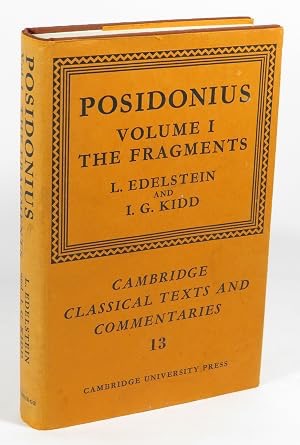
Hardcover. UK, Cambridge University Press , 1st, 1972, Book: Very Good, Dust Jacket: Very Good, Hardcover in a bright orange dust jacket, 336 pages. This book is a commentary on the surviving testimonia and fragments of Posidonius' work collected in Volume I of this edition. Posidonius was one of the most important philosophers and intellectuals writing in the first century BC Graeco-Roman world. The purpose of this commentary is to assess the fragmentary evidence and reports of Posidonius found in the writings of about sixty ancient authors, and to separate what Posidonius himself actually said from the interpretations and distortions of his reporters. Since Posidonius also wrote at length on the sciences and on geography, and composed a large History, Kidd assesses his work against the philosophical, scientific, and historical writings of Posidonius' predecessors and contemporaries. Each fragment is explored through detailed examination of its context, philosophical and scientific content, and its relationship to Posidonius' whole thought and to contemporary ideas. VOLUME 1 ONLY. The fragments are in the original Greek and Latin (mostly Greek). The Introduction is in English. Previous owner's name on front fly leaf, embossed stamp, otherwise a clean copy.
Softcover. London, Imperial War Museums, 1st, 2014, Book: Very Good, Dust Jacket: None, 96 pages. Softcover. Very clean, unmarked copy with only minor edgewear. Posters of the First World War collects more than one hundred posters from America, Britain, France, Germany, and Italy that showcase renewed concern among the warring nations with national character and conduct.
Hardcover. New Haven CT, Yale University Press, 1st, 2015, Book: Very Good, Dust Jacket: None, Hardcover, 238 pages. Like new in publisher's shrink-wrap. Covering the period from the Revolution to the beginning of World War II, this book considers Soviet avant-garde photography and film in the context of political history and culture. Three essays trace this generation of artists, their experiments with new media, and their pursuit of a new political order. A wealth of stunning photographs, film stills, and film posters, as well as magazine and book designs, demonstrate that their output encompassed a spectacular range of style, content, and perspective, and an extraordinary sense of the power of the photograph to change the world.
Hardcover. Oxford, Oxford University Press, 1st, 1973, Book: Very Good, Dust Jacket: Good, 193 pages, 8 color and 100 b&w plates. Examines the approach of the Pre-Raphaelite Brotherhood and their associates to the natural world. It is the first serious examination of the consequences of the Pre-Raphaelite creed of 'exact truth to nature', which led to the ever increasing importance of natural detail in Pre-Raphaelite school of landscape painting. Following a discussion of the developing interest in the precise depiction of nature by the Pre-Raphaelites from 1848 to 1851, chapters on individual artists, many hitherto almost forgotten, trace the history of the Pre-Raphaelite landscape in the 1850s and 1860s and its relation to earlier and later art in England and abroad. Much new light is cast on Ruskin's central role as theorist, patron, and critic of mid Victorian art.

 "Pax Romana: War, Peace and Conquest in the Roman World by: Goldsworthy, Adrian")
 "Peace-Making and the Settlement with Japan by: Frederick S. Dunn")

 "Peter Blake: Retrospectiveby: Grunenberg , Christoph")
 "Phil Frostby: Pushead, Carlo McCormick, et al.")
 "Photographer of the World: A Biography of Herbert Pontingby: Arnold, H. J. P.")

 "Photography Theoryby: James Elkins")
 "Photography, an Independent Art: Photographs from the Victoria and Albert Museum, 1839-1996by: Mark Haworth-Booth")

 "Picture History of the Reformation and Protestantism by: Haverstick, John")
 "Pictures of the Times: A Century of Photography from The New York Timesby: Safire, William/ Peter Galassi, Susan Kismaric")
 "Playlist for the Apocalypse: Poemsby: Rita Dove")
 "Politics and History in Band Societiesby: Eleanar Leacock and Richard Lee (Ed.)")
 "Pop Artby: Tilman Osterwold")
 "Portrait of the Art World: A Century of ARTnews Photographsby: William F. Stapp")
 "Posters of the First World Warby: Slocombe, Richard")
 "Power of Pictures, The: Early Soviet Photography, Early Soviet Filmby: Goodman, Susan Tumarkin")
 "Pre-Raphaelite Landscape, The by: Staley, Allen")