Hardcover. NY, Rizzoli, 1st, 2011, Book: Very Good, Dust Jacket: Very Good, Hardcover, 288 pages. Nostalgia in Vogue celebrates the popular and poignant coming-of-age memoir columns that have been enchanting Vogue readers since 2000. This elegant volume collects a wonderful selection of Vogue's famous "Nostalgia" columns and the stunning photographs that accompanied them. Writers, designers, models, and celebrities share coming-of-age stories based on a rich range of themes from fashion to art, Hollywood, music, childhood, work, and love, each triggered by an extraordinary photograph from Vogue's history. With a host of intriguing characters and stories, and images by legendary photographers such as Irving Penn, Richard Avedon, Henry Clarke, Helmut Newton, Horst P. Horst, and Henri Cartier-Bresson, Nostalgia in Vogue is both a visual treat and a fascinating read. Whether told from the point of view of a budding movie star or a teenager straining to make sense of the sophisticated adult world, each entry offers a unique slice of life sharply evocative of time and place. Nostalgia in Vogue is a must for devotees of fashion, pop culture, photography, and literary memoir and reaches across a readership of all ages. Text by Eve Macsweeney with a Foreword by Anna Wintour and essays by Joan Didion, Margaret Atwood, Patti Smith, Edmund White, Karl Lagerfeld, Carly Simon, John Galliano, Ann Packer, Anjelica Huston, Nora Ephron, A. M. Homes, and others.
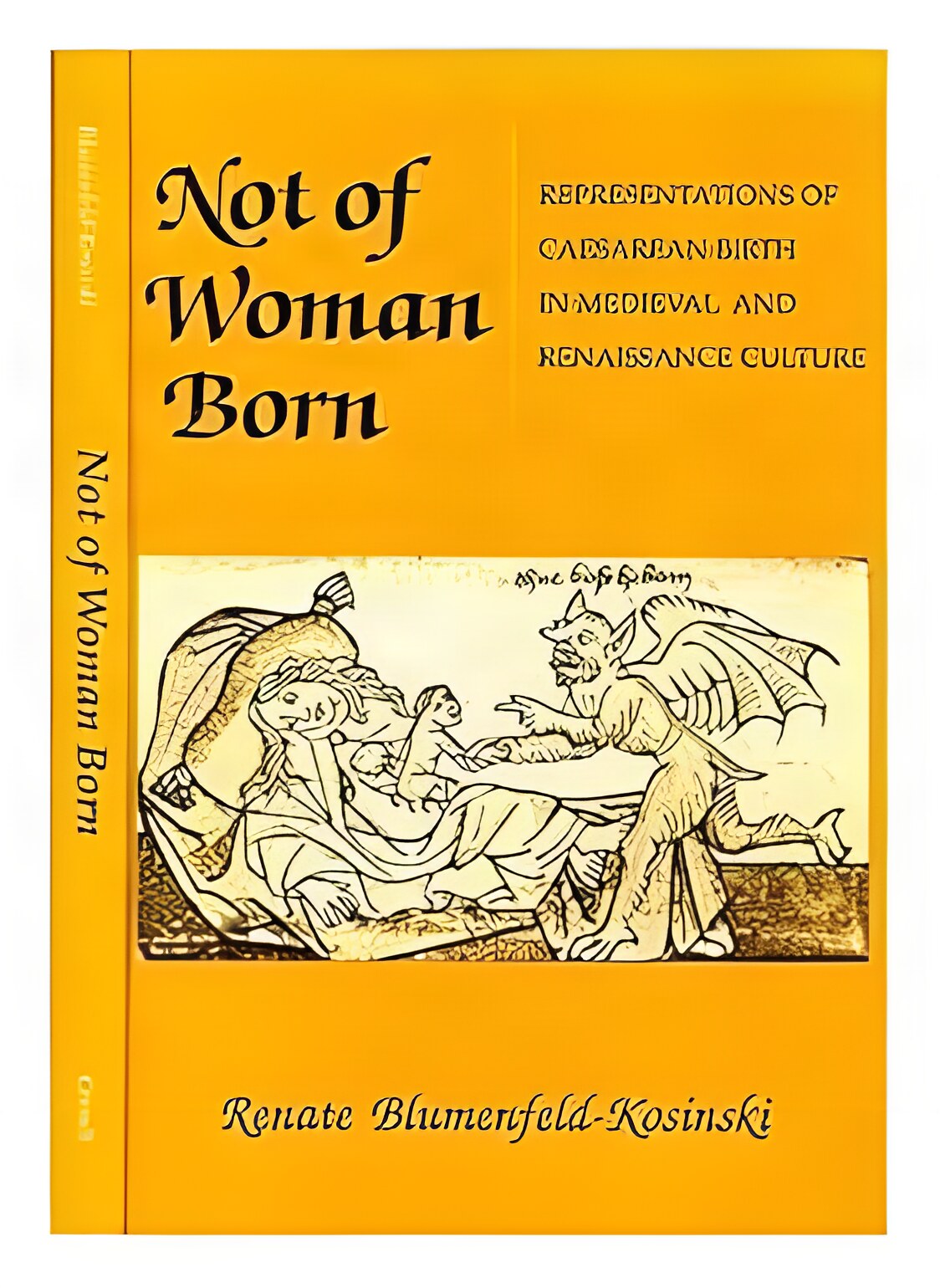
Softcover. Ithaca NY, Cornell University Press, reprint, 1991, Book: Very Good, Dust Jacket: None, Softcover, 204 pages. "Not of woman born," "the Fortunate," "the Unborn" - the terms designating those born by Caesarean section in medieval and Renaissance Europe were mysterious and ambiguous. In antiquity, children fortunate enough to have survived a Caesarean birth were believed to be marked for a special destiny. Vividly tracing the evolution of Caesarean birth from the early 1300s (when the operation was performed almost exclusively by midwives) through the Renaissance period (when midwives were considered witches and male surgeons took control), Blumenfeld-Kosinski . . . does more than provide [an] engrossingly accessible, historical account of the now-commonplace procedure--she unveils the roots of a medical misogyny that still prevails today. A richly cross-disciplined study utilizing depictions of Caesarean delivery in art, literature, and medical texts and illuminations (illustrations), [this book] is a captivating and revealing work that will be relished by readers of medical and cultural history, as well as by those who are interested in the subject of male dominance over women. Clean copy.
Hardcover. Boston, MA, Little Brown & Company, 1st, 1928, Book: Good, Dust Jacket: None, Hardcover, light gray cloth with red lettering, 228 pages. INSCRIBED BY AUTHOR on prelim-page. Slight wear and soil to covers, internally very good
Softcover. Kilmallock IR, Abey Printing Works, 1st, 1940, Book: Very Good, Dust Jacket: None, Softcover, stapled green wrappers, 28 pages. A local history of the picturesque village. Clean copy.
Softcover. Worcester MA, self-published, 1st, 1913, Book: Very Good, Dust Jacket: None, Softcover, plain paper wraps with tanning, 87 pages. This is the 1913 first printing, clean. Small tape repair to paper spine otherwise very good.
Hardcover. Paris, Editions Hazan, 1st, 2016, Book: Very Good, Dust Jacket: None, Hardcover, 240 pages. This beautifully illustrated book offers a comprehensive look at the career of photographer William Notman (1826-1891). Born in Scotland, Notman emigrated to Canada in 1856; he settled in Montreal and opened a photography studio that later had branches throughout Canada and the United States. Notman documented the development of a continent, photographing street scenes in burgeoning cities and modern transportation by steam and rail, and creating portraits of such notable figures as Mark Twain, Henry Wadsworth Longfellow, Sitting Bull, and Buffalo Bill. By fully exploiting the commercial and aesthetic potential of the rapidly advancing photographic technology, Notman contributed to the establishment of the socio-economic prominence of Montreal and played a key role in the formation of a Canadian national identity. Published and unpublished photographs are paired with texts that explore the photographer's numerous achievements.
Hardcover. Paris, Editions Hazan, 1st, 2016, Book: Very Good, Dust Jacket: None, Hardcover, 240 pages. This beautifully illustrated book offers a comprehensive look at the career of photographer William Notman (1826-1891). Born in Scotland, Notman emigrated to Canada in 1856; he settled in Montreal and opened a photography studio that later had branches throughout Canada and the United States. Notman documented the development of a continent, photographing street scenes in burgeoning cities and modern transportation by steam and rail, and creating portraits of such notable figures as Mark Twain, Henry Wadsworth Longfellow, Sitting Bull, and Buffalo Bill. By fully exploiting the commercial and aesthetic potential of the rapidly advancing photographic technology, Notman contributed to the establishment of the socio-economic prominence of Montreal and played a key role in the formation of a Canadian national identity. Published and unpublished photographs are paired with texts that explore the photographer's numerous achievements.
Hardcover. New York, Princeton Architectural Press, 1st, 2008, Book: Very Good, Dust Jacket: Very Good, Hardcover, 192 pages. A collection of highlights from the Maresca collection of snapshot photographs housed at the Newark Musuem, featuring images from the 1920s through the 1960s. Essays by Marvin Heiferman, Geoffrey Batchen, and Nancy Martha West; interview with Frank Maresca conducted by Heiferman; foreword by Mary Sue Sweeney Price. 192 pages; profusely illustrated in duo-toned b&w and color.
Hardcover. New York, Princeton Architectural Press, 1st, 2008, Book: Very Good, Dust Jacket: Very Good, Hardcover, 192 pages. A collection of highlights from the Maresca collection of snapshot photographs housed at the Newark Musuem, featuring images from the 1920s through the 1960s. Essays by Marvin Heiferman, Geoffrey Batchen, and Nancy Martha West; interview with Frank Maresca conducted by Heiferman; foreword by Mary Sue Sweeney Price. 192 pages; profusely illustrated in duo-toned b&w and color.
Hardcover. Seattle, WA, Fantagraphics Books, 1st, 2013, Book: Very Good, Dust Jacket: None, Non paginated. Hardcover without dust jacket. Extensive color and b&w illustrations throughout. Slight stains to front cover, otherwise clean, tight copy. Inspired by a real-life incident -getting his tie caught in a moving Moviola editing machine- Gene Deitch, cartoonist, animator, memoirist, renaissance man, created Nudnik, his Everyman character, a cross between Candide and Godot. The star of 12 Paramount-produced animated shorts that ran in theatres as an opening to the main movie in 1964 and 1965, Nudnik was one of Deitch's most creatively personal and commercially successful creations in a long career of innovative and successful work, including the award-winning animated versions of Jules Feiffer's Munro and Maurice Sendak's Where the Wild Things Are. Nudnik is the well-intentioned, kind, cheerful, but bumbling naf, inspired by and reflecting such archetypal characters as Jackie Gleason's Poor Soul, Charlie Chaplin's Tramp, and Charles Schulz's Charlie Brown. He never gets a break, can't do anything right, but somehow muddles through, dignity more or less intact. Nudnik Revealed! finally collects all of Deitch's original drawings, sketches, model sheets, storyboards, and color set-up that he drew during the Nudnik production season of 1964-1965, all reproduced from original art, showcasing his lively pencil line and his slick, authoritative pen and ink work. Deitch, a born storyteller and one of the great raconteurs of comics and animation, accompanies the copious examples of art with a running commentary by turns, funny, spirited, and chock full of historical insights.
Hardcover. Seattle, WA, Fantagraphics Books, 1st, 2013, Book: Very Good, Dust Jacket: None, Non paginated. Hardcover without dust jacket. Extensive color and b&w illustrations throughout. Slight stains to front cover, otherwise clean, tight copy. Inspired by a real-life incident -getting his tie caught in a moving Moviola editing machine- Gene Deitch, cartoonist, animator, memoirist, renaissance man, created Nudnik, his Everyman character, a cross between Candide and Godot. The star of 12 Paramount-produced animated shorts that ran in theatres as an opening to the main movie in 1964 and 1965, Nudnik was one of Deitch's most creatively personal and commercially successful creations in a long career of innovative and successful work, including the award-winning animated versions of Jules Feiffer's Munro and Maurice Sendak's Where the Wild Things Are. Nudnik is the well-intentioned, kind, cheerful, but bumbling naf, inspired by and reflecting such archetypal characters as Jackie Gleason's Poor Soul, Charlie Chaplin's Tramp, and Charles Schulz's Charlie Brown. He never gets a break, can't do anything right, but somehow muddles through, dignity more or less intact. Nudnik Revealed! finally collects all of Deitch's original drawings, sketches, model sheets, storyboards, and color set-up that he drew during the Nudnik production season of 1964-1965, all reproduced from original art, showcasing his lively pencil line and his slick, authoritative pen and ink work. Deitch, a born storyteller and one of the great raconteurs of comics and animation, accompanies the copious examples of art with a running commentary by turns, funny, spirited, and chock full of historical insights.
Hardcover. New York , Scala Publishers, 1st, 2010, Book: Very Good, Dust Jacket: Very Good, Like new in publishers shrink-wrap. The history of New York's ties to the Spanish-speaking world is as old as New Amsterdam itself, and is largely unknown. Accompanying a major exhibition organized by the New York Historical Society and El Museo del Barrio, this groundbreaking, interdisciplinary publication will for the first time make visible these connections and the myriad ways in which they have shaped the city for more than four centuries. Hardcover, 286 pages, b&w, some color illustrations.
Hardcover. New York, Hyperion Books, 1st, 2002, Book: Very Good, Dust Jacket: Very Good, Hardcover, 169 pages, light blue covers with a bright, unclipped dust jacket. Stated first with all numbers present.
Softcover. Philadelphia, self-published, 1st, 1804, Book: Very Good, Dust Jacket: None, Disbound 40 page pamphlet. A dissertation by the author for a degree in medicine at the University of Pennsylvania. Mild foxing.
Hardcover. Boston, American Tract Society, 1st, 1905, Book: Very Good, Dust Jacket: None, 416 pages, hardcover. Stamped boards with gilt titling to spine and front panel. An account of life in the Philippines before American exploitation. Inscription to previous owner on front flyleaf. Age toning to top text block. Bumped corners. Mild rubbing and edgewear to boards, mostly to spine. Frontispiece intact. A bright and tight copy.
Hardcover. NY, Birch Lane Press, 1st, 1994, Book: Very Good, Dust Jacket: Very Good, Hardcover in a bright dust jacket, 414 pages, b&w illustrations. A biography of controversial designer Calvin Klein draws on interviews with friends, business associates, and lovers to trace his dramatic rise to fame in the fashion world and his self-indulgent personal life.
Softcover. Cambridge MA, MIT Press, 1st, 1978, Book: Very Good, Softcover, 128 pages. INSCRIBED BY BOTH EDITORS on the front endpapers. Contributors include Dziga Vertov ('The Factory of Facts and Other Writings'), Alfred H. Barr, Jr. ('Russian Diary 1927-28', along with Jere Abbott, John E. Bowlt, and Elizabeth Jones), A. V. Lunacharsky ('Gogol-Meyerhold's "The Inspector-General"'), Paul Schmidt (on Meyerhold), Margit Rowell (on Vladimir Tatlin), and Michelson. Related ephemera laid in.
Hardcover. Portland OR, Timber Press, 1st, 2010, Book: Very Good, Dust Jacket: Very Good, Hardcover in a bright, unclipped dust jacket. 208 pages, color photos. The visually arresting and often misunderstood octopus has long captured popular imagination. With an alien appearance and an uncanny intellect, this exceptional sea creature has inspired fear in famous lore and legends--from the giant octopus attack in 20,000 Leagues Under the Sea to Ursula the sea witch in The Little Mermaid. Yet its true nature is more wondrous still. After decades of research, the authors reveal a sensitive, curious, and playful animal with remarkable intelligence, an ability to defend itself with camouflage and jet propulsion, an intricate nervous system, and advanced problem-solving abilities. In this beautifully photographed book, three leading marine biologists bring readers face to face with these amazingly complex animals that have fascinated scientists for decades. From the molluscan ancestry of today's octopus to its ingenious anatomy, amazing mating and predatory behaviors, and other-worldly relatives, the authors take readers through the astounding life cycle, uncovering the details of distinctive octopus personalities. With personal narratives, underwater research, stunning closeup photography, and thoughtful guidance for keeping octopuses in captivity, Octopus is the first comprehensive natural history of this smart denizen of the sea. Clean copy.
Hardcover. Focal Point, 1st, 2008, Book: Very Good, Dust Jacket: Very Good, Hardcover, 224 pages. Spanning almost a century of global upheaval and riveting human drama, this magnificent book follows the careers of Maynard Owen Williams, Volkmar Wentzel, Luis Marden, and Tom Abercrombie--a stellar quartet of National Geographic photographers who used their cameras to record a truly remarkable era. While the lensmen were all supported and nurtured both technically and creatively by the Geographic, each had his own interests and his own distinctive style--and each made his own unique contribution to world culture, science, and history. Following a thoughtful introduction that sets the scene, the book is divided into four parts, each devoted to one man's life and work. Chapters open with an essay and then display up to 50 pages of breathtaking historic images, many of which lay hidden in National Geographic archives for decades. Close associates and loved ones authored each photographer's intimate story, calling on journals, anecdotes, and behind-the-scenes correspondence to portray the real person behind the lens. Our four subjects, taken together, represent the entire and quite glamorous progression of National Geographic photography--a chronicle that will be eagerly embraced by all who love world history, biography, and great pictures.
Softcover. NY, Plume/New American Library, 1st, 1980, Book: Very Good, Dust Jacket: None, Softcover, 470 pages, illustrated in b&w and color. Film historian and critic, Leonard Maltin's extensively researched book about the world of animated cartoons. Illustrated with drawings, photographs, and color posters. With studio filmographies, Academy Award nominees and winners, glossary of animation terms, source listings, and index. Clean copy.
Softcover. Chicago, University of Chicago Press, reprint, 1992, Book: Very Good, Dust Jacket: None, Softcover, 414 pages. An anthropological and historical discourse on the arrival of Christianity in the Southern Tswana region of South Africa. A compelling read and referenced in an in-depth manner. Clean copy.
Hardcover. Hartford CT, Guyde Publishing Co., 1927, Book: Very Good, Dust Jacket: None, Limp red cloth covers stamped in gilt, now faded. Vintage travel guide for the northeast. Maps, advertising, photos, large folding map inside rear cover with a tear to one panel, no paper loss. Previous owners embossed stamp on front fly leaf, otherwise clean, very good.
Hardcover. Washington DC, War Department, 1st, 1905, Book: Very Good, Hardcover, Large folio volume (17x12 inches) in pebbled red embossed cloth with gilt lettering, modest wear at the extremities with bottom corners bumped. Marbled edges, 584 pages. Hundreds of woodcut illustrations with no stains or flaws. Massive work which reproduces hundreds of black and white engravings of the Civil War. The illustrations originally appeared in Leslie's Magazine during the war. Narrative and descriptions by John Clark Ridpath, Rossiter Johnson, General Fitzhugh Lee, General John T. Morgan, George L. Kilmer, General Joseph B. Carr. No makings. DOMESTIC SHIPPING ONLY.
Hardcover. Seattle, University of Washington Press, 1st, 1991, Book: Very Good, Dust Jacket: Very Good, 388 pages, hardcover. B&w plates. INSCRIBED BY ECKERT. Light foxing to edge and light wear to bottom edges of cover. According to conventional interpretations, the Japanese annexation of Korea in 1910 destroyed a budding native capitalist economy on the peninsula and blocked the development of a Korean capitalist class until 1945. In this expansive and provocative study, now available in paperback, Carter J. Eckert challenges the standard view and argues that Japanese imperialism, while politically oppressive, was also the catalyst and cradle of modern Korean industrial development. Ancient ties to China were replaced by new ones to Japan - ties that have continued to shape the South Korean political economy down to the present day. Eckert explores a wide range of themes, including the roots of capitalist development in Korea, the origins of the modern business elite, the nature of Japanese colonial policy and the Japanese colonial state, the relationship between the colonial government and the Korean economic elite, and the nature of Korean collaboration. He conveys a clear sense of the human complexity, archival richness, and intellectual challenge of the historical period. His documentation is thorough; his arguments are compelling and often strikingly innovative.


 "Not-Quite Puritans, The: Some Genial Follies and Peculiar Frailties of Our Revered New England Ancestors (SIGNED COPY)by: Lawrence, Henry W.")

 "Notes on the History of Waterford Maine by: Thomas Hovey Gage")
 "Notman: Visionary Photographerby: H")
 "Notman: Visionary Photographerby: H")
 "Now Is Then: Snapshots from the Maresca Collectionby: Heiferman, Marvin")
 "Now Is Then: Snapshots from the Maresca Collectionby: Heiferman, Marvin")


 "Nueva Yorkby: Sullivan, Edward J. (Ed.)")
 "Numbering All the Bonesby: Rinaldi, Ann")
 "Observations on that form of disease nosologically called dysenteryby: John Hoskins")
 "Observer in the Philppines, Anby: Devins, John Bancroft")
 "Obsession: The Lives and Times of Calvin Kleinby: Steven Gaines, Sharon Churcher")


 "Odysseys and Photographs: Four National Geographic Field Menby: Bendavid-Val/Gilbert M. Grosvenor, et al., Leah")

 "Of Revelation and Revolution, Volume 1: Christianity, Colonialism, and Consciousness in South Africa by: Comaroff, Jean, Comaroff, John L.")
 "Official New Motor Trips: New England New York Canada Pennsylvania New Jersey Floridaby: N/A")
 "Official Portfolio of War and Nation: A Graphic and Pictorial History Prepared Directly from Government Records in the Departments of War and Statistics by: Wright, M")
 "Offspring of Empire: The Koch'ang Kims and the Colonial Origins of Korean Capitalism 1876-1945 (SIGNED COPY)by: Eckert, Carter J.")