London, Society For Promoting Christian Knowledge, 1st, 1930, Book: Very Good, Dust Jacket: None, Hardcover, green cloth covers with gilt title on spine. 121 pages including index. Clean copy.
Softcover. Hanover NH, University Press of New England, 1st, 2004, Softcover, 222 pages. From 1942 to 1945, Lieutenant Colonel Betty Bandel (retired) served in the Women's Army Auxiliary Corps (WAAC, later WAC, the Women's Army Corps), eventually heading the WAC Division of the Army Air Force. During these years she wrote hundreds of letters to family and friends tracing her growth from an enthusiastic recruit, agog in the presence of public figures such as Eleanor Roosevelt (code named Rover), to a seasoned officer and leader. Bandel was one of the Corps' most influential senior officers. Her letters are rich with detail about the WAC's contribution to the war effort and the inner workings of the first large, non-nurse contingent of American military women. In addition, her letters offer a revealing look at the wartime emergence of professional women. Perhaps for the first time, women oversaw and directed hundreds of thousands of personnel, acquired professional and personal experiences, and built networks that would guide and influence them well past their war years.
Hardcover. NY, Dodd, Mead and Company, 1st, 1917, Book: Very Good, Dust Jacket: None, Two hardcover volumes, 436 and 485 pages. Illustrated in black and white. Navy blue cloth covered boards with gilt spine. Top edges gilt. Both volumes illustrated with photographs, portraits, and maps. Name on front fly leaf of both volumes, mild cover soil, otherwise a clean, bright set. DOMESTIC SHIPPING ONLY.
Hardcover. Bemis Heights NY, privately printed, reprint, 1926, Book: Very Good, Dust Jacket: None, Hardcover, green cloth covers, gilt lettering on spine. 290 pages. Folded battle map laid in at rear. A reprint of the 1844 account published in Albany. Clean copy.
Hardcover. Pasadena MD, Minerva Center, 1st, 1994, Book: Very Good, Dust Jacket: Very Good, Hardcover in a bright dust jacket, 110 pages, b&w illustrations. As the debate on the role of women in the military continues, an interesting historical footnote has been brought forth: the publication of the only known surviving set of letters of one of the estimated 400 women who disguised themselves as men to fight as soldiers in the Civil War. Born on a farm in New York in 1843, Wakeman was the oldest of nine children. Few details of her family life are known, nor what exactly precipitated her flight into the army, but glimpses of this strong-minded woman are provided throughout: "I am as independent as a hog on the ice. If it is God's will for me to fall in the field of battle, it is my will to go and never return home." Private Wakeman did not return home: she is buried under her masculine pseudonym. How many more women were buried as men? Civil War historian Burgess provides an intriguing introduction to what is sure to become an area of growing interest. Name on front fly leaf, otherwise clean.
Softcover. University Park, Pennsylvania State University Press, 2nd pr., 2023, Book: Very Good, Dust Jacket: None, Softcover, 266 pages, b&w illustrations. INSCRIBED BY KELLEY on the title page. Lydia Hamilton Smith (1813-1884) was a prominent African American businesswoman in Lancaster, Pennsylvania, and the longtime housekeeper, life companion, and collaborator of the state's abolitionist congressman Thaddeus Stevens. In his biography of this remarkable woman, Mark Kelley reveals how Smith served the cause of abolition, managed Stevens's household, acquired property, and crossed racialized social boundaries. In the last years of Stevens's life, as his declining health threatened to short-circuit his work, Smith risked her own well-being to keep him alive while he led the drive to end slavery, impeach Andrew Johnson, and push for the ratification of the Thirteenth, Fourteenth, and Fifteenth Amendments. Clean copy.
Hardcover. London, Methuen & Co, Reprint, 1904, Book: Good, Dust Jacket: None, 323 pages. Hardcover. Extensive color illustrations by H. Alken throughout. Binding cracked between rear end paper and front fly leaf. Foxing to top edge and rear paste down and end paper. Some edge wear to spine, otherwise clean, tight copy.
Softcover. New York, Thunder's Mouth Press, 1st, 2003, Book: Very Good, Dust Jacket: None, 376 pages. Softcover. Black and white photographs. Light edgewear to wrappers. A photographic memoir of the sixties by McDarrah who was the picture editor for The Village Voice.
Hardcover. New Haven, Princeton University Press, 1st, 2001, Book: Very Good, Dust Jacket: Very Good, Hardcover, 192 pages. 55 B&w illustrations and 21 plates in full color. Debates the relationship between art, science and religion by exploring the 19th century landscape painters fascination with geology. Scarce. Pictorial boards, black cloth spine. Pictorial dust jacket. Like new. In original shrinkwrap.
Softcover. Bowie MD, Heritage Books, reprint, 1994, Book: Very Good, Two softcover volumes, Vol. 1 and 2 complete, 835 total pages, b&w illustrations. Facsimile reprints of the 1910 Grafton Press original edition. Clean copies.
Softcover. Los Angeles, The Augustan Reprint Society, reprint, 1989, Book: Very Good, Dust Jacket: None, Softcover, 67 pages, Introduction by H.T. Dickinson. A facsimile reprint of Lord Hervey's 1734 political pamphlet. Name on front cover, otherwise clean.
Hardcover. Princeton NJ, Princeton University Press, 1st, 2011, Book: Very Good, Dust Jacket: Very Good, Hardcover in a bright dust jacket, 300 pages. From China's most influential foreign policy thinker, a vision for a "Beijing Consensus" for international relations. The rise of China could be the most important political development of the twenty-first century. What will China look like in the future? What should it look like? And what will China's rise mean for the rest of world? This book, written by China's most influential foreign policy thinker, sets out a vision for the coming decades from China's point of view. In the West, Yan Xuetong is often regarded as a hawkish policy advisor and enemy of liberal internationalists. But a very different picture emerges from this book, as Yan examines the lessons of ancient Chinese political thought for the future of China and the development of a "Beijing consensus" in international relations. Yan, it becomes clear, is neither a communist who believes that economic might is the key to national power, nor a neoconservative who believes that China should rely on military might to get its way. Rather, Yan argues, political leadership is the key to national power, and morality is an essential part of political leadership. Economic and military might are important components of national power, but they are secondary to political leaders who act in accordance with moral norms, and the same holds true in determining the hierarchy of the global order. Clean copy.
Hardcover. Chicago, Argonaut Inc, 1st, 1964, Book: Very Good, Hardcover, stated First American Edition. "A New Illustrated Edition Containing: 'Greek Dress' by Ethel Abrahams; 'Chapters on Greek Dress' by Lady Evans." Edited by Marie Johnson. Navy cloth with gold lettering on the spine. Illustrated with 20 plates and with several full-page and in-text illustrations. Combines two works on the history of ancient fashion.
Softcover. London, Penguin Books, 2rd Ed., 1992, Book: Very Good, Dust Jacket: None, Softcover, 547 pages, b&w illustrations. Newly revised and containing information from recent excavations and discovered artifacts, Ancient Iraq covers the political, cultural, and socio-economic history from Mesopotamia days of prehistory to the Christian era. Clean copy.
Hardcover. Birmingham AL, Legal Classics Library, reprint, 1982, Book: Very Good, Dust Jacket: None, Hardcover, handsomely bound in crimson red cowhide leather lettered and decorated in gilt, raised spine bands, all edges gilt, attached ribbon bookmarks, marbled endpapers. A facsimile of the original 1861 London edition. Bright, clean copy.
Hardcover. London, 1840, Book: Good, Dust Jacket: None, Hardcover. Volume one. Rebound. Some pencil underlining and notation. Previous owner's signature on front end paper. Wrinkle to front top corner. Fading to covers.
Hardcover. London, 1840, Book: Good, Dust Jacket: None, Hardcover. Volume Two. Rebound. Some pencil underlining and notation. Previous owner's signature on front end paper. Light markings to covers.
Hardcover. Gloucester MA, Peter Smith, reprint, 1985, Book: Very Good, Dust Jacket: None, Hardcover, green cloth covers, 569 pages. Two decades after Darwin, intellectuals were writing about the evolution of everything. In England Edward Taylor focused on material culture such as fire making, cooking, or tool making. In America, Lewis Henry Morgan, concentrated on social evolution combined with subsistence techniques. His thinking was influenced by his Iroquois neighbors in New York. Like many others he posited three stages of evolution: savagery, barbarism and civilization, but he refined the three periods with three subperiods. In Lower savagery, for example, he saw humans subsisting on fruits and roots in tropical climes, using gesture language and marrying siblings in a consanguine family. Middle savagery saw fish subsistence, monosyllabic language, and marriage of cousins. Bows and arrows appeared in Upper Savagery along with syllabic language, clans, and tribal organization. Obviously Morgan was speculating on most of the developments, but he had found arguments for his positions from the reports of explorers and missionaries around the world. As a result, Morgan inspired an era of inquisitive thought that led to the development of American anthropology. Name on front fly leaf, otherwise clean.
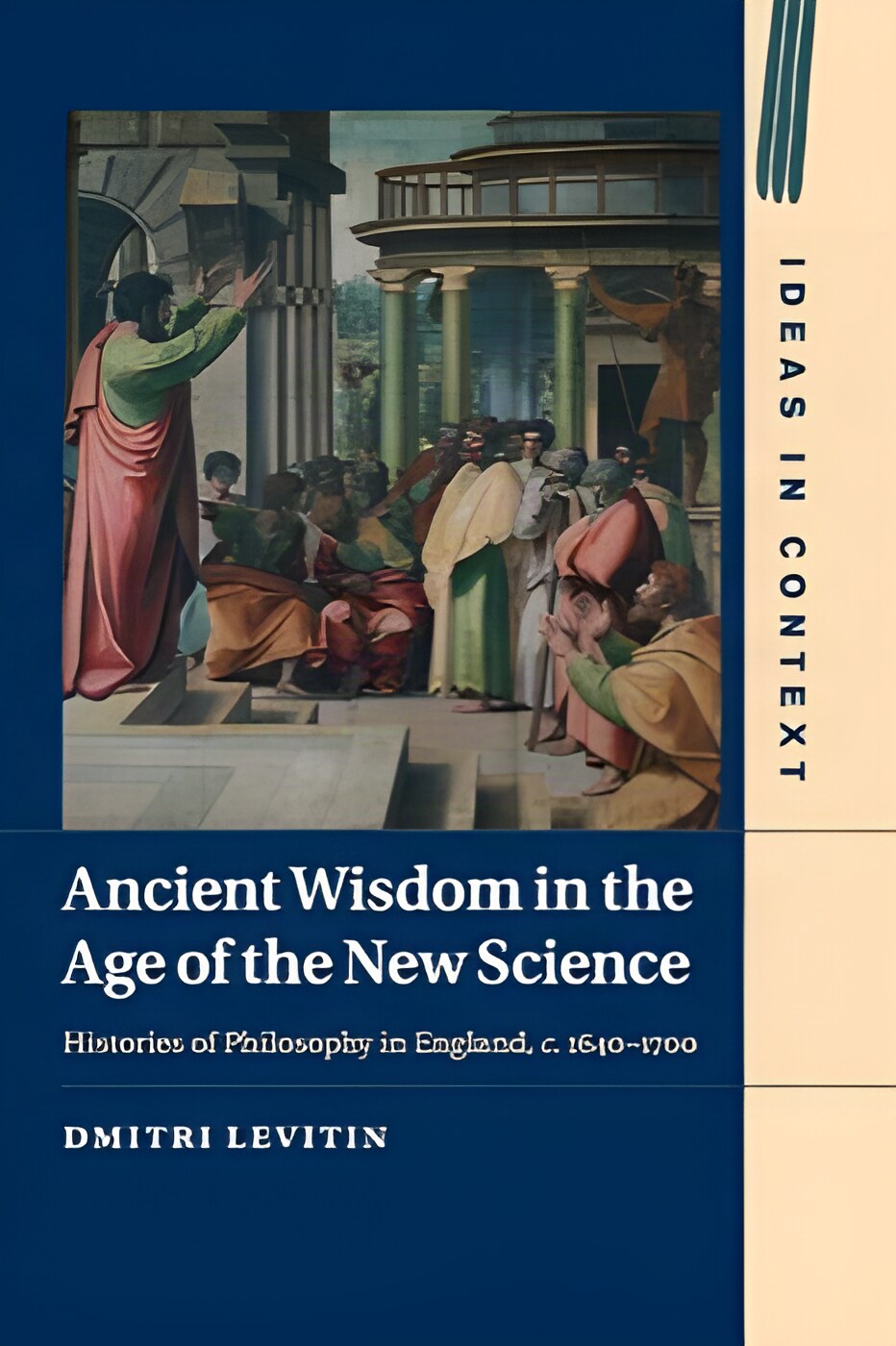
Hardcover. Cambridge UK, Cambridge University Press, 1st, 2015, Book: Very Good, Dust Jacket: Very Good, Hardcover in a bright dust jacket, pages. Seventeenth-century England has long been heralded as the birthplace of a so-called 'new' philosophy. Yet what contemporaries might have understood by 'old' philosophy has been little appreciated. In this book Dmitri Levitin examines English attitudes to ancient philosophy in unprecedented depth, demonstrating the centrality of engagement with the history of philosophy to almost all educated persons, whether scholars, clerics, or philosophers themselves, and aligning English intellectual culture closely to that of continental Europe. Drawing on a vast array of sources, Levitin challenges the assumption that interest in ancient ideas was limited to out-of-date 'ancients' or was in some sense 'pre-enlightened'; indeed, much of the intellectual justification for the new philosophy came from re-writing its history. At the same time, the deep investment of English scholars in pioneering forms of late humanist erudition led them to develop some of the most innovative narratives of ancient philosophy in early modern Europe. Name on front fly leaf, otherwise clean.
Hardcover. NY, Scribners, 1st, 1946, Book: Very Good, Dust Jacket: None, Hardcover, 387 pages. The autobiography of a legendary advertising and marketing genius who was active in the early 1900s. Black & white illustrations. Previous owner's signature on front fly leaf, otherwise clean.
Hardcover. Philadelphia, H.W. Fisher & Company, 1st, 1901, Book: Very Good, Dust Jacket: None, Hardcover, olive green cloth on boards with gilt lettering and border ruling around front, gilt lettering to spine. Book is tight, square. Story about a man from Philadelphia who buys an island in Rangely Lake in western Maine and builds a summer house. Great information about Maine, it's people, the flora and fauna of the area, and history too. Seems to be a blend of fiction and memoir. Color frontis, 15 b&w plates. Small water stain to first 10 pages, in the top of outer margin, not affecting plates or text. Otherwise clean.
Hardcover. Toledo OH, D.R. Locke, 1st, 1879, Book: Very Good, Dust Jacket: None, Hardcover, green cloth with black and gilt decoration to front cover and spine. 655 pages. 'Andersonville' is a rare, post-Civil War work that describes the horrors of prison life during the Civil War. McElroy describes prison conditions, battles and prolonged military struggles, accounts of prisoner struggles, plantation slaves, and soldier depression. Also included are depictions of various jails including those in Atlanta, Richmond, Savannah, Blackshear, and Florence. Illustrated with over 150 views of trial scenes, prisons, portraits, and battle scenes! According to Nevins,"Well written, gripping, and very detailed; but reliance on memory and bitterness." Mild wear to top and bottom of spine, Name on first blank white page, otherwise clean.
Hardcover. New York, Norton, 1st, 2005, Book: Very Good, Dust Jacket: Very Good, A monograph focusing for the first time exclusively on Kertesz's early Hungarian prints; selected from more than 1,000 contact prints in the artist's estate and reproduced actual size. Photographs by Andre Kertesz; introduction by Bruce Silverstein; essay by Robert Gurbo. 160 pages; 66 duo-toned b&w plates + 11 text illustrations; 5.25 x 5.25 inches.
Hardcover. NY, Harper & Row, 1st, 1984, Book: Very Good, Dust Jacket: Very Good, Hardcover in a bright, price-clipped dust jacket. Volume Three only, index, bibliography, chapter notes, maps, b&w illustrations. Award sticker on front cover. Clean copy






 "An Uncommon Woman: The Life of Lydia Hamilton Smith (INSCRIBED COPY)by: Kelley, Mark")
 "Analysis Of The Hunting Field: Being A Series of Sketches OF the Principle Characters That Compose Oneby: N/A")
 "Anarchy, Protest & Rebellion: and the Counterculture that Changed Americaby: McDarrah, Fred W.")
 "Anatomy of Nature, The: Geology & American Landscape Painting 1825-1875by: Bedell, Rebecca")
 "Ancestral Records and Portraits; A Compilation from the Archives of Chapter I, The Colonial Dames of America (2 Volumes)by: Colonial Dames of America")





 "Ancient Laws and Institutes of England, vol. Iby: Commissioners on the Public Records of the Kingdom")
 "Ancient Laws and Institutes of England, vol. Ilby: Commissioners on the Public Records of the Kingdom")
 "Ancient Society Or Researches in the Lines of Human Progress from Savagery Through Barbarism to Civilizationby: Morgan, Lewis Henry")
 "And Hearing Not: Annals of an Admanby: Calkins, Earnest Elmo")

 "Andersonville: Story of Rebel Military Prisons: Fifteen Months a Guest of the So Called Southern Confederacyby: McElroy, John Co. (L/16th Ill. Cav..)")


 "Andre Kertesz: The Early Yearsby: Kertesz, Andre")