Hardcover. Honolulu, University of Hawaii, 1st, 2002, Book: Very Good, Dust Jacket: Very Good, Hardcover, 250 pages with 160 color and 20 black & white photographs of the elaborately carved and costumed puppets and portraits of the master puppeteers and carvers, list of Wayang characters, glossary, bibliography. Indonesia's wayang golek puppet theatre is among the world's oldest and richest puppetry traditions, contemporary with Japanese Noh drama and the mystery plays of Europe. In an unclipped dust jacket with some light fading to spine.
Softcover. Annapolis MD, Naval Institute Press, reprint, 2007, Book: Very Good, Dust Jacket: None, Softcover, 509 pages, b&w illustrations. Based on twenty years of research in formerly secret archives, this book reveals for the first time the full significance of War Plan Orange -- the U.S. Navy's strategy to defeat Japan, formulated over the forty years prior to World War II. The author does a good job of describing how the plan changed over time regarding possible objectives (rescuing Philippines, capturing Truk, making Guam into the "Gibraltar of the Pacific) as well as the different groups who pushed for their vision on how to best execute the plan from the gung-ho thrusters to the cautionaries to name the major approaches. The book also details the interplay between the navy and the army as they worked together to create a global plan of war as the world became more dangerous in the 1930's (the Rainbow Plans). The work concludes with an analysis of just how successful all the effort that went into creating Plan Orange was to the waging of the Pacific War in 1941-45. Clean copy.
Hardcover. Brooklyn NY, powerHouse Books, 1st, 2008, Book: Very Good, Dust Jacket: Very Good, Hardcover, 256 pages, Clean copy in a bright dust jacket. Edited by Stephen Daiter. Introduction by Fred Ritchin. Essay by Kerry Tremain. A wide ranging collection of 190 duotone images. Miller's work always contained a peculiar empathy, whether he was photographing American servicemen, Italian street urchins, or Japanese survivors of the atomic bomb, and that ethos extends to his subsequent landmark studies of the famous Bronzeville neighborhood in postwar Chicago.
Hardcover. Brooklyn NY, powerHouse Books, 1st, 2008, Book: Very Good, Dust Jacket: Very Good, Hardcover, 256 pages, Clean copy in a bright dust jacket. Edited by Stephen Daiter. Introduction by Fred Ritchin. Essay by Kerry Tremain. A wide ranging collection of 190 duotone images. Miller's work always contained a peculiar empathy, whether he was photographing American servicemen, Italian street urchins, or Japanese survivors of the atomic bomb, and that ethos extends to his subsequent landmark studies of the famous Bronzeville neighborhood in postwar Chicago.
Hardcover. New York, Clarion Books, 1st, 2002, Book: Very Good, Dust Jacket: Very Good, Hardcover in a bright, unclipped dust jacket, 199 pages. A brother & sister face the increasingly oppressive occupation of Korea by Japan during WW II, which threatens to suppress their culture. WON JANE ADDAMS HONOR AWARD. Clean copy.
Hardcover. NY, Hobart Company, 1st, 1904, Book: Very Good, Dust Jacket: None, Hardcover, green cloth stamped in orange and black. Three introductory pages of text; balance of book consists entirely of 77 black and white photographs with descriptive captions. Plates showing temples, traditional Japanese residences and businesses, Japanese people at work and at play, a karuma carriage, Yokohama Bay, etc. Clean, bright copy.
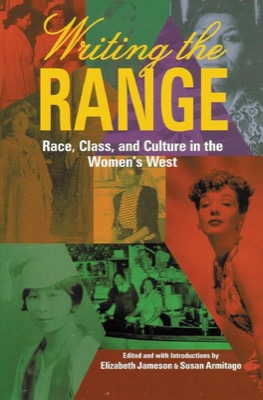
Softcover. Norman OK, University of Oklahoma Press, 1st, 1997, Book: Very Good, Dust Jacket: None, Softcover, 656 pages. In mythic sagas of the American West, the wide western range offered boundless opportunity to a limited cast of white men. Buffalo roamed, deer and antelope played, and women's voices were never heard. Writing the Range allows us to hear many long-silenced women: Spanish-Mexican settlers and American Indians on New Spain's northern frontiers; Chinese, Basque, Japanese, Korean, Vietnamese, Slavic, and Irish immigrants; film stars Dolores del Rio and Lupe Velez; Navajos and African Americans who moved to western cities during World War II; and the activist Mothers of East Los Angeles, who organized to resist environmental dangers to their community. A valuable introduction to the rapidly changing field of western history, Writing the Range explains clearly how race, class, and culture are constructed and connected. The first section examines issues raised by more than a decade of multicultural western women's histories; following are six chronological sections spanning four centuries. Each section offers a short introduction connecting is essays and placing them in analytic and historical perspective. Clean copy.
Hardcover. Lewiston NY, Edwin Mellen Press, 1st, 1998, Book: Very Good, Dust Jacket: None, Hardcover, red cloth with b&w decoration to front cover, 295 pages. INSCRIBED BY AUTHOR on front fly leaf, possibly to the publisher Edwin Mellen. (the name has been corrected and is difficult to read.)
Hardcover. NY, Simon and Schuster, 1946, Book: Good, Dust Jacket: None, Hardcover, tan cloth covers stamped in black. A fascinating collection. It features the cartoons of David Low, most from the London Evening Standard, from Japan's invasion of Manchuria in 1931 through the surrender of Japan in 1945, in chronological order. They are each accompanied by text by Quincy Howe, which explains the context of each cartoon. The reader can follow the events in the order that they happen from the build-up to the war through its conclusion, in an easy-to-read format. Howe has also written a chronology of the period, which appears at the end of the book. No dust jacket. The cloth spine has wear to top and bottom, Firm binding and the interior is clean and bright.
Hardcover. Philadelphia , Lippincott, 1st, 1917, Book: Very Good, Dust Jacket: None, Hardcover, 286 pages, color frontispiece, fold-out map of Tokyo Bay, cream colored cloth with Japanese characters on front. Previous owner's signature on front fly leaf otherwise clean, tight copy.
Hardcover. NY/Oakland, Triangle Square, 1st, 2018, Book: Very Good, Dust Jacket: Very Good, Hardcover in a bright, unclipped dust jacket. Illustrated by Ed Young. Told in haiku-based American Sentences and pictures, Yugen is the story of a boy and his mother, inspired by the profound concept of "yugen," a Japanese word for the mystery and beauty of the universe and of human experience. The second collaboration between Caldecott-winning illustrator Ed Young and Mark Reibstein after their award-winning 2008 debut, Wabi Sabi, Yugen is a book of longing and remembrance that is unequaled in its beauty and poetic simplicity.
Hardcover. NY/Oakland, Triangle Square, 1st, 2018, Book: Very Good, Dust Jacket: Very Good, Hardcover in a bright, unclipped dust jacket. Illustrated by Ed Young. Told in haiku-based American Sentences and pictures, Yugen is the story of a boy and his mother, inspired by the profound concept of "yugen," a Japanese word for the mystery and beauty of the universe and of human experience. The second collaboration between Caldecott-winning illustrator Ed Young and Mark Reibstein after their award-winning 2008 debut, Wabi Sabi, Yugen is a book of longing and remembrance that is unequaled in its beauty and poetic simplicity.

 "Voices of the Puppet Masters: The Wayang Golek Theater of Indonesiaby: Herbert, Mimi")

 "Wayne F. Miller: Photographs 1942-1958by: Tremain, Kerry")
 "Wayne F. Miller: Photographs 1942-1958by: Tremain, Kerry")
 "When My Name Was Keoko (Jane Addams Honor Bookby: Park, Linda Sue")
 "Wonders of Japan: A Portfolio of Views in the Enchanted Bamboo Land by: N/A")
 "Yang Kuei-Fei Legend in Japanese Literature, The (Japanese Studies, Vol 6) (SIGNED COPY)by: Masako Nakagawa Graham")
 "Years of Wrath (A Cartoon History: 1931-1945)by: David Low")
 "Yotsuya Kwaidan, The: Or O'iwa Inariby: Benneville, James S. De")
 "Yugenby: Mark Reibstein and Ed Young")
 "Yugenby: Mark Reibstein and Ed Young")