Hardcover. NY, Grosset & Dunlap, 1st, 1939, Book: Very Good, Dust Jacket: None, Color, black & white illustrations by Margaret Ayer. Color illustrated boards. Bottom edgewear, corner wear to boards
Hardcover. NY, Farrar Straus Giroux, 1st US, June 12, 2007, Book: Very Good, Dust Jacket: Very Good, Hardcover, 458 pages, b&w illustrations. Brown cloth, gilt lettering to spine, pictorial dust jacket. Lovely copy. Like new.
Hardcover. Evanston IL, Northwestern University Press, 1st, 1966, Book: Very Good, Dust Jacket: Good, Hardcover in a lightly worn dust jacket with mild tanning, 220 pages. Lowith is probably most known for his two books From Hegel to Nietzsche, which describes the decline of German classical philosophy, and Meaning in History, which discusses the problematic relationship between theology and history.
Hardcover. London, Macmillan & Co, reprint, 1956, Book: Good, Dust Jacket: Good, Hardcover, 530 pages, dust jacket edge wear and small tears, price clipped. Pencil markings and underlining on some pages, foxing on edges, and previous owner's signature on front fly leaf, otherwise, clean and tight copy.
Softcover. US, Prestel, 1st, 2014, Book: Very Good, Dust Jacket: None, 128 pages. Softover. Clean, unmarked copy with only minor wear to wrappers. Like new in publisher's shrink-wrap. Photographer Iain McKell offers an extraordinary and breathtakingly beautiful glimpse into the lives of a real and raw group of present-day nomads whose culture is built around ideals of freedom, nature, and simplicity. Historically despised the new gypsies are there by choice, not heritage. Unrelated to the Roma, the movement began in 1986 when a group of Post-Punk Anti-Thatcher protesters headed out of London into the English countryside. McKell followed these New Age Travellers to the West Country and over the years he watched them become a hybrid tribe - the new gypsies - present-day rural anarchists, living the subversive lifestyle in elaborately decorated horse-drawn caravans. Known as 'Horse-drawn', the new gypsies share a desire for sustainability, a love of self-reliance and a disdain for the trappings of contemporary life. For more than a decade McKell has focused his lens on travellers of all ages: parents, children, couples and loners. With sensitivity and honesty he captures a way of life that seems at once romantic, strange, beautiful and simple. The result is a deeply insightful portrayal of a culture that eschews the traditional creature comforts of urban life in favour of the simplicity and freedom of the natural world.
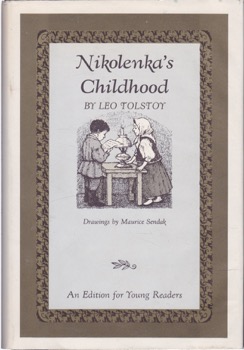
Hardcover. NY, Pantheon Books, 1st, 1963, Book: Very Good, Dust Jacket: Very Good, Hardcover in a bright, lightly worn dust jacket ($3.95 on flap), b&w illustrations by Maurice Sendak. "Childhood" focuses on the character Nikolenka, a young boy who shares many similarities with Tolstoy himself. The novel provides an intimate and nostalgic portrayal of Nikolenka's inner world as he navigates the joys, sorrows, and formative experiences of his early childhood. Set in rural Russia during the 19th century, the novel captures the idyllic and carefree nature of Nikolenka's early life. Clean copy.
Softcover. Augusta GA, Morris Communications Company, 1st, 2004-01-01, Book: Very Good, Dust Jacket: None, Softcover, 100 pages, illustrated throughout in color. Clean, unmarked copy with only minor wear to wrappers.
Hardcover. London, Thames & Hudson, 1st, 2001, Book: Very Good, Dust Jacket: Very Good, Hardcover, 192 pages. 106 illustrations 97 in color. Still in shrinkwrap. The first exploration of the art that Georgia O'Keeffe retained for her personal collection, including works that have never been publicly exhibited. Georgia O'Keeffe was one of America's preeminent artists and one of the first to experiment with abstract form, though she never abandoned her deep response to and observation of nature. An enormously popular artist, she became identified and respected as an independent American spirit through both her art and her life. At the time of her death in 1986, Georgia O'Keeffe owned more than half of the approximately 2,000 works she had produced during the eighty years she was active as an artist: some 400 works in oil, charcoal, pastel, pencil, and watercolor, as well as more than 700 sketches. For various reasons, she had always kept a portion of her art out of the public eye and these works were not published, exhibited, or available for purchase during her lifetime. Among the works that had been exhibited and sold over the years, some were repurchased by O'Keeffe as they became available. This book explores for the first time the significance of O'Keeffe's collection of her own work. Approximately 75 seminal works, dating from about 1910 through the 1960s and reproduced in full color, document the range and quality of the art that O'Keeffe either chose to retain in her estate or consciously distributed to institutions in her lifetime and as bequests.
Hardcover. San Francisco, Chronicle Books, 1st, 2006, Book: Very Good, Dust Jacket: Very Good, Hardcover, 120 pages, color photos. Terry Falke's wry, lyrical photographs center on the terrain of the American Southwest and the ubiquity of humanity s imprint on it. The images in Observations in an Occupied Wilderness both honor and subvert the grand tradition of western landscape photography, conveying the bleak splendor of the land and Falke's sheer love of looking. Gorgeous, sardonic, and playful, Falke's work emphasizes beauty and incongruity, and is as much about human nature as it is about the land. Shot with a large-format camera, the resultant images are personal and provocative, raising as many questions than they answer. This remarkable debut monograph is a shrewd exploration of our last wild places.
Hardcover. Portland OR, Timber Press, 1st, 2010, Book: Very Good, Dust Jacket: Very Good, Hardcover in a bright, unclipped dust jacket. 208 pages, color photos. The visually arresting and often misunderstood octopus has long captured popular imagination. With an alien appearance and an uncanny intellect, this exceptional sea creature has inspired fear in famous lore and legends--from the giant octopus attack in 20,000 Leagues Under the Sea to Ursula the sea witch in The Little Mermaid. Yet its true nature is more wondrous still. After decades of research, the authors reveal a sensitive, curious, and playful animal with remarkable intelligence, an ability to defend itself with camouflage and jet propulsion, an intricate nervous system, and advanced problem-solving abilities. In this beautifully photographed book, three leading marine biologists bring readers face to face with these amazingly complex animals that have fascinated scientists for decades. From the molluscan ancestry of today's octopus to its ingenious anatomy, amazing mating and predatory behaviors, and other-worldly relatives, the authors take readers through the astounding life cycle, uncovering the details of distinctive octopus personalities. With personal narratives, underwater research, stunning closeup photography, and thoughtful guidance for keeping octopuses in captivity, Octopus is the first comprehensive natural history of this smart denizen of the sea. Clean copy.
Softcover. NY, Jordan Volpe Gallery, 1st, 1980, Book: Very Good, Dust Jacket: None, Softcover, 89 pages, b&w and color photographs. Very light edge wear, rubbing to wrappers, else a very clean, tight copy.The catalogue of an exhibition at the Jordan-Volpe Gallery, New York, April 15 - June 30, 1980. Illustrated with 18 color plates and 11 figures in the text.
Hardcover. Seattle, University of Washington Press, 1st, 1991, Book: Very Good, Dust Jacket: Very Good, 388 pages, hardcover. B&w plates. INSCRIBED BY ECKERT. Light foxing to edge and light wear to bottom edges of cover. According to conventional interpretations, the Japanese annexation of Korea in 1910 destroyed a budding native capitalist economy on the peninsula and blocked the development of a Korean capitalist class until 1945. In this expansive and provocative study, now available in paperback, Carter J. Eckert challenges the standard view and argues that Japanese imperialism, while politically oppressive, was also the catalyst and cradle of modern Korean industrial development. Ancient ties to China were replaced by new ones to Japan - ties that have continued to shape the South Korean political economy down to the present day. Eckert explores a wide range of themes, including the roots of capitalist development in Korea, the origins of the modern business elite, the nature of Japanese colonial policy and the Japanese colonial state, the relationship between the colonial government and the Korean economic elite, and the nature of Korean collaboration. He conveys a clear sense of the human complexity, archival richness, and intellectual challenge of the historical period. His documentation is thorough; his arguments are compelling and often strikingly innovative.
Hardcover. NY, The New Press, 1st, 1999, Book: Very Good, Dust Jacket: Very Good, Hardcover in a bright, unclipped dust jacket, 182 pages, b&w illustrations. Lucy R. Lippard weaves together cultural criticism, anthropology, and community activism for an in-depth look at how tourism sites are conceived and represented, and how they affect the places they transform. Critic Andrew Ross calls Lippard "the most surefooted tour guide you could hope for" in her exploration of being a tourist in one's own home, of how advertising and photography define place, of how antique shops function as populist museums, and of the commodification of indigenous cultures. With her characteristic breadth and critical eye, Lippard discusses the political economies of leisure spaces, the tourist's fascination with tragic destinations (such as the sites of massacres and nuclear weapons tests, or Holocaust memorials), and our willingness to let national parks and heritage sites define nature and history. Clae copy.
Hardcover. Springer, 1st, 2021, Book: Very Good, Dust Jacket: None, Hardcover, glazed pictorial boards, 894 pages. INSCRIBED BY BOTH AUTHORS on front fly leaf. This work is a large, powerfully illustrated interdisciplinary natural sciences volume, the first of its kind to examine the critically important nature of ecological paradox, through an abundance of lenses: the biological sciences, taxonomy, archaeology, geopolitical history, comparative ethics, literature, philosophy, the history of science, human geography, population ecology, epistemology, anthropology, demographics, and futurism. The ecological paradox suggests that the human biologicaland from an insular perspective, successful struggle to exist has come at the price of isolating H. sapiens from life-sustaining ecosystem services, and far too much of the biodiversity with which we find ourselves at crisis-level odds. It is a paradox dating back thousands of years, implicating millennia of human machinations that have been utterly ruinous to biological baselines. Clean copy. DUE TO WEIGHT, DOMESTIC SHIPPING ONLY.
Hardcover. NY, St. Martin's Press, 1st, 1990, Book: Very Good, Dust Jacket: Very Good, Hardcover in a bright dust jacket, 278 pages, b&w illustrations. From the early days in Brooklyn to the champion Los Angeles Dodgers teams of the Sixties, Hall-of-Fame pitcher Don Drysdale's memoir recalls the great moments and players of Dodgers history. Verdi, Chicago Tribune columnist, has given Drysdale his own voice in this nostalgic look at Drysdale's career with the Dodgers organization, and the nature of the changes in the game. Drysdale's colorful anecdotes and opinions make for an informative, enjoyable book, as he describes his teammates (e.g., Gil Hodges, Pee Wee Reese, Duke Snyder), his bosses (Buzzie Bavasi, Walter Alston, Walter O'Malley), his style (including his "mean" nature in protecting the plate and his use of the spitball), and his broadcasting career. Clean copy.
Softcover. Cambridge MA, Harvard University Press, reprint, 1977, Book: Very Good, Dust Jacket: None, Softcover, 501 pages, b&w illustrations. "Ontogeny recapitulates phylogeny" was Haeckel's answer-the wrong one-to the most vexing question of nineteenth-century biology: what is the relationship between individual development (ontogeny) and the evolution of species and lineages (phylogeny)? In this, the first major book on the subject in fifty years, Stephen Jay Gould documents the history of the idea of recapitulation from its first appearance among the pre-Socratics to its fall in the early twentieth century. Clean copy.
NY, Harper & Brothers, 1911, Book: Very Good, Dust Jacket: None, Painting of little girl enticing squirrel in tree holding a nut. Art by Arthur Dove. Approx. 10 X 13". PLEASE NOTE The image shown is a scan of the actual product you are purchasing. What you see is what you get. The sheet may have some imperfections beyond the cropped area shown. You are buying THIS PAGE ONLY- not the entire magazine. Your order will be placed carefully between stiff paper and an acetate overlay, then packed in a rigid cardboard sleeve to prevent bending.
Softcover. College Station, Agricultural and Mechanical College of Texas, 1st, 1939, Book: Good, Dust Jacket: None, 315 pages. Softcover. Previous owners name at top right corner of front cover. Black & white photographs and illustrations. Darkening to spine paper, light surface rubbing to front cover. Clean, unmarked copy.
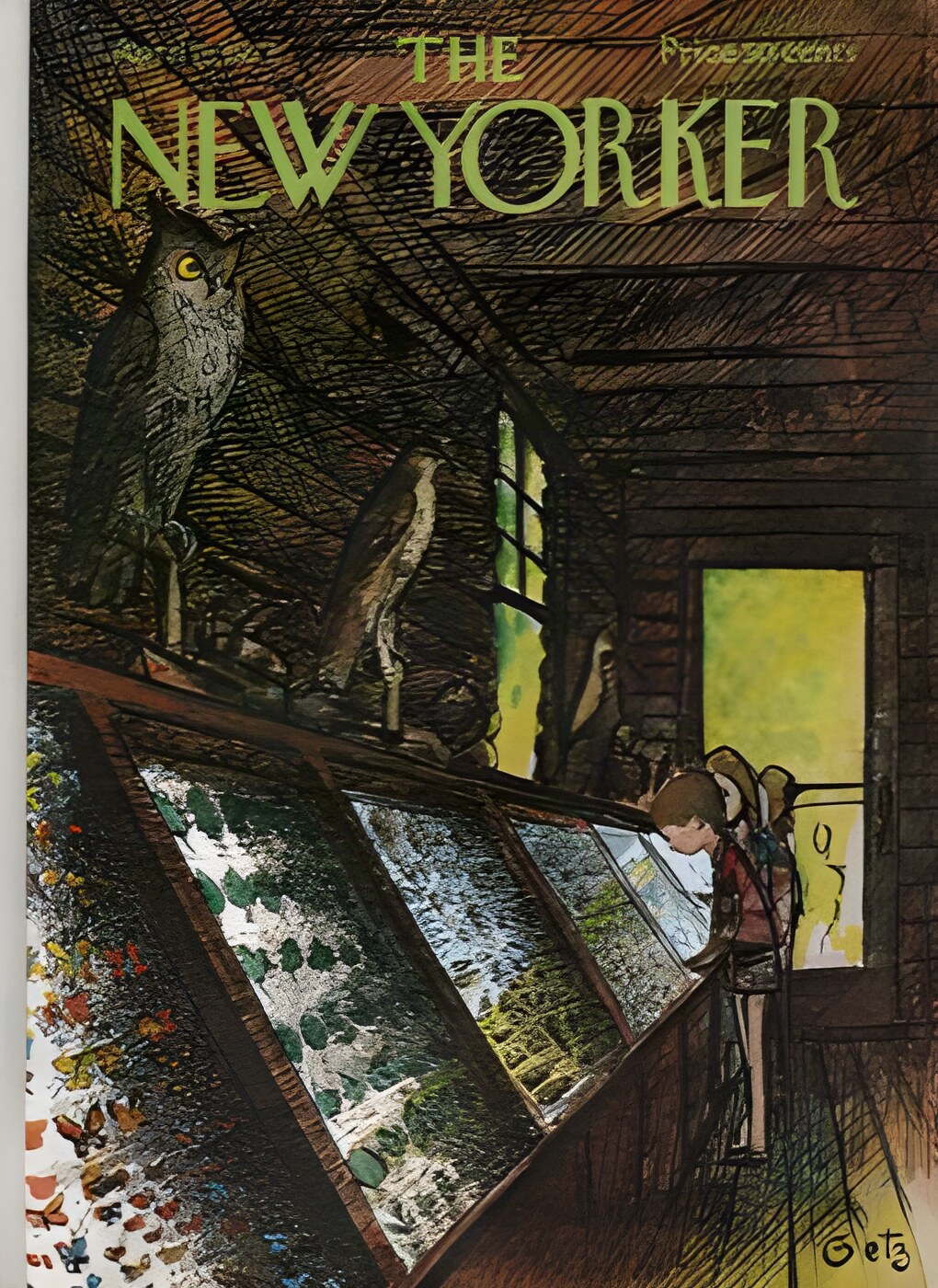
1972, Book: Very Good, Color art of children viewing specimens in nature camp setting. 8 3/4 X 12", very good. PLEASE NOTE: The image shown is a scan of the actual product you are purchasing. What you see is what you get. The sheet may have some imperfections beyond the cropped area shown. You are buying THE COVER ONLY- not the entire magazine. Your order will be placed carefully between stiff paper in clear plastic envelope, then packed in a rigid cardboard sleeve to prevent bending.
Hardcover. NY, Frederick A. Stokes, 1st, 1918, Book: Very Good, Dust Jacket: None, Hardcover, terra-cotta cloth with a color paste-down on cover, 263 pages, A collection of 35 Native American animal folklore tales. Wood-lore (or, the ways of wild things) are told in an engaging format - a wise old chief holds evening "story-time" sessions with his very curious grandson, Little Beaver. Running through the linked narrative is the little black bear Moween, of whom Little Beaver is particularly fond. Illustrated with 8 color plates, a color title page and an endpapers drawing by Paul Bransom. Light shelf wear.
Hardcover. NY, Frederick A. Stokes, 1st, 1918, Book: Good, Dust Jacket: None, Hardcover, terra-cotta cloth with a color paste-down on cover, 263 pages, A collection of 35 Native American animal folklore tales. Wood-lore (or, the ways of wild things) are told in an engaging format - a wise old chief holds evening "story-time" sessions with his very curious grandson, Little Beaver. Running through the linked narrative is the little black bear Moween, of whom Little Beaver is particularly fond. Illustrated with 8 color plates, a color title page and an endpapers drawing by Paul Bransom. Light shelf wear.
Hardcover. University of Washington Press, 1st, 2001, Book: Very Good, Dust Jacket: Very Good, Hardcover in a bright dust jacket, 285 pages. Over the Line: The Art and Life of Jacob Lawrence includes essays by eight distinguished art historians examining the ways in which Jacob Lawrence's art speaks so powerfully to different audiences. It is the first multi-author, in-depth probe of the artist's entire career: the nature of his work, his education, the critical climate in which he worked, and his use of materials and techniques. It reproduces, in full color, more than 200 works, most of which have not been published in color, or at all, in other books on the artist.

 "Nature Was Firstby: Fabell/Margaret Ayer, Walter C.")
 "Nature's Engraver: A Life of Thomas Bewickby: Uglow, Jenny")
![Nature, History, and Existentialismby: Karl Lowith; Arnold Levison [Editor]](https://www.browsingisarousing.com/shop/images/Nature-History-and-Existentialism_by_Karl-Lowith-Arnold-Levison-Editor400196-457823.jpg "Nature, History, and Existentialismby: Karl Lowith; Arnold Levison [Editor]")
 "Nature, Man and God: Being the Gifford Lectures Delivered in the University of Glasgow in the Academical Years 1932-1933 and 1933-1934by: Temple, William")
 "New Gypsies, Theby: McKell, Iain")
 "Northern Adventure, A: The Art of Fred Machetanzby: Woodward, Kesler E.")
 "O'Keeffe's O'Keeffes - The Artists Collectionby: Lynes, Barbara Buhler")
 "Observations in an Occupied Wilderness: Photographs by Terry Falkeby: Falke and Carol McCusker, Terry")

 "Ode to nature: Flowers and landscapes of the Rookwood Pottery, 1880-1940, April 15-June 30, 1980by: Trapp, Kenneth R")
 "Offspring of Empire: The Koch'ang Kims and the Colonial Origins of Korean Capitalism 1876-1945 (SIGNED COPY)by: Eckert, Carter J.")
 "Old Bill Williams, Mountain Manby: Favour, Alpheus H.")




 "Oomingmak - The Expedition to the Musk Ox Island in the Bering Seaby: Matthiessen, Peter")

 "Origin of Indian Corn and its Relatives - Texas Agricultural Experiment Station - Bulletin Number 574 - May 1939, Theby: Mangelsdorf, P. C./R. G. Reeves")
 "Over Indian and Animal Trailsby: Thompson, Jean M. and Paul")
 "Over the Line: The Art and Life of Jacob Lawrenceby: Elizabeth Hutton Turner, Patricia Hills, et al.")