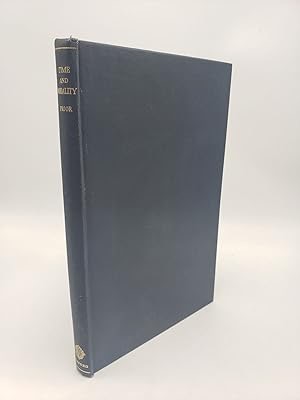
Hardcover. Oxford UK, Clarendon Press, 1st, 1957, Book: Very Good, Dust Jacket: None, Hardcover, blue cloth with gilt lettering on spine, 148 pages, paper with light tanning. The relationship between formal logic and general philosophy is discussed under headings such as A Re-examination of Our Tense-Logical Postulates, Modal Logic in the Style of Frege, and Intentional Logic and Indeterminism. The relationship between formal logic and general philosophy is discussed under headings such as A Re-examination of Our Tense-Logical Postulates, Modal Logic in the Style of Frege, and Intentional Logic and Indeterminism. Name on front fly leaf, otherwise clean.
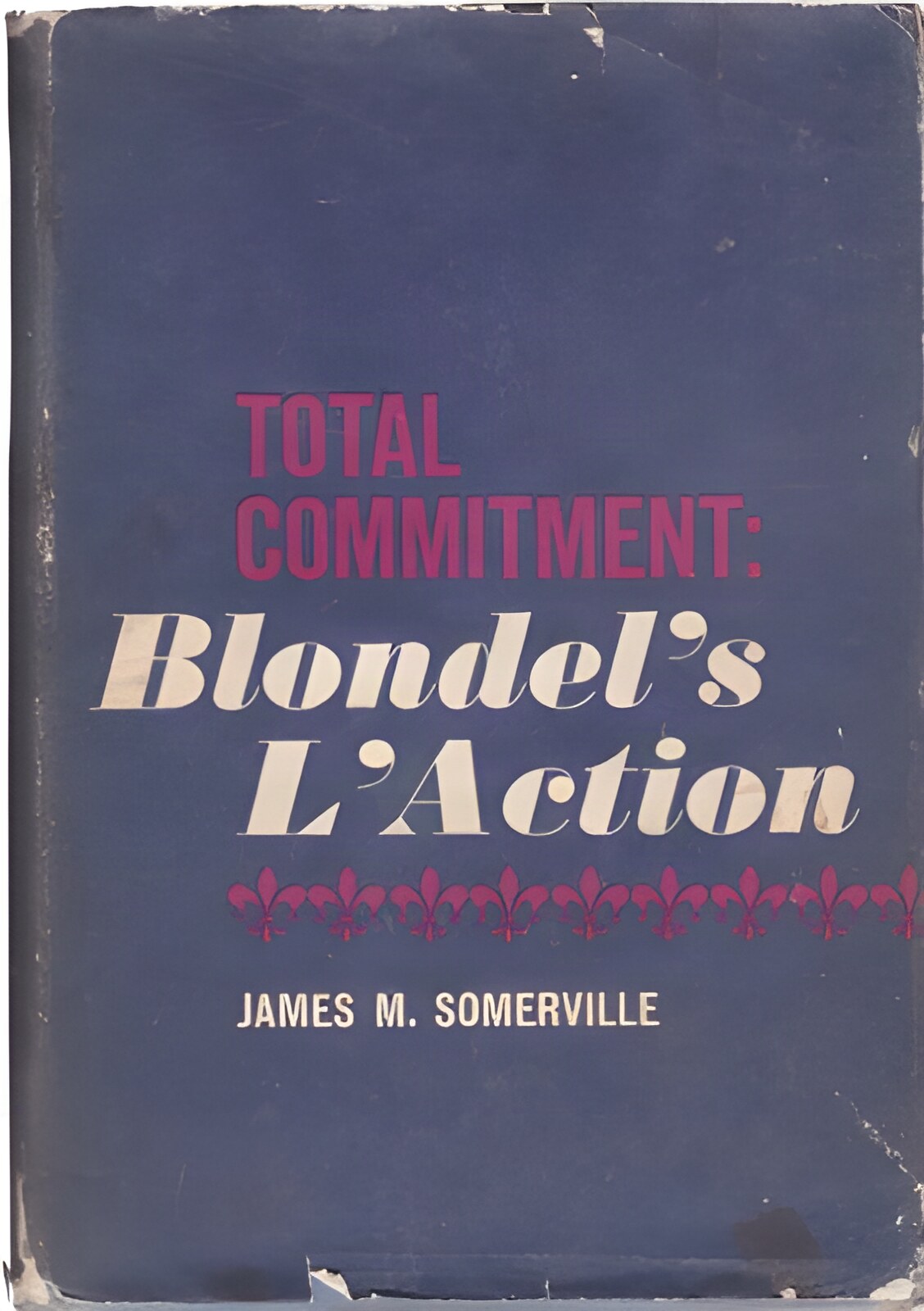
Hardcover. Washington DC, Corpus Books, 1st, 1968, Book: Good, Dust Jacket: Fair, Hardcover in a worn, chipped dust jacket, Light blue cloth covers with dark blue lettering to spine. 390 pages. Maurice Blondel was a phenomenologist long before the term was used to describe an identifiable movement. His monumental work, L'Action (1893). set the stage for an intellectual revolution that is still in progress. It remains a classic effort to demonstrate the integral unity of science, metaphysics, and the moral life in the light of man's religious aspirations. Name on front fly leaf, otherwise clean.
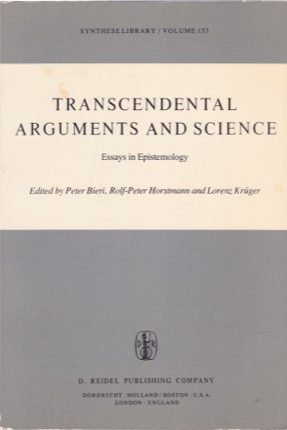
Softcover. Boston, Reidel Publishing, 1st, 1979, Book: Very Good, Dust Jacket: None, Softcover, 314 pages. The goal of the present volume is to discuss the notion of a 'conceptual framework' or 'conceptual scheme', which has been dominating much work in the analysis and justification of knowledge in recent years. More specifi- cally, this volume is designed to clarify the contrast between two competing approaches in the area of problems indicated by this notion: On the one hand, we have the conviction, underlying much present-day work in the philosophy of science, that the best we can hope for in the justifi- cation of empirical knowledge is to reconstruct the conceptual means actually employed by science, and to develop suitable models for analyzing conceptual change involved in the progress of science. This view involves the assumption that we should stop taking foundational questions of epistemology seriously and discard once and for all the quest for uncontrovertible truth. The result- ing program of justifying epistemic claims by subsequently describing patterns of inferentially connected concepts as they are at work in actual science is closely connected with the idea of naturalizing epistemology, with concep- tual relativism, and with a pragmatic interpretation of knowledge. On the other hand, recent epistemology tends to claim that no subsequent reconstruction of actually employed conceptual frameworks is sufficient for providing epistemic justification for our beliefs about the world. This second claim tries to resist the naturalistic and pragmatic approach to epistemology and insists on taking the epistemological sceptic seriously. Name on front fly leaf, otherwise clean.
Hardcover. New York, John Wiley & Sons, reprint, 1888, Book: Very Good, Dust Jacket: None, Hardcover, 452 pages. Blue cloth covers with gilt titles and black embossed illustration, b&w tissue-protected frontispiece of Ruskin's portrait, brown decorated endpapers, top edge gilt. Slight edgewear and rubbing to covers, previous owner's inscription on blank preview page, a few brown markings to right edge of page block, pages crisp and otherwise unmarked, stiff binding; overall, a very clean, tight copy.
Hardcover. Bristol UK, Thoemmes Press, reprint, 1997, Book: Very Good, Dust Jacket: None, Hardcover, blue cloth with gilt lettering on spine, 195 plus 276 pages. A facsimile reprint of the 1682 edition. One of 9 volumes in More's collected works. Name on front fly leaf otherwise a clean, bright copy.
Hardcover. NY, Garland Publishing, reprint, 1978, Book: Very Good, Dust Jacket: None, Hardcover, orange cloth with black lettering on spine, 195+ 276 pages. Facsimile of the original 1682 edition. From the 'British Philosophers and Theologians of the 17th and 18th Century' series, edited by Rene Wellek. Name on front fly leaf otherwise clean.
Hardcover. NY, Simon & Schuster, 1st, 2015, Book: Very Good, Dust Jacket: Very Good, Hardcover in a bright, unclipped dust jacket. 449 pages, b&w illustrations. Ty Cobb is baseball royalty, maybe even the greatest player who ever lived. His lifetime batting average is still the highest of all time, and when he retired in 1928, after twenty-one years with the Detroit Tigers and two with the Philadelphia Athletics, he held more than ninety records. But the numbers don't tell half of Cobb's tale. The Georgia Peach was by far the most thrilling player of the era: "Ty Cobb could cause more excitement with a base on balls than Babe Ruth could with a grand slam," one columnist wrote. When the Hall of Fame began in 1936, he was the first player voted in. But Cobb was also one of the game's most controversial characters. He got in a lot of fights, on and off the field, and was often accused of being overly aggressive. In his day, even his supporters acknowledged that he was a fierce and fiery competitor. Because his philosophy was to "create a mental hazard for the other man," he had his enemies, but he was also widely admired. After his death in 1961, however, something strange happened: his reputation morphed into that of a monster--a virulent racist who also hated children and women, and was in turn hated by his peers. Clean copy.
Hardcover. Cambridge MA, Belknap Press / Harvard University Press, 1st, 1979, Book: Very Good, Dust Jacket: Very Good, Hardcover in a lightly worn dust jacket, 896 pages. This masterly study has a grand sweep. It ranges over centuries, with a long look backward over several millennia. Yet the history it unfolds is primarily the story of individuals: thinkers and dreamers who envisaged an ideal social order and described it persuasively, leaving a mark on their own and later times. The roster of utopians includes men of all stripes in different countries and eras--figures as disparate as More and Fourier, the Marquis de Sade and Edward Bellamy, Rousseau and Marx. Fascinating character studies of the major figures are among the delights of the book. 1980 National Book Award winner. Name on front fly leaf, otherwise clean.
Hardcover. NY, New York University Press, 2nd pr., 1972, Book: Very Good, Dust Jacket: None, Hardcover, orange cloth covers, gilt lettering on spine, 159 pages. While Morgan's literary portfolio shows remarkable diversity, it is studded with works on Puritanism. 'Visible Saints' further solidifies his reputation as a leading authority on this subject. An expanded version of his Anson G. Phelps Lectures of 1962 (presented at New York University), this slender volume focuses on the central issue of church membership. Morgan posits and develops a revisionary main thesis: the practice of basing membership upon a declaration of experiencing saving grace, or 'conversion,' was first put into effect not in England, Holland, or Plymouth, as is commonly related, but in Massachusetts Bay Colony by non-separating Puritans. Characterized by stylistic grace and exegetic finesse, 'Visible Saints' is another scholarly milestone in the 'Millerian Age' of Puritan historiography. Name on front fly leaf, otherwise clean.
Hardcover. Oxford UK, Clarendon Press, reprint, 2005, Book: Very Good, Dust Jacket: None, Hardcover with glossy boards, 204 pages. Why should there be anything at all? Why, in particular, should a material world exist? Bede Rundle advances clear, non-technical answers to these perplexing questions. If, as the theist maintains, God is a being who cannot but exist, his existence explains why there is something rather than nothing. However, this can also be explained on the basis of a weaker claim. Not that there is some particular being that has to be, but simply that there has to be something or other. Rundle proffers arguments for thinking that that is indeed how the question is to be put to rest. Traditionally, the existence of the physical universe is held to depend on God, but the theist faces a major difficulty in making clear how a being outside space and time, as God is customarily conceived to be, could stand in an intelligible relation to the world, whether as its creator or as the author of events within it. Rundle argues that a creator of physical reality is not required, since there is no alternative to its existence. There has to be something, and a physical universe is the only real possibility. He supports this claim by eliminating rival contenders; he dismisses the supernatural, and argues that, while other forms of being, notably the abstract and the mental, are not reducible to the physical, they presuppose its existence. Name, date on front fly leaf. Light pencil marking to about 20 pages.
Hardcover. Middletown CT, Wesleyan University Press, 1st, Book: Very Good, Dust Jacket: Very Good, Hardcover in a bright, unclipped dust jacket, 204 pages. Composer John Luther Adams makes his home in the boreal forest near Fairbanks, Alaska, where he has created a unique musical world grounded in the elemental landscapes and indigenous cultures of the North. Winter Music, a collection of Adams's essays, journal entries, and other writings is poetic and inspirational and delves into the environmental and cultural awareness that creates his reflective, almost spiritual, approach to music. The accompanying audio CD includes two previously unrecorded works by Adams. Adams's music explores natural phenomena from the songs of birds, to the complex nature of chaos, fractal geometry, and elemental noise. Similarly, his writings explore "that region between place and culture, between environment and imagination," reflecting a philosophy of deep awareness that makes him one of the most original composers working today. Clean copy.



 "True and the Beautiful, Theby: Ruskin, John")
 "TWO CHOICE AND USEFUL TREATISES ; The One LUX ORIENTALIS ; or An Enquiry into the Opinion of the Eastern Sages Concerning the Praeexistence of Souls. Being a Key to Unlock the Grand Mysteries of Providence. In Relation to Mans Sin an")
![Two Choice and Useful Treatises. [British Philosophers and Theologians of the 17th and 18th Centuries] by: Joseph Glanvill](javascript:largeIMTop('https://www.browsingisarousing.com/shop/images/Two-Choice-and-Useful-Treatises.-British-Philosophers-and-Theologians-of-the-17th-and-18th-Centuries386834-440941.jpg','https://www.browsingisarousing.com/shop/images/Two-Choice-and-Useful-Treatises.-British-Philosophers-and-Theologians-of-the-17th-and-18th-Centuries386834-440941.jpg',0,'386834',0,'') "Two Choice and Useful Treatises. [British Philosophers and Theologians of the 17th and 18th Centuries] by: Joseph Glanvill")
 "Ty Cobb: A Terrible Beautyby: Leerhsen, Charles")