Hardcover. UK, Cambridge University Press, 1st, 1999, Book: Very Good, Dust Jacket: Very Good, Hardcover in a bright dust jacket, 346 pages. Dr. Notomi presents a new interpretation of one of Plato's most important dialogues, the Sophist, addressing both historical context and philosophical content. He shows how important the issues concerning the sophist (professional teacher and rhetorician in ancient Greece) are to the possibility of philosophy. His new approach to the whole dialogue reveals that Plato struggles with difficult philosophical issues in a single line of inquiry; and that Plato shows, in defining the sophist, his conception of the authentic philosopher. Name, date on front fly leaf, otherwise clean.
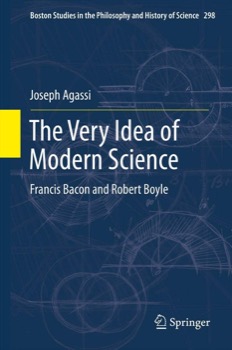
Hardcover. London/NY, Springer , 1st, 2013, Book: Very Good, Dust Jacket: None, Hardcover in glossy boards, 315 pages. This book is a study of the scientific revolution as a movement of amateur science. It describes the ideology of the amateur scientific societies as the philosophy of the Enlightenment Movement and their social structure and the way they made modern science such a magnificent institution. It also shows what was missing in the scientific organization of science and why it gave way to professional science in stages. In particular the book studies the contributions of Sir Francis Bacon and of the Hon. Robert Boyle to the rise of modern science. The philosophy of induction is notoriously problematic, yet its great asset is that it expressed the view of the Enlightenment Movement about science. This explains the ambivalence that we still exhibit towards Sir Francis Bacon whose radicalism and vision of pure and applied science still a major aspect of the fabric of society. Finally, the book discusses Boyle's philosophy, his agreement with and dissent from Bacon and the way he single-handedly trained a crowd of poorly educated English aristocrats and rendered them into an army of able amateur researchers. Clean, bright.
Hardcover. London, Viking, 1st, 1992, Book: Very Good, Dust Jacket: Very Good, Hardcover in a bright, unclipped dust jacket. A dark comedy recreates the biblical books of Genesis and Exodus from Cain's point of view, depicting a capricious God who resents Eve's flirting with an angel, an envious and sullen Adam, and Abel, Cain's irreconcilable opposite. Clean copy.
Hardcover. NY, Jewish Publication Society, 1st, 1984, Book: Very Good, Dust Jacket: None, Hardcover in black cloth, lacks dust jacket, 256 pages. A major treatise of Levi ben Gershom of Provence (1288-1344), one of the most creative and daring minds of the medieval world. It is devoted to a demonstration that the Torah, properly understood, is identical to true philosophy. Volume 1 ONLY. Clean copy.
Hardcover. NY, Jewish Publication Society, 1st, 1987, Book: Very Good, Dust Jacket: Very Good, Hardcover in a bright dust jacket, 278 pages. A major treatise of Levi ben Gershom of Provence (1288-1344), one of the most creative and daring minds of the medieval world. It is devoted to a demonstration that the Torah, properly understood, is identical to true philosophy. Volume 2 ONLY. Clean copy.
Softcover. Cambridge UK, Cambridge University Press, reprint, 1983, Book: Good, Dust Jacket: None, Two softcover volumes, Parts 1 and 2, 259 and 368 pages. A philosophical study of the nature of bodily action and the will - and the responsibility we have for our own active bodily movements, which is distinct from though closely related to both causal and moral responsibility. Name on front fly leaf and light pencil notations to 20 pages in volume 1, light stain in volume 2 on copy block, not affecting text.
Hardcover. NY, Arno Press, reprint, 1977, Book: Very Good, Dust Jacket: None, Hardcover, dark green cloth with gilt lettering. A facsimile reprint of the London 1717 edition. 405 pages plus publisher's ads. Light pencil notes on front endpapers with owner's name in ink. Otherwise clean, tight copy.
Hardcover. UK, Oxford University Press, reprint, 2005, Book: Very Good, Dust Jacket: None, Hardcover in glossy boards, 712 pages. John Wilmot, second Earl of Rochester (1647-80), was a leading member of the group of "court wits" surrounding Charles II and one of the wittiest and most sexually explicit poets in English. In this long-awaited edition, Harold Love, a leading scholar of seventeenth-century manuscript circulation, presents a scholarly text based on detailed examination of Wilmot's manuscripts, with full textual and explanatory notes. This is a reprint of the 1999 first printing. Light notations to about 30 pages, otherwise bright, tight copy.
Hardcover. UK, Oxford University Press, 1st, 2012, Book: Very Good, Dust Jacket: Very Good, This is the first volume in the four-volume edition of The Works of Lucy Hutchinson, the first-ever collected edition of the writings of the pioneering author and translator. Hutchinson (1620-81) had a remarkable range of her interests, from Latin poetry to Civil War politics and theology. In two parts, two volumes: 797 total pages. This edition of her translation of Lucretius's De rerum natura offers new biographical material, demonstrating the changes and unexpected continuities in Hutchinson's life between the work's composition in the 1650s and its dedication in 1675. Hers is the first complete surviving English translation of one of the great classical epics, a challenging text at the borderlines of poetry and philosophy. For the first time, the Lucretius translation is made available alongside the Latin text Hutchinson used, which differs in innumerable ways from versions known today. The commentary, the fullest in any edition of a literary translation, provides multiple ways into further understanding of the translation and its contexts. Written at a momentous period in political and literary history, Hutchinson's Lucretius throws light on the complex transition between 'ancient' and 'modern' conceptions of the classical canon and of natural philosophy. It offers a case study in the history of reading, and more specifically of reading by a woman. Name on front fly leaves, pencil notations to front fly leaf, a dozen pages in Part 1. DUE TO WEIGHT, DOMESTIC SHIPPING ONLY.
Hardcover. NY, AMS Press, reprint, 1972, Book: Very Good, Dust Jacket: None, Hardcover, brown cloth with gilt lettering on spine, 412 pages. Volume I only (of 3 volumes). A reprint of the Oxford edition of 1838. Name and pencil notations on front fly leaf on front fly leaf and approx. 12 pages. Otherwise a clean, bright copy.
Hardcover. NY, AMS Press, reprint, 1972, Book: Very Good, Dust Jacket: None, Hardcover, brown cloth with gilt lettering on spine, 499 pages. Volume II only (of 3 volumes). A reprint of the Oxford edition of 1838. Name on front fly leaf with pencil notations, otherwise a clean, bright copy.
Hardcover. NY, AMS Press, reprint, 1972, Book: Very Good, Dust Jacket: None, Hardcover, brown cloth with gilt lettering on spine, 450 pages. Volume III only (of 3 volumes). A reprint of the Oxford edition of 1838. Ten sermons followed by 8 additional discourses. Name on front fly leaf otherwise a clean, bright copy.
Hardcover. Bristol UK, Thoemmes Press, reprint, 1998, Book: Very Good, Dust Jacket: None, Hardcover, maroon cloth, 537 pages. Gilt lettering on a green band on the spine. A reprint of the 1830 edition. Clean copy.
Softcover. London/NY, Routledge, reprint, 2001, Book: Very Good, Dust Jacket: None, Softcover, 328 pages. This unique collection of essays, published together for the first time, not only elucidates the complexity of ancient Greek thought, but also reveals Karl Popper's engagement with Presocratic philosophy and the enlightenment he experienced in his reading of Parmenides. As Karl Popper himself states himself in his introduction, he was inspired to write about Presocratic philosophy for two reasons - firstly to illustrate the thesis that all history is the history of problem situations and secondly, to show the greatness of the early Greek philosophers, who gave Europe its philosophy, its science and its humanism. Light pencil marking to 8 pages.
Hardcover. New Haven CT, Yale University Press, 1st, 2001, Book: Very Good, Dust Jacket: None, Hardcover in burgundy cloth boards with gilt lettering to front panel and spine, as issued w/out dj. Short inscription on front fly leaf, otherwise clean. This book gathers together for the first time an important body of texts written between 1672 and 1686 by the great German philosopher and polymath Gottfried Leibniz. These writings, most of them previously untranslated, represent Leibniz's sustained attempt on a problem whose solution was crucial to the development of his thought, that of the composition of the continuum. The volume begins with excerpts from Leibniz's Paris writings, in which he tackles such problems as whether the infinite division of matter entails "perfect points," whether matter and space can be regarded as true wholes, whether motion is truly continuous, and the nature of body and substance. Comprising the second section is Pacidius Philalethi, Leibniz's brilliant dialogue of late 1676 on the problem of the continuity of motion. In the selections of the final section, from his Hanover writings of 1677-1686, Leibniz abandons his earlier transcreationism and atomism in favor of the theory of corporeal substance, where the reality of body and motion is founded in substantial form or force. Leibniz's texts (one in French, the rest in Latin) are presented with facing-page English translations, together with an introduction, notes, appendixes containing related excerpts from earlier works by Leibniz and his predecessors, and a valuable glossary detailing important terms and their translations.
Hardcover. Hartford CT, Edwin Hunt, 1st, 1847, Book: Very Good, Dust Jacket: None, Hardcover, 213 pages. 7.75 x 4.75", blind & gold stamped brown cloth. A collection of sermons: Elements of Power: spirit of enterprise, enthusiasm, courage, readiness to receive & propagate new truths; Sources of Danger: trifling pursuits, unworthy associates, improper pleasures & amusements, ball-room, intemperance, theatre, improper reading; Pleasure & the Judgment; Demands of Age: reforms, slavery, war, temperance; spurious reforms, capital punishment. Some light foxing, minor wear to covers, clean.
Softcover. NY, Oxford University Press, 1st, 2015, Book: Very Good, Dust Jacket: None, Softcover, 360 pages. Ex nihilo nihil fit. Philosophy, especially great philosophy, does not appear out of the blue. In the current volume, a team of top scholars-both up-and-coming and established-attempts to trace the philosophical development of one of the greatest philosophers of all time. Featuring twenty new essays and an introduction, it is the first attempt of its kind in English and its appearance coincides with the recent surge of interest in Spinoza in Anglo-American philosophy. Spinoza's fame-or notoriety-is due primarily to his posthumously published magnum opus, the Ethics, and, to a lesser extent, to the 1670 Theological-Political Treatise. Few readers take the time to study his early works carefully. If they do, they are likely to encounter some surprising claims, which often diverge from, or even utterly contradict, the doctrines of the Ethics. Consider just a few of these assertions: that God acts from absolute freedom of will, that God is a whole, that there are no modes in God, that extension is divisible and hence cannot be an attribute of God, and that the intellectual and corporeal substances are modes in relation to God. Yet, though these claims reveal some tension between the early works and the Ethics, there is also a clear continuity between them. Name, date on front fly leaf, otherwise clean.
Softcover. Oxford UK, Blackwell, 1st, 1999, Book: Very Good, Dust Jacket: None, Softcover, 332 pages. The Zizek Reader - which includes a Foreword by Zizek and a new, previously unpublished essay on cyberspace - provides a comprehensive and accessible introduction to the flamboyant work of a figure who has been variously described as 'one of the most arresting, insightful and scandalous thinkers in recent memory' and 'the Giant of Ljubljana'. His work is an extraordinary mix of Hegel and Hitchcock, Schelling and science fiction, Kant and courtly love, Stalin and Stephen King, all of which is strongly seasoned with Lacanian psychoanalysis. Divided into three parts - Culture, Woman and Philosophy - the Reader not only provides careful explications of the individual extracts within each section but also connects these extracts in a general introduction, mapping the shiftings of Zizek's thought within the Lacanian framework. The essays on woman offer feminism ammunition from unexpected sources, within a reading of Lacan that goes counter to his ambiguous reception by feminists. In fact, at this collection dazzlingly demonstrates, Zizek provides us with one of the most limpid and persuasive readings so far produced of Lacan's difficult thought. Name on inside of front cover, otherwise clean.
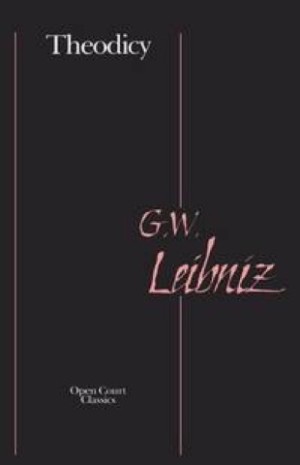
Softcover. La Salle IL, Open Court, reprint, 1990, Book: Very Good, Dust Jacket: None, Softcover, 448 pages. In this 1710 treatise, Gottfried Liebniz's only book-length work, he applies the idea of philosophical 'optimism'- that we live in the best of all possible worlds-to the 'problem of evil'- If a benevolent God exists, why do terrible things happen? He explores the possibility that humanity's happiness is not necessarily part of God's plan.Much of Leibniz's thinking in the realm of the sciences flowed from his philosophy-he believed the universe to operate under simple, intelligible, interconnected rules. Understanding how he approached the metaphysical world and humanity's place in it is vital to understanding his contributions to modern science. The impact of the work of this German mathematician (1646-1716) on modern science and technology is all but incalculable. His notation for infinitesimal calculus-which he developed independently of Newton-remains in use today, and his invention of binary counting is the basis for modern computing. He was a powerfully influential philosopher as well, and is still considered, alongside Descartes and Spinoza, one of the great 17th-century rationalists.
Hardcover. New York, Harper and Brothers, reprint, Book: Very Good, Dust Jacket: Good, Hardcover, 331 pages, putty color cloth covers with black lettering on spine. Dust jacket with edgewear, chipping. Previous owner's signature on front fly leaf.
Softcover. Indianapolis, Hackett Publishing, reprint, 1989, Book: Very Good, Dust Jacket: None, Softcover, 358 pages. This volume includes Whewell's seminal studies of the logic of induction (with his critique of Mill's theory), arguments for his realist view that science discovers necessary truths about nature, and exercises in the epistemology and ontology of science. The book sets forth a coherent statement of a historically important philosophy of science whose influence has never been greater: every one of Whewell's fundamental ideas about the philosophy of science is presented here. Clean, bright copy.
Hardcover. Bristol UK, Thoemmes, reprint, 1990, Book: Very Good, Dust Jacket: None, Hardcover, red cloth with gilt lettering on spine, 554 pages. A facsimile reprint of the 1733 edition. Name on front fly leaf, otherwise clean.
Softcover. NY, Farrar, Straus and Giroux, 1st, 2012, Book: Very Good, Dust Jacket: Very Good, Hardcover, 416 pages. In this definitive biography, Justin Wolff places Benton in the context of his tumultuous historical moment-as well as in the landscapes and cultural circles that inspired him. Thomas Hart Benton-with compelling insights into Benton's art, his philosophy, and his family history-rescues a great American artist from myth and hearsay, and provides an indelibly moving portrait of an influential, controversial, and often misunderstood man.


 "The Use of Sacrificial Ideas in Greek Christian Writers from the FNew Testament to John Chrysostom: Patristic Monograph Series by: Young, Frances")









 "The Works of William Chillingworth, Volume 1by: Chillingworth, William")
 "The Works of William Chillingworth, Volume 2by: Chillingworth, William")
 "The Works of William Chillingworth, Volume 3by: Chillingworth, William")




 "Theological Essaysby: Maurice, Frederick Denison")