Hardcover. Chicago, Ivan R. Dee, 1st, 2000, Book: Very Good, Dust Jacket: Very Good, Hardcover in a bright, unclipped dust jacket. General Dwight D. Eisenhower's decision to campaign for the presidency in 1952 was a pivotal even in America's cold war years-- it influenced almost a decade of foreign and domestic policy. Based on recently discovered letters and diaries, William Pickett provides the first complete account of Eisenhower's decision to run, with surprising new conclusions. Clean, unread copy.
Hardcover. Chapel Hill, University of North Carolina Press , 1st, 1937, Book: Very Good, Dust Jacket: None, Hardcover, 849 pages, b&w illustrations. Tan cloth covers with dark brown decoration. Previous owner's stamp on both end papers.
Hardcover. Lawrence KS, University Press of Kansas, 1st, 2007, Book: Very Good, Dust Jacket: Very Good, Hardcover in a bright dust jacket, 274 pages. With the landmark election of Franklin Delano Roosevelt in 1932, decades of Republican ascendancy gave way to a half century of Democratic dominance. It was nothing less than a major political realignment, as the direction of federal policy shifted from conservative to liberal-and liberalism itself was redefined in the process. Electing FDR is the first book in seventy years to examine in its entirety the 1932 presidential election that ushered in the New Deal. Award-winning historian Donald Ritchie looks at how candidates responded to the nation's economic crisis and how voters evaluated their performance. More important, he explains how the Democratic Party rebuilt itself after three successive Republican landslides: where the major shifts in party affiliation took place, what contingencies contributed to FDR's victory, and why the new coalition persisted as long as it did. Ritchie challenges prevailing assumptions that the Depression made Roosevelt's election inevitable. He shows that FDR came close to losing the nomination to contenders who might have run to the right of Hoover, and discusses the role of newspapers and radio in presenting the candidates to voters. He also analyzes Roosevelt's campaign strategies, recounting his attempts to appeal to disaffected voters of all ideological stripes, often by altering his positions to broaden his popularity. With the advent of the New Deal, Americans came to enjoy a wide federal safety net that provided everything from old age pensions to rural electricity-government innovations so embraced by voters that even later conservative presidents recognized their importance. Ritchie traces this legacy through the Reagan and Bush years, but he relates how FDR in 1932 was often vague about the specifics of his program and questions whether voters really knew what they were in for with the New Deal. Clean copy.
Hardcover. Berkeley CA, University of California Press, 1st, 1974, Book: Very Good, Dust Jacket: Good, Hardcover in a lightly worn dust jacket, 205 pages. Name on front fly leaf otherwise clean. Small hole on dj front.
Hardcover. NY, Overlook Press, 1st US, 2013, Book: Very Good, Dust Jacket: Very Good, Hardcover in a bright, unclipped dust jacket. Against the background of the Cold War, and the looming spectre of Soviet-sponsored subversion in Britain's dwindling colonial possessions, the imperial intelligence service MI5 played a crucial but top secret role in passing power to newly independent national states across the globe. Walton reveals this `missing link' in Britain's post-war history. He sheds light on everything from violent counter-insurgencies fought by British forces in the jungles of Malaya and Kenya, to urban warfare campaigns conducted in Palestine and the Arabian Peninsula. Draws on (among other sources) records from the Foreign Office's secret archive at Hanslope Park, which contains some of the darkest and most shameful secrets from the last days of Britain's empire. 411 pages, b&w illustrations. Clean copy.
Hardcover. NY, W. W. Norton & Company, 1st, 1976, Book: Very Good, Dust Jacket: Very Good, Hardcover in a lightly worn dust jacket, 332 pages, b&w illustrations. Clean, tight copy.
Softcover. Oxford UK, Cambridge University Press, 2nd Ed., 2000, Book: Very Good, Dust Jacket: None, Softcover, 580 pages. INSCRIBED BY AUTHOR on inside front cover. This classic work of recent historiography broke the hold of the "old guard" on this key period of English history. It has now been extensively rewritten, and in its updated form reinforces its arguments with new evidence and addresses some of the historical preoccupations of the past fifteen years.
Softcover. Berkeley CA, University of California Press, reprint, 1966, Book: Very Good, Dust Jacket: None, Softcover, 151 pages. Deals with the parliamentary group in England which claimed the Whig tradition during the American Revolution. The Americans asserted rights that were essentially Whig, but at the same time repudiated the authority of parliament, the stronghold of Whig tradition. Fading to spine, name on front fly leaf, otherwise clean.
Hardcover. London, Longmans, Green, Reader, and Dyer, 2nd, 1874, Book: Very Good, Dust Jacket: None, 164 pages, plus 24 pages of new works from publishers. Green cloth covers, gilt titles to spine, blind stamped titles and border to front cover. Light edgewear and rubbing to covers, spine cracked at inside of front hinge, previous owner's inscription to front endpaper, Edinburgh Medical Society stamp to title page, short pencil notations to rear endpaper; otherwise a very neat, tight copy.
Hardcover. Austin TX, University of Texas Press, 1stt, 1969, Book: Very Good, Dust Jacket: Very Good, Hardcover in a bright dust jacket. Three essays (on the Shelterbelt Project, New Deal critics, and FDR's attempt to expand the Supreme Court) make up the second annual Walter Prescott Webb Memorial Lectures; foreword by C. B. Smith; edited by Harold M. Hollingsworth and William F. Holmes. Bound in bright green cloth-covered boards with silver lettering on the front board and spine.
Softcover. Cambridge MA, Harvard University Press, reprint, 1985, Book: Very Good, Dust Jacket: None, Softcover, 291 pages with index. A social history of Europe in all its aspects: economic, political, diplomatic military, colonial-expansionist. Crisply and succinctly written, it describes Europe not through a history of individual countries, but in a common context during the three quarters of a century between the death of Louis XIV and the industrial revolution in England and the social and political revolution in France. It presents the development of government, institutions, cities, economies, wars, and the circulation of ideas in terms of social pressures and needs, and stresses growth, interrelationships, and conflict of social classes as agents of historical change, paying particular attention to the role of popular, as well as upper- and middle-class, protest as a factor in that change. Clean, bright copy.
Hardcover. Chicago, Quadrangle Books, 1st, 1972, Book: Very Good, Dust Jacket: Good, Hardcover in a rubbed, worn dust jacket, 277 pages. Name on front fly leaf, otherwise clean.
Hardcover. Reno, Center for Basque Studies, 1st, 2012, Book: Very Good, Dust Jacket: None, 333 pages, b&w photos. Black illustrated boards, no dust jacket. Light bumping to corners, else a clean, tight copy. his story--that of the government-in-exile of Lehendakari Jose Antonio Agirre and the multitudes of other Basques who were forced by war and oppression to flee their homeland--has not been written in English before and is rather unknown to the Basque, Spanish, and French historiography. Drawing on primary sources; archival documentation; and interviews with many Basque political exiles, resistance members, and former prisoners of labor camps Professor Xabier Irujo tells a gripping story of the Basque autonomous government, conceived during the beginnings of a bloody civil war, forced to organize a mass exile and then overtaken by necessity to feed and clothe its exiled population. Following this initial period, the exiled Basques were then confronted by World War and forced again into flight, this time mainly to the Americas. Never giving up their opposition to the dictatorship of Francisco Franco, the government continued its struggle during forty long years of existence, through wars hot and cold as well as countless political developments. While tracing the history of Lehendakari Agirre, this book is more the story of all of the Basques who were forced into exile, and it serves as a testimony to their unwavering determination to return to their homeland. In addition, the book contains an extensive biographical index of many of the heretofore unknown exile activists: writers, politicians, soldiers, intellectuals, but even more so, Basque patriots.
Hardcover. Urbana IL, University of Illinois Press, 1st, 1990, Book: Very Good, Dust Jacket: Very Good, Hardcover in a bright, unclipped dust jacket. Power was at the heart of FDR's relationship with the media: the power of the nation's chief executive to control his public messages versus the power of the free press to act as an independent watchdog over the president and the government. This compelling study points to Roosevelt's consummate news management as a key to his political artistry and leadership legacy.
Hardcover. NY, NYU Press , 1st, 2014, Book: Very Good, Dust Jacket: None, Hardcover, illustrated boards, no dust jacket issued, 272 pages. Returning Vietnam veterans had every reason to expect that the government would take care of their readjustment needs in the same way it had done for veterans of both World War II and Korea. But the Vietnam generation soon discovered that their G.I. Bills fell well short of what many of them believed they had earned. Mark Boulton's groundbreaking study provides the first analysis of the legislative debates surrounding the education benefits offered under the Vietnam-era G.I. Bills. Specifically, the book explores why legislators from both ends of the political spectrum failed to provide Vietnam veterans the same generous compensation offered to veterans of previous wars. Clean copy.
Hardcover. Philadelphia, University of Pennsylvania Press, 1st, 1982, Book: Very Good, Dust Jacket: Good, Hardcover in a dust jacket with fading to spine, 297 pages. Focusing on the family and career of the prominent Egyptian politician Sayed Bey Marei, Robert Springborg provides in this volume a political ethnography on the changing roles of the family and other social units in Egypt's political economy. He traces the rise to power of the rural nobility from the late nineteenth century, demonstrating how members of this class used family, regional, patron-client, and small-group loyalties to maintain and enhance their powers and privileges under the regimes of Nasser and Sadat. In this context the author also investigates the complexities between provincial and national politics, and between the bureaucratic/technocratic elite and the political elite of the country. Clean copy.
Hardcover. London, Sir Isaac Pitman & Sons, 1st, 1911, Book: Very Good, Dust Jacket: None, Hardcover, red cloth with gilt titles, top edge gilt, 456 pages. Preface, editorial notes accompanying each speech from Cromwell, delivered September 17, 1665 to Gladstone, May 7, 1877. Some light foxing to first 12 pages, otherwise clean, no markings.
Softcover. Berkeley CA, University of California Press, 1st, 1997, Book: Very Good, Dust Jacket: None, Softcover, 234 pages. Behind all of the statistics on downsizing, the shrinking of our industrial base, and the folly of short-sighted management is the human drama of working women and men and their unions, struggling for dignity, fairness, and security. In Farewell to the Factory, Ruth Milkman tells us the stories of workers in a New Jersey auto plant. Milkman's scholarship makes a valuable contribution to the national conversation on restoring the American Dream for working families. Clean copy.
Softcover. Berkeley CA, University of California Press, 1st pbk, 2001, Book: Very Good, Dust Jacket: None, Softcover, 418 pages, b&w illustrations. "...chronicles the historic transition from apartheid to democracy. This compelling story is told through the lives of four pairs of South Africans from opposite sides of the racial and political divide. Taken together, the profiles provide the most intimate look yet at the social dynamics of post-apartheid South Africa." Clean copy.
Hardcover. NY, Da Capo Press, 1st, 2012, Book: Very Good, Dust Jacket: Very Good, Hardcover in a bright, unclipped dust jacket. When the wartime 1944 presidential election campaign geared up late that spring, Franklin D. Roosevelt had already occupied the White House years longer than any other president. Sensing likely weakness, the Republicans mounted an energetic and expensive campaign, hitting hard at FDR's liberal domestic policies and the war's ongoing cost. Despite gravely deteriorating health, FDR and his feisty running mate, the unexpected Harry Truman, campaigned vigorously against young governor Thomas E. Dewey of New York and old-line Ohio governor John Bricker. Roosevelt's charm and wit, as well as the military successes in Europe and the Pacific, contributed to his sweeping electoral victory. But the hard-fought campaign would soon take its toll on America's only four-term president. Preeminent historian and biographer Stanley Weintraub recaptures FDR's striking "last campaign" and the year's momentous events, from the rainy city streets where Roosevelt, his legs paralyzed by polio since 1922, rode in an open car, to the battlefronts where the commander-in-chief's forces were closing in on Hitler and Hirohito.
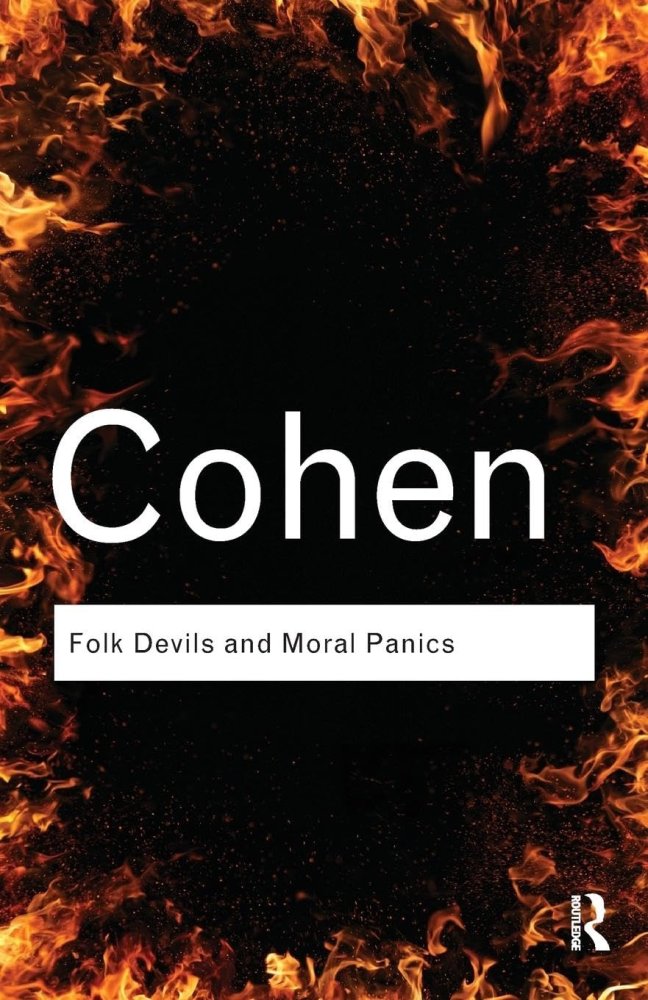
Softcover. NY, Routledge, reprint, 2011, Book: Very Good, Dust Jacket: None, Softcover, 282 pages. Mods and Rockers, skinheads, video nasties, designer drugs, bogus asylum seeks and hoodies. Every era has its own moral panics. It was Stanley Cohen's classic account, first published in the early 1970s and regularly revised, that brought the term 'moral panic' into widespread discussion. It is an outstanding investigation of the way in which the media and often those in a position of political power define a condition, or group, as a threat to societal values and interests. Fanned by screaming media headlines, Cohen brilliantly demonstrates how this leads to such groups being marginalized and vilified in the popular imagination, inhibiting rational debate about solutions to the social problems such groups represent. Furthermore, he argues that moral panics go even further by identifying the very fault lines of power in society. Clean, bright copy.
Hardcover. NY, Harcourt Brace and Company, 1st US, 1939, Book: Very Good, Dust Jacket: Good, Hardcover in a lightly worn and faded dust jacket, 366 pages. A collection of speeches by the Right Hon. Anthony Eden in the House of Commons and elsewhere through 1938, which offers a criticism on British foreign policy. Previous owner's inscription on front fly leaf, otherwise clean.
Hardcover. Princeton University Press , 1st, 1967, Book: Very Good, Dust Jacket: None, Hardcover, gray cloth-covered boards, gilt titles to spine on black ground, 350 pages., illustrated with tables. The book sets out to "describe the inception, organisation, and administration of the Nazi foreign labor program and the relationship of the program to the Nazi war economy and government". It uses captured documents as well as material published during the war. Spine slightly cocked, clean copy.

 "Eisenhower Decides to Run: Presidential Politics and Cold War Strategyby: Pickett, William B.")
 "Ejido, The: Mexico's Way Outby: Simpson, Eyler N.")
 "Electing FDR: The New Deal Campaign of 1932by: Donald A. Ritchie")


 "English Judiciary in the Age of Glanvill and Bracton, c. 1176-1239, Theby: Turner, Ralph V.")
 "English Society, 1660-1832: Religion, Ideology and Politics During the Ancien Regime (INSCRIBED COPY)by: Clark, J. C. D.")
 "English Whiggism and the American Revolution by: G. H. Guttridge")
 "Essays on Some Unsettled Questions of Political Economyby: Mill, John Stuart")
 "Essays on the New Dealby: William E. Leuchtenburg William H. Droze, George Wolfskill")


 "Expelled from the Motherland The Government of President Jose Antonio Agirre in Exile, 1937-1960by: Irujo, Xabier")


 "F.D.R. and the News Mediaby: Betty Houchin Winfield")
 "Failing Our Veterans: The G.I. Bill and the Vietnam Generationby: Mark Boulton")
 "Family, Power, and Politics in Egypt: Sayed Bey Mare--His Clan, Clients, and Cohorts by: Robert Springborg")
![Famous Speechesby: Herbert, Paul [Ed.]](javascript:largeIMTop('https://www.browsingisarousing.com/shop/images/Famous-Speeches_by_Herbert-Paul-Ed.374147-398870.jpg','https://www.browsingisarousing.com/shop/images/Famous-Speeches_by_Herbert-Paul-Ed.374147-398870.jpg',0,'374147',0,'') "Famous Speechesby: Herbert, Paul [Ed.]")
 "Farewell to the Factory: Auto Workers in the Late Twentieth Century by: Ruth Milkman")
 "Fault Lines: Journeys into the New South Africa by: Goodman, David")
 "Final Victory: FDR's Extraordinary World War II Presidential Campaignby: Stanley Weintraub")

 "Foreign Labor in Nazi Germany by: Edward L. Homze")