Hardcover. Athens GA, University of Georgia Press, 1st, 2001, Book: Very Good, Dust Jacket: Very Good, Hardcover in a bright dust jacket, 168 pages. This work tells how the first generation of Protestant fundamentalists embraced the modern business and entertainment techniques of marketing, advertising, drama, film, radio, and publishing to spread the gospel. Clean copy.
Hardcover. London, Hodder and Stoughton, 1st, 1938, Book: Very Good, Dust Jacket: None, Hardcover, maroon cloth with gilt stamped spine, 255 pages including index. Karl Barth (1886-1968), the Swiss Reformed professor and pastor, was once described by Pope Pius XII as the most important theologian since Thomas Aquinas. As principal author of 'The Barmen Declaration', he was the intellectual leader of the German Confessing Church -- the Protestant group that resisted the Third Reich. This volume contains The Gifford Lectures he delivered in Aberdeen in 1937 and 1938. Name on front fly leaf, pencil marking (mostly underlining) to half the pages. Sound copy.
Hardcover. NY, Doubleday, Doran & Co, 1st, 1934, Book: Very Good, Dust Jacket: Very Good, Hardcover, pictorial boards with a red cloth spine. Original unclipped color and gilt pictorial dust jacket ($1.75). Illustrated in color, gilt, and black-and-white throughout by the D'Aulaires, with color pictorial endpapers and color and gilt pictorial title page. 32 pages. The Protestant Edition. Name on inside front cover, otherwise clean.
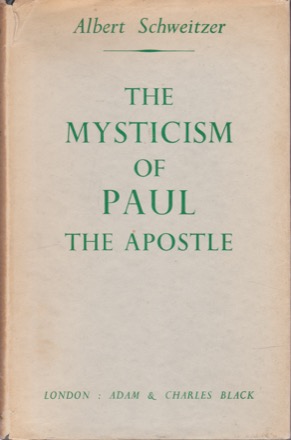
Hardcover. London, Adam & Charles Black, 2nd Ed., 1953, Book: Very Good, Dust Jacket: Good, Hardcover on a worn, chipped dust jacket, 411 pages. First published in 1931, this is the Second Edition with corrections. Albert Schweitzer goes against Luther and the Protestant tradition to look at what Paul actually writes in the Epistles to the Romans and Galatians: an emphasis upon the personal experience of the believer with the divine. Clean copy.
Hardcover. NY, Henry Holt, 1st, 1986, Book: Very Good, Dust Jacket: Very Good, Hardcover in a bright, unclipped dust jacket. Fifteen-year-old Sammy di Cantini, resident of a mining region of Pennsylvania, is determined to rise above his class, falls disastrously in love with a Protestant, and visits his Mafia brother in New York where he becomes involved in impossible struggles. Takes place in 1925 in Pennsylvania's coal country. Clean, bright copy.
Softcover. London, Cambridge, University Press, reprint, 1981, Book: Very Good, Dust Jacket: None, Softcover, 514 pages. The Post-Darwinian Controversies offers an original interpretation of Protestant responses to Darwin after 1870, viewing them in a transatlantic perspective and as a constitutive part of the history of post-Darwinian evolutionary thought. The impact of evolutionary theory on the religious consciousness of the nineteenth century has commonly been seen in terms of a 'conflict' or 'warfare' between science and theology. Dr. Moore's account begins by discussing the polemical origins and baneful effects of the 'military metaphor', and this leads to a revised view of the controversies based on an analysis of the underlying intellectual struggle to come to terms with Darwin. Clean, bright copy.
Softcover. Dublin IR, The Lilliput Press, 1st, 2005, Book: Very Good, Dust Jacket: None, Softcover, 266 pages, b&w illustrations. INSCRIBED BY SANDS on the front fly leaf. 'With a Fenian fiddle in one ear and an Orange drum in the other', singer Tommy Sands was reared in the foothills of the Mourne mountains, where he still lives. As a child, he was immersed in folk music - his father played the fiddle, his mother the accordion. The kitchen was where Protestant and Catholic farmers alike would gather for songs and storytelling at the end of a day's harvesting. During the sixties and seventies Tommy was chief songwriter for The Sands Family, who played wherever they were welcome, from local wakes and weddings to New York's Carnegie Hall; his songs have been recorded by Joan Baez, Dolores Keane, Dick Gaughan and The Dubliners. He tells of his family's traditional way of life; of the turbulent days of the civil rights movement; The Bothy Band brawling in Brittany; encounters with Alan Stivell, Mary O'Hara and Pete Seeger; Ian Paisley on his radio show Country Ceili; and a 'defining moment' during the Good Friday Agreement talks, when he organized an impromptu performance with children and Lambeg drummers. The Songman is a memoir replete with warmth and wit.

 "Selling the Old-Time Religion: American Fundamentalists and Mass Culture, 1920-1940 by: Douglas Carl Abrams")
 "The Knowledge of God and the Service of God According to the Teaching of the Reformation: Recalling the Scottish Confession of 1560 (Gifford Lectures 1937 & 1938)by:")
 "The Lord's Prayerby: D'Aulaire, Ingri & Edgar Parin")



 "The Post-Darwinian Controversies: A Study of the Protestant Struggle to Come to Terms with Darwin in Great Britain and America, 1870-1900 by: Moore, James R.")
 "The Songman: A Journey in Irish Music (SIGNED COPY)by: Tommy Sands")