Hardcover. NY, Abrams, 1st, 1981, Book: Very Good, Dust Jacket: Very Good, Hardcover, 256 pages, in a bright, unclipped dust jacket. Edward Steichen virtually created the world of high fashion and advertising photography, but his military coverage of two World Wars was equally remarkable. He received the Croix de Guerre for pioneering photoreconnaissance as part of Pershing's American Expeditionary Force in 1918, and his team's shots of the American Navy's advance across the Pacific from 1942 to 1945 form the visual core of our memory of that crucial period. Tragically, however, Steichen's thousands of incisive images of military action were dissolved into the morass of the National Archives, and attempts to retrieve specific subjects of his are often as effective as trying to taste fine brandy after pouring it into a swimming pool. Hence the value of retrospectives such as Christopher Phillips' hefty book on Steichen's coverage of the U.S. Navy in the Pacific War. Combining skillfully chosen anecdotes from Steichen's life with vivid evocation of the pioneering photographer's joy in capturing memorable images, Phillips gives us not only an unforgettable slice of Steichen's work but also enough historical background to let readers sense the excitement and drama of a nation's best young warriors fighting for freedom's sake. Lieutenant Commander Steichen's parade of images didn't begin until after the pivotal Battle of Midway in June 1942, but the ensuing carrier warfare and savage island fighting appear in unforgettable clarity. As in all great photographs, the humanity of the subjects shines through amid their triumph, or pain, or mere existence. Students of both military history and photography can spend days poring over these astonishingly revealing images. DOMESTIC SHIPPING ONLY.
Hardcover. NY, Abrams, 1st, 1981, Book: Very Good, Dust Jacket: Very Good, Hardcover, 256 pages, in a bright, unclipped dust jacket. Edward Steichen virtually created the world of high fashion and advertising photography, but his military coverage of two World Wars was equally remarkable. He received the Croix de Guerre for pioneering photoreconnaissance as part of Pershing's American Expeditionary Force in 1918, and his team's shots of the American Navy's advance across the Pacific from 1942 to 1945 form the visual core of our memory of that crucial period. Tragically, however, Steichen's thousands of incisive images of military action were dissolved into the morass of the National Archives, and attempts to retrieve specific subjects of his are often as effective as trying to taste fine brandy after pouring it into a swimming pool. Hence the value of retrospectives such as Christopher Phillips' hefty book on Steichen's coverage of the U.S. Navy in the Pacific War. Combining skillfully chosen anecdotes from Steichen's life with vivid evocation of the pioneering photographer's joy in capturing memorable images, Phillips gives us not only an unforgettable slice of Steichen's work but also enough historical background to let readers sense the excitement and drama of a nation's best young warriors fighting for freedom's sake. Lieutenant Commander Steichen's parade of images didn't begin until after the pivotal Battle of Midway in June 1942, but the ensuing carrier warfare and savage island fighting appear in unforgettable clarity. As in all great photographs, the humanity of the subjects shines through amid their triumph, or pain, or mere existence. Students of both military history and photography can spend days poring over these astonishingly revealing images.
Hardcover. NY, Abrams, 1st, 1981, Book: Very Good, Dust Jacket: Very Good, Hardcover, 256 pages, in a bright, unclipped dust jacket. Edward Steichen virtually created the world of high fashion and advertising photography, but his military coverage of two World Wars was equally remarkable. He received the Croix de Guerre for pioneering photoreconnaissance as part of Pershing's American Expeditionary Force in 1918, and his team's shots of the American Navy's advance across the Pacific from 1942 to 1945 form the visual core of our memory of that crucial period. Tragically, however, Steichen's thousands of incisive images of military action were dissolved into the morass of the National Archives, and attempts to retrieve specific subjects of his are often as effective as trying to taste fine brandy after pouring it into a swimming pool. Hence the value of retrospectives such as Christopher Phillips' hefty book on Steichen's coverage of the U.S. Navy in the Pacific War. Combining skillfully chosen anecdotes from Steichen's life with vivid evocation of the pioneering photographer's joy in capturing memorable images, Phillips gives us not only an unforgettable slice of Steichen's work but also enough historical background to let readers sense the excitement and drama of a nation's best young warriors fighting for freedom's sake. Lieutenant Commander Steichen's parade of images didn't begin until after the pivotal Battle of Midway in June 1942, but the ensuing carrier warfare and savage island fighting appear in unforgettable clarity. As in all great photographs, the humanity of the subjects shines through amid their triumph, or pain, or mere existence. Students of both military history and photography can spend days poring over these astonishingly revealing images.
Hardcover. Urbana IL, University of Illinois Press, 1st, 1999, Book: Very Good, Dust Jacket: Very Good, Hardcover in a bright, unclipped dust jacket. 162 pages, b&w illustrations. In the wake of Kristallnacht, November 9, 1938, Sigmund Tobias and his parents fled their home in Germany and relocated to one of the few cities in the world that offered shelter without requiring a visa: the notorious pleasure capital, Shanghai. Seventeen thousand Jewish refugees flocked to Hongkew, a section of Shanghai ruled by the Japanese, and they created an active community that continued to exist through the end of the war. Tobias's coming-of-age story unfolds within his descriptions of Jewish life in the exotic sanctuary of Shanghai. Depleted by disease and hunger, constantly struggling with primitive and crowded conditions, the refugees faced shortages of food, clothing, and medicine. Tobias also observes the underlife of Shanghai: the prostitution and black market profiteering, the brutal lives of the Chinese workers, the tensions between Chinese and Japanese during the war, and the paralyzing inflation and the approach of the communist "liberators" afterward. Richly detailed, Strange Haven opens a little-documented chapter of the Holocaust and provides a fascinating glimpse of life for these foreigners in a foreign land. An epilogue describes the changes Tobias observed when he returned to Shanghai forty years later as a visiting professor.
Hardcover. Somerville MA, Candlewick, 1st, 2015, Book: Very Good, Dust Jacket: Very Good, Hardcover in a bright dust jacket, 456 pages, SIGNED BY AUTHOR on the title page. In September 1941, Adolf Hitlers Wehrmacht surrounded Leningrad in what was to become one of the longest and most destructive sieges in Western history-almost three years of bombardment and starvation. Trapped between the Nazi invading force and the Soviet government itself was composer Dmitri Shostakovich, writing a symphony to rouse, rally, eulogize, and commemorate his fellow citizens: the Leningrad Symphony. This is the true story of a city under siege, the triumph of bravery and defiance in the face of terrifying odds. It is also a look at the power-and layered meaning-of music in beleaguered lives. Symphony for the City of the Dead is a masterwork thrillingly told and impeccably researched by National Book Award-winning author M. T. Anderson. Signed copy sticker on front cover, otherwise like new.
Hardcover. NY, Century Co., 1st, 1918, Book: Very Good, Dust Jacket: None, Hardcover, red cloth with black lettering and decoration on spine and front board. The author's reminiscences of time in the trenches during World War I. An American serving at the time with British 'Tommies', he also wrote 'Over the Top' and other books about his experiences. Front fly leaf missing, book opens to half title page, otherwise a clean, tight copy.
Softcover. NY, International Publishers, 1st, 1944, Book: Good, Dust Jacket: None, Softcover, 128 pages. Author was leader of the American communist party, and the Teheran he refers to, is the meeting between Stalin, Churchill and Roosevelt in Teheran in 1943, and Brewstewr's wish to maintain the colalition post war. Clean, light shelf wear.
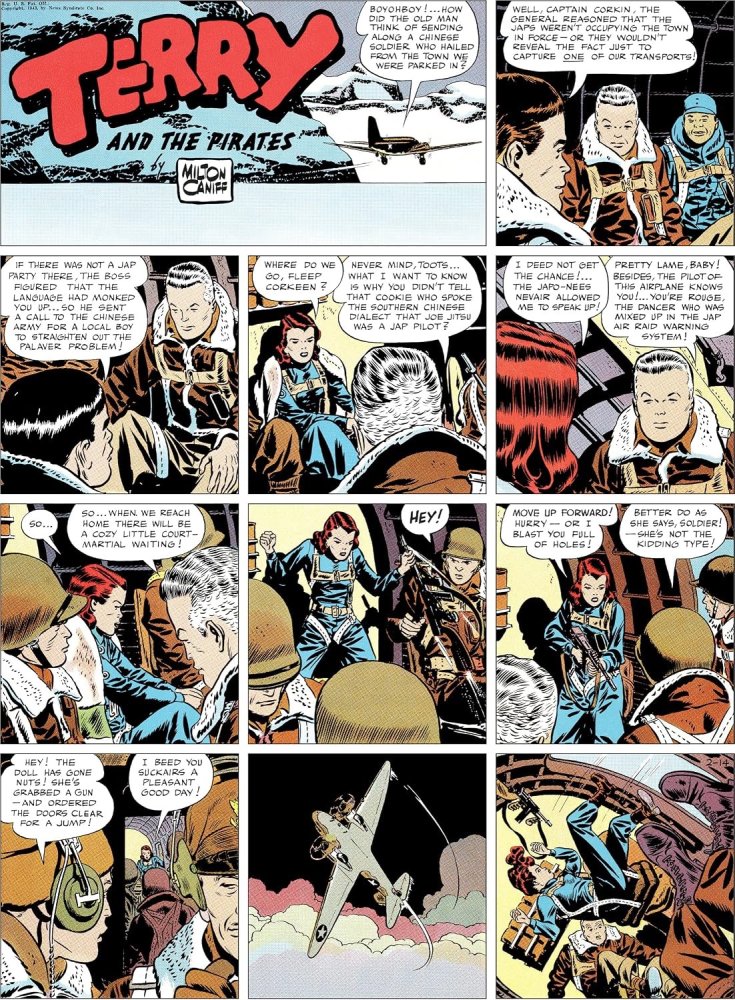
Hardcover. Clover Press, 1st, 2024, Book: Very Good, Dust Jacket: None, Hardcover, pictorial boards, 164 pages. The saga continues in Terry and the Pirates Volume 9, reproduced from Milton Caniff's personal set of color syndicate tabloid proofs. Flip Corkin schools Joe Jitsu in good ol' American know-how before he schools Terry about the ins-and-outs of being a fighter pilot. The October 17th Sunday page--as Terry earns his wings and Flip delivers "The Pilot's Creed"--is so powerful it was read into the Congressional Record. Before that can happen, wily Rouge abducts Taffy Tucker and gives her amnesia before slipping away! Taffy is in safe hands, however, when she falls under the wing of Connie, Big Stoop, and Navy Lieutenant Pat Ryan! Taffy's reunion with her memory and with Flip coincides with the arrival of Flight Lieutenant Tote Bonny and Grett Murmur, while Terry investigates the French Captain Midi, whom some find almost--hypnotic. This tabloid-sized Volume 9 containing the 1943 dailies and Sundays is an unparalleled upgrade for collectors. Still in publisher's shrinkwrap.
Hardcover. Cambridge MA, Harvard University Press, 1st, 2014, Book: Very Good, Dust Jacket: Very Good, Hardcover in a bright dust jacket, 334 pages, b&w photos. In May 1941, Gertrude van Tijn arrived in Lisbon on a mission of mercy from German-occupied Amsterdam. She came with Nazi approval to the capital of neutral Portugal to negotiate the departure from Hitler's Europe of thousands of German and Dutch Jews. Was this middle-aged Jewish woman, burdened with such a terrible responsibility, merely a pawn of the Nazis, or was her journey a genuine opportunity to save large numbers of Jews from the gas chambers? In such impossible circumstances, what is just action, and what is complicity? A moving account of courage and of all-too-human failings in the face of extraordinary moral challenges, The Ambiguity of Virtue tells the story of Van Tijn's work on behalf of her fellow Jews as the avenues that might save them were closed off. Between 1933 and 1940 Van Tijn helped organize Jewish emigration from Germany. After the Germans occupied Holland, she worked for the Nazi-appointed Jewish Council in Amsterdam and enabled many Jews to escape. Some later called her a heroine for the choices she made; others denounced her as a collaborator. Clean copy.
Hardcover. Boston, Little, Brown and Company, reprint, 1957, Book: Very Good, Dust Jacket: None, Hardcover, blue cloth with gilt lettering on spine. Volume X in The History of United States Naval Operations in World War II. 399 pages, illustrated with maps (one fold-out) and b&w photos. Gilt on spine with light fading, lacks dust jacket, dj flap copy pasted inside front cover, otherwise clean, tight copy.
Softcover. Annapolis MD, Naval Institute Press, reprint, 1989, Book: Very Good, Dust Jacket: None, Softcover, 596 pages. The second part of H. P. Willmott's three-volume history of the war in the Pacific, this work tells how Japan arrived at a situation in which war with the United States was the only means of ensuring long-term security and resolving her immediate problems of access to raw materials and of an unwinnable war in China. Totally balanced in presentation, the book also explains the basis of Allied miscalculations and provides explanations of the defeats that overwhelmed American, British, and Dutch forces throughout Southeast Asia in a little more than three months. Willmott argues that it was Japan's concentration and economy of force that contributed to its success in that early campaign. It was a later decision to disperse forces over a large area, he says, that resulted in Japan's loss of the Coral Sea and Midway battles and ultimately the entire war. Clean copy
Hardcover. Boston, Little, Brown and Company, reprint, 1950, Book: Very Good, Dust Jacket: None, Hardcover, blue cloth with gilt lettering on spine. Volume I in The History of United States Naval Operations in World War II. 432 pages, illustrated with maps and b&w photos. Gilt on spine with light fading, lacks dust jacket, otherwise clean, tight copy.
Hardcover. Annapolis MD, Dead Reckoning, 1st, 2018, Book: Very Good, Dust Jacket: None, Hardcover in pictorial boards, 221 pages in color. A collection of the best stories from the classic run of Don Winslow of the Navy, one of the most popular comic books running during and after World War II. Edited by Craig Yoe, the selected stories are digitally remastered and contextualized with Yoe's historical research. Preceding the full, colorful tales is a detailed introduction on the creation of the adventurous Don Winslow. The character served to foster recruitment and entertain Navy personnel and the general public alike during World War II and beyond. Winslow fights the Axis and supervillains like The Snake and the attractive, but deadly, Singapore Sal. Clean copy.
Hardcover. Annapolis MD, Dead Reckoning, 1st, 2018, Book: Very Good, Dust Jacket: None, Hardcover in pictorial boards, 221 pages in color. A collection of the best stories from the classic run of Don Winslow of the Navy, one of the most popular comic books running during and after World War II. Edited by Craig Yoe, the selected stories are digitally remastered and contextualized with Yoe's historical research. Preceding the full, colorful tales is a detailed introduction on the creation of the adventurous Don Winslow. The character served to foster recruitment and entertain Navy personnel and the general public alike during World War II and beyond. Winslow fights the Axis and supervillains like The Snake and the attractive, but deadly, Singapore Sal. Clean copy.
Hardcover. NY, Farrar & Rinehart, 1st US, 1939, Book: Good, Hardcover, blue cloth with dark blue lettering, 251 pages. Endpapers tanned and soiled at edges. Name on front fly leaf, otherwise clean.
Hardcover. Boston, Little, Brown and Company, 1st US, 1945, Book: Very Good, Dust Jacket: None, Hardcover, red cloth with front and spine printed in black and gilt, 417 pages. This volume publishes his speeches, broadcasts, messages, statements, and letters made, sent, and issued between 22 February and 31 December 1944. A full and momentous year, 1944 included the Normandy invasion, the largest amphibious operation in history, which re-established the Allied military presence in German-occupied Europe. Light spotting to covers, otherwise clean.
Hardcover. NY, Orion/Crown, 1st, 1989, Book: Very Good, Dust Jacket: Very Good, Hardcover, 272 pages. Recaptures the World War II bombing raid over Tokyo under the command of Lt. Col. "Jimmy" Doolittle and the incredible seek-and-destroy mission that he and other American pilots endured after the bombing.
Hardcover. Boston, Little, Brown and Company, 1st US, 1943, Book: Very Good, Dust Jacket: None, Hardcover, red cloth covers lettered in gold with black letterbox, 322 pages. Contains speeches throughout 1942. This year was a low point of the war, full of setbacks and disappointments across the globe for the British. Throughout the year Churchill's speeches conveyed sober, resolved, and eloquent defiance - with of course an occasional sparkle of Churchillian wit, even in the dark hours of the war. The title of this volume comes from Churchill's 10 November 1942 speech at the Lord Mayor's Day Luncheon in London at a time when fortune finally favored the British with victories in North Africa: "The Germans have received back again that measure of fire and steel which they have so often meted out to others. Now this is not the end. It is not even the beginning of the end. But it is, perhaps, the end of the beginning." Light marking to front endpapers.
Hardcover. Chicago, University of Chicago Press, 1st thus, 2004, Book: Very Good, Dust Jacket: Very Good, Hardcover in a bright, unclipped dust jacket. 87 pages. Foreword, black and white photographs, and colophon. A description of the Allied bombing campaign from the perspective of the German survivors.
Hardcover. NY, Penguin Press, 3rd pr., 2011, Book: Very Good, Dust Jacket: Very Good, Hardcover in a bright, unclipped dust jacket. 564 pages. From the preeminent Hitler biographer, a fascinating and original exploration of how the Third Reich was willing and able to fight to the bitter end of World War II. As Kershaw shows, the structure of Hitler's "charismatic rule" created a powerful negative bond between him and the Nazi leadership- they had no future without him, and so their fates were inextricably tied. Terror also helped the Third Reich maintain its grip on power as the regime began to wage war not only on its ideologically defined enemies but also on the German people themselves. Yet even as each month brought fresh horrors for civilians, popular support for the regime remained linked to a patriotic support of Germany and a terrible fear of the enemy closing in. Based on prodigious new research, Kershaw's The End is a harrowing yet enthralling portrait of the Third Reich in its last desperate gasps. B&w illustrations. Clean copy.
Hardcover. NY, Viking Press, 2nd pr., 2002, Book: Very Good, Dust Jacket: Very Good, Hardcover in a bright, unclipped dust jacket, 430 pages. Immediately after Japan's attack on Pearl Harbor, President Franklin D. Roosevelt sought to restore the honor of the United States with a dramatic act of a retaliatory bombing raid on Tokyo. On April 18, 1942, eighty brave young men, led by the famous daredevil Jimmy Doolittle, took off from a navy carrier in the mid-Pacific on what everyone regarded as a suicide mission but instead became a resounding American victory and helped turn the tide of the war. The First Heroes is the story of that mission. Meticulously researched and based on interviews with twenty of the surviving Tokyo Raiders, this is a true account that almost defies belief, a tremendous human drama of great personal courage, and a powerful reminder that ordinary people, when faced with extraordinary circumstances, can rise to the challenge of history. Clean copy.
Hardcover. Chicago, University of Chicago Press , 1st, 2015, Book: Very Good, Dust Jacket: Very Good, Hardcover in a bright dust jacket. 280 pages. Preface by Geoff Dyer. Essay by David Van Reybrouck. Includes 20 color plates and 80 halftones. Still in publisher's shrinkwrap. The First World War presents a startlingly different perspective, one based on rare glass plate photographs, that reveals the war with previously unseen, even uncanny, clarity. Scanned from the original plates, with scratches and other flaws expertly removed, these oversized reproductions offer a wealth of unusual moments, including scenes of men in training, pictures of African colonial troops on the Western front, landscapes of astonishing destruction, and postmortem portraits of Belgian soldiers killed in action. Readers previously familiar with only black-and-white or sepia-toned prints of the hostilities will be riveted by the book's many authentic color photographs, products of the early autochrome method. From children playing war games to a wrenching deathbed visit, these images are extraordinary not only for their subject matter, but also for the wide range of emotions they evoke.
Hardcover. NY, E. P. Dutton, 1st, 1919, Book: Very Good, Dust Jacket: None, Hardcover, blue cloth covers with gilt lettering, 402 pages. Translated form the Italian by Maria Sermolino. An account of WW1 by an officer in the Italian Army. Clean, tight copy.
Hardcover. NY, Viking, 1st, 2018, Book: Very Good, Dust Jacket: Very Good, Hardcover in a bright, unclipped dust jacket. 294 pages, b&w photos. Sam Kleiner's The Flying Tigers uncovers the hidden story of the group of young American men and women who crossed the Pacific before Pearl Harbor to risk their lives defending China. Led by legendary army pilot Claire Chennault, these men left behind an America still at peace in the summer of 1941 using false identities to travel across the Pacific to a run-down airbase in the jungles of Burma. In the wake of the disaster at Pearl Harbor this motley crew was the first group of Americans to take on the Japanese in combat, shooting down hundreds of Japanese aircraft in the skies over Burma, Thailand, and China. At a time when the Allies were being defeated across the globe, the Flying Tigers' exploits gave hope to Americans and Chinese alike. Clean copy.