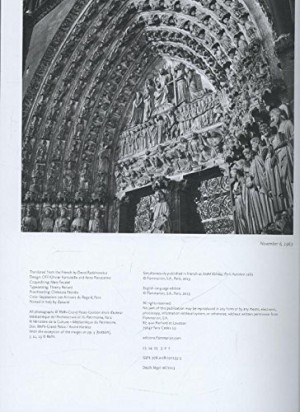
Hardcover. NY, Flammarion, 1st, 2013, Book: Very Good, Dust Jacket: None, Hardcover, 80 pages illustrated in b&w. A previously unpublished body of work from the late, great photographer Andre Kertesz, featuring a collection of photographs that capture the ephemeral beauty of Paris in 1963. Andre Kertesz, a master photographer of the twentieth century, was a pioneer in photographic composition and photojournalism who gained critical acclaim for his image distortions. Born in Hungary, he moved from Paris to New York during World War II. In 1963, he returned to Paris and took more than 2,000 black-and-white photographs and nearly 500 slides that capture the city's essence--from Montmartre to the banks of the Seine to its gardens and parks. Kertesz edited these photographs into book form, but the work was set aside and was only recently rediscovered in his archives, twenty-five years after his death. The previously unpublished material is reproduced here as he originally intended and completed with archival documents and a critical essay.
Hardcover. US, Angelika Books, 1st, 2012, Book: Very Good, Dust Jacket: None, Hardcover, 304 pages. Like new in publisher's shrink-wrap. Anna Bauer's Backstage is a comprehensive portrait of the protagonists of fashion in the twenty-first century's first decade: not just the designers but the entire cast of PR agents, photographers, make-up artists, art directors, editors and, of course, the models. Photographing at shows in Paris, Milan, London and New York, using a large-format camera and black-and-white Polaroid, Bauer decided to portray the diversity of the talent at work behind the scenes. "I got totally addicted to the backstage," Bauer says in the preface to this volume. "I wanted to show how much is involved." Elegantly designed by Fabien Baron, Backstage is divided into eight themed sections.
Softcover. New York , Aperture, 1st, 1987, Book: Very Good, Dust Jacket: None, Softcover. This issue features the work of Raghubir Singh, Raghu Rai, Roaslind Solomon, Linda Connor, Mitch Epstein, Alex Webb and others.
Softcover. New York , Aperture Book, 1st, 1987, Book: Very Good, Dust Jacket: None, Softcover. Fall 1897. Includes work by: Sebastiao Salgado, Susan Meiselas, David Goldblatt, Bill Burke. Also writing by Arthur Miller, William Shawcross, Frances Hodgson, Nadine Gordimer.
Softcover. New York , Aperture, 1st, 2006, Book: Very Good, Dust Jacket: None, Softcover. 88 pages, Summer 2006. Features work by William Christenberry (in Memphis), Jessie Mann, Bruce Conner (his "Punk" photographs), and more. A clean, tight issue.
Softcover. New York , Aperture, 1st, 2006, Book: Very Good, Dust Jacket: None, Softcover. 88 pages, Fall 2006. Katherine Wolkoff on Post Katrina. Articles covering aspects of the Afghan Opium Trade, Edgar Martin's Silent Shores and many more. A clean, tight issue.
Softcover. New York , Aperture, 1st, 2006, Book: Very Good, Dust Jacket: None, Softcover. 88 pages. Winter 2006. Photography quarterly with an essay on authenticity in news photography, women in the middle east and photographs by Marilyn Bridges, Jessica Dimmock, Patti Smith and others. A clean, tight issue.
Softcover. New York , Aperture, 1st, 2007, Book: Very Good, Dust Jacket: None, Softcover. 88 pages, Spring 2007. Portraits by Pieter Hugo; interview with Stephen Shore conducted by Luc Sante; Mary Ellen Mark on the photography of Jessica Lange; Lee Miller; Jay DeFeo; Jason Oddy; Takashi Yasamura; and much more. A clean, tight issue.
Softcover. New York , Aperture, 1st, 2007, Book: Very Good, Dust Jacket: None, Softcover. 88 pages, Summer 2007. Features photographers: Mary Ellen Mark, Barry Frydlender, Florian Maier-Aichen. Also includes articles by Gerry Badger and Vince Aletti. A clean, tight issue.
Softcover. New York , Aperture, 1st, 2009, Book: Very Good, Dust Jacket: None, Softcover. 88 pages, Summer 2009. Photography journal. Articles: Not-so-fashion photography, Edward Hopper's legacy and dialogue with Don McCullin A clean, tight issue.
Softcover. New York , Aperture, 1st, 2009, Book: Very Good, Dust Jacket: None, Softcover. 88 pages. Fall 2009. William Eggleston artwork on the cover and an article on his drawings inside, with features on William Klein's 1956 portrait of Rome, Neil LaBute with photographs by Gerald Slota, Mark Alice Durant on monuments, Rob Hornstra's Russia, Luc Santo on American real-photo postcards, and Sally Gall's color insects. A clean, tight issue.
Softcover. New York , Aperture, 1st, 2009, Book: Very Good, Dust Jacket: None, Softcover. 88 pages, Winter 2009. Feature articles on Carrie Mae Weems, Raymond Cauchetier, Contemporary Iranian Photography, Andrew Moore and urban archaeology, Robert Adams on editing, Maira Kalman, and Nick Knight, and more. A clean, tight issue.
Softcover. New York , Aperture, 1st, 2009, Book: Very Good, Dust Jacket: None, Softcover. 88 pages, Winter 2009. Feature articles on Carrie Mae Weems, Raymond Cauchetier, Contemporary Iranian Photography, Andrew Moore and urban archaeology, Robert Adams on editing, Maira Kalman, and Nick Knight, and more. A clean, tight issue.
Softcover. New York , Aperture , 1st, 1987, Book: Very Good, Dust Jacket: None, Softcover. Spring 1987. 78 pages. Includes an article with photographs by Lewis Baltz with text by Mark Haworth-Booth. Other articles feature works by Catherine Wagner, Lynne Cohen, Robert Cumming, Reagan Louie, David T. Hanson, and Kira Petrov. A near fine copy in wrappers.
Hardcover. Penland, NC, Jargon Society, 1st, 1971, Book: Very Good, Dust Jacket: Very Good, 63 pages. Hardcover with dust jacket. Clean, tight copy with only minor wear to edges. Related news clipping laid in.
Hardcover. NY, W. W. Norton & Company, 1st, 2006, Book: Very Good, Dust Jacket: Very Good, Hardcover in a bright dust jacket. Like many who grew up during the spread of sprawl--with its predictable landscape of housing developments, shopping malls, interstate highways, and big-box construction--acclaimed photographer Jeff Brouws is drawn to places that still embody the vernacular past as well as to those that starkly portray the soulless, franchised American landscape. What began as cultural geography of Main Streets became a visual critique of the myth of upward mobility that created this car-centered, paved-over universe. Some images look outward to the edges of suburbia where sprawl is encroaching upon nature. Others turn inward, documenting the devastated inner cities. All the stunning color photographs reflect the complex beauty and desolation of visual life in our time. 100 color photographs.
Hardcover. New York , W. W. Norton & Company, 1st, 2006, Hardcover in a bright dust jacket. Like many who grew up during the spread of sprawl--with its predictable landscape of housing developments, shopping malls, interstate highways, and big-box construction--acclaimed photographer Jeff Brouws is drawn to places that still embody the vernacular past as well as to those that starkly portray the soulless, franchised American landscape. What began as cultural geography of Main Streets became a visual critique of the myth of upward mobility that created this car-centered, paved-over universe. Some images look outward to the edges of suburbia where sprawl is encroaching upon nature. Others turn inward, documenting the devastated inner cities. All the stunning color photographs reflect the complex beauty and desolation of visual life in our time. 100 color photographs.
Hardcover. US, Center for American Places, 1st, 2011, Book: Very Good, Dust Jacket: Very Good, Hardcover, 80 pages. Like new in publisher's shrink-wrap. From 2000 to 2007, Jay Wolke photographed in the south of Italy to capture the complexity of a region that is colloquially known as Il mezzogiorno. What he found in this historic and often troubled landscape was an elaborate set of physical, social, and political forces manifested in an extraordinary tapestry of visual information. Both referential and suggestive, Wolke's pictures reveal the marks of a long line of invaders, conquerors, and occupiers from the Greeks to the Spanish to the Camorra. Architectural and structural adaptations and "resignations" are evident in every scene and serve as the photographer's focus. Although the landscape is marred by layers of dysfunction and greed, we can't help but view it through the lens of the timeless belief in the bel paese--the beautiful country.
Hardcover. Krause Publications, 1st, 2007, Book: Very Good, Dust Jacket: Very Good, Hardcover, 208 pages. As the 2004 Presidential Election was beginning to take shape, Kyle Cassidy took note of the important role the simple concept of gun ownership was playing. Hardly anyone he knew didn't have an opinion in the debate over owning guns. Why was a constitutionally protected right so heavily debated, and who exactly as these folks that own guns? "I began to wonder who these seventy or so million Americans were, how they lived and what was important to them. I set out to photographs as many gun owners as I could and ask them one question: "Why do you own a gun." Cassidy traveled over 20,000 miles, crisscrossing the country to meet with gun owners in their homes. Cassidy's photo essays create a powerful, thought provoking and sometimes startling view of gun ownership in the U.S. These "everyman" portraits, and the accompanying views of gun owners, fashion a riveting and provocative book.
Hardcover. Krause Publications, 1st, 2007, Book: Very Good, Dust Jacket: Very Good, Hardcover, 208 pages. As the 2004 Presidential Election was beginning to take shape, Kyle Cassidy took note of the important role the simple concept of gun ownership was playing. Hardly anyone he knew didn't have an opinion in the debate over owning guns. Why was a constitutionally protected right so heavily debated, and who exactly as these folks that own guns? "I began to wonder who these seventy or so million Americans were, how they lived and what was important to them. I set out to photographs as many gun owners as I could and ask them one question: "Why do you own a gun." Cassidy traveled over 20,000 miles, crisscrossing the country to meet with gun owners in their homes. Cassidy's photo essays create a powerful, thought provoking and sometimes startling view of gun ownership in the U.S. These "everyman" portraits, and the accompanying views of gun owners, fashion a riveting and provocative book.
Hardcover. NY, powerHouse Books, 1st, 2002, Book: Very Good, Dust Jacket: Very Good, Hardcover, 240 pages. Arms Against Fury examines the dramatic struggle of the Afghan people through the lens of Magnum photographers, dating back to co-founder George Rodger's documentation of the country's role in World War II. Ever since, Magnum's intrepid photographers have crisscrossed the country's striking landscape from the Central Asian steppes to the parched southern desert by way of the Hindu Kush mountains surrounding Kabul and the adjacent Panjshir Valley. As early as the 1950s, Eve Arnold and Marc Riboud filed unprecedented stories from a legendary Shangri-La, showing a small kingdom struggling for statehood against the forces of underdevelopment and unfortunate geographic position during the Cold War. The ultimate overthrow of the monarchy and brutal liquidation of Afghanistan's constitutional government in 1978 heralded the arrival of Soviet-style communism. Peasants in Nuristan rebelled immediately and initiated a jihad that was covered first by Raymond Depardon and then by Steve McCurry, and later by renowned photojournalist Abbas, who also focused on the progress of the mujahedin, who eventually faced a massive Red Army invasion and savage aerial bombardments.
Hardcover. NY, powerHouse Books, 1st, 2002, Book: Very Good, Dust Jacket: Good, Hardcover in a lightly worn dust jacket. 240 pages. Arms Against Fury examines the dramatic struggle of the Afghan people through the lens of Magnum photographers, dating back to co-founder George Rodger's documentation of the country's role in World War II. Ever since, Magnum's intrepid photographers have crisscrossed the country's striking landscape from the Central Asian steppes to the parched southern desert by way of the Hindu Kush mountains surrounding Kabul and the adjacent Panjshir Valley. As early as the 1950s, Eve Arnold and Marc Riboud filed unprecedented stories from a legendary Shangri-La, showing a small kingdom struggling for statehood against the forces of underdevelopment and unfortunate geographic position during the Cold War. The ultimate overthrow of the monarchy and brutal liquidation of Afghanistan's constitutional government in 1978 heralded the arrival of Soviet-style communism. Peasants in Nuristan rebelled immediately and initiated a jihad that was covered first by Raymond Depardon and then by Steve McCurry, and later by renowned photojournalist Abbas, who also focused on the progress of the mujahedin, who eventually faced a massive Red Army invasion and savage aerial bombardments. Clean copy.
Hardcover. Boston, Godine, 1st, 1988, Book: Very Good, Dust Jacket: Very Good, Hardcover, 23 pages of text plus 63 black & white plates. Dust jacket has light edgewear. Dust jacket with mild edgewear, protected by a mylar cover.

 "Andre Kertesz: Paris, Autumn 1963by: Andre Kertesz (Author), Matthieu Rivallin (Introduction)")

 "Anna Bauer: Backstageby: Baron, Fabien")
 "Aperture 105: The Dream of Indiaby: Conner, Linda and Michael Hoffman")
 "Aperture 108 Witness to Crisisby: Holborn, Mark")
 "Aperture 12:4 1965 by: White, Minor (Editor)")
 "Aperture 183 Summer 2006by: Harris, Melissa (Ed.)")
 "Aperture 184 Fall 2006by: Harris, Melissa (Ed.)")
 "Aperture 185 Winter 2006by: Harris, Melissa (Ed.)")
 "Aperture 186 Spring 2007by: Harris, Melissa (Ed.)")
 "Aperture 187 Summer 2007by: Harris, Melissa (Ed.)")
 "Aperture 195 Summer 2009by: Harris, Melissa (Ed.)")
 "Aperture 196by: Hoffman, Michael")
 "Aperture 197 Winter 2009by: Harris, Melissa (Ed.)")
 "Aperture 197 Winter 2009by: Harris, Melissa (Ed.)")
 "Aperture: Technology and Transformation, 106/Spring 1987by: Frascella, Larry")
 "Appalachian Photographs of Doris Ulman, Theby: Niles, John Jacob (Intro by)")
 "Approaching Nowhere: Photographsby: Brouws, Jeff (Photographer)")
 "Approaching Nowhere: Photographsby: Brouws, Jeff (Photographer)")
 "Architecture of Resignation: Photographs from the Mezzogiornoby: Wolke, Jay")
 "Armed America: Portraits of Gun Owners in Their Homesby: Cassidy, Kyle")
 "Armed America: Portraits of Gun Owners in Their Homesby: Cassidy, Kyle")
 "Arms Against Fury: Magnum Photographers in Afghanistanby: Robert Dannin and Magnum Photographers")
 "Arms Against Fury: Magnum Photographers in Afghanistanby: Robert Dannin and Magnum Photographers")
 "Arnold Newman in Floridaby: Weber, Bruce")