Hardcover. Hatje Cantz, 1st, 2007, Book: Very Good, Dust Jacket: None, Hardcover, 84 pages. When David Goldblatt received the world-renowned Hasselblad Award in 2006, he had been making photographs of the South African landscape and culture for more than 50 years. Born in 1930 in a gold-mining town near Johannesburg, his parents were Jewish refugees from Lithuania, and they raised him with an emphasis on tolerance and antiracism. In 1975, at the height of apartheid, Goldblatt explored white nationalist culture in Some Afrikaners Photographed, and in the 80s he observed workers on the Kwandebele-Pretoria bus, many of whom traveled eight hours every day to work and back. His late-90s solo show at New York's Museum of Modern Art focused on architectural work, and showed off Goldblatt's uncanny ability to discover a society through its buildings and landscapes. His photographs of architectural structures revealed the ways that ideology had defined his home country's landscape. No dj issued.
Hardcover. Benteli Verlags , 1st, 2017, Book: Very Good, Dust Jacket: None, Oblong hardcover with a pictorial label, 192 pages. The faded remnants of a glorious past are captured in all their morbid beauty, in images that manifest the ephemeral and go beyond all conventional associations and conceptions of the American South: Days Gone By combines carefully crafted photographs from the past ten years with a cultural history of the region's social and structural changes. With an unflinching gaze, Jorg Rubbert presents the demise of countless small towns between Georgia, Mississippi and Texas, their suffering particularly tangible following the financial crisis. Rural towns, idyllic at first glance, are soon revealed as forgotten relics of times long past.
Hardcover. Huntington Beach, James Cahill Publishing, 1st, 1995, Book: Very Good, Dust Jacket: Very Good, Hardcover in a bright, unclipped dust jacket. SIGNED AND DATED on title page by Dunning. Originally a paperback in 1981, this is the first hardcover edition. Clean copy. This early standalone novel by Dunning presents a Pulitzer prize-winning journalist for a smaller New Jersey paper who has several stories assigned- an Amish woman who becomes a Radio City Rockette, a traveling circus fire that kills an eight year old girl and no one claims the body, and an old FBI investigation of student activists.
Hardcover. Birmingham AL, Legal Classics Library, reprint, 1988, Book: Very Good, Dust Jacket: None, Hardcover, full gray leather. all edges gilt, ribbon marker, marbled endpapers, raised bands. Facsimile reprint of his landmark work first published in two volumes in 1838 and 1840. The author was a French aristocrat, political philosopher and historian. His travels through America and his astute observations about our government and it's people create an important historical portrait of the country at the time. Bright, clean copy.
Hardcover. New York, Anson D. F. Randolph & Company, 1st, 1872, Book: Good, Dust Jacket: None, 365 pages plus 6 pages of ads. Previous owners inscription in pencil on front endpaper. Original advertising leaflet for book laid-in. Moderate rubbing, chipping to cover edges. Clean, unmarked pages.
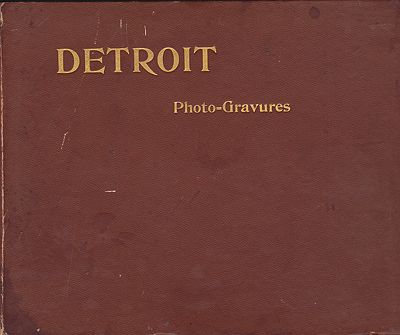
Hardcover. New York, A. Wittemann, 1st, 1894, Book: Good, Dust Jacket: None, Hardcover, brown boards stamped in gilt. 29 plates with photos of Detroit landmarks in the late 1800s. Top half inch of spine cover gone, title page with a tan corner stain. Plates all clean. Front endpapers with previous owner's signature, address. Binding shaken, but holding.
Hardcover. Boston, L. C. Page & Company, 1st US, 1903, Book: Very Good, Dust Jacket: None, Hardcover, gilt-stamped light gray cloth with Dickens' escutcheon in red & gold on cover, top edge gilt, frontispiece photographic profile of Dickens & 18 B&W photographic illustrations. Nice retrospective of London in reference to Charles Dickens life, book provides a brief look at Dickens' literary life, manner and customs, history of the area and more. 300 pages including index,
Softcover. Mechanicsburg PA, Stackpole, 1st, 2005, Book: Very Good, Dust Jacket: None, 274 pages, paperback. A definitive guide to New England diners. Mild edgewear to wraps. With color photographs throughout. Bright and clean; a tight copy.
Softcover. Philadelphia, PA, Running Press, 1st, 2015, Book: Very Good, Dust Jacket: None, 256 pages. Softcover. A very clean, unmarked copy with only minor edgewear. Color illustrations throughout. Donuts are America's favorite treat and, in Donut Nation, Ellen Brown travels the United States in search of the best donut shops. From beloved mom-and-pop establishments and roadside cafes to innovative boutiques and artisanal restaurants, there are more than seventy hand-crafted donut shops to take you from Maine to Arizona.
Hardcover. New York, Aperture, 1st, 1998, Book: Very Good, Dust Jacket: Very Good, Hardcover in a bright, unclipped dust jacket. 96 pages, color photographs, Like new in publisher's shrinkwrap. Doors of the Kingdom is a unique collection of photographs depicting the ancient and disappearing craft of doormaking in Arabia. The Islamic concept of hurma, or sanctity of a place of dwelling or worship, is recurrent throughout Arabic poetry and literature. The door (bab), preserver of sanctity, becomes symbolic of the boundary between public and private space, and between the profane and the sacred. In 1995, Haajar Gouverneur traveled throughout the Arabian Peninsula photographing each region's distinctive doorways and the remaining artisans who make them. The doors of Arabia, painstakingly hand-carved from the wood of the Al-Athel trees, last in their exquisite variety for hundreds of years. This ancient craft, passed down from generation to generation in the central and northern regions of Saudi Arabia, is now nearly extinct. Modern materials, technology, and changing priorities threaten the continuity of the sacred and artisanal tradition of doormaking.
Hardcover. NY, Farrar, Straus And Giroux, 1st, 2024, Book: Very Good, Dust Jacket: Very Good, Hardcover in a bright dust jacket, 464 pages. A personal exploration of the American West and the work of one of America's greatest photographers. Timothy O'Sullivan is America's most famous war photographer. You know his work even if you don't know his name: A Harvest of Death, taken at Gettysburg, is an icon of the Civil War. He was also among the first photographers to elevate what was then a trade to the status of fine art. The images of the American West he made after the war, while traveling with the surveys led by Clarence King and George Wheeler, display a prescient awareness of what photography would become; years later, Ansel Adams would declare his work 'surrealistic and disturbing.' At the same time, we know very little about O'Sullivan himself. Nor do we know-really know-much more about the landscapes he captured. Robert Sullivan's Double Exposure sets off in pursuit of these two enigmas. This book documents the author's own road trip across the West in search of the places, many long forgotten or paved over, that O'Sullivan pictured. It also stages a reckoning with how the changes wrought on the land were already under way in the 1860s and '70s, and how these changes were a continuation of the Civil War by other means.
Hardcover. Philadelphia, Hubbard Brothers, 1st, 1888, Book: Very Good, Dust Jacket: None, Hardcover, dark brown cloth stamped in black and gilt design, 443 pages plus 53 page appendix, b&w plates with a folding map (in excellent condition). B&w frontispiece portrait of the author, blue floral endpapers. Clean, tight copy with minor wear to corners. Title page says 1888, copyright page states 1887. Still believed to be a first printing. Early exploration through Chippewa country, source of the Mississippi, Grand Rapids, Minneapolis. Saint Paul, La cRosse, Rock Island, Saint Louis, Memphis, Natchez to Baton Rouge, New Orleans.
Hardcover. NY, The New Press, 1st, 2009, Book: Very Good, Dust Jacket: Very Good, Hardcover in a bright, unclipped dust jacket, 280 pages. Dedicated readers and fans of Theodor Seuss Geisel, or Dr. Seuss, know of Seuss's fascinating, long-forgotten career as a political cartoonist for the New York daily newspaper PM during World War II. Dr. Seuss, however, was only one of a number of distinguished cartoonists whose work appeared in PM. In Dr. Seuss & Co. Go to War, we discover an astonishing treasure trove of over three hundred incisive political cartoons by Seuss as well as a cohort of other legendary cartoonists of the time, including Saul Steinberg, Al Hirschfeld, Arthur Szyk, Carl Rose, and Mischa Richter. These fascinating cartoons offer a totally different picture of the war, both at home and abroad. Sure to fascinate and surprise readers across the generations, Dr. Seuss & Co. Go to War lets readers ?time travel to a remarkable time when editorial cartoons really mattered". Clean copy.
Softcover. Cambridge, MIT Press, 1st, 1996, Book: Very Good, Dust Jacket: None, Softcover, exhibition catalogue featuring the famed architect's travel sketches along with photographs of the buildings he encountered and essays on their influence on his work. 11'' x 8.5''. In original dark orange pictorial wrappers. Illustrated throughout in black and white, some color, 136 pages. Spine sun faded.
Softcover. Manchester, England, Manchester University Press, 1st Paperback Edition, 1994, Book: Very Good, Dust Jacket: None, 300 pages. Softcover. Color and b/w illustrations throughout. Wrapper very good, has a crease at the top right corner of front cover. Pages clean and unmarked, edges have some light foxing/tanning. Binding tight. In great shape. This superbly-illustrated new book explores English society and its relationship to the landscape, as seen through photography and tourism over the last hundred years.
Hardcover. Hildesheim GR, Edition Olms, 1st, 2010, Book: Very Good, Dust Jacket: Very Good, Hardcover, 325 pages. Illustrated in color and b&w. Like new in publishers shrink-wrap.
Hardcover. NY, W. W. Norton , 1st, 2007, Book: Very Good, Dust Jacket: Very Good, Hardcover, 176 pages, 120 b&w images. Once locked away in European archives, these early modernist photographs of America rival those of Steichen and Evans. Emil Otto Hoppe was born in Munich in 1878 but lived in London from 1900 until his death in 1972. He was an early and important modernist whose seminal views of the United States in the 1920s rival those of his peers: Paul Strand, Edward Steichen, Alfred Stieglitz, and Walker Evans. His work shows us an America as only an outsider could: brave, new, and grand in scale but with a hint of trouble brewing in the gaps between its multicultural and economic diversities.
Hardcover. NY, W. W. Norton , 1st, 2008, Book: Very Good, Dust Jacket: Very Good, Hardcover, 208 pages, b&w illustrations. Photographer E. O. Hoppe journeyed to Australia in the 1930s with the goal of capturing "the true spirit" of the nation. Enthralled by the country and its people, he traveled for a year tirelessly capturing images of life in bustling cities as well as the remote interior. No other photographer had presented such a comprehensive national portrait at the time; his iconic images captured a land both wild and refined. Very good in a bright dust jacket.
Hardcover. Gottingen GR, Steidl, 1st, 2015, Book: Very Good, Dust Jacket: Very Good, Hardcover, 237 pages, b&w plates throughout. Hoppe traveled throughout Germany between 1925 and 1938, photographing movie stars, workers and peasants, the birth of the Autobahn, and the explosion of industrial building. This collection includes parts of his 1930 book "Deutsche Arbeit" and many photos never previously seen. Clean copy in a dust jacket.
Hardcover. Boston/NY, Bulfinch/Little Brown, 1st, 2002, Book: Very Good, Dust Jacket: Very Good, Hardcover, 96 pages. Essay by Maria Morris Hambourg. Includes 54 tritones, 10 text illustrations and 4 gatefolds. A clean and tight near fine copy. Published in conjunction with a traveling show that ran January 14 through April 21, 2002 at The Metropolitan Museum of Art
Hardcover. NY, Macmillan, 1st, 1961, Book: Very Good, Dust Jacket: Very Good, Hardcover in a bright dust jacket, 215 pages plus index. Illustrated by Don Pottinger plus b&w photos. Clean copy.
Hardcover. Hanover NH, University Press of New England, 1st, 2012, Book: Very Good, Dust Jacket: Very Good, Hardcover in a bright dust jacket, 214 pages, color and b&w illustrations. Edward and Jo Hopper first discovered Vermont in 1927, making day trips from the Whitney Studio Club's summer retreat for New York artists in Charlestown, New Hampshire. In 1935 and 1936 the Hoppers again traveled to Vermont, this time from their summer home in Cape Cod, in Edward's continuing search for new places to paint. During these quests they identified the White River and what Edward considered to be Vermont's "finest" river valley, and they returned there for longer visits in 1937 and 1938, boarding at Robert and Irene Slater's Wagon Wheels farm in South Royalton. These "vacations" were a change from the usual tempo of their lives, a break from the studio-bound easels, canvas, and oils, an opportunity to paint something different, to be in a new place and paint en plein air. Over the course of Vermont sojourns, Edward Hopper produced some two dozen paintings, watercolors that are among the most distinctive of his regional works, strongly characterized by place. In this accessible volume, Bonnie Tocher Clause tells the story of the Hoppers' visits to Vermont, their stays on the Slater farm, and their introduction to farm life. She locates the sites shown in Hopper's Vermont paintings, identifies two watercolors not previously recognized as Vermont scenes, and traces the development of Hopper's singular interpretations of the Vermont landscape. Clean copy.
Hardcover. NY, Henry Holt and Co. , 1st, 2014, Book: Very Good, Dust Jacket: Very Good, SIGNED BY AUTHOR AND ILLUSTRATOR on half title page. Light edgewear to dust jacket, else a clean, tight copy. As a boy, Edward Hopper knew exactly what he wanted to be when he grew up: on the cover of his pencil box, he wrote the words EDWARD HOPPER, WOULD-BE ARTIST. He traveled to New York and to Paris to hone his craft. And even though no one wanted to buy his paintings for a long time, he never stopped believing in his dream to be an artist. He was fascinated with painting light and shadow and his works explore this challenge. In this striking picture book biography, Robert Burleigh and Wendell Minor invite young readers into the world of a truly special American painter (most celebrated for his paintings "Nighthawks" and "Gas").
Softcover. NY, Hirschl & Adler Galleries, 1st, 1987, Book: Very Good, Dust Jacket: None, Softcover, 40 pages illustrated in color and b&w. 6 color, 32 b&w plates, frontispiece. Showcases select artwork by Edward Hopper. With an essay by Douglas Dreishpoon. Many of these works were included in a traveling exhibition entitled "Edward Hopper: The Early Years", and held Mar. 14 to Apr. 18, 1987. The exhibition checklist cites 81 pieces, and about 40 are shown here. Clean copy.

 "David Goldblatt: Photographs: Hasselblad Award 2006by: Michael Godby, David Goldblatt, et al.")
 "Days Gone By: Roadside Photographs of the American South by: Jorg Rubbert")
 "Deadline (SIGNED COPY)by: Dunning John")

 "Derwent; or, Recollections of Young Life in the Countryby: Chester, John")


 "Diners of New Englandby: Garbin, Randy")
 "Donut Nation: A Cross-Country Guide to America's Best Artisan Donut Shopsby: Brown, Ellen")
 "Doors of the Kingdomby: Gouverneur/Khaled Azzam (Author), Mohamed Zakariya , Haajar")
 "Double Exposure: Resurveying the West with Timothy O'Sullivan America's Most Mysterious War Photographer by: Robert Sullivan")
 "DOWN THE GREAT RIVER; EMBRACING AN ACCOUNT OF THE DISCOVERY OF THE TRUE SOURCE OF THE MISSISSIPPI Together With Views Descriptive and Pictorial of the Cities Towns Villages. During a Canoe Voyage of over Three Thousand Miles from its")


 "Dream of England, A: Landscape, Photography and the Tourist's Imaginationby: Taylor, john")


 "Driving: The Horse, the Man, and the Carriage from 1700 up to the Present Dayby: Furger, Andres")
 "E. O. Hopp")
 "E. O. Hopp")
 "E.O. Hoppe: The German Work: 1925-1938by: Phillip, Prodger")
 "Earthly Bodies: Irving Penn's Nudes, 1949-50by: Penn/Maria Morris Hambourg, Irving")



 "Edward Hopper Paints His World (SIGNED COPY)by: Burleigh, Robert/Wendell Minor")