Hardcover. Indianapolis, Bobbs-Merrill, 1st, 1952, Book: Good, Dust Jacket: None, Hardcover, green cloth with gilt lettering, 326 pages, b&w plates. The story of the sculptor who carved the faces of America's heroic dead on granite mountains, most prominently, Mount Rushmore. Previous owner's name on front fly leaf, otherwise clean. Mild shelf-wear.
Hardcover. NY, Abrams, 1st, 2024, Book: Very Good, Dust Jacket: None, Hardcover, pictorial boards, 330 pages. A visually captivating history of the evolution of Glamour magazine and the brands legendary decades at the forefront of female empowerment in an incredible photographic volume For more than 80 years, Glamour has been the preeminent women's empowerment brand in America. But until now, no one has told the extraordinary story of its origins, the famous names who helped shape the magazine into the global powerhouse it is today, and Glamour's many historic firsts. Glamour was the first American fashion magazine to feature a Black cover star, the first to present Gloria Steinem's writing, and the first to feature groundbreaking reporting on reproductive rights. In a gripping journey, follow the group of women editors and journalists who spearheaded the magazine as World War II transformed the female landscape with over 7.5 million working women suddenly in the US workforce in 1940 and repositioned the title from charting Hollywood glamour to the magazine for the girl with a job.
Softcover. Cleveland OH, The Cleveland News Co., 1st, 1901, Book: Good, Dust Jacket: None, Softcover, illustrated wrappers, 96 pages. Lettering & Embellishments Conceived & Executed by W. J. Morgan & Co. Covers worn with light soil, spine paper worn. Still a solid copy. Name on rear cover. Amusing humor from the turn of the last century. Profusely and humorously illustrated with many in-text sketches. Ezra Freemont Kendall was an American actor-comedian, humorist, playwright and author who was known for his depiction of typical New England Yankees. During his time in vaudeville Kendall was said to have been among the highest paid monologist in America.
Hardcover. NY, Pantheon, 1st, 2007, Book: Very Good, Dust Jacket: Very Good, Hardcover in a bright, unclipped dust jacket. Grand Avenues tells the riveting story of Pierre Charles L'Enfant and the creation of Washington D.C.--from the seeds of his inspiration to the fulfillment of his extraordinary vision. L'Enfant's story is one of consuming passion, high emotion, artistic genius, and human frailty. As a boy he studied drawing at the most prestigious art institute in the world. As a young man he left his home in Paris to volunteer in the army of the American colonies, where he served under George Washington. There he would also meet many of the people who would have a profound impact on his life, including Alexander Hamilton and James Monroe. And it was Washington himself who, in 1791, entrusted L'Enfant with the planning of the nation's capital--and reluctantly allowed him to be dismissed from the project eleven months later. The plan for the city was published under another name, and for the remainder of his life L'Enfant fought for recognition of his achievement. But he would not live to see that day, and a century would pass before L'Enfant would be given credit for his brilliant design. Scott W. Berg recounts this tale, richly evocative of time and place, with the narrative verve of a novel and with a cast of characters that ranges from Thomas Jefferson and the other Founding Fathers to the surveyor who took credit for L'Enfant's plans, the assistant who spent a week in jail for his loyalty to L'Enfant, and the men who finally restored L'Enfant's reputation at the beginning of the twentienth century.
Hardcover. Princeton Architectural Press, 1st, 2006, Book: Very Good, Dust Jacket: Very Good, Hardcover, 256 pages. The Breakers, the Waldorf, the Biltmore, the Sherry, the Pierre--these landmark hotels are synonymous with grand luxury and style. When they were built, in the 1920s, their refined elegance and grandeur set the bar for hotels and resorts the world over. Responsible for creating these and countless other hotels throughout the United States, were the partners of a single architectural firm: Schultze & Weaver. Together, this duo--an architect and an engineer--virtually invented the glamorous lifestyle made famous in films like Grand Hotel. Catering to the social elite of which they were themselves a part, Schultze & Weaver synthesized the Old World style of Renaissance Italy, Moorish Spain, and Georgian England with all of the modern amenities that made hotel living luxurious. This book presents portfolios of fifteen of the firm's most spectacular hotels, culminating in the Art Moderne masterpiece of the Waldorf-Astoria. Over two hundred period photographs and hand-colored architectural renderings chart the ascent of the American hotel in all its glory and glamour, before the Great Depression forever changed the lifestyles of America's rich and famous. Essays address the cultural and technological developments that underpin the creation of resort and residential hotels, including the elemental role played by Schultze & Weaver.
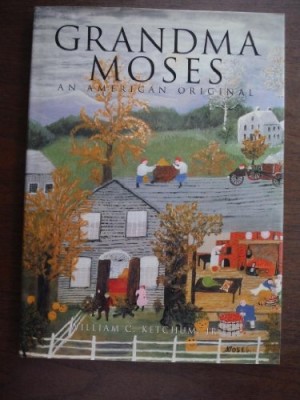
Hardcover. Alexandria VA, Art Service International / Yale University Press, 1st, 2001, Book: Very Good, Dust Jacket: Very Good, Hardcover in a bright dust jacket, 263 pages. Comprehensive treatment of Grandma Moses, her life, work, significance, and with a Catalogue of her work. Illustrated in color. Designed for a major traveling exhibition of Moses' work, the hardcover copies were distributed by Yale. Clean copy.
Hardcover. Columbia, University of Missouri Press, reprint, 1986, Book: Very Good, Dust Jacket: Very Good, Hardcover, 256 pages, illustrated in color and b&w. Like new in a bright, unclipped dust jacket. The definitive study of the painter.
Softcover. England, UK, FAB Press, 1st, 2015, Book: Very Good, Dust Jacket: None, 144 pages. Softcover. Very clean, unmarked copy with only minor edgwear to wrappers. Graphic Thrills Volume Two proudly assembles another stunning selection of debauched and innuendo-packed theatrical film posters, with glorious unabashed sexuality dripping from every page. These joyous and colourful odes to sultry sin were designed to hang in the lobbies and front windows of the porno theaters and grindhouses of yesteryear.
Softcover. New York, Associated American Artists, 1st, 1970, Book: Very Good, Dust Jacket: None, Softcover with blue wraps. Unpaginated. Compiled and edited by Sylvan Cole, Jr., 2 b&w frontispieces, 66 b&w plates, errata slip laid in. A clean, tight copy.
Softcover. New York, Da Capo, 1st, 1977, Book: Good, Dust Jacket: None, Softcover, 14 pages + 100 prints in b&w. Green pictorial stiff wrappers with some wear to spine and slight rubbing to covers, otherwise a nice, tight copy.
Hardcover. New York , De Vinne Press, 1st, 1916, Book: Very Good, Dust Jacket: None, Hardcover, 269 pages. Light blue and white cover. Printed for the Naval History Society. Pages untrimmed. Worn slipcase. Clean condition inside and out. Number 582 of 650 copies. B&w illustrations with tissue guards by various artists. Includes one page insert addressed to members of the Naval History Society. With introduction stressing the importance of Naval campaigns in the American Revolution.
Hardcover. London, Chartwell Books, reprint, 2006, Book: Very Good, Dust Jacket: Very Good, 160 pages. Hardcover. Extensive b&w photography throughout. Slight edge wear, otherwise clean, tight copy. Many photos of old saloons, both interior and exterior shots. From Alaska, Arizona, California, Minnesota, Texas, and all over the country.
Softcover. San Francisco, Ten Speed Press, 1st, 2007, Book: Very Good, Dust Jacket: None, Softcover, 224 pages. Early in the 20th century, as Americans climbed into their Model-Ts and took to the open road, American manufacturers and retailers discovered miles and miles of new advertising space, and the audaciously oversized billboard was born. For a century, billboards have recruited, congratulated, teased, sold, and seduced us, promoting everything under the sun, from hosiery to war bonds, presidential candidates to rock shows. GREAT AMERICAN BILLBOARDS not only offers a lively look back at changing styles, products, and tastes, but is also an important visual record of this largely unheralded yet ubiquitous American art form.
Softcover. New York, Harry N. Abrams, 1st, 1980, Book: Very Good, Dust Jacket: None, 96 pages, 84 plates, 33 in color. Softcover exhibition catalog in tight, clean condition.
Hardcover. NY, Columbia University Press, 1st, 2014, Book: Very Good, Dust Jacket: Very Good, Hardcover in a bright dust jacket, 328 pages. William Logan has been a thorn in the side of American poetry for more than three decades. Though he has been called the "most hated man in American poetry," his witty and articulate reviews have reminded us how muscular good reviewing can be. These new essays and reviews take poetry at its word, often finding in its hardest cases the greatest reasons for hope. Logan begins with a devastating polemic against the wish to have critics announce their aesthetics every time they begin a review. "The Unbearable Rightness of Criticism" is a plea to read those critics who got it wrong when they reviewed Lyrical Ballads or Leaves of Grass or The Waste Land. Sometimes, he argues, such critics saw exactly what these books were-they saw the poems plain yet often did not see that they were poems. In such wrongheaded criticism, readers can recover the ground broken by such groundbreaking books. Logan looks again at the poetry of Wallace Stevens, Frank O'Hara, and Philip Larkin; at the letters of T. S. Eliot, Elizabeth Bishop, and Robert Lowell; and at new books by Louise Gluck and Seamus Heaney. Always eager to overturn settled judgments, Logan argues that World War II poets were in the end better than the much-lauded poets of World War I. He revisits the secretly revised edition of Robert Frost's notebooks, showing that the terrible errors ruining the first edition still exist. The most remarkable essay is "Elizabeth Bishop at Summer Camp," which prints for the first time her early adolescent verse along with the intimate letters written to the first girl she loved. Clean, like new.
Hardcover. Syracuse NY, Syracuse University Press, 1st, 1983, Book: Very Good, Dust Jacket: Very Good, Hardcover in a bright dust jacket. 186 pages, 116 illustrations. "The first serious study of the totality of Stickley's accomplishments, especially his architecture", and as a central figure in the American Arts and Crafts Movement as founder of The Craftsman and of the Stickley Workshops. Bibliographical references, pages 169-181. Clean copy.
Hardcover. NY, James Graham & Sons, 1st, 2004, Book: Very Good, Dust Jacket: Very Good, Hardcover, 176 pages. Color plates throughout. Color pictorial dust jacket. Blue cloth boards with silver lettering along spine. B&w frontispiece. clean, tight copy. A monograph on the work of Gu Pene Du Bois, an American painter known for his depiction of American culture in the early 1900s, with this book discussing his murals and portrait paintings, among other work.
Hardcover. NY, Taschen, 1st, 2026, Book: Very Good, Dust Jacket: None, Hardcover, large format in pictorial boards, 392 pages in color. In 1928 commercial artist Hal Foster took a job to turn Edgar Rice Burroughs' novel Tarzan of the Apes into a 60-installment black and white newspaper comic. Initially, no American papers wanted it, so it premiered in England, to great acclaim. When U.S. papers picked it up and wanted more, Foster wasn't interested. It was only in 1931, with the Great Depression threatening his family with starvation, that he consented to take it on as a full color, full page Sunday comic, still calling the low-paid job "a bit of pottage." That bit of pottage fed him for the next seven years, as Tarzan became the first adventure comic, and one of the most beloved Sunday strips in America. From 1931 to 1937, 292 full-page Tarzan Sunday comics followed. Foster's ape man defined Tarzan and adventure comics for decades to come. This volume reprints every comic from the original newspapers, in a colorful XXL format. Clean copy. This is a heavy and oversized book and will require extra shipping. International customers please ask for a shipping quote before purchasing.
Softcover. New York, Harcourt Brace Jovanovich, 1st Edition, 1980, Book: Very Good, Dust Jacket: None, Nonpaginated. Softcover. B/w illustrations throughout. Wrapper clean and very good. Pages clean and unmarked. Binding tight. Edges have a touch of tanning from age.
Hardcover. New York, Harry Abrams Inc, 2nd Ed., Book: Very Good, Dust Jacket: Very Good, Hardcover, in a bright. unclipped dust jacket, 227 pages, 168 illustrations and 51 tipped-in color plates. Includes five essays by Hans Hofmann and an introductory essay by Sam Hunter. Stated second edition.
Hardcover. Naperville IL, Sourcebooks MediaFusion, 1st, 2006, Book: Very Good, Dust Jacket: Very Good, Hardcover in a bright dust jacket. 502 pages, b&w illustrations. For three decades after World War I, Harlem was the site of burgeoning racial and cultural awareness and ambitions among African Americans. In the opening section of this book, Wintz provides the historical context for what became known as the Harlem Renaissance. In separate sections devoted to poetry, music, politics, art, and the phenomenon of the New Negro, contributors profile many of the era's major figures, including Langston Hughes, Zora Neale Hurston, Bessie Smith, Ethel Waters, Josephine Baker, W. E. B. DuBois, Paul Robeson, A. Phillip Randolph, and Marcus Garvey. The essays place the Harlem Renaissance in the broader context of an awakening of black culture throughout the U.S. The book contains references to the accompanying CD, which offers 60 minutes of music, poetry, interviews, performances, and speeches, giving voice to the vibrant life of Harlem. Photographs, drawings, book covers, and posters add to the richness of this collection. A fabulous resource on the Harlem Renaissance.
Hardcover. New York , Random House , 1st, 1967, Book: Very Good, Dust Jacket: Fair, Hardcover, 307 pages, over 250 photos and illustrations with 16 color plates. Wonderful photos by Avedon (25), Dahl-Wolfe (12), Munkasci (11) and many others. Purple cloth covers with an edgeworn, soiled dust jacket.
Softcover. Schiffer, 1st, 1998, Book: Very Good, Dust Jacket: None, Softcover, 176 pages. Harrison Fisher: Defining the American Beauty is the largest picturial guide to this popular artist ever produced. Nearly 450 color and black and white reproductions of his magazine covers and book illustrations document this important artist's career. Harrison Fisher enjoyed incomparable fame from 1905 to 1920, achieving celebrity status and holding the enviable position of national beauty judge. Fisher portrayed the American woman as an outgoing, lively personality, wealthy and healthy. She rode horses, played tennis, and motored in the new automobiles while holding court for admiring men. Fisher's portrayals of such beauties added market value to dozens of novels as well as hundreds of magazines which clamored for his art on both their covers and inside pages. With Fisher's work extremely hot on the collectibles market, new and seasoned buyers alike will benefit from the advice of antiques dealer and Price Guide author Bruce Magnotti.
Softcover. Atglen, PA, Schiffer , 1st, 1999, Book: Very Good, Dust Jacket: None, 175 pages. Softcover with light edge wear to paper wrappers. Color pictorial guide throughout. Includes price guide.

 "Give the Man Room. The Story of Gutzon Borglumby: Casey Robert J.; Borglum Mary")
 "Glamour: An Extraordinary History: 85 Years of Women Breaking Boundariesby: Pearlman, Natasha; Wolle, Ruhama; Moeslein, Anna")


 "Good Gravy: A Pure Tonic Of Wit And Humorby: Kendall, Ezra")
 "Grand Avenues: The Story of the French Visionary Who Designed Washington, D.C.by: Scott W. Berg")
 "Grand Hotels of the Jazz Age: The Architecture of Schultze & Weaverby: Marianne Lamonaca")
 "Grant Wood: A Study in American Art and Cultureby: Dennis, James")
 "Graphic Thrills Volume Two: American XXX Movie Posters 1970 to 1985by: Bougie, Robin")
 "Graphic Work of Joseph Hirsch, Theby: Hirsch, Joseph")
 "Graphic Works of the American Thirties: a Book of 100 Printsby: Stravenitz, Alex R. (Foreword)")
 "Graves Papers, The: And Other Documents Relating to the Naval Operations of the Yorktown Campaign, July to October, 1781.by: Chadwick (ed), French Ensor")
 "Great American Bars and Saloons, Theby: Weiser, Kathy")
 "Great American Billboards: 100 Years of History by the Side of the Road by: Basten, Fred E.")
 "Guacamole Airlines and Other Drawingsby: Ruscha, Ed")

 "Gustav Stickley, The Craftsmanby: Smith, Mary Ann")
 "Guy Pene du Bois: Painter of Modern Lifeby: Fahlman, Betsy")



 "Hamburger Madness: Cartoons by Jack Zieglerby: jack Ziegler")


 "Hans Hofmannby: Hofmann, Hans")
 "Harlem Speaks: A Living History of the Harlem Renaissance (with CD)by: Cary D. Wintz")

 "Harrison Fisher: Defining the American Beauty by: Skinner, Tina")