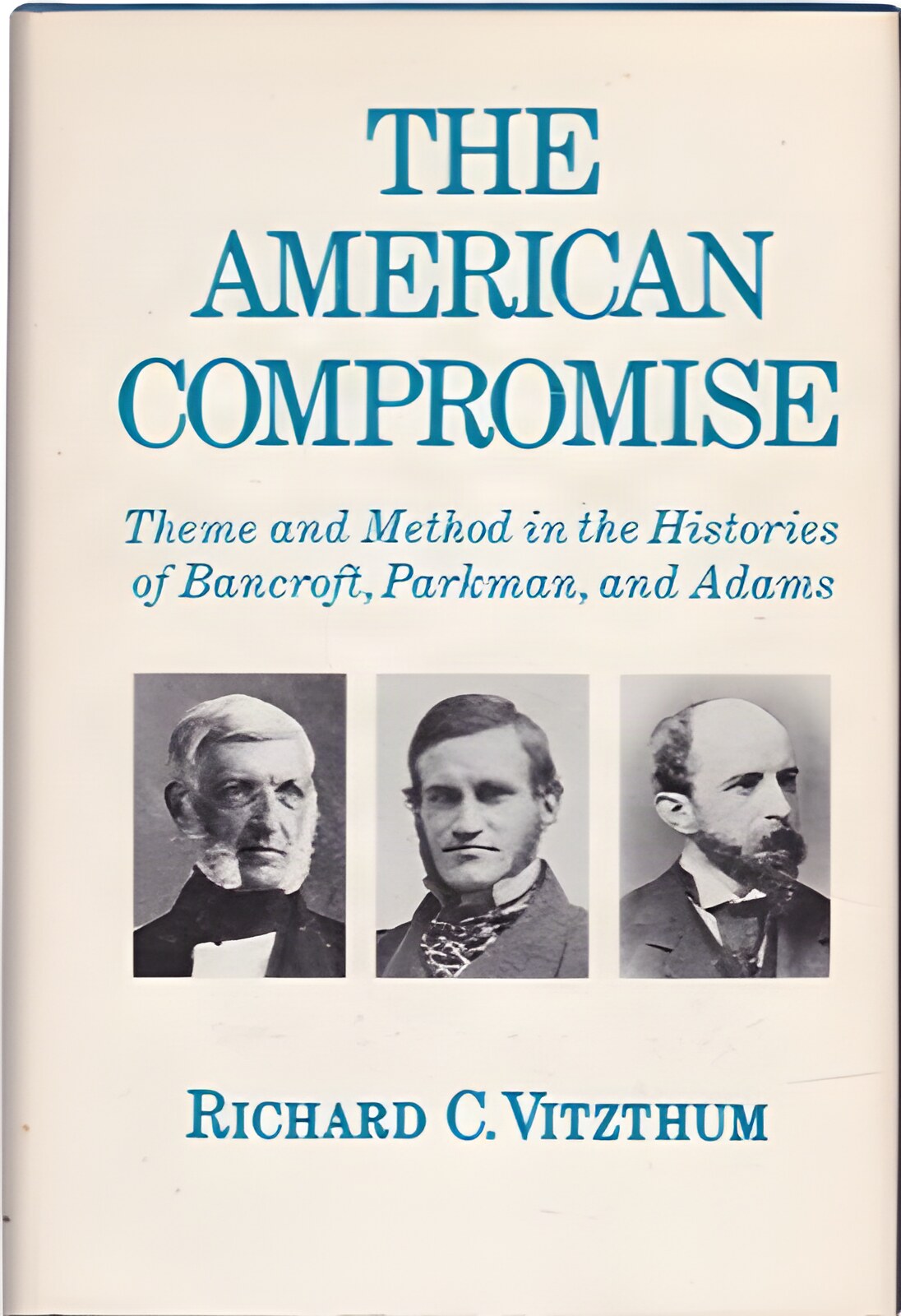
Hardcover. Knoxville, University Of Tennessee Press, 1st, Book: Very Good, Dust Jacket: Very Good, Hardcover in a bright dust jacket, 432 pages. Shields shows how both the myth of Adam and the myth of Aeneas, in crossing over to America from Europe, dynamically intermingled in the thought of the earliest American writers. This rearticulation of the myths of Adam and Aeneas became peculiarly adapted to the demands of the American adventure in freedom. Shields argues that uncovering and acknowledging the classical roots of our culture can allay the American fear of "pastlessness" that the long-standing emphasis on the Adamic myth has generated. The authors probing analysis sheds new light on the works of such seminal figures as Edward Taylor, Cotton Mather, Phillis Wheatley, George Washington, Nathaniel Hawthorne, and Herman Melville.
Hardcover. Princeton Providence, Princeton University Press / Brown University Press, 1st, 1972, Book: Very Good, Dust Jacket: Very Good, Hardcovers. Complete in two volumes. Volume I: The Journals of Clermont-Crevecoeur, Verger, and Berthier. Volume II: The Itineraries, Maps, Views. Both volumes are fine in near fine unclipped dust jackets. Housed in a lightly rubbed slipcase that has a chip to one of the pictorial labels. INSCRIBED BY CO-EDITOR ANNE BROWN on the half title page in Vol. 1. Mild residue to prelim page in Vol. 2, otherwise nice, clean and unmarked. Vol. 1: 351 pages, Vol. 2: 362 pages, color and b&w illustrations, indexed, fold out maps. PLEASE NOTE: DUE TO SIZE AND WEIGHT, DOMESTIC SHIPPING ONLY.
Hardcover. Norman OK, University of Oklahoma Press, 1st, 1974, Book: Very Good, Dust Jacket: Very Good, Hardcover in a bright dust jacket, 236 pages. Clean copy.
Hardcover. Dallas TX, Taylor Publishing, 1st, 1993, Book: Very Good, Dust Jacket: Very Good, Hardcover, in a bright, unclipped dust jacket. 168 pages. A brief history with some 300 color and b&w illustrations of covers, posters, publicity shots of detective and spy stories, TV, and cinema.
Softcover. NY, Collier Books, 1st, 1977, Book: Very Good, Dust Jacket: None, Softcover, large format. 175 pages, 82 b&w portraits of film directors including many who were just beginning their careers ie. Scorsese, Coppola, Spielberg and Lucas along with some of the great directors in the history of American film including Cukor, Hitchcock, Wellman and many others. Includes filmographies and some commentaries. DOMESTIC SHIPPING ONLY.
Softcover. Baltimore, Johns Hopkins, reprint, 1985, Book: Very Good, Dust Jacket: None, Softcovers, two large quarto, about 12.75 inches tall, in gray pictorial wraps. 690 pages, the two volumes being paginated consecutively. Illustrated by very detailed photographs, drawings, schematics, engravings. A massive technological / engineering history of American railroad cars dedicated to passenger traffic.
Hardcover. NY, Arno Press, reprint, 1969, Book: Very Good, Dust Jacket: None, Hardcover in a lightly worn dust jacket, 620 pages. History of the American Army in the Southern states during the Revolutionary war. Written by Henry (Light Horse) Lee, father of Robert E Lee. This is a reprint of the 1869 edition, with a biography of Henry Lee by Robert E Lee. Clean copy.
Hardcover. Boston, Thomas & Andrews , 6th Ed., 1812, Book: Good, Dust Jacket: None, Hardcover in contemporary calf, with gilt letting on red leather spine label and sound and bright internally with 3 fold-out maps (Africa, Asia/Arabia and Europe). Covers worn, bottom of spine has a small chunk gone from bottom, about a square inch. Interior clean, minor foxing. VOLUME 2 ONLY.
Hardcover. University Park PA, Penn State University Press, 1st, 2007, Book: Very Good, Dust Jacket: Very Good, Hardcover in a bright dust jacket, 264 pages. Numerous color illustrations. An exploration of Bartram's writings and artwork; all sixty-eight Bartram drawings owned by the Natural History Museum are brought together for the first time. Works by other eighteenth and nineteenth century natural history artists are included. His love of nature led him to explore the environs of the American Southeast between 1773 and 1777. Here he collected plants and seeds, kept a journal of his observations of nature, and made drawings of the plants and animals he encountered. The completed drawings were sent to his patron in London, and these make up the bulk of the collection held at London's Natural History Museum. Still in publisher's shrinkwrap.
Hardcover. New York, William Morrow & Co, 1st, 1992, Book: Very Good, Dust Jacket: Very Good, 160 pages. Hardcover with dust jacket. Very clean, unmarked copy with some minor shelfwear to dust jacket. This beautiful book is a spectacular overview of McCarthy's exciting Western work, presenting colorful paintings from his fine art career. Color illustrations throughout.
Hardcover. NY, Abrams, 1st, 2009, Book: Very Good, Dust Jacket: Very Good, Hardcover, 256 pages. Harvey Kurtzman discovered Robert Crumb and gave Gloria Steinem her first job in publishing when he hired her as his assistant. Terry Gilliam also started at his side, met an unknown John Cleese in the process, and the genesis of Monty Python was formed. Art Spiegelman has stated on record that he owes his career to him. And he's one of Playboy publisher Hugh Hefner's favorite artists. Harvey Kurtzman had a Midas touch for talent, but was himself an astonishingly talented and influential artist, writer, editor, and satirist. The creator of MAD and Playboy's "Little Annie Fanny" was called, "One of the most important figures in postwar America" by the New York Times. Kurtzman's groundbreaking "realistic" war comics of the early '50s and various satirical publications (MAD, Trump, Humbug, and Help!) had an immense impact on popular culture, inspiring a generation of underground cartoonists. Without Kurtzman, it's unlikely we'd have had Airplane, SNL, or National Lampoon. The Art of Harvey Kurtzman is the first and only authorized celebration of this "Master of American Comics." This definitive book includes hundreds of never-before-seen illustrations, paintings, pencil sketches, newly discovered lost E.C. Comics layouts, color compositions, illustrated correspondence, and vintage photos from the rich Kurtzman archives
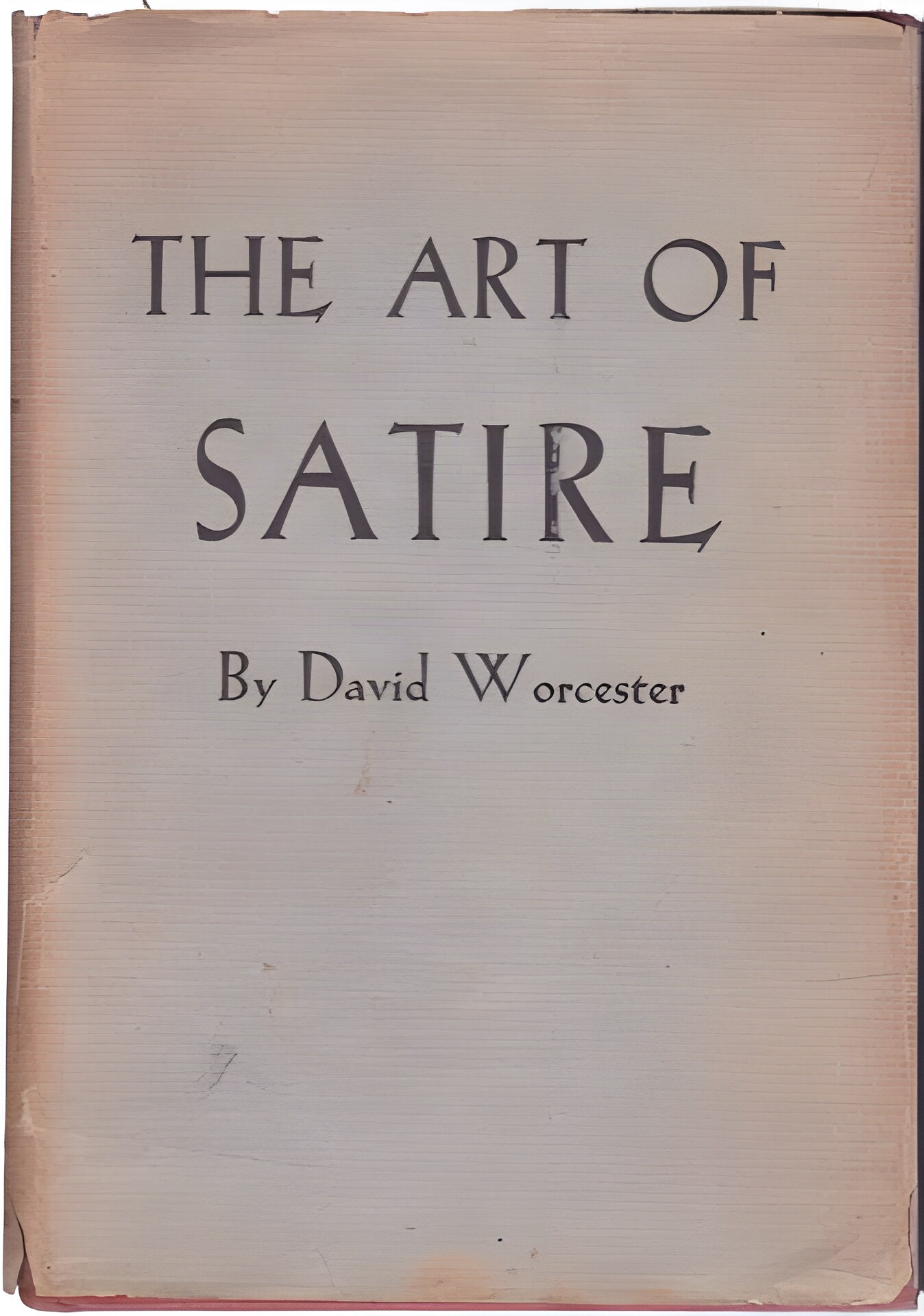
Hardcover. Cambridge MA, Harvard University Press, 1st, 1940, Book: Very Good, Dust Jacket: Poor, Hardcover, red cloth in a worn and chipped dust jacket with closed tears, 191 pages with index. Dr. Worcester presents a theory of satire, surveying the whole field since Dryden's Discourse of the Origin of Satire and drawing illustrations not only from English but from classical, French, German, and American literature. At the same time he makes a penetrating study of irony and its uses. Name on inside front cover otherwise clean.
Hardcover. Pittsburgh PA, GoodKnight Books, 1st, 2017, Book: Very Good, Dust Jacket: Very Good, Hardcover in a bright, unclipped dust jacket. The Art of Selling Movies presents the first-ever look at 60 years of newspaper advertising for motion pictures great and small. These ads created by Hollywood and adapted by local and regional exhibitors motivated patrons to leave their homes, part with precious income, and spend time in the dark. Because of the high stakes involved, theater operators used wildly creative means to make that happen. They made movie advertising equal parts art and psychology, appealing to every human instinct (especially sex) in an effort to push product and keep their theatres in business. From the pen-and-ink masterpieces of the 1920s and 30s to location-specific folk art to ad space jam-packed with enticements for every member of the family, The Art of Selling Movies dissects the psyche of the American movie-going public ... and the advertisers seeking to push just the right buttons.
Hardcover. Princeton NJ, Princeton University Press, 1st, 2007, Book: Very Good, Dust Jacket: Very Good, Hardcover, 288 pages. The impact of the humble American snapshot has been anything but humble. Any American who takes a snapshot contributes to a compelling and influential genre. Since 1888, when George Eastman introduced the Kodak camera and roll film, the snapshot has not only changed everyday American life and memory; it has also changed the history of fine art photography. The distinctive subject matter and visual vocabulary of the American snapshot--its poses, facial expressions, viewpoints, framing, and themes--influenced modernist photographers as they explored spontaneity, objectivity, and new topics and perspectives. A richly illustrated chronicle of the first century of snapshot photography in America, The Art of the American Snapshot is the first book to examine the evolution of this most common form of American photography. The book shows that among the countless snapshots taken by American amateurs, some works, through intention or accident, continue to resonate long after their intimate context and original meaning have been lost.The catalogue of a fall 2007 exhibition at the National Gallery of Art in Washington, DC, The Art of the American Snapshot reproduces some 250 snapshots drawn from Robert Jackson's outstanding collection and from a recent gift Jackson made to the museum. Organized decade by decade, the book traces the evolution of American snapshot imagery and describes how technical, social, and cultural factors affected the look of snapshots at different periods.
Hardcover. Chicago, University of Chicago Press, 1st, 2016, Hardcover in a bright dust jacket, still in publisher's shrinkwrap. This stunning book charts the rich history of the blues, through the dazzling array of posters, album covers, and advertisements that have shaped its identity over the past hundred years. The blues have been one of the most ubiquitous but diverse elements of American popular music at large, and the visual art associated with this unique sound has been just as varied and dynamic. There is no better guide to this fascinating graphical world than Bill Dahl--a longtime music journalist and historian who has written liner notes for countless reissues of classic blues, soul, R&B, and rock albums. With his deep knowledge and incisive commentary--complementing more than three hundred and fifty lavishly reproduced images--the history of the blues comes musically and visually to life.
Softcover. Baltimore, Johns Hopkins University Press, 1st, 2007, Book: Very Good, Dust Jacket: None, Softcover, 155 pages. Thomas Dennis emigrated to America from England in 1663, settling in Ipswich, a Massachusetts village a long day's sail north of Boston. He had apprenticed in joinery, the most common method of making furniture in sixteenth- and seventeenth-century Britain, and he became Ipswich's second joiner, setting up shop in the heart of the village. During his lifetime, Dennis won wide renown as an artisan. Today, connoisseurs judge his elaborately carved furniture as among the best produced in seventeenth-century America. Robert Tarule, historian and accomplished craftsman, brilliantly recreates Dennis's world in recounting how he created a single oak chest. Writing as a woodworker himself, Tarule vividly portrays Dennis walking through the woods looking for the right trees; sawing and splitting the wood on site; and working in his shop on the chest-planing, joining, and carving. Dennis inherited a knowledge of wood and woodworking that dated back centuries before he was born, and Tarule traces this tradition from Old World to New. He also depicts the natural and social landscape in which Dennis operated, from the sights, sounds, and smells of colonial Ipswich and its surrounding countryside to the laws that governed his use of trees and his network of personal and professional relationships. Clean copy.
Hardcover. Boston, Little, Brown and Company, reprint, 1957, Book: Very Good, Dust Jacket: None, Hardcover, blue cloth with gilt lettering on spine. Volume X in The History of United States Naval Operations in World War II. 399 pages, illustrated with maps (one fold-out) and b&w photos. Gilt on spine with light fading, lacks dust jacket, dj flap copy pasted inside front cover, otherwise clean, tight copy.
Hardcover. Westport CT, Greenwood Press, 1st, 2003, Book: Very Good, Dust Jacket: None, Hardcover, glazed pictorial boards, 177 pages. Postma draws on primary sources and current historical scholarship to offer secondary readers and researchers a comprehensive and well-written history. He covers the entire Atlantic slave trade era, from the 1400s to the final abolition of chattel slavery in the New World in 1888. The focus is on Africa and the entire New World. While he describes the many horrors of the Middle Passage, he also examines how the slave trade contributed to the development of the modern international economy. The last chapters discuss the efforts to abolish the slave trade and its legacy. Throughout, Postma documents the sources that support his discussion and conclusions. Chapter notes are supplemented by an extensive annotated bibliography that includes books, articles, films, and electronic resources. The volume concludes with biographical sketches of important people and excerpts from primary documents written by enslaved Africans and white officials. The black-and-white reproductions of period illustrations add little to the text. Clean copy.
Hardcover. Boston, Little, Brown and Company, reprint, 1950, Book: Very Good, Dust Jacket: None, Hardcover, blue cloth with gilt lettering on spine. Volume I in The History of United States Naval Operations in World War II. 432 pages, illustrated with maps and b&w photos. Gilt on spine with light fading, lacks dust jacket, otherwise clean, tight copy.
Hardcover. NY, Alfred A. Knopf, 1st, 1946, Book: Very Good, Dust Jacket: None, Hardcover, 313 pages plus index. Tan cloth boards that show minor fading to top, spine and light discoloration to back cover. Otherwise very good. No dust jacket. Generous selection of black and white illustrations. This copy also complete with both the fold-out maps that are often missing: (1) City of Richmond in 1861; and (2) Richmond-Petersburg Theatre of Operations. These ten chapters reconstitute, across an eighty-year gap, the everyday life of a capital city close behind the fighting fronts of a prolonged war. From records that originated close to the facts or in the midst of them--newspapers, advertisements, diaries, letters, stenographic reports of the time--Mr. Bill discloses how people lived on the home front of the Confederacy. He tells in abundant detail what the people did to amuse themselves, what rumors alternately exalted and depressed them, about what and whom they gossiped, what they found procurable in the black market and what it cost them.
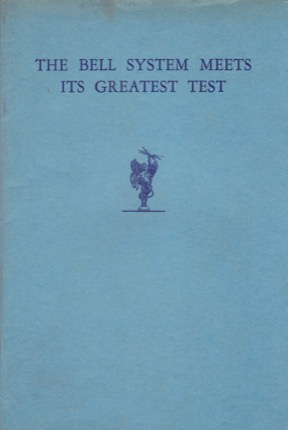
Softcover. NY, American Telephone and Telegraph Company, 1938, Book: Very Good, Softcover, blue wraps, 6 3/4 x 10 inches, 22 pages of text + 24 pages of plates (photos). Account of the massive effort to restore telephone service after the devastating hurricane of September 21, 1938. Clean copy, mild musty odor.
NY, St. Martin's Press, 1st, 2002, Book: Very Good, Dust Jacket: Very Good, Hardcover in a bright, unclipped dust jacket. A masterful, definitive, and eloquent look at the enormous cultural and economic impact on America of New England's textile mills. The author, an award-winning CBS producer, traces the history of American textile manufacturing back to the ingenuity of Francis Cabot Lodge. The early mills were an experiment in benevolent enlightened social responsibility on the part of the wealthy owners, who belonged to many of Boston's finest families. But the fledgling industry's ever-increasing profits were inextricably bound to the issues of slavery, immigration, and workers' rights. William Moran brings a newsman's eye for the telling detail to this fascinating saga that is equally compelling when dealing with rags and when dealing with riches. Clean copy.
Hardcover. Chicago, University of Chicago Press, 1st, 2000, Book: Very Good, Dust Jacket: Very Good, Hardcover in a bright, unclipped dust jacket. In this daring reexamination of the connections between national politics and Hollywood movies, Lary May offers a fresh interpretation of American culture from the New Deal through the Cold War and one in which a populist, egalitarian ethos found itself eventually supplanted by a far different view of the nation. Clean copy.
Hartford CT, Clapp and Benton, 1st, 1832, Book: Good, Hardcover, leather bound, 422 pages. A rare, early 19th-century account of the famed American President, focusing primarily on his career as a military officer and as a lawyer. This 1832 first edition of Goodwin's book includes a portrait frontispiece of Andrew Jackson. It is filled with information regarding his early childhood, civil life as lawyer senator and judge, as well as heroics in the War of 1812, the Creek War, and the American Revolution with an inclusion of his time in the presidency. Previous owner's name on verso of frontis. Covers show edgewear, top 2" of title page missing, frontispiece engraving of Jackson has a repaired tear. Still a solid copy, spine label with gilt title.


![The American Campaigns of Rochambeau's Army, 1780-1783 (2 Volumes) (SIGNED COPY)by: Rice, Howard C. Jr. [Editor And Translator]; Brown, Anne S. K. [Editor And Transla](https://www.browsingisarousing.com/shop/images/The-American-Campaigns-of-Rochambeaus-Army-1780-1783-2-Volumes-SIGNED-COPY_by_Rice-Howard-C.-Jr.-Edi383191-429346.jpg "The American Campaigns of Rochambeau's Army, 1780-1783 (2 Volumes) (SIGNED COPY)by: Rice, Howard C. Jr. [Editor And Translator]; Brown, Anne S. K. [Editor And Transla")
![The American Campaigns of Rochambeau's Army, 1780-1783 (2 Volumes) (SIGNED COPY)by: Rice, Howard C. Jr. [Editor And Translator]; Brown, Anne S. K. [Editor And Transla](https://www.browsingisarousing.com/shop/images/The-American-Campaigns-of-Rochambeaus-Army-1780-1783-2-Volumes-SIGNED-COPY_by_Rice-Howard-C.-Jr.-Edi383191-429346_50_th.jpg)
![The American Campaigns of Rochambeau's Army, 1780-1783 (2 Volumes) (SIGNED COPY)by: Rice, Howard C. Jr. [Editor And Translator]; Brown, Anne S. K. [Editor And Transla](https://www.browsingisarousing.com/shop/images/The-American-Campaigns-of-Rochambeaus-Army-1780-1783-2-Volumes-SIGNED-COPY_by_Rice-Howard-C.-Jr.-Edi383191-429347_50_th.jpg)
 "The American Detective: An Illustrated History by: Siegel, Jeff")
 "The American Film Directors by: Lambray, Maureen")














 "The Atlantic Battle Won, May 1943-May 1945: History of United States Naval Operations in World War II, Volume 10 by: Morison, Samuel Eliot")

 "The Battle of the Atlantic: September 1939 - May 1943 (History of United States Naval Operations in World War Ii, Volume 1)by: Morison, Samuel Eliot")