Hardcover. Boston, Little, Brown and Company, 1st, 1929, Book: Very Good, Dust Jacket: None, Hardcover, bright green cloth with gilt and black stamping, 548 pages. Illustrated from photographs, facsimiles, plates. Study of Jefferson's mind based on contributions of "French thinkers" on his political philosophy. Inscription on inside front cover, otherwise a clean, tight copy.
Hardcover. Austin, TX, University of Texas Press, 1st, 1980, Book: Very Good, Dust Jacket: Very Good, Hardcover, 180 pages. Cream cloth cover with gilt lettering to spine, acetate-protected color-illustrated dust jacket, text and catalogue raisonne by Carol Clark, color frontispiece, 9 color plates, dozens of b&w plates. Very light wear to dust jacket; book in excellent condition.
Hardcover. Austin, University of Texas Press, 1st, 1980, Book: Very Good, Dust Jacket: Good, Hardcover, 180 pages, illustrated throughout in b&w with a few color plates. Light shelf-wear, rubbing and soil to dust jacket. Internally very good.
Softcover. Montpelier VT, Wood Art Gallery, 1st, 1972, Book: Very Good, Dust Jacket: None, Softcover, 63 pages illustrated in b&w. Lists 79 works exhibited. Thomas Waterman Wood was an American painter born in Montpelier, Vermont. Essay by William Lipke. Exhibition held at Robert Hull Fleming Museum, Burlington, Vt., Sept. 11-Oct. 5; the Currier Gallery of Art, Manchester, N.H., Oct. 14-Nov. 12; and the Wiggin Gallery, Boston Public Library, Nov. 16-Dec. 10, 1972. Includes bibliographical references. Clean copy.
Hardcover. NY, Abrams, 1st, 2023, Book: Very Good, Dust Jacket: Very Good, Hardcover in a bright dust jacket, 265 pages illustrated in b&w. From Bill Griffith, creator of Zippy the Pinhead and Nobody's Fool, comes Three Rocks, a biography of cartoonist Ernie Bushmiller, creator of the iconic comic strip Nancy. But this graphic novel is about more than a single comic book artist. It is the story of this American art form, tracing its inception to 1895 with the Yellow Kid, the creation of Nancy in 1933, and all the strips that followed, including Peanuts and The Far Side. When Bushmiller died in 1982, Nancy was running in almost 900 daily newspapers--a number few syndicated cartoonists ever achieve. Nancy is hailed as the "perfect" comic strip by fans and cartoonists alike. The title Three Rocks refers to the trope of three hemispherical rocks often seen in a Bushmiller landscape--just enough to communicate environment to the reader. This distillation is exemplary of the iconic, diagrammatic look of Nancy, a comic strip about the nature of what it means to be a comic strip--the perfect avatar for Griffith to expand upon his philosophy of creating comics. Clean, bright copy.
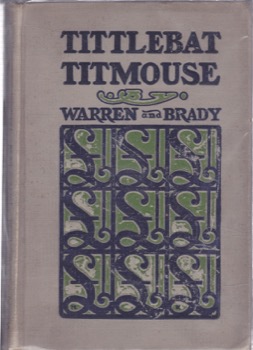
Hardcover. NY, Funk and Wagnalls , 1st, 1903, Book: Good, Hardcover, gray cloth stamped in green and black, 464 pages, b&w illustrations by Will Crawford. A version of Samuel Warren's 1839 novel, Ten Thousand a Year, which has been abridged by American author, Cyrus Townsend Brady (1861 - 1920). Warren (1807 - 1877), was a British barrister, novelist and MP with an in-depth knowledge of British common law and the original novel was based on a famous forgery case from the 1830s, where a claim was made to a vacant earldom using fake documents. Rear hinge cracked, shelf wear, name stamp on inside front cover.
Softcover. Yonkers, NY, Hudson River Museum, 1st, 1984, Book: Very Good, Dust Jacket: None, Softcover, 125 pages, b&w illustrations. Light rubbing to wrappers. Else a very clean, tight copy. Issued in conjunction with a 1984 exhibition of drawings by Hudson River School artist Frederic Edwin Church (1826-1900). With an essay by Elaine Evans Dee and foreword by Rick Beard. The annotated and illustrated catalogue presents 107 works. This is the only publication that examines in detail the preparatory studies of this master Hudson River School artist. Shows Church's drawings that were intended to provide preliminary detail for his oil paintings. The extensive notations on the drawings themselves are clear evidence of this intent. This provides a special insight into the processes of artistic creation as employed by one of 19th century American's greatest landscape painters.
Softcover. Yonkers, NY, Hudson River Museum, 1st, 1984, Book: Very Good, Dust Jacket: None, Softcover, 125 pages, b&w illustrations. Light rubbing to wrappers. Else a very clean, tight copy. Issued in conjunction with a 1984 exhibition of drawings by Hudson River School artist Frederic Edwin Church (1826-1900). With an essay by Elaine Evans Dee and foreword by Rick Beard. The annotated and illustrated catalogue presents 107 works. This is the only publication that examines in detail the preparatory studies of this master Hudson River School artist. Shows Church's drawings that were intended to provide preliminary detail for his oil paintings. The extensive notations on the drawings themselves are clear evidence of this intent. This provides a special insight into the processes of artistic creation as employed by one of 19th century American's greatest landscape painters.
Hardcover. NY, Parents Magazine Press, 1st, 1967, Book: Very Good, Dust Jacket: Very Good, Hardcover in a bright dust jacket. Wonderful introduction to different styles of architecture. Illustrated in color by Devlin. Related notes & articles to various landmark houses laid-in. Dust jacket price clipped. Clean copy.
Hardcover. NY, Knopf, 2nd pr., 1967, Book: Very Good, Dust Jacket: Good, Hardcover in a edgeworn, chipped dust jacket. A spectator's guide. Illustrated with 62 black and white photographs. Second printing of the second American edition (revised and enlarged). Clean copy.
Hardcover. Philadelphia, John C. Winston, 1st, 1930, Book: Very Good, Dust Jacket: None, Hardcover, blue cloth with gilt decoration, 500 pages. Color frontispiece and 246 illustrations, the majority black and white photographic illustrations. 3 maps and endpaper maps. Index. Gifford Pinchot (1865-1946) was an American forester, the first head of the US Forestry Service, the person for whom the Gifford Pinchot National Forest in Washington state is named, and a governor of Pennsylvania. In 1929 Pinchot and family took a seven-month cruise to the South Seas during which time he collected specimens for the National Museum. On board were other naturalists and representatives of scientific institutions. Profusely illustrated.
Hardcover. Columbia MO, University of Missouri Press , 1st, 1985, Book: Very Good, Dust Jacket: Very Good, Hardcover, 224 pages, Illustrated in color and b&w. Bright, clean copy. Blue cloth with gilt lettering to the spine. Includes footnotes, list of illustrations, notes on illustrations, and index. In a bright, unclipped dust jacket.
Hardcover. NY, The Century Co., 1st, 1892, Book: Very Good, Dust Jacket: None, Hardcover, original decorated two-part blue and mustard cloth, front and rear covers stamped in black, spine panel stamped in gold. 254 pages, b&w illustrations by W.A. Rogers. Boys' fiction set in New York City of a hunt for gold coins stolen during the American Revolution. Mild soil to covers, no markings
Hardcover. New York , Dodd Mead, 1st, 1942, Book: Very Good, Dust Jacket: Good, Hardcover, 70 pages, illustrated in color and b&w by Paul Lantz. Blue cloth covers, dust jacket with light edgewear, soil.
Hardcover. NY, Abbeville Press, 1st, 2023, Book: Very Good, Dust Jacket: None, Hardcover, pictorial boards, 222 pages in color and b&w. Tony Sarg (1880-1942), an American artist born in Guatemala to a diplomatic family, first achieved professional success as an illustrator in London and New York. But in the 1920s, he gained even greater renown for his touring puppet shows based on classic tales like Alice in Wonderland and Robinson Crusoe. Fusing the time-honored craft of traditional marionette shows with a playful modern sensibility, Sarg's productions were foundational to American puppetry: Jim Henson can be considered a direct artistic descendant. Yet this was only one facet of Sarg's varied accomplishments: he was also a pioneer in animated films and children's books, and, as a longtime designer for Macy's, he invented the gigantic balloons used in the firm's Thanksgiving Day Parade. (He also employed one of his parade balloons in the famous Nantucket Sea Serpent hoax of 1937.) This abundantly illustrated volume, published to coincide with a major exhibition organized by the Norman Rockwell Museum, is the first to survey Tony Sarg's protean career. It brings together imagery and artifacts from numerous public and private collections, and includes special sections on Sarg's long association with the island of Nantucket and his influence on American puppetry. Tony Sarg: Genius at Play will be essential reading for anyone with an interest in the history of popular culture. Claen copy.
Hardcover. New York, PowerHouse, 1st, 2004, Book: Very Good, Dust Jacket: None, Non-paginated. Illustrated with full color photographs. Clean, bright copy. Rocking on tour with America"s heavy metal superstars--Kiss, Poison, Iron Maiden, Slaughter, Ted Nugent, Dokken, and Cinderella--photographer David Yellen tailgated among the headbangers, metalheads, burnouts, and self-styled fanatics waiting for the show or hanging around backstage hoping to meet their idols. The results are a captivating record of Yellen"s trip to metal"s Shangri-la.
Hardcover. NY, Rizzoli, 1st, 1996, Book: Very Good, Dust Jacket: Very Good, Hardcover in a bright, unclipped dust jacket, 304 pages, illustrated in color and b&w throughout. Spotless and tight copy. American architect Morris Lapidus is best known as the designer of glamorous postwar resort hotels in Florida, such as the Fontainebleau (1954) and the Eden Roc (1955) in Miami Beach, and the Americana in Bal Harbour (1956). Yet in a remarkable sixty-year career that began in 1926, he designed more than 500 retail stores, hotels, apartment complexes, and stage sets that captured the popular spirit and changing face of Main Street America in the twentieth century.
Hardcover. Lunenburg, Town of Lunenburg Historical Society, 1st, 1977, Book: Very Good, Dust Jacket: None, 80 pages. Illustrated with black & white photographs. Previous owners bookplate on half-title page. Some light underlining in pen of residents names on front endpaper. Cloth covers age darkened along spine and edges. Clean, tight copy.
Hardcover. Leipzig, Bernard Tauchnitz, 1860, Book: Very Good, Dust Jacket: None, A very handsome edition of The Marble Faun, otherwise known as Transformation: Or The Romance of Monte Beni. The work was written on the eve of the American Civil War and is set in Italy. The work combines gothic literature, travel guides and fables. Two matching volumes, 292 + 280 pages. Title page states 1860. Bound in full vellum with leather ties, gilt-ruled and gilt-lettered parchment. Copyright Edition stated on title page of each volume and Printing Office of the Publisher on page 292 of volume one. twenty-six albumen photographic plates of contemporary Rome to 'Volume One' and twenty three to 'Volume Two'. Covers splayed as is common with this edition. Clean copies.
Hardcover. Paterson NJ, St. Anthony Guild Press, 1st, 1956, Book: Very Good, Dust Jacket: None, Hardcover in light tan cloth stamped in brown, 113 pages. Illustrated in 2-colors by Robert Bradbury. A tale of an orphaned American Indian girl who was worthy of sainthood in the eyes of her admirers. Remnants of color dust jacket and related article laid in. Clean copy.
Hardcover. Ithaca, Cornell University Press, 1st, 2005, Book: Very Good, Dust Jacket: Very Good, Hardcover in a bright, unclipped dust jacket, 71 pages. Illustrated throughout in color. Essay by Kevin J. Avery. "The wide variety of selections from Frederic Edwin Church's collection of his own paintings shows the master in all phases of his career, in sketches and finished paintings, depicting the breadth of his subjects and the high technical skills that established him as an eminent and influential artist in his own time. As works he held on to or reacquired and kept in his house during his lifetime, they embody the heart of his artistic vision and convey a deeply personal slant. As pictures he hung and lived with at Olana, they tell the larger story of that extraordinary place and are as illuminating when seen in context as on their own."
Hardcover. NY, American Studio Books/Watson-Guptill, 1st, 1947, Book: Very Good, Dust Jacket: Good, Hardcover, 128 pages, 268 illustrations (17 in color). A nice survey of American book illustration, covering such subjects as children's books, the growth of the American book publishing industry, and dust jackets, followed by illustrations by a wide number of artists in black and white and in color. Artists include Rockwell Kent, N. C. Wyeth, Marguerite de Angeli, the dAulaires, Lois Lenski, William Pene Du Bois, Salvador Dali, Margery Bianco, E. A. Abbey, Wanda Gag, Dorothy P. Lathrop, and numerous others. Bookplate on inside front cover, otherwise clean. In a chipped, edgeworn dust jacket.
Hardcover. Boston, Little, Brown and Company, 1st, 1938, Book: Good, Dust Jacket: None, 395 pages. Hardcover. No slipcase. SIGNED BY KENNETH ROBERTS AND N. C. WYETH. One thousand and seventy-five numbered copies of this Arundel Edition have been printed on all-rag paper, bound in natural finish cloths and autographed by the author and by the artist - this being hand numbered #147. Full color illustrations by N. C. Wyeth - illustrations are clean, and bright. Cloth covers with areas of strong fading. Spine cloth darkened, with some shallow abrading to leather title label. Interior is clean, and tight.
Hardcover. Taschen, 1st, 1013, Book: Very Good, Dust Jacket: Very Good, hardcover, 336 pages. At the height of the Jazz Age, when Prohibition was turning ordinary citizens into criminals and ordinary criminals into celebrities, America's true crime detective magazines were born. True Detective came first in 1924, and by 1934, when the Great Depression had produced colorful outlaws like Machine Gun Kelly, Bonnie and Clyde, Baby Face Nelson, and John Dillinger, the magazines were so popular cops and robbers alike vied to see themselves on the pages. Even FBI boss J. Edgar Hoover wrote regularly for what came to be called the "Dickbooks," referring to a popular slang term for a detective. As the decades rolled on, the magazines went through a curious metamorphosis, however. When liquor was once more legal, the Depression over and all the flashy criminals dead or imprisoned, the "detectives" turned to sin to make sales. Sexy bad girls in tight sweaters, slit skirts, and stiletto heels adorned every cover. Cover lines shouted "I Was a Girl Burglar-For Kicks," "Sex Habits of Women Killers," "Bride of Sin!," "She Played Me for a Sucker," and most succinctly, "Bad Woman."True Crime Detective Magazines follows the evolution and devolution of this distinctly American genre from 1924 to 1969. Hundreds of covers and interior images from dozens of magazine titles tell the story, not just of the "detectives," but also of America's attitudes towards sex, sin, crime, and punishment over five decades. With texts by magazine collector Eric Godtland, George Hagenauer, and True Detective editor Marc Gerald, True Crime Detective Magazines is an informative and entertaining look at one of the strangest publishing niches of all time.


 "Thomas Moran: Watercolors of the American Westby: Clark, Carol")
 "Thomas Moran: Watercolors of the American Westby: Clark, Carol")




 "To Embrace the Universe: The Drawings of Frederic Edwin Churchby: Dee, Elaine Evans")
 "To Embrace the Universe: The Drawings of Frederic Edwin Churchby: Dee, Elaine Evans")
 "To Grandfather's House We Go - A Roadside Tour of American Homesby: Harry Devlin")
 "To the Bullfight Againby: Marks, John")
 "To the South Seas. The Cruise of the Schooner Mary Pinchot to the Galapagos, the Marquesas, and the Tuamotu Islands, and Tahiti by: Pinchot, Gifford")
 "Tom Benton and His Drawings: A Biographical Essay and a Collection of His Sketches, Studies, and Mural Cartoonsby: Marling, Karal Ann")
 "Tom Paulding. The Story of a Search for Buried Treasure in the Streets of New Yorkby: Matthews, Brander")
 "Tom Whippleby: Edmonds/Paul Lantz, Walter D.")



 "Too Fast for Love - Heavy Metal Portraitsby: Yellen, David")

 "Transformation: Or The Romance of Monte Beni (Two volumes)by: Nathaniel Hawthorne")

 "Treasures from Olana - Landscapes by Frederic Edwin Churchby: Church, Frederic Edwin")
 "Treasury of American Book Illustration, Aby: Pitz, Henry C.")
 "Trending Into Maine (SIGNED COPY)by: Roberts, Kenneth/N. C. Wyeth")