Hardcover. Oxford UK, Clarendon Press, 1st, 1986, Book: Very Good, Dust Jacket: Very Good, Hardcover in a very good dust jacket with light fading to dj spine. 139 pages of text, 124 b&w plates in rear section. This is the second volume of Edgar Wind's selected papers, a companion to The Elegance of Symbols. Of all the scholars associated with the early development of the Warbur Institute Edgar Wind was the first to apply different theoretical principles to the study of English Art, above all in his early study of English portraiture, now a classic art history text. As the seminal essay, it gives title to the present volume, and is here translated into English for the first time. In this essay, which marked a change of direction in Wind's own development, he argues that two opposing styles of portraiture, exemplified in the art of Gainsborough and Reynolds, can be related to the different notions of humanity subscribed to by the philosophers David Hume and James Beattie. Other important studies, also reprinted here, make this volume an excellent resource to Wind's tremendous contributions to art history. Clean copy.
Hardcover. St Paul MN, Minnesota Historical Society , 1st, 2015, Book: Very Good, Dust Jacket: Very Good, Hardcover in a bright dust jacket. In this book lush, life-like illustrations by natural history artist Laurie Caple accompany Cheryl Blackford's poetic imagining of a year in the life of an urban coyote. Across the pages, Coyote sneaks, skulks, and scurries in his constant quest to feed himself and his growing family. While Coyote hunts nearby, people enjoy a city park. At the lake, in the marsh, among the trees, children jump, twirl, and play, oblivious to his secret life. Clean copy.
Hardcover. Bloomington IN, Indiana University Press, 1st, 1993, Book: Very Good, Dust Jacket: Very Good, Hardcover in a bright dust jacket. 263 pages,16 BW illus., 16 color plates. Takes us into the mind of American abstract painter Ethel Schwabacher (1903-1984). "Comparable to such important literary journals as those of Virginia Woolf and Anais Nin, Schwabacher's record will become a valuable resource for research into the creative process as well as the art history and theory of our time." Clean copy.
Softcover. Seattle, University of Washington Press, 1st, 2000, Book: Very Good, Dust Jacket: None, Softcover. Like new in publishers shrink-wrap. Chief Joseph's exhausted words of surrender, 'Hear me, my chiefs, I am tired; my heart is sick and sad. From where the sun now stands, I will fight no more forever', are the accepted end of the Nez Perce War of 1877, in which several bands of Nez Perce attempting to find a new home outside their diminished Idaho reservation clashed with the U.S. military (and occasionally other Indians) along the Clearwater and Big Hole Rivers, and finally at the foot of the Bear Paw Mountains. However, a number of Nez Perce escaped transportation to Indian Territory with Joseph and continued their flight to Canada, with perhaps a hundred eventually joining Sitting Bull's Lakota."I Will Tell of My War Story" reproduces, describes, and discusses a remarkable series of drawings by an anonymous Indian artist who fought with Chief Joseph and later reached Canada. The drawings, in red, blue, and black pencil, include portraits of principal participants in the war, battle scenes, and views of Nez Perce camp life and celebrations during the war and after. The drawings are preserved in a small pocket ledger labeled 'Cash Book' on the front, which was acquired by Indian Agent Charles D. Warner in the 1880s. It was willed by him to a family living in northern Idaho, and is now in the collection of the Idaho State Historical Society. Scott Thompson worked closely both with the owners and with members of the Nez Perce community in preparing his manuscript. Thompson's detective work and research methods to identify Nez Perce and other parties pictured in the Cash Book make fascinating reading. He is careful to point out what is speculation and what has been documented or attested to by experts on dress, weapons, ceremony, and other aspects of Native culture. The Cash Book drawings are unique in several ways. They are one of very few firsthand pictorial records of the Nez Perce War, representing an even scarcer record of this war as seen from the Indian viewpoint. They contain invaluable historical and ethnographic information not only explicit in the form of military and Native dress, regalia, and quite graphic battle scenes, but also implicit. The drawings reveal an important stage of cultural adaptation as shown by the mixture of white and Native goods combined in Nez Perce material culture during the 1870s and 1880s, and by the artist's assimilation of white/European drawing techniques such as texture and perspective. The artist combined these drawing techniques with Native art traditions to make exceptionally effective pictorial communications. Scott M. Thompson is an art teacher at Chase Middle School in Spokane, Washington.
Hardcover. Venice, Marsilio, 1st, 1986, Book: Very Good, Dust Jacket: Good, Hardcover in a lightly sunned dust jacket. Lovely retrospective of Italian fashion. 151 pages, 277 illustrations, many in color. ITALIAN TEXT. Small sticker, pencil marking to front endpapers, otherwise clean. DOMESTIC SHIPPING ONLY.
Softcover. Decatur IL, Illustrated Press, 1st, 2022, Book: Very Good, Dust Jacket: None, Softcover, 80 pages illustrated in color. The entire issue devoted to two illustrators: Jessie Wilcox Smith and John Schoenherr.
Hardcover. NY, The Society of Illustrators, 1st, 2001, Book: Very Good, Dust Jacket: Very Good, 452 pages, illustrated throughout in color and b&w. Light edgewear to dust jacket, else a clean, tight copy. A fascinating history of modern American illustrations traces 140 years of endeavor and the work of more than 450 artistis--including such masters as Maxfield Parrish, Rockwell Kent, and Theodore Geisel--and discusses the different schools of illustration, styles, artistic innovations and trends, and more. DUE TO WEIGHT, This is a heavy and oversized book and will require extra shipping. International customers please ask for a shipping quote before purchasing.
Hardcover. New York, George Braziller, 1st, 1974, Book: Very Good, Dust Jacket: Good, 189 pages. Hardcover. Black & white illustrations. Dust jacket with spine fading, light wear at corners, edges. Clean, tight copy.
Hardcover. New York, The Free Press, 1st, 2001, Book: Very Good, Dust Jacket: Very Good, 263 pages. Hardcover. Dust jacket unclipped. Color illustrations throughout. Gilt title on spine. A touch of foxing on spine, otherwise clean inside. Binding tight, in great shape.
Hardcover. Chapel Hill NC, University of North Carolina Press, 1st, 2001, Book: Very Good, Dust Jacket: None, Hardcover, blue cloth covers with silver lettering, 384 pages, b&w illustrations. Say "New England" and you likely conjure up an image in the mind of your listener: the snowy woods or stone wall of a Robert Frost poem, perhaps, or that quintessential icon of the region--the idyllic white village. Such images remind us that, as Joseph Conforti notes, a region is not just a territory on the ground. It is also a place in the imagination. This ambitious work investigates New England as a cultural invention, tracing the region's changing identity across more than three centuries. Incorporating insights from history, literature, art, material culture, and geography, it shows how succeeding generations of New Englanders created and broadcast a powerful collective identity for their region through narratives about its past. Whether these stories were told in the writings of Frost or Harriet Beecher Stowe, enacted in historical pageants or at colonial revival museums, or conveyed in the pages of a geography textbook or Yankee magazine, New Englanders used them to sustain their identity, revising them as needed to respond to the shifting regional landscape. Clean copy. No dust jacket.
Hardcover. Lewes, DE, GILES, 1st, 2015, Book: Very Good, Dust Jacket: Very Good, 256 pages. Hardcover with dust jacket. A very clean, unmarked copy. Like new still in publishers shrinkwrap. In addition to color plates of all works in the exhibition--nearly one hundred paintings, works on paper, and sculptures--this volume features essays by exhibition curators Douglas Dreishpoon and Tyler Cann, as well as poet and critic Raphael Rubinstein, and an illustrated chronology by academic and granddaughter of the artist Cary Cordova. From his early Abstract Expressionist-inspired paintings to his organic, anthropomorphic figure-ground compositions and later diagrammatical, hard-edged works, Imperfections by Chance charts the full range of Feeley's influential life and career.
Hardcover. Berkeley CA, Ten Speed Press, Revised Ed., 2000, Book: Very Good, Dust Jacket: Very Good, Revised Edition of a book first published in 1990 in London. 204 pages illustrated with detailed color and b&w photographs. Court fashion of the Qing Dynasty (1644-1911).
Hardcover. Lewes, DE, GILES, 1st, 2015, Book: Very Good, Dust Jacket: Very Good, 232 pages. Hardcover with dust jacket. A very clean, unmarked copy still in publishers shrinkwrap. Over 140 color illustrations. Provides analysis of this single panel painting of St. Francis, rendered by Italian Renaissance painter Giovanni Bellini
Softcover. Caldwell, NJ, Heritage Committee of The First Presbyterian Church at Caldwell, 1st Edition, 2003, Book: Near Fine, Dust Jacket: None, 69 pages. Soft cover. Vivid color illustrations throughout. Wrapper in beautiful condition. pages have just a touch of tanning around edges, otherwise clean and bright. Binding tight. In excellent shape. "Part of Daugherty's legacy to us is the sixty works in this book entitled 'In His Image'. These paintings were done in the period 1940 to 1960. They are executed in a powerful, emotional mood."
Hardcover. NY, Penguin Press, 1st, 2019, Book: Very Good, Dust Jacket: Very Good, Hardcover in a bright, unclipped dust jacket., 310 pages, color and b&w illustrations. In Montparnasse begins on the eve of the First World War and ends with the 1936 unveiling of Dali's Lobster Telephone. As those extraordinary years unfolded, the Surrealists found ever more innovative ways of exploring the interior life, and asking new questions about how to define art. In Montparnasse recounts how this artistic revolution came to be amidst the salons and cafes of that vibrant neighborhood. Sue Roe is both an incisive art critic of these pieces and a beguiling biographer with a fingertip feel for this compelling world. Beginning with Duchamp, Roe then takes us through the rise of the Dada movement, the birth of Surrealist photography with Man Ray, the creation of key works by Ernst, Cocteau, and others, through the arrival of Dali. On canvas and in their readymades and other works these artists juxtaposed objects never before seen together to make the viewer marvel at the ordinary--and at the workings of the subconscious. We see both how this art came to be and how the artists of Montparnasse lived. Roe puts us with Gertrude Stein in her box seat at the opening of The Rite of Spring; with Duchamp as he installs his famous urinal; at a Cocteau theatrical with Picasso and Coco Chanel; with Breton at a session with Freud; and with Man Ray as he romances Kiki de Montparnasse.
Hardcover. NY, Metropolitan Museum of Art, 1st, 2019, Book: Very Good, Dust Jacket: None, Hardcover, pictorial boards with a wraparound title band. This handsome volume explores the modern discipline of fashion collecting, presenting remarkable works from one of the greatest private collection of 20th-century costume. This group of clothing and accessories, assembled over several decades by Sandy Schreier, includes many rare and historically significant pieces that define key moments in fashion. Her collection features not only iconic garments by established designers but also looks by pioneering couturiers rarely represented in museum collections. Outstanding works, by designers that include Gilbert Adrian, Cristobal Balenciaga, Boue Soeurs, Gabrielle Chanel, Christian Dior, Mariano Fortuny, Karl Lagerfeld, Paul Poiret, and Valentina, are illustrated with new photography by fashion photographer Nicholas Cope. An informative introduction traces the progress of her collecting from its roots in Detroit to the present day. The book also includes descriptions of over 80 works, including garments, accessories, and rare designer drawings, in addition to a lively interview with Schreier by Andrew Bolton that reveals her collecting philosophy.
Softcover. Bangor ME, Bangor and Aroostook Railroad , 1st, 1941, Book: Very Good, Dust Jacket: None, Softcover. Published by the Bangor and Aroostook Railroad, this wonderfully evocative magazine brings the unspoiled Maine woods of pre-World War II back to life. The magazine has articles on a variety of topics, including camping, canoeing, Indian relics, Maine guides, Moosehead Lake and climbing Mt. Katahdin. Illustrated throughout with black and white photos designed to make you drop everything and head North. With canoeing map, list of big game records for 1940, Sportsman's Directory of camps, hotels and fishing waters reached by the railroad and 39 pages of vintage advertisements. 128 pages. Light edgewear, small name on first page, otherwise clean.
Hardcover. US, Minnesota Historical Society Press, 1st, 2011, Book: Very Good, Dust Jacket: Very Good, Hardcover, 116 pages, illustrated throughout in b&w. Clean, unmarked copy with only minor wear to dust jacket.
Hardcover. NY, New York Graphic Society, 1st, 1973, Book: Very Good, Dust Jacket: None, Hardcover, 192 pages. 200 black-and-white photographs by Dorothea Lange, Walker Evans, Carl Mydans, Marion Post Wolcott, Ben Shahn, Arthur Rothstein, Jack Delano, Russell Lee, and Others. Black cloth, missing dust jacket.
Softcover. US, University of California Press, 1st, 1995, Book: Very Good, Dust Jacket: None, 304 pages, illustrated throughout in color and b&w. Light sun-fade and edgewear to wrappers, else a clean, tight copy. Independent Spirits brings to vivid life the West as seen through the eyes of women painters from 1890 to the end of World War II. Expert scholars and curators identify long-lost talent and reveal how these women were formidable cultural innovators as well as agitators for the rights of artists and women during a period of extraordinary development.
Hardcover. UK, Cambridge University Press, 1st, 2005, Book: Very Good, Dust Jacket: Very Good, Hardcover, 334 pages. Spanning his renunciation of the Salon in 1834 until his large retrospective at the crucial 1855 Universal Exposition, this book examines the critical writing and journalistic reportage on Jean-Auguste-Dominque Ingres. It demonstrates how Ingres shaped his career in the rapidly evolving art world of mid-nineteenth century Paris. While enjoying the benefits of his affiliation with the Academy, the artist also pursued certain modes of presentation, most notably the single-artist exhibition and illustrated monograph, through which he distanced himself from the embattled world of artistic officialdom.
Hardcover. Penn State University Press, 1st, 2012, Book: Very Good, Dust Jacket: Very Good, Hardcover in a bright dust jacket, 328 pages illustrated in color. Jean-Auguste-Dominique Ingres has long been recognized as one of the great painters of the modern era and among the greatest portraitists of all time. Over a century and a half of scholarly writing on the artist has grappled with Ingres's singular identity, his relationship to past and future masters, and the idiosyncrasies of his art. Ingres and the Studio: Women, Painting, History makes a unique contribution to this literature by focusing on the importance of Ingres's training of students and the crucial role played by portraits-and their subjects-for Ingres's studio and its developing aesthetic project. Rather than understanding the portrait as merely a screen onto which the artist's desires were projected, the book insists on the importance of accounting for the active role of portrait sitters themselves. Through careful analysis of familiar and long-overlooked works, Ingres and the Studio traces a series of encounters between painters and portrait subjects in which women sitters-such as the artist Julie Mottez, art critic, salonniere, and historian Marie d'Agoult, and tragic actress Rachel-emerge as vital interlocutors in a shared aesthetic project. Still in publisher's shrinkwrap.
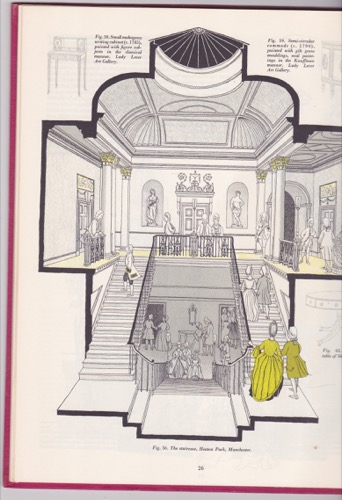
Hardcover. London, John Murray, 1st, 1957, Book: Very Good, Dust Jacket: None, Hardcover, red cloth stamped with white lettering, decoration. Delightfully illustrated history of interior design and furniture. 48 pages, 2-color art throughout by the authors. Small library stamp on title page, otherwise clean.