Hardcover. NY, Pantheon, 1st, 2013, Book: Very Good, Dust Jacket: Very Good, Hardcover in a bright dust jacket, 345 pages. As political change sweeps the streets and squares, the parliaments and presidential palaces of the Arab world, Shereen El Feki has been looking at an upheaval a little closer to home--in the sexual lives of men and women in Egypt and across the region. The result is an informative, insightful, and engaging account of a highly sensitive and still largely secret aspect of Arab society. Sex is entwined in religion, tradition, politics, economics, and culture, so it is the perfect lens through which to examine the complex social landscape of the Arab world. From pregnant virgins to desperate housewives, from fearless activists to religious firebrands, from sex work to same-sex relations, Sex and the Citadel takes a fresh look at the sexual history of the region and brings new voices to the debate over its future. Clean copy.
Hardcover. UK, ACC Editions, 1st, 2014, Book: Very Good, Dust Jacket: None, Hardcover in pictorial bpards. Felicity Green brought a new, original voice and look to the fashion pages of the '60s' Daily Mirror. For the first time in newspaper history she created fashion pages designed to appeal to both sexes as the circulation soared to more than 5 million copies a day. Great pictures, great photographers, top designers, top models - Felicity made these Swinging '60s fashion stories FUN! bringing the glamor and style of glossy magazines to the Mirror. These award-winning pages broke the fashion mould and captured the stellar time when London fashion conquered the world. Under Felicity Green's by-line comes stories of the stars of the '60s - they're all talking in this original book: Mary Quant, Barbara Hulanicki, Vidal Sassoon, Twiggy, Terry O'Neill, and a sparkling foreword by Barbara Hulanicki, of Biba fame, tells the story of a fashion collaboration/friendship whose gingham dress made fashion history. Still in publisher's shrinkwrap.
Hardcover. London, Secker & Warburg, 1st, 1996, Book: Very Good, Dust Jacket: Very Good, 115 pages, illustrated throughout in b&w. Light edgewear to dust jacket with small closed tear to upper edge. Clean, tight copy. John Minihan was raised in Athy, Co. Kildare and has been photographing his home town and its people for over thirty years. The collection forms a portrait of an ordinary Irish county town which is gradually feeling the incursions of industry, comparative wealth and modernity. At the centre of the book is the wake of Katy Tyrrell, which Minihan photographed for two nights and three days. These photographs have been exhibited throughout the world. Here, they are accompanied by an introduction by Eugene McCabe, one of Ireland's finest writers. The collaboration between these two artists results in a timeless and moving portrait of a small Irish town. DOMESTIC SHIPPING ONLY.
Hardcover. NY, Abrams, 1st, 2005, Book: Very Good, Dust Jacket: Very Good, Hardcover, 192 pages. Shadows of War presents an astonishing collection of previously unpublished, unknown photographs of life at the front lines in the German war machine during World War II, taken by a common foot soldier. The work of a gifted amateur, Willi Rose's images present a powerful vision of a largely suppressed aspect of the war. These fractured glimpses of the world at war, from quotidian tasks and moments of leisure to scenes of death and destruction, reveal one man's experience of the epic flow of history. A miller in the years before World War II, Rose was drafted into the German army in October 1939 and served as a motorbike messenger on the front, first in France and then in Russia. He was wounded twice and was later captured by the Polish army, eventually returning home in June 1946. Throughout his military service, Rose sent home photographs that he took of the action, mostly along the Eastern Front. Discovered by his widow after his death, these images form a unique photographic document of one soldier's war.
Softcover. Princeton NJ, Princeton University Press, 1st, 2002, Book: Very Good, Softcover, 372 pages. Ten leading scholars explore how, over the past two centuries, the changing positions of the United States in the world economy and in the international political order have shaped U.S. political institutions and domestic politics. Ira Katznelson, Aristide R. Zolberg, and Robert O. Keohane demonstrate the central role that efforts to contend with foreign military and economic competition played in forming the major institutions of U.S. government from the framing of the Constitution through the Civil War. Clean copy.
Hardcover. Boston, The Atlantic Monthly Press, 1st, 1918, Book: Very Good, Dust Jacket: None, Hardcover, Green boards,gilt title box and title on front cover and spine. 151 pages plus ads, rough cut foredges. The effects and treatment of traumatic shock after World War I written by s physician who was there. Bright, clean copy.
Hardcover. London, Methuen, 1st, 1984, Book: Very Good, Dust Jacket: Very Good, Hardcover in a bright, lightly worn dust jacket, 283 pages. Shopkeepers and master artisans had a striking presence in the history of nineteenth-century Europe, not only in the development of industrial and urban economies, but also the fabric of social life and the politics of protest. The experience of 1848, the differing pace of various forms of nationalism and liberalism and, at the end of the century, the shift towards right-wing nationalist or Catholic political movements reflected a developing 'crisis' in the petite bourgeoisie. The essays examine the nature of this crisis and ask critical questions about the social relations of the petite bourgeoisie with the developing working classes. This book as a whole provides a fresh and integrated approach to the world of these shopkeepers and master artisans and illuminates much else besides in the social history of nineteenth-century Europe. Clean copy.
Hardcover. Metuchen NJ, Scarecrow Press], 1st, 1984, Book: Very Good, Dust Jacket: None, Hardcover, brick-red cloth with white lettering, no dust jacket issued. 508 pages. Text illustrations. Study covers period between Dziga Vertov's Man with a Movie Camera and documentary-movement associated with the Sandanista Revolution. This anthology of 25 articles is both historical and cross- cultural, covering the pioneering period of the twenties and thirties and the dynamic growth of committed documentary since the sixties; recent feminist initiatives in North America and Britain; committed documentary in the Third World over the last 25 years; the use of film within the American 'New Left;' and the particular problematic of radical film distribution. Contributors include such well-known activists and scholars as Joan Braderman, Julianne Burton, Guy Hennebelle, John Hess, Claire Johnstone, E. Ann Kaplan, Chuck Kleinhans, Julia Lesage, Steve Neale, Bill Nichols, Anand Patwardhan, and Paul Willemen. Filmmakers and collectives discussed include Dziga Vertov, Joris Ivens, Jean Renoir, Frontier Films, Newsreel, Chris Marker, Barbara Kopple, JoAnn Elam, Michelle Citron, Shinsuke Ogawa, Fernando Birri, Patricio Guzman, Santiago Alvarez, Fernando Solanas, Jean-Luc Godard, Anand Patwardhan, and the Nicaraguan Studio 'Incine.'Clean copy.
Hardcover. NY, Simon & Schuster, 1st, Book: Very Good, Dust Jacket: Very Good, Hardcover in a bright dust jacket, A sociological look at the influence of Shakespeare's Shylock on world mythology describes the character's creation and his evolution on the stage, and presents writing about him by Proust, James, T. S. Eliot, and others. Amazingly, Shylock is in only five scenes in the Merchant of Venice. Yet, as pointed out by Gross, the theater critic for the London Sunday Telegraph , his impact and significance transcend his physical presence, so much so that his name and "pound of flesh" idea are almost universally known. In the first part of this character/cultural study, Gross examines the antecedents of Shylock and the play, and his development within the play. The second part considers "interpretations" both theatrical and literary in England and America until World War II; the third part considers Shylock more broadly as a touchstone (e.g., how his "type" is used by the Victorians--Trollope's Lopez, Dickens's Riah, Ruskin's use of him in Munera Pulveris ). Clean copy.
Hardcover. Boston, Little, Brown and Company, reprint, 1957, Book: Very Good, Dust Jacket: None, Hardcover, blue cloth with gilt lettering on spine. Volume IX in The History of United States Naval Operations in World War II. 413 pages, illustrated with maps (one fold-out) and b&w photos. Gilt on spine with light fading, lacks dust jacket, otherwise clean, tight copy.
Hardcover. US, 5 Continents, 1st, 2006, Book: Very Good, Dust Jacket: Very Good, Hardcover, 144 pages. Like new in publisher's shrink-wrap. French photographer Olivier Mriel (b. 1955) has practiced photography for over 26 years. His work focuses on landscapes with a taste for the obscure. The son of a chemist, he lives and works in France in the small seaside town of Saint Aubin-sur-Mer, just as his ancestors did before him. His photographs perfectly capture the feeling of history this region is steeped in. Mriel's landscapes, while dark and moody, ultimately document his search for light. This light is reflected off the land and as surfaces act as mirrors, they exude a subtle glow that seeps into even the darkest corners. A human presence that is felt but not seen subtly leads us to explore and to contemplate the secrets of these magical places and the profound meaning of existence.
Hardcover. Boston, Gambit , 1st, 1973, Book: Very Good, Dust Jacket: Good, Hardcover in a worn, chipped dust jacket. Emissar of Charles the First, second governor of Massachusetts, pillar of the Protectorate, and victim of Charles the Second, atypical Puritan and passionate lover, Sir Harry Vane was a man of peace who initiated genocide in the New World and found martyrdom in the Old. His experience reaches from Indian wigwam to royal palace. This is an unparalleled picture of a formative age which is with us yet. Clean copy.
Hardcover. Cambridge, Cambridge University Press, 1st, 2000, Book: Very Good, Dust Jacket: None, 328 pages with bibliography and index. A revised and abridged version of Watkins earlier work on Soane (1753-1837), concentrating on the twelve lectures the eminent architect gave to the Royal Academy between 1810 and 1820, dealing with the huge scope of the lessons to be gained from world architecture.
Hardcover. NY, Thames & Hudson, 1st, 2013, Book: Very Good, Dust Jacket: Very Good, Hardcover in a bright dust jacket, still in publisher's shrink wrap. Celebrates the height of Weimar cinema through images and commentaries on more than seventy of its finest films Between the First and Second World Wars, Germany under the Weimar Republic was the scene of one of the most creative periods in film history. Through the silent era to the early years of sound, the visual flair and technical innovation of its filmmakers set an international standard for the powerful possibilities of cinema as an art form, with movies such as The Cabinet of Dr. Caligari, Nosferatu, Metropolis, and M building a legacy that shaped the world of film. Here is a showcase of more than seventy films, selected to give a wide-ranging overview of Weimar cinema at its finest. Every genre is represented, from escapist comedies and musicals to gritty depictions of contemporary city life, from period dramas to fantastical visions of the future, with themes such as sexuality and social issues tackled by iconic stars like Marlene Dietrich and Louise Brooks. A wealth of film stills captures the bold vision of great directors like Fritz Lang and Ernst Lubitsch, while the text sets the historical scene and gives intriguing insights into what the films meant to the society that created them.
Hardcover. NY, Knopf, 1st, 2012, Book: Very Good, Dust Jacket: Very Good, Hardcover in a bright, unclipped dust jacket. 418 pages, b&w illustrations. From the author of the best-selling One Minute to Midnight, a riveting account of the pivotal six-month period spanning the end of World War II, the dawn of the nuclear age, and the beginning of the Cold War. When Roosevelt, Stalin, and Churchill met in Yalta in February 1945, Hitler's armies were on the run and victory was imminent. The Big Three wanted to draft a blueprint for a lasting peace--but instead set the stage for a forty-four-year division of Europe into Soviet and western spheres of influence. After fighting side by side for nearly four years, their political alliance was rapidly fracturing. By the time the leaders met again in Potsdam in July 1945, Russians and Americans were squabbling over the future of Germany and Churchill was warning about an "iron curtain" being drawn down over the Continent. These six months witnessed some of the most dramatic moments of the twentieth century: the cataclysmic battle for Berlin, the death of Franklin Roosevelt, the discovery of the Nazi concentration camps, Churchill's electoral defeat, and the dropping of atomic bombs on Japan. While their armies linked up in the heart of Europe, the political leaders maneuvered for leverage: Stalin using his nation's wartime sacrifices to claim spoils, Churchill doing his best to halt Britain's waning influence, FDR trying to charm Stalin, Truman determined to stand up to an increasingly assertive Soviet superpower.
Hardcover. Boston, New York Graphic Society, 1st, 1987, Book: Very Good, Dust Jacket: Very Good, 159 pages, large format. B&w plates throughout. Dust jacket with minor edgewear. Introduction by Hubert de Givenchy. Skrebneski is celebrated as one of the world's finest fashion and portrait photographers. His diverse body of work has won him international accolades and, for more than half a century, he has photographed the world's most famous people, from Orson Welles, Truman Capote, and Audrey Hepburn to Andy Warhol, David Bowie, and Iman. In 1962, Skrebneski became the exclusive photographer for Estee Lauder, and over the years his flawless images of models such as Paulina Porizkova and Willow Bay made history. Five Beautiful Women is an elegant portfolio published to commemorate his twenty-five year collaboration with Estee Lauder. For the project, five distinctly beautiful models were chosen--Phyllis Connor, Karen Harris, Karen Graham, Shaun Casey, and Willow Bay--and, as Hubert de Givenchy notes, "[Skrebneski] succeeded in his very personal way to convey not only the external individuality of his subjects but, what in my opinion is most important, their inner beings."
Hardcover. Boston, New York Graphic Society, 1st, 1987, Book: Very Good, Dust Jacket: Very Good, 159 pages, large format. B&w plates throughout. Introduction by Hubert de Givenchy. Skrebneski is celebrated as one of the world's finest fashion and portrait photographers. His diverse body of work has won him international accolades and, for more than half a century, he has photographed the world's most famous people, from Orson Welles, Truman Capote, and Audrey Hepburn to Andy Warhol, David Bowie, and Iman. In 1962, Skrebneski became the exclusive photographer for Estee Lauder, and over the years his flawless images of models such as Paulina Porizkova and Willow Bay made history. Five Beautiful Women is an elegant portfolio published to commemorate his twenty-five year collaboration with Estee Lauder. For the project, five distinctly beautiful models were chosen--Phyllis Connor, Karen Harris, Karen Graham, Shaun Casey, and Willow Bay--and, as Hubert de Givenchy notes, "[Skrebneski] succeeded in his very personal way to convey not only the external individuality of his subjects but, what in my opinion is most important, their inner beings."
Hardcover. Chicago, University of Chicago Press, 2nd pr., 2015, Book: Very Good, Dust Jacket: Very Good, Hardcover in a bright dust jacket, 233 pages, b&w illustrations. From the minute it opened--on Christmas Day in 1865--it was Chicago's must-see tourist attraction, drawing more than half a million visitors each year. Families, visiting dignitaries, even school groups all made trips to the South Side to tour the Union Stock Yard. There they got a firsthand look at the city's industrial prowess as they witnessed cattle, hogs, and sheep disassembled with breathtaking efficiency. At their height, the kill floors employed 50,000 workers and processed six hundred animals an hour, an astonishing spectacle of industrialized death. Slaughterhouse tells the story of the Union Stock Yard, chronicling the rise and fall of an industrial district that, for better or worse, served as the public face of Chicago for decades. Dominic A. Pacyga is a guide like no other--he grew up in the shadow of the stockyards, spent summers in their hog house and cattle yards, and maintains a long-standing connection with the working-class neighborhoods around them. Pacyga takes readers through the packinghouses as only an insider can, covering the rough and toxic life inside the plants and their lasting effects on the world outside. He shows how the yards shaped the surrounding neighborhoods and controlled the livelihoods of thousands of families. He looks at the Union Stock Yard's political and economic power and its sometimes volatile role in the city's race and labor relations. And he traces its decades of mechanized innovations, which introduced millions of consumers across the country to an industrialized food system. Clean copy.
Softcover. NY, Harcourt Brace and World, 1st pbk, 1966, Book: Good, Dust Jacket: None, Softcover, 261 pages. For whom was slavery profitable? Did it aid the slave, slaveowner, nonslaveholder, the South or all America? The readings here seek to clarify such questions. Front cover with light wear to fore-edge otherwise clean.
Hardcover. New York, Philomel, 1st, 2005, Book: Very Good, Dust Jacket: Very Good, Hardcover in a bright, unclipped dust jacket, 32 pages illustrated in color by Small. So you want to be an explorer? What does it take, you ask? To find out, take a look at Judith St. George and David Small's witty collection of some of the best explorers the world has ever known.You know Marco Polo and Christopher Columbus, but what about Mary Kingsley, who studied cannibals in Africa, or cowboy Jim White, who, by mistake, found Carlsbad Caverns? Full of boundless energy and illustrations you won't forget, this historical jaunt will inspire the explorer in all of us, young and old.
Hardcover. London, Oxford University Press, 1953, Book: Good, Dust Jacket: Good, 708 pages. Hardcover. This is Volume two only. Illustrated with black & white photographs. Some darkening to endpapers and to a few pages. Dust jacket with chipping, darkening to edges. DUE TO WEIGHT, DOMESTIC SHIPPING ONLY.
Hardcover. Columbia SC, University of South Carolina Press, 1st, 1988, Book: Very Good, Dust Jacket: Very Good, Hardcover in a bright dust jacket. 278 pages, b&w illustrations. INSCRIBED BY AUTHOR on front fly leaf. "Drawing upon hundreds of obscure and hard-to-find sources, the author has produced a fresh, sometimes humorous, sometimes heartbreaking chronicle of what it was like to be a participant in the most intense war the world had ever seen up to that time." Clean copy.
Hardcover. New Haven CT, Yale University Press, 1st, 2013, Book: Very Good, Dust Jacket: Very Good, Hardcover in a bright dust jacket, 430 pages. SIGNED BY MONOD on the tile page, also INSCRIBED on the half-title page. The late seventeenth and eighteenth centuries are known as the Age of Enlightenment, a time of science and reason. But in this illuminating book, Paul Monod reveals the surprising extent to which Newton, Boyle, Locke, and other giants of rational thought and empiricism also embraced the spiritual, the magical, and the occult. Although public acceptance of occult and magical practices waxed and waned during this period they survived underground, experiencing a considerable revival in the mid-eighteenth century with the rise of new antiestablishment religious denominations. The occult spilled over into politics with the radicalism of the French Revolution and into literature in early Romanticism. Even when official disapproval was at its strongest, the evidence points to a growing audience for occult publications as well as to subversive popular enthusiasm. Ultimately, finds Monod, the occult was not discarded in favor of "reason" but was incorporated into new forms of learning. In that sense, the occult is part of the modern world, not simply a relic of an unenlightened past, and is still with us today. Clean copy.
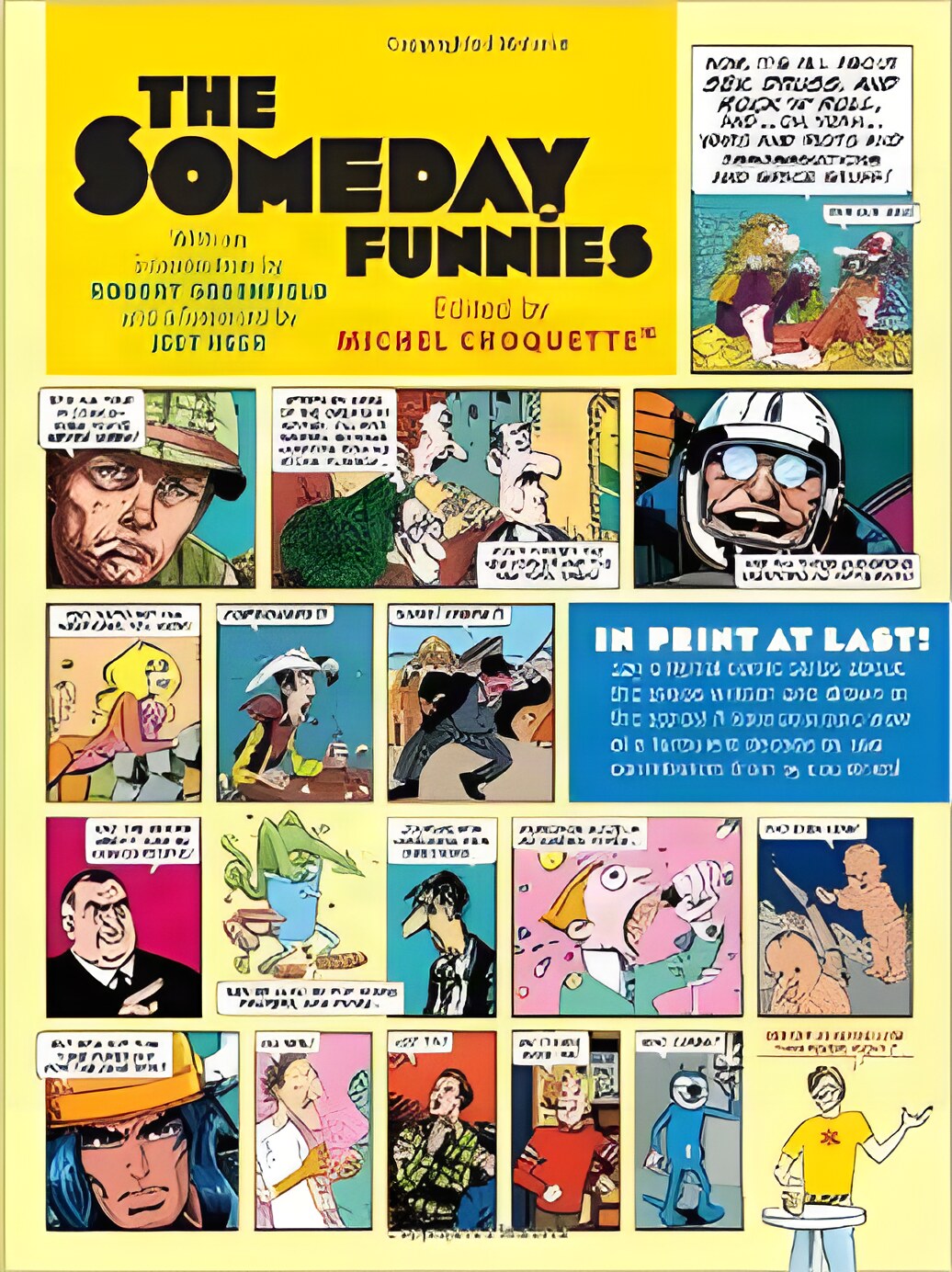
Hardcover. New York , Harry N. Abrams, 1st, 2011, Book: Very Good, Dust Jacket: Very Good, Hardcover, 216 pages. Like new in publisher's shrink-wrap. The long-awaited collection of comic strips created in the early 1970s by some 169 contributors from 15 countries from C.C. Beck to Art Spiegelman. What started out as a special insert for Rolling Stone took on a life of its own as writer/editor Michel Choquette traveled the world, commissioning this visual chronicle of the 1960s, only to find himself without a publishing partner or the financial support to continue. Forty years later, readers finally get to experience this legendary anthology as Choquette celebrate the birth, death, and resurrection of The Someday Funnies. DUE TO SIZE, DOMESTIC SHIPPING ONLY.


 "Shadows from the Pale: Portrait of an Irish Townby: Minihan, John")
 "Shadows of War: A German Soldier's Lost Photographs of World War IIby: Petra Bopp, Willi Rose , et al.")

 "Shock at the Frontby: Porter, William Townsend")
 "Shopkeepers and Master Artisans in Nineteenth-Century Europeby: Crossick, Geoffrey & Heinz-Gerhard Haupt")
 "Show Us Life: Toward a History and Aesthetics of the Committed Documentary by: Waugh, Thomas (Ed.)")

 "Sicily-Salerno-Anzio: January 1943 - June 1944 ( History of United States Naval Operations in World War II) Volume 9by: Morison, Samuel Eliot")
 "Silent Worldsby: Olivier Mriel")
 "Sir Harry Vane: His Life and Times 1613-1662by: Adamson, J. H. & H. F. Folland")
 "Sir John Soane: The Royal Academy Lecturesby: Watkin, David (Editor)")
 "Sirens & Sinners: A Visual History of Weimar Film 1918-1933by: Hans Helmut Prinzler")
 "Six Months in 1945: FDR, Stalin, Churchill, and Truman--from World War to Cold Warby: Michael Dobbs")

 "Skrebneski: Five Beautiful Womenby: Skrebneski, Victor")
 "Slaughterhouse: Chicago's Union Stock Yard and the World It Made by: Pacyga, Dominic A.")

 "So You Want to Be an Explorer?by: St. George, Judith and David Small")
 "Social & Economic History of the Hellenistic World, The: vol. IIby: Rostovtzeff, M.")
 "Soldiers Blue and Gray (SIGNED COPY)by: Robertson, James I., Jr.; Connelly, Thomas L. (editor)")