Hardcover. India, Mapin Publishing Group, 1st, 2006, Book: Very Good, Dust Jacket: Very Good, 171 pages, color and b&w illustrations. This very visual work features the religious and historical significance of feet and footwear in Indian culture as reflected in the civilization's art, sacred writings, and literature. Like new in publishers shrink-wrap.
Hardcover. New York, Dial Press, 1st, 1969, Book: Very Good, Dust Jacket: Very Good, Hardcover. 90 pages. Black & white illustrations by Alan E. Cober. Edgewear, light rubbing to dust jacket. Clear plastic protective cover.
Softcover. Washington DC, Smithsonian's National Museum of the American Indian, 1st, 2004, Book: Very Good, Dust Jacket: None, Softcover, 263 pages. Color plates throughout. Five essays by contributors. Clean copy.
Hardcover. Albuquerque, University of New Mexico, 1st, 1971, Book: Very Good, Dust Jacket: Good, Hardcover in a lightly worn, chipped dust jacket. 253 pages, INSCRIBED BY TAYLOR on the title page. Previous owner's inscription on half-title page, otherwise clean. First Mail West recounts the colorful history of stagecoach lines on the Santa Fe Trail during the height of overland traffic from 1850 to 1879. Desert, rain, snow, wind, outlaws, Indians, buffalo stampedes, and business competitors challenged, and sometimes scuttled, the operation of stage lines between Missouri and New Mexico. The author describes the topography, roads, rolling stock, stations, accommodations, and natural and human dangers along the trail, and analyzes the fierce competition between independent lines for passenger traffic and federal mail contracts.
Softcover. Riverdale-on-Hudson NY, The Sheep Meadow Press, 1st, 1987, Book: Very Good, Dust Jacket: None, Softcover, 115 pages. INSCRIBED BY BARNSTONE on the title page. Barnstone was a distinguished professor emeritus from Indiana University. He was in China during the Cultural Revolution, which is central to this collection. Clean, bight copy.
Hardcover. Bloomingdale, Indiana University Press, reprint, 1991, Book: Very Good, Dust Jacket: Very Good, 290 pages. Hardcover with dust jacket. Clean and tight copy with only light edgewear to dust jacket and very light foxing to top text block. This classic work, first published in 1956, is now available in English. Along with Luthi's The European Folktale and Propp's The Morphology of the Folktale, Rohrich's Marchen und Wirklichkeit is considered a key text in folklore scholarship.
Softcover. Charleston, SC, Arcadia Publishing, 1st, 2004, Book: Very Good, Dust Jacket: None, Softcover, 128 pages, b&w photos throughout. At the foot of the Huachuca Mountains, the U.S. Army founded one of the most crucial military posts for American expansion into the southwest frontier. Soldiers had been stationed in the region for decades, but in 1877 Fort Huachuca became the symbolic cornerstone of America's western domain. The Native American word huachuca, meaning "place of thunder," described the sporadic but marvelous electrical storms in the area, but the skies would not be the only thing booming. During the tumultuous campaigns to resolve American and Indian disputes, the U.S. infantry and famed Buffalo Soldiers faced off with Geronimo and his Apache nation in both tense negotiations and bitter combat. As time marched on, the fort developed into a permanent installation with barracks, modern training grounds, and other facilities to accommodate troop rotations and eventually became the innovative Center for Military Intelligence. Clean copy.
Hardcover. New York, Crown Publishers, 1st Thus, 1971, Book: Very Good, Dust Jacket: Very Good, 239 pages. Hardcover. Black & white illustrations. Dust jacket in protective clear plastic cover. Clean, unmarked text.
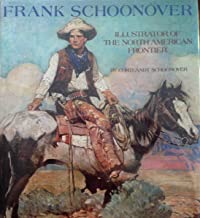
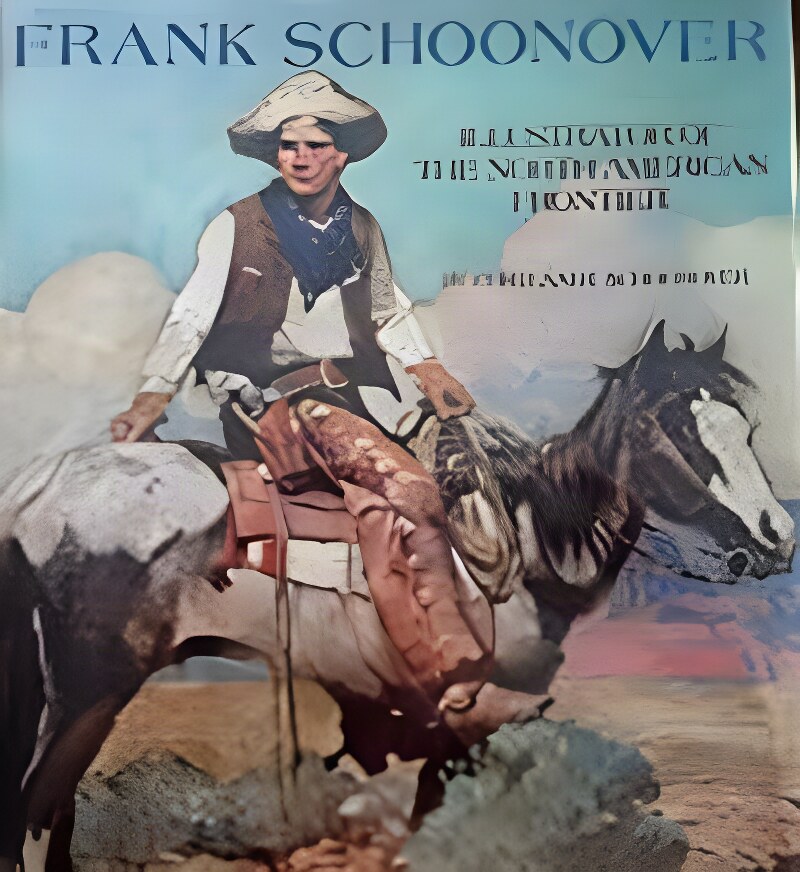
Hardcover. NY, Watson-Guptill, 1st, 1976, Book: Very Good, Dust Jacket: Very Good, Hardcover. Frank Schoonover, one of the giants of the Golden Age of American Illustration, was renowned for his scenes of life on the western frontier of America and Canada. Schoonover captured the flavor of the west and northwest in his dramatic outdoor compositions which depicted cowboys, Indians, trappers, Eskimos - the people and way of life that he knew, loved, and painted first hand. His keen sense of observations, coupled with his vivid documentary style, made his illustrations powerful paintings in themselves. They are now exhibited and collected for their own sake, independent of the books they illustrated, as unforgettable documents of a legendary way of life. Like the other great painter/illustrators of the Brandywine School -he was a student of Howard Pyle and a contemporary of such notables as N. C. Wyeth and Harvey Dunn - Schoonover was passionate about the portrayal of the American past. Although he lived most of his life in the Brandywine River area of Pennsylvania and Delaware, his commitment to the frontier dominated his work. A natural love for adventure and a yearning to find his own style sent him initially to the Canadian northwest, where he took naturally to the challenge of frontier life. Living among the Indians, canoeing, traveling by dogsled, and fending for himself brought authentic flavor to his paintings which illustrated many popular books and stories of adventure - most of which are now forgotten, although the paintings endure. This handsome collection is the first full-scale illustrated study of Schoonover's work, not only rediscovering the paintings of a major artist, but providing an important visual document of frontier life. 208 pages. 10 1/2 X 11 1/4. 48 color plates. 150 black-and-white illustrations. Chronology. Index. Due to size and weight, DOMESTIC SHIPPING ONLY.
Hardcover. NY, Watson-Guptill, 1st, 1976, Book: Very Good, Dust Jacket: Very Good, Hardcover. Frank Schoonover, one of the giants of the Golden Age of American Illustration, was renowned for his scenes of life on the western frontier of America and Canada. Schoonover captured the flavor of the west and northwest in his dramatic outdoor compositions which depicted cowboys, Indians, trappers, Eskimos - the people and way of life that he knew, loved, and painted first hand. His keen sense of observations, coupled with his vivid documentary style, made his illustrations powerful paintings in themselves. They are now exhibited and collected for their own sake, independent of the books they illustrated, as unforgettable documents of a legendary way of life. Like the other great painter/illustrators of the Brandywine School -he was a student of Howard Pyle and a contemporary of such notables as N. C. Wyeth and Harvey Dunn - Schoonover was passionate about the portrayal of the American past. Although he lived most of his life in the Brandywine River area of Pennsylvania and Delaware, his commitment to the frontier dominated his work. A natural love for adventure and a yearning to find his own style sent him initially to the Canadian northwest, where he took naturally to the challenge of frontier life. Living among the Indians, canoeing, traveling by dogsled, and fending for himself brought authentic flavor to his paintings which illustrated many popular books and stories of adventure - most of which are now forgotten, although the paintings endure. This handsome collection is the first full-scale illustrated study of Schoonover's work, not only rediscovering the paintings of a major artist, but providing an important visual document of frontier life. 208 pages. 10 1/2 X 11 1/4. 48 color plates. 150 black-and-white illustrations. Chronology. Index.
Hardcover. New York, Knopf, 1st US, 1999, Book: Very Good, Dust Jacket: Very Good, Hardcover in a bright dust jacket. 434 pages, three novels. Very clean and tight copy.
Hardcover. Hamden CT, The Shoe String Press, 1st, 1971, Book: Very Good, Dust Jacket: None, 265 pages, hardcover. SIGNED BY AUTHOR on front flyleaf. Non-discrept tan boards clean and tight. French policy regarding the Chinese inhabitants of Madagascar. Scarce. A bright copy.
Hardcover. Indianapolis/NY, Bobbs Merrill, 1st, 1963, Book: Very Good, Dust Jacket: Very Good, Hardcover in a bright, unclipped dust jacket. Historical adventure. A young Spaniard goes to sea on a voyage to the Yukon and British Columbia to trade with Indian trappers. It is the late 18th century and sea otter pelts are bringing high prices. The plan is to proceed down the coast of North America, collecting hides from the natives. But things do not go according to plan. Mild chipping wear to rear of dust jacket, otherwise a clean copy.
Hardcover. Indianapolis/New York, Bobbs-Merrill, 1st, 1971, Book: Very Good, Dust Jacket: Good, Hardcover in a worn, rubbed dust jacket, 190 pages. INSCRIBED BY BERGE on the front fly leaf to Roger (Mitchell), fellow poet and teacher. Clean copy.
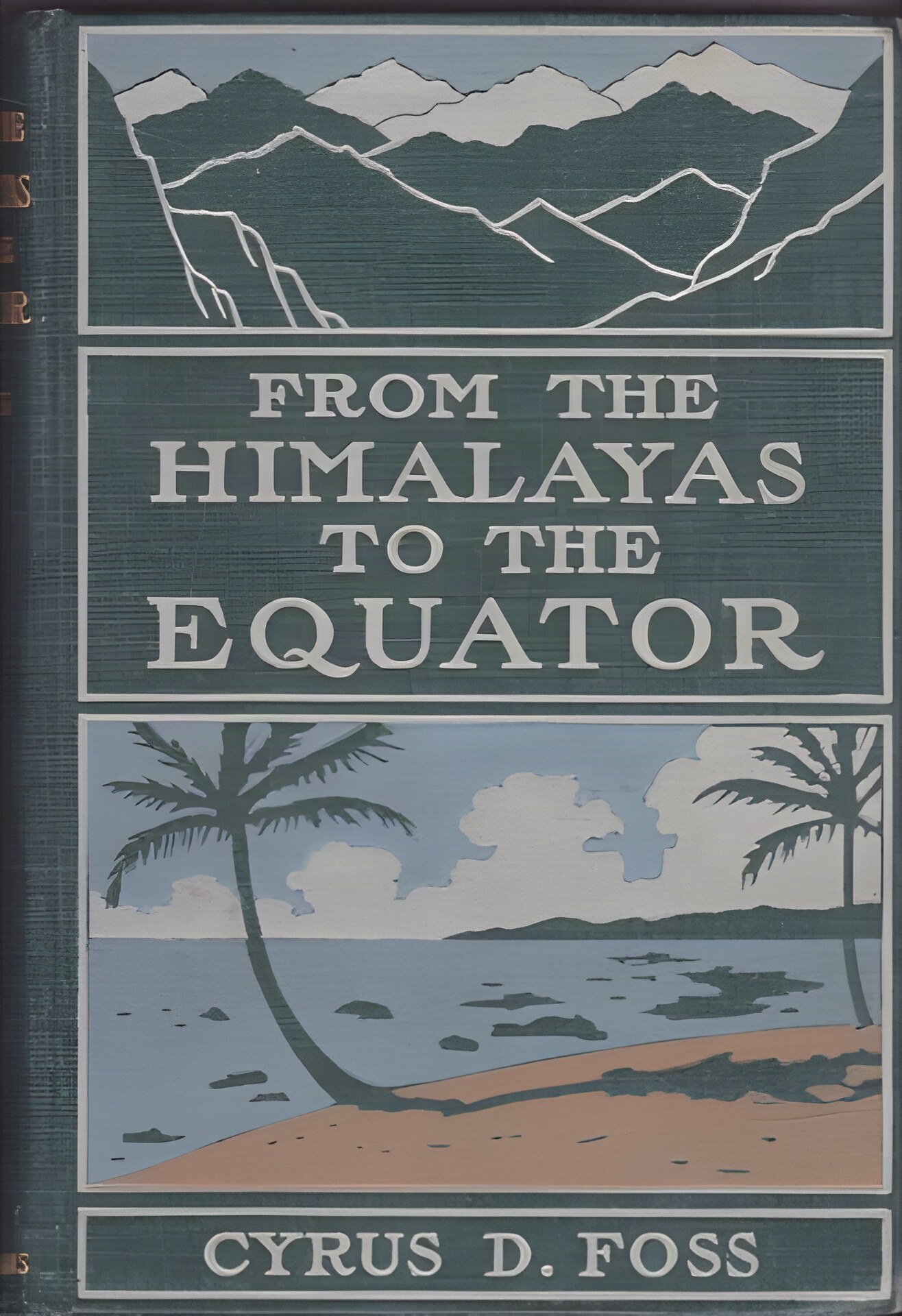
Hardcover. NY, Eaton and Means, 1st, 1899, Book: Very Good, Dust Jacket: None, Hardcover, decorated cloth, gilt lettering on spine, 262 pages. An Account of the visitation of Bishop Foss and Dr. Goucher to the Indian and Malaysian Missions of the Methodist Episcopal Church. This book gives the reader new information as to the needs of the different fields which are under discussion, grasps more vividly the magnitude of the modern missionary movement, and gathers fresh confidence in the final triumph of the Messiah throughout the heathen world. B&w illustrations. Old ink price on front fly leaf, otherwise clean.
Hardcover. NY, University of Chicago, 1st, 2012, Book: Very Good, Dust Jacket: Very Good, Hardcover in a bright dust jacket, 224 pages. Richard Sorabji presents a fascinating study of Gandhi's philosophy in comparison with Christian and Stoic thought. Sorabji shows that Gandhi was a true philosopher. He not only aimed to give a consistent self-critical rationale for his views, but also thought himself obliged to live by what he taught--something that he had in common with the ancient Greek and Christian ethical traditions. Understanding his philosophy helps with re-assessing the consistency of his positions and life. Clean copy.
Hardcover. POONA, Oriental Book Agency, 1st, 1939, Book: Very Good, Dust Jacket: None, 567 pages. Hardcover. Boards bound at spine with orange quartercloth, has fading and foxing to spine from age. Gray cardboard cover boards (some agewear). Pages and edges have some tanning, but otherwise unmarked. Previous owner's name on front flyleaf. This work is a product of seven manuscripts. It begins with the English tranlation of lectures on Nyayasutras by Gautama. The author has also used his notes from Bodhasiddhi.
Softcover. Bloomington IN, Indiana University Press, 1st, 2003, Book: Very Good, Dust Jacket: None, Softcover, 209 pages. This groundbreaking study explores the Harlem Renaissance as a literary phenomenon fundamentally shaped by same-sex-interested men. Christa Schwarz focuses on Countee Cullen, Langston Hughes, Claude McKay, and Richard Bruce Nugent and explores these writers' sexually dissident or gay literary voices. The portrayals of men-loving men in these writers' works vary significantly. Schwarz locates in the poetry of Cullen, Hughes, and McKay the employment of contemporary gay code words, deriving from the Greek discourse of homosexuality and from Walt Whitman. By contrast, Nugent-the only "out" gay Harlem Renaissance artist-portrayed men-loving men without reference to racial concepts or Whitmanesque codes. Schwarz argues for contemporary readings attuned to the complex relation between race, gender, and sexual orientation in Harlem Renaissance writing. Clean copy.
Softcover. Baltimore, Clearfield, reprint, 2000, Book: Very Good, Dust Jacket: None, Softcover, light gray wrappers, 278 pages. This volume consists of abstracts of genealogical data from four of New York's earliest newspapers--the New-York Gazette (1726-1744) and the New-York Weekly Journal (1733-1751), the two earliest city papers, and the New-York Mercury and the Weekly Mercury (1752-1783). These newspapers were originally produced as weeklies and usually consisted of four pages, with occasional supplementary issues. Their subject matter encompassed essays, treatises, parliamentary proceedings, governors' messages, European and West Indian news, shipping news, incidents culled from other newspapers, and many advertisements. In this volume of abstracts may be found items yielding information concerning marriage, birth, death, age, status, place of residence, and place of origin, covering, in all, the years 1726 through most of 1783. Treatment is not confined to New York, for among individuals mentioned are those from all the other colonies, especially New Jersey (which had no newspaper in the colonial period), New England, Pennsylvania, and Maryland.
Hardcover. Norton/Smithsonian, 1st, 2002, Book: Very Good, Dust Jacket: Very Good, Hardcover, 288 pages. From the foremost collection of the artist's work, a remarkable portrait of Native American life. In 1832, George Catlin-showman, entrepreneur, and artist-made the first of four trips into Indian country, painting as he went, in a wonderfully spontaneous, if somewhat naive style. His ambition was to paint every tribe. He fell short. But what he did achieve, and the subject of this splendid volume, is a remarkable look into the faces and daily activities of Native Americans before their lands and their numbers were so radically diminished. And while Catlin was clearly influenced by the idea that Indians were Noble Savages (rapidly acquiring the vices of the white man while losing their "savage" virtues), his passion for his work is evidence of a profound respect and affection for his subjects, clearly demonstrated in this magnificent book. 275 illustrations, 150 in color.
Hardcover. London, Hamish Hamilton, 1st, 2008, Book: Very Good, Dust Jacket: Very Good, Hardcover, 496 pages. SIGNED BY THEROUX on title page. In 1975 a young and ambitious writer named Paul Theroux made his literary mark by taking the 28,000-mile intercontinental journey via rail from London to Tokyo and back home again. Thirty years later, an older and wiser Theroux decided to retrace his steps. The result is Ghost Train to the Eastern Star, a fascinating account of the places you vaguely knew existed, yet definitely should know something about. Get on board Theroux's fast-moving travelogue, which features some of the most astute commentary on our distorted notions of time, space, and each other in the age of jet speed, broadband connections, and cultural extinction. A railway journey through Eastern Europe, India, and Asia. Clean copy
Hardcover. New Brunswick NJ, Rutgers University Press, 1st, 1982, Book: Very Good, Dust Jacket: Very Good, Hardcover in a bright dust jacket, 178 pages. In this intimate and fascinating study, Fruzzetti paints a vivid picture of the activities and rituals governing life in Vishnupur, a large town in rural West Bengal. Drawing on four years of fieldwork during which she was both an observer and a participant in many of the rituals she describes, Fruzzetti, unlike most writers on India, gives primary attention to women, their daily activities, and their marriage rituals. These, she believes, are an important key to understanding Indian society as a whole. Small ownership stamp on front fly leaf, otherwise clean.

 "Feet and Footwear in Indian Cultureby: Jain, Jatta")
 "Financial Expert, The - A Novel of Indian Lifeby: Narayan, R.K.")
 "Fire Plume, The: Legends of the American Indiansby: Bierhorst (Ed.), John")
![First American Art: The Charles and Valerie Diker Collection of American Indian Art by: Bernstein, Bruce [Editor]; McMaster, Gerald [Editor]; Ash-Milby, Kathleen E. [](javascript:largeIMTop('https://www.browsingisarousing.com/shop/images/First-American-Art-The-Charles-and-Valerie-Diker-Collection-of-American-Indian-Art_by_Bernstein-Bruc378700-411946.jpg','https://www.browsingisarousing.com/shop/images/First-American-Art-The-Charles-and-Valerie-Diker-Collection-of-American-Indian-Art_by_Bernstein-Bruc378700-411946.jpg',0,'378700',0,'') "First American Art: The Charles and Valerie Diker Collection of American Indian Art by: Bernstein, Bruce [Editor]; McMaster, Gerald [Editor]; Ash-Milby, Kathleen E. [")


 "Folktales and Realityby: Rohrich, Lutz")
 "Fort Huachuca by: Price, Ethel Jackson")
 "Fourth World of the Hopis, Theby: Courlander, Harold")
 "Freedom Song: Three Novelsby: Chaudhuri, Amit")
 "French Policy Towards the Chinese in Madagascar (SIGNED COPY)by: Slawecki, Leon M.S.")
 "Friendly Cove by: Brant, Irving")


 "Gautama's Nyaua Sutras (With Vatsuayana-Bhasya)by: Jha, Ganganatha (English translation with revised notes)")

 "Gay Voices of the Harlem Renaissance by: Schwarz, A.B. Christa")
 "Genealogical Data from Colonial New York Newspapers: A Consolidation of Articles from The New York Genealogical and Biographical Record by: Kenneth Scott (Compiler)")
 "Generations in Clay: Pueblo Pottery of the American Southwestby: Dittert, Alfred E., Jr. and Fred Plog")

 "Ghost Train to the Eastern Star: On the Tracks of the Great Railway Bazaar (SIGNED COPY)by: Theroux, Paul")
 "Gift of a Virgin: Women, Marriage, and Ritual in a Bengali Societyby: Lina M. Fruzzetti")