Hardcover. London, Barrie & Jenkins, 1st UK, 1970, Book: Very Good, Dust Jacket: Very Good, Hardcover in a lightly worn, price-clipped dust jacket. The first British edition featuring wrap-around color pictorial artwork by Frederick S. Remington (The Sign of the Buffalo Scout,1907). 487 pages. Notes, Bibliography, Index; illustrated in photos, reproductions, double-page frontis map. Clean copy.
Hardcover. NY, The Macmillan Company, 6th pr., 1936, Book: Very Good, Dust Jacket: None, Hardcover, green cloth with black lettering to front cover and spine. B&w illustrations by Kate Seredy. A nice vintage copy (published November 1936) of this Newbery-winning classic. Caddie Woodlawn is a real adventurer. She'd rather hunt than sew and plow than bake, and tries to beat her brother's dares every chance she gets. Caddie is friends with Indians, who scare most of the neighbors. Caddie is brave, and her story is special because it's based on the life and memories of Carol Ryrie Brink's grandmother, the real Caddie Woodlawn. Her spirit and sense of fun have made this book a classic that readers have taken to their hearts for more than seventy years. Clean copy with a mild slant to spine.
Hardcover. NY, The Macmillan Company, reprint, 1967, Book: Very Good, Dust Jacket: None, Hardcover, rose-color cloth with black lettering to front cover and spine. B&w illustrations by Kate Seredy. A nice vintage copy (published November 1936) of this Newbery-winning classic. Caddie Woodlawn is a real adventurer. She'd rather hunt than sew and plow than bake, and tries to beat her brother's dares every chance she gets. Caddie is friends with Indians, who scare most of the neighbors. Caddie is brave, and her story is special because it's based on the life and memories of Carol Ryrie Brink's grandmother, the real Caddie Woodlawn. Her spirit and sense of fun have made this book a classic that readers have taken to their hearts for more than seventy years. Clean copy with a mild slant, fading to spine.
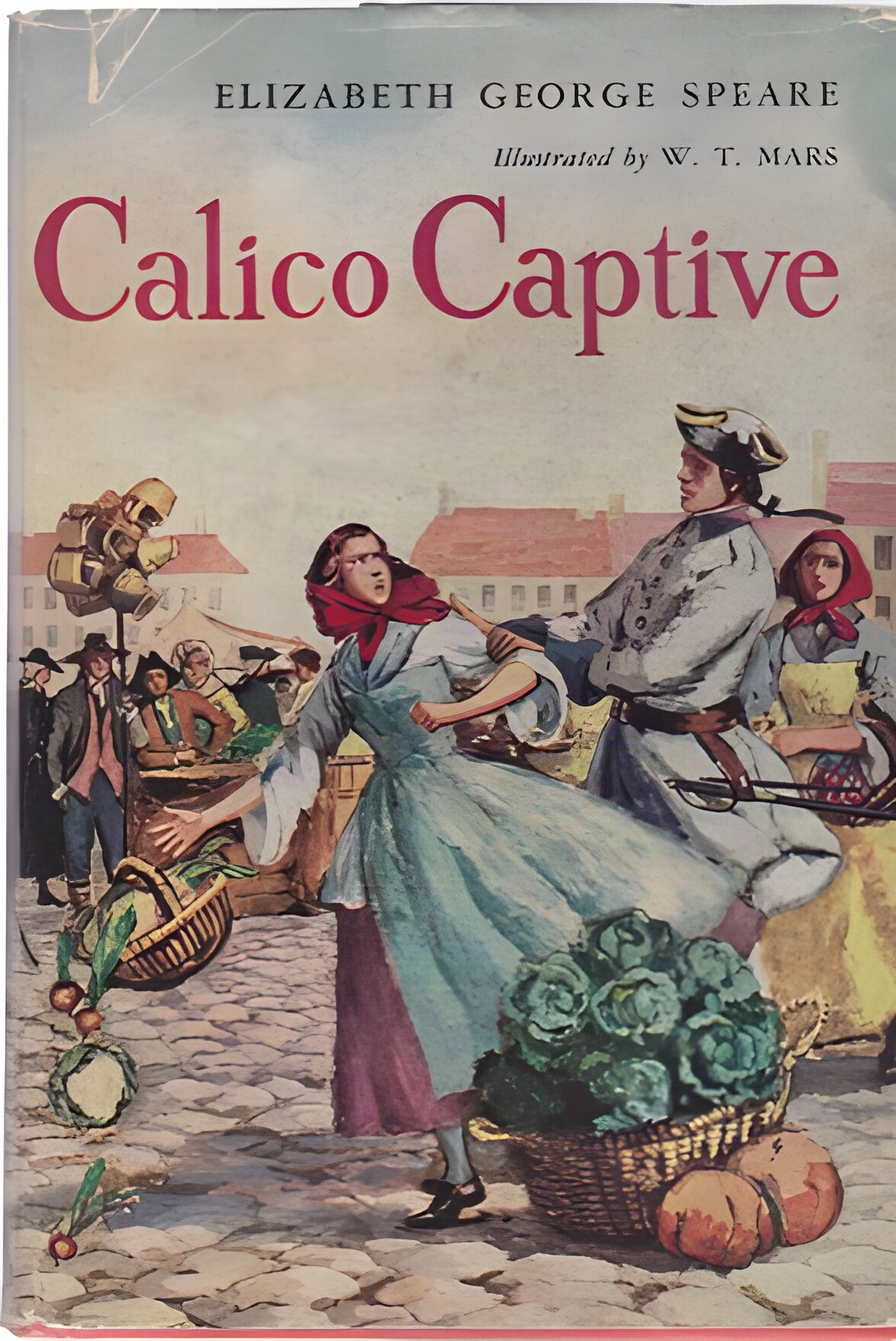
Hardcover. Boston, Houghton Mifflin, reprint, 1957, Book: Very Good, Dust Jacket: Very Good, Hardcover in a lightly worn dust jacket. $3.50 on flap, no date on title page, so assumed reprint. B&w illustrations by W.T. Mars. Short repaired tear, light chipping to dust jacket, clean copy. Newbery Award-winning author Elizabeth George Speare adapted the true account by Charlestown NH colonial settlers for this youth historical fiction. The lead character was developed from the imagined adventures of Miriam Willard, younger sister to Susanna Johnson. Set on the brink of the French & Indian War, the Johnson family was captured and marched to the French enclave in Montreal, where they were sold. Susanna wrote her account when she was 70.
Hardcover. New York, NY, Derby & Jackson, 1st, 1856, Book: Very Good, Dust Jacket: None, Hardcover, 401 pages with 8 pages of advertisements. 2 illustrations before title page. Brown embossed cover with gilt title and decoration to spine. Wear to back cover. Soiling to edges. Previous owner signature on front flyleaf and rear pastedown.
Hardcover. New York, Harper and Brothers, reprint, 1890, Book: Very Good, Dust Jacket: None, Hardcover, blue cloth with gilt lettering and design, 295 pages, frontispiece portrait of author. The Indian War of 1876 in the Big Horn and Yellowstone campaigns. Previous owner's inscription on front fly leaf. Light fraying to bottom of spine otherwise very good, clean.
Softcover. Chapel Nill NC, University of North Carolina Press , 1st, 2002, Book: Very Good, Dust Jacket: None, Softcover, 419 pages. This sweeping, richly evocative study examines the origins and legacies of a flourishing captive exchange economy within and among native American and Euramerican communities throughout the Southwest Borderlands from the Spanish colonial era to the end of the nineteenth century. Indigenous and colonial traditions of capture, servitude, and kinship met and meshed in the borderlands, forming a "slave system" in which victims symbolized social wealth, performed services for their masters, and produced material goods under the threat of violence. Slave and livestock raiding and trading among Apaches, Comanches, Kiowas, Navajos, Utes, and Spaniards provided labor resources, redistributed wealth, and fostered kin connections that integrated disparate and antagonistic groups even as these practices renewed cycles of violence and warfare. Always attentive to the corrosive effects of the "slave trade" on Indian and colonial societies, the book also explores slavery's centrality in intercultural trade, alliances, and "communities of interest" among groups often antagonistic to Spanish, Mexican, and American modernizing strategies. The extension of the moral and military campaigns of the American Civil War to the Southwest in a regional "war against slavery" brought differing forms of social stability but cost local communities much of their economic vitality. Clean copy.
Softcover. Ithaca NY, Cornell University Press, 2nd pr., 1993, Book: Very Good, Dust Jacket: None, Softcover, 280 pages. Since 1965, West Indians have been emigrating to the United States in record numbers, and to New York City in particular. Caribbean New York shows how the new immigration is reshaping American race relations and sheds much-needed light on factors that underlie some of the city's explosive racial confrontations. Philip Kasinitz examines how two forces-racial solidarity and ethnic distinctiveness-have helped to shape the identity of New York's West Indian community. He compares "new" (post-1965) immigrants with West Indians who arrived earlier in the century, and looks in detail at the economic, political, and cultural rules that Afro-Caribbean immigrants have played in the city during each period.
Softcover. San Francisco, Argonaut Book Shop, 1982, Book: Very Good, Dust Jacket: None, Stapled wrappers, 48 pages. A Selection of Vintage Photographs Original Art and Related Material. As a photographer, Carl Moon photographed a total of twenty-nine tribes and villages. He studied the Indian from all sides and at close range. He lived in his camps and villages, became his friend and recorded a way of life that is no more. This catalog details 103 items of his work.
Hardcover. London, Cassell Petter & Galpin, unknown, unknown, Book: Good, Dust Jacket: None, Two volumes in one. Volume I is 576 pages. Volume II is 588 pages. Blue cloth cover, gilt lettering and design, corners and edges are worn and frayed. Top edge gilt. Heavy foxing on title page and frontispiece, light foxing on some pages throughout, otherwise inside is bright and clean with many b&w illustrations. Previous owner's sticker on front endpage, reads "Used in tour around the world, 1881-1882." Previous owner was author and traveller Joseph Cook. A impressive and thorough copy. PLEASE NOTE: DUE TO SIZE & WEIGHT, DOMESTIC SHIPPING ONLY.
Hardcover. NY, Random House, 1st, 2013, Book: Very Good, Dust Jacket: Very Good, Hardcover, 228 pages. At the beginning of World War II Cecil Beaton was commissioned by the British government to photograph the home front. He set to work recording both the destruction of the city, and the heroism of Londoners under attack. He conducted a survey of Bomber and Fighter Commands for the RAF, which was published with his own astute commentary. Beaton was an effective propagandist, but his voice, like his photographs, was touchingly elegant. Beaton's wartime work amounted to 7,000 photographs. He traveled through the Western Desert and on to Iraq, Palestine, Transjordan, Syria, and India, where he photographed the final days of the Raj in New Delhi and Calcutta before joining the Burma campaign. He ended the war deep in Chinese territory where he witnessed the Nationalist resistance to the Japanese. This collection of Beaton's masterful WWII photography captures the home front, the Middle East, arms and vehicle manufacturing in Britain, India, the Burma Campaign, and the war in China. It also includes a chronology placing events in Beaton's life alongside developments in photography, journalism, and the arts; war photography; and world events. His original photographs are reproduced large on the page, alongside his diary extracts, allowing for deep scrutiny and appreciation of the images and their artist.
Hardcover. New York, Coward-McCann, 1st, 1940, Book: Good, Dust Jacket: None, Hardbound, red cloth covers worn with faded spine. 157 pages. Illustrated by Burbank. Illustrated endpapers. Small dent in top edge of covers and edge. A story of adventure and intrigue set in the Guatemalan mountains. With a glossary of Spanish/Indian words and a guide to Mayan numerals in front. No markings.
Hardcover. New York, Harry N. Abrams, Inc., 1st Edition, 1989, Book: Very Good, Dust Jacket: Very Good, 155 pages. Hardcover. Color and b/w illustrations throughout. Cover boards bound in orange cloth, gilt title on spine, all excellent. Dust jacket unclipped, has small puncture near spine on front cover (patched from inside a with tape, see image), otherwise very good. Binding tight. Spine straight. In beautiful condition. Hassrick's illuminating discussion of Russell's work, based on much new research, is set against the backgrond of the artist's experiences in the West.
Hardcover. Norman, OK, University of Oklahoma Press (, 1st, 1989, Book: Very Good, Dust Jacket: Very Good, Hardcover, 415 pages, b&w illustrations. Light edge wear to dust jacket, creases to front flap. Light soiling to edges. Else a clean, tight copy. The first major battle between the U.S. Army and the Cheyenne Indians took place on the south fork of the Solomon River in present-day northwest Kansas. In this stirring account, William Y. Chalfant recreates the human dimensions of what was probably the only large-unit sabre charge against the Plains tribes, in a battle that was as much a clash of cultures as of cavalry and Cheyenne warriors.
NY , E. P. Dutton, 1st, 1971, Book: Very Good, Dust Jacket: Very Good, Hardcover, 215 pages, in a nice, unclipped dust jacket. Mystery involving the attempts of some long downtrodden Indians to obtain schools for their people. Clean copy.
Softcover. Muncie, Ind., Ball State University, 1st, 1985, Book: Very Good, Dust Jacket: None, 72 pages, b&w and color illustrations. Light rubbing to wrappers, small tear to rear cover, else a very clean, tight copy.
Hardcover. London/Calcutta, Seagull Books , 1st, 2010, Book: Very Good, Dust Jacket: Very Good, Hardcover in a bright dust jacket. Circuses provide surreal, fantastic entertainment. At times magical and at others chilling, the circus is a world of magic and spectacle for the viewer, but for the performer, a career in the circus often brings with it a nomadic, lonely life. In Circus Girl, photographer Saibal Das captures beautiful and unusual images of circus girls, photographs which evokes this sense of darkness and resignation that underlies the otherworldly feats they perform under the big top. For instance, in one photograph, a circus girl whose act involves a lioness is seen sitting in front of a mirror putting on her makeup. The lioness that she usually whips in the ring stands behind her, her paw touching the girl's shoulder affectionately. But both wear a solemn look. In another, the girl sits on her props, staring silently at the snack packets strewn on the ground. The giant marquee is empty. Internationally renowned mime Nola Rae provides a haunting accompanying text that poetically comments on the transient wanderings of the circus performers who often yearn for a conventional family life while donning their costumes and taking hold of the trapeze. Rae gives voice to the circus girls, articulating the thoughts too often hidden by the brilliant illusion of stage lights.
Hardcover. Bloomington IN, Indiana University Press, 1st, 1999, Book: Very Good, Dust Jacket: Very Good, Hardcover in a bright, unclipped dust jacket. 199 pages, scattered maps & drawings & figures. The authors selected five reasonably well excavated settlements in southern and central Greece to stand as the exemplars for the contemporary situation and the ongoing transformations of Greek society between 1200 and 700 B.C. (?) Thus, for the late-thirteenth to twelfth centuries there is Mycenae; Nichoria for the eleventh; Athens for the tenth; Lefkandi for the ninth; Corinth for the eight; and Ascra for the early seventh. Each settlement?s particular situation provides them with an opportunity to expand on how this is similar or not to the situations of other, contemporary settlements as well as to the larger picture and trends of cultural transformation. Clean copy.
Hardcover. Seattle, Salisbury Press, 1st, 1970, Book: Very Good, Dust Jacket: None, 64 pages. Hardcover. Illustrated in full color and black & white. Book with original wrap around band on cover. A nice copy.
Softcover. Norfolk VA, Jamestown Exposition Company, 1st, 1907, Book: Very Good, Dust Jacket: None, A softcover booklet with orange covers picturing indian at a campfire, printed in black. 17 pages of copy with b&w illustrations. The main attraction here are the two folding maps attached to front and back covers. Front: Population near Hampto roads Virginia in 3-colors, about 15 X 22". The Rear: Historical Tidewater Virginia, detailing railroads and steamship lines (foreign and domestic). Bott maps clean, no tears.
Softcover. Bloomington IN, Indiana University Press, 2nd pr., 2011, Book: Very Good, Dust Jacket: None, Softcover, 263 pages. For members of Cairo's upper classes, cosmopolitanism is a form of social capital, deployed whenever they acquire or consume transnational commodities, or goods that are linked in the popular imagination to other, more "modern" places. In a series of thickly described and carefully contextualized case studies-of Arabic children's magazines, Pokemon, private schools and popular films, coffee shops and fast-food restaurants-Mark Allen Peterson describes the social practices that create class identities. He traces these processes from childhood into adulthood, examining how taste and style intersect with a changing educational system and economic liberalization. Peterson reveals how uneasy many cosmopolitan Cairenes are with their new global identities, and describes their efforts to root themselves in the local through religious, nationalist, or linguistic practices. Clean copy.
Hardcover. UK, Cambridge University Press, 1st, 2013, Book: Very Good, Dust Jacket: Very Good, Hardcover in a bright dust jacket, 407 pages. Color and b&w illustrations. Details the history of cotton and how it has impacted the textile and garment trade. Today's world textile and garment trade is valued at a staggering $425 billion. We are told that under the pressure of increasing globalisation, it is India and China that are the new world manufacturing powerhouses. However, this is not a new phenomenon: until the industrial revolution, Asia manufactured great quantities of colorful printed cottons that were sold to places as far afield as Japan, West Africa and Europe. Cotton explores this earlier globalized economy and its transformation after 1750 as cotton led the way in the industrialization of Europe. By the early nineteenth century, India, China and the Ottoman Empire switched from world producers to buyers of European cotton textiles, a position that they retained for over two hundred years. This is a fascinating and insightful story which ranges from Asian and European technologies and African slavery to cotton plantations in the Americas and consumer desires across the globe. Clean copy.
Hardcover. NY, Farrar, Straus and Giroux , 1st, 1995, Book: Very Good, Dust Jacket: Very Good, Hardcover in a bright, unclipped dust jacket. Color illustrations by Pohrt. Coyote-a creator, a messenger, and, above all, a trickster-is at his mischievous best in these adventures retold from Native American sources. Brilliant illustrations depict the playful character in four tales: "Coyote Creates a New World," "Coyote and Mice," "Coyote and Woodpecker," and "Coyote and the Buffalo Bull."
Indianapolis, Bobbs-Merrill, 1st, 1975, Book: Very Good, Dust Jacket: Very Good, Hardcover in a lightly worn, unclipped dust jacket. 86 pages, b&w illustrations by Shelley Freshman. "Cricket is a charming little fellow with immense longings. Bored with his life as a farmer, with the sun and the grass, he yearns for something new, something that will bring him fame and fortune." No markings.


 "Caddie Woodlawn by: Carol Ryrie Brink/Kate Seredy")
 "Camp Fires of The Red Man: Or, A Hundred Years Agoby: Orton, J. R.")
 "Campaigning With Crook and Stories of Army Lifeby: King, Captain Charles")

 "Carl Moon: Photographer & Illustrator of the American Southwest (Argonaut Book Shop Catalogue 83)by: Moon, Carl")

 "Cecil Beaton: Theatre of Warby: Beaton, Cecil")
 "Cedar Deer, Theby: Burbank, Addison")
 "Charles M. Russell (The Library of American Art)by: Peter H. Hassrick")


 "Cheyennes and Horse Soldiers: The 1857 Expedition and the Battle of Solomon's Forkby: Chalfant, William Y.")
 "Chiefby: Bonham, Frank")
 "Childe Hassam in Indianaby: Joyaux, Alain G. (Contributor)")
 "Circus Girlby: Das, Saibal,/ Rae, Nola")
 "Citadel to City-State: The Transformation of Greece, 1200-700 BCEby: Thomas, Carol G.; Conant, Craig;")
 "CMR (Charles M. Russell) Book, Theby: Willard, John")
 "Commemorating the Event of the First Permanent English Settlement in America: 1607 Jamestown Exposition - May 1st to Nov 1st 1907by: Jamestown Exposition Company")


 "Coyote Goes Walkingby: Pohrt, Tom")
 "Cricket - Three Storiesby: Nye, Robert")