Hardcover. NY, Watson-Guptill, 1st, 1976, Book: Very Good, Dust Jacket: Very Good, Hardcover. Frank Schoonover, one of the giants of the Golden Age of American Illustration, was renowned for his scenes of life on the western frontier of America and Canada. Schoonover captured the flavor of the west and northwest in his dramatic outdoor compositions which depicted cowboys, Indians, trappers, Eskimos - the people and way of life that he knew, loved, and painted first hand. His keen sense of observations, coupled with his vivid documentary style, made his illustrations powerful paintings in themselves. They are now exhibited and collected for their own sake, independent of the books they illustrated, as unforgettable documents of a legendary way of life. Like the other great painter/illustrators of the Brandywine School -he was a student of Howard Pyle and a contemporary of such notables as N. C. Wyeth and Harvey Dunn - Schoonover was passionate about the portrayal of the American past. Although he lived most of his life in the Brandywine River area of Pennsylvania and Delaware, his commitment to the frontier dominated his work. A natural love for adventure and a yearning to find his own style sent him initially to the Canadian northwest, where he took naturally to the challenge of frontier life. Living among the Indians, canoeing, traveling by dogsled, and fending for himself brought authentic flavor to his paintings which illustrated many popular books and stories of adventure - most of which are now forgotten, although the paintings endure. This handsome collection is the first full-scale illustrated study of Schoonover's work, not only rediscovering the paintings of a major artist, but providing an important visual document of frontier life. 208 pages. 10 1/2 X 11 1/4. 48 color plates. 150 black-and-white illustrations. Chronology. Index.
Hardcover. Garden City, NY, Doubleday & Company, Inc., 1st, 1974, Book: Very Good, Dust Jacket: Very Good, Hardcover, 207 pages with full colored plate illustrations, as well as black and white illustrations and photos. Remainder spray on bottom edge. Bound in blue cloth. Tightly bound, clean copy. Dust jacket shows a little bit of wear on corners, protected by a mylar cover.The first complete biography of a major American artist who devoted both his life & his immense talents to the realistic portrayal of the frontier West." Frank Tenney Johnson (1874 - 1939) was a painter of the Old American West, and he popularized a style of painting cowboys which became known as "The Johnson Moonlight Technique".
Hardcover. NY, Holt, Rinehart and Winston, BC Ed., 1976, Book: Very Good, Dust Jacket: Very Good, Hardcover in a bright dust jacket, 268 pages. Illustrated with a section of black-and-white photographs. "In the poised, outspoken style that typifies his career as one of baseball's fiercest competitors and a superstar of the modern era, Frank Robinson recounts in this book his remarkable and dramatic experience as the first black manager in the history of the major leagues. Written in collaboration with Dave Anderson, the renowned sports columnist of The New York Times, Frank is both the essence of baseball and a document that transcends sports: an intimate, superbly detailed record of the business of managing men on the playing field and a revelation of one man on a spot no one ever occupied before him." Copyright page states first edition but lack of price on dust jacket tells us it's a Book Club. Embossed stamp on front fly leaf, otherwise clean.
Hardcover. NY, Grolier Club, 1st, 1914, Book: Very Good, Dust Jacket: None, Ltd to 303 copies. 216 pages. Light foxing to some pages, spotting to edges.Some flecking or spotting to cloth spine. Black slipcase worn at edges.
Hardcover. Antwerp/Paris, Fonds Mercador/Alpin Michel, 1st, 1975, Book: Very Good, Dust Jacket: Very Good, Hardcover, 318 pages, color and b&w illustrations. Slipcased. Text in Dutch. Original illustrated dustjacket over white quarter paper and black cloth with gilt-stamped lettering on spine and initials on cover. Black illustrated endpapers. Two frontispieces, a Masereel woodcut and 1923 self-portrait woodcut. Sound monograph profusely illustrated with 284 mostly b/w Masereel woodcuts and drawings, two fold-outs and 7 color plates. Includes indices with Masereel's published artwork, partly with b/w thumbnail reproductions and list of illustrations.
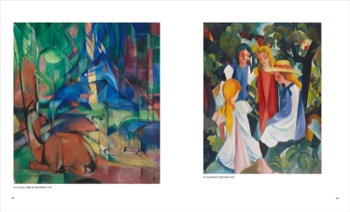
Hardcover. Munich / New York, Prestel / Neue Galerie, 1st, 2019, Book: Very Good, Dust Jacket: Very Good, Hardcover in a bright dust jacket, 207 pages. profusely illustrated in color and black & white throughout, including several full-page illustrations. Includes a preface by Ronald S. Lauder, a foreword by Renee Price and essays by Vivian Endicott Barnett, Erich Franz, Ursula Heiderich, Annegret Hoberg, Isabelle Jansen, and Olaf Peters. This generously illustrated volume focuses on the poignant friendship of Franz Marc and August Macke, two innovative members of the Blue Rider group. During the five years Franz Marc and August Macke knew each other, the two men carried on an artistic and personal friendship that had an immense impact of each of their careers. This book traces their relationship and features meticulously reproduced images that bring their paintings, and the bond they shared, to life. In addition to paintings, watercolors, and drawings from both artists, this book includes objects and documents that show their connection to one another. Clean copy.
Hardcover. Berlin, Hatje Cantz, reprint, 2023, Book: Very Good, Dust Jacket: None, Hardcover, pictorial boards, 319 pages. Text by David Campany, Jeff Wall, Hans-Michael Koetzle. Text in English and German. Fred Herzog is known for his unusual use of color in the 1950s and 1960s, a time when art photography was almost exclusively associated with black and white imagery. The Canadian photographer worked almost exclusively with Kodachrome slide film for over 50 years, and only in the past decade has technology allowed him to make archival pigment prints that match the exceptional color and intensity of the Kodachrome slide. In this respect, his photographs can be seen as a pre-figuration of the New Color photographers of the seventies. This book brings together over 230 images, many never before reproduced, and will feature essays by acclaimed authors David Campany and Hans-Michael Koetzle. Small bunp tp top of front board otherwise very good, clean copy.
Hardcover. New York , Knopf, 1st, 1955, Book: Good, Dust Jacket: None, 241 pages, pink cloth covers with blue and black design. End paper drawing and b&w illustrations by Kurt Wiese. Light wear, ex-library with residue on end papers, small ink price on front fly leaf, no dust jacket.
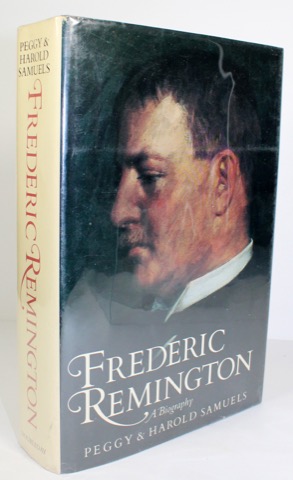
Hardcover. Garden City, Duobleday & Company Inc., First Edition, 1982, Book: Very Good, Dust Jacket: Very Good, 537 pages. Hardcover. Black cloth covered boards with white titles to spine. Black & white illustrations. Dust jacket with light, marginal wear, now protected with a plastic cover. Tight binding, clean & unmarked pages throughout.
Softcover. Washington DC, National Gallery of Art, reprint, 2003, Book: Very Good, Dust Jacket: None, Exhibition Catalog organized by the National Gallery of Art in association with the Gilcrease Museum, Tulsa. Squarish quarto, about 11.25 inches (28.5 cm) tall in pictorial yellow and black wraps. 228 pages illustrated by 71 color plates and other illustrations. Well produced catalog featuring Remington's imaginative night scenes.
Hardcover. Louisville KY, Butler Books, 1st, 2007, Book: Very Good, Dust Jacket: Very Good, Hardcover in a bright dust jacket with wraparound title band. The book measures 13.25x10 inches and has 327 glossy, color and black and white pages. Frederick Hart (1943-1999) was surely among the most profoundly talented sculptors to live in our times. For his work on the Vietnam Memorial, the National Cathedral, and for his careful crafting of scores of more intimate pieces, Hart touched the human soul even as he dazzled the human mind. Art gallery sticker on front fly leaf otherwise clean, like new. DOMESTIC SHIPPING ONLY.
Softcover. New York, Strawberry Hill Book, 1st, 1973, Book: Very Good, Dust Jacket: None, 255 pages. Softcover. Black & white drawings and photographs. Light wear along spine, cover edges. This is the softcover edition. Clean, unmarked pages.
Softcover. NY, Oxford University Press, reprint, 2010, Book: Very Good, Dust Jacket: None, Softcover, 402 pages, b&w illustrations. An insightful examination of the impact of the Civil Rights Movement and African Independence on jazz in the 1950s and 60s, Freedom Sounds traces the complex relationships among music, politics, aesthetics, and activism through the lens of the hot button racial and economic issues of the time. Ingrid Monson illustrates how the contentious and soul-searching debates in the Civil Rights, African Independence, and Black Power movements shaped aesthetic debates and exerted a moral pressure on musicians to take action. Throughout, her arguments show how jazz musicians' quest for self-determination as artists and human beings also led to fascinating and far reaching musical explorations and a lasting ethos of social critique and transcendence. Clean copy.
Hardcover. London, Faber and Faber, 1st UK, 1976, Book: Very Good, Dust Jacket: None, Hardcover, black cloth with gilt and red title block on spine. 422 pages, b&w map. Light bump to top corner otherwise very good, clean copy. "An analysis That carries an indictment of the whole colonial system."
Hardcover. Reading, Garnet, 1st UK, 1994, Book: Very Good, Dust Jacket: Very Good, 118 pages. Illustrated with black & white photographs by Freya Stark. 1/2" deep closed tear at top right corner of first 4 pages - appears to be publishers error. Clean, bright copy.
Hardcover. NY, Charles Scribner's Sons , 1st, 1879, Book: Very Good, Dust Jacket: None, Hardcover, olive green cloth with gilt fern and black lettering on cover, beveled edges, 178 pages. Mild foxing to some pages. Clean copy.
Hardcover. D.A.P./Distributed Art Publishers,Schirmer/Mosel, 1st, 2004, Book: Very Good, Dust Jacket: Very Good, Hardcover, 280 pages. The first 38 pages of this oversized book are devoted to a biography of Frida Kahlo's life and a discussion of some of her most famous paintings. Several vintage color and black & white photos are also included in this section. The remaining pages of this book are the plates...large full page images of her paintings reproduced in full color and detail. Each painting is titled and dated, the medium used and the current whereabouts of the original piece.
Hardcover. New York, Federal Book Company , reprint, n.d., Book: Very Good, Dust Jacket: None, 332 pages, 5 b&w plates. Green cloth covers with orange, black design and gilt title on spine. Color illustration on cover label. No year given, appears to be circa 1900. Bright, clean copy.
Hardcover. Camden, International Marine Publishing Company, First Edition, 1985, Book: Very Good, Dust Jacket: Very Good, 194 pages. Ivory cloth boards with gilt titles to spine. Coffee-table sized volume, profusely illustrated in black & white. Full color dust jacket with light toning, price clipped, & light wear to edges. Clean & unmarked.
hardcover. NY, Knopf , 1st, 1999, Book: Very Good, Dust Jacket: Very Good, Hardcover, 448 pages. Black & white photos and illustrations. Like new. Purely out of artistic ambition, Armenian-American abstract painter Gorky (1895-1948; born in Turkey as Vostanig Adoian) fabricated a new identity, complete with an Ivy League education and personal histories with master artists, on arriving in the United States. Spender (Within Tuscany), who is married to Gorky's oldst daughter, unhesitatingly exposes the painter's many "tall tales." He also assesses Gorky's difficulty in arriving at his own aesthetic until late in life in terms of both the artist's ties to the artistic patriarchs of the previous generation, the Surrealists (including Breton, Duchamp and Brancusi) and his complex status as a forerunner who eventually became alienated from the New York Abstract Expressionists (particularly de Kooning and Rothko). Spender derives much information from anecdotal sources, including an interview with de Kooning, and assumes a chatty tone in dealing with other artists. But he becomes increasingly less sympathetic to Gorky, whose last years are presented from the perspectives of Spender's wife and her mother. Nonetheless, painting constantly despite failing health, family problems and critical indifference, Gorky's frustrations are heartbreaking. Equally compelling is the window opened on New York's art scene when it was still a small clique. Gorky was so in love with the "artist" archetype that he not only lied about himself but also plagiarized anecdotes, artistic statements, love letters and possibly even his own suicide note. Spender preserves the personal dimensions of his subject while demonstrating that the painter should have adopted a youthful declaration. "I shall be a great artist or if not a great crook"as his motto. 90 b&w illustrations.
Hardcover. New York, Macmillan Publishing Company, 1st, 1987, Book: Very Good, Dust Jacket: Very Good, 436 pages. Hardcover. Dust jacket unclipped, excellent, covered in protective clear, plastic brodart. Black cover boards and quarter cloth, gilt title on spine, all very good. Pages clean and unmarked. Binding tight, spine straight. In beautiful condition. A celebration of one of America's greatest poets and a wonderful and necessary addition to all poetry lovers' libraries.
Hardcover. Baton Rouge, Louisiana State University , 1st, 1979, Book: Very Good, Dust Jacket: Very Good, Hardcover in a bright dust jacket, 173 pages. This work is a brief look at worldwide slave revolts in the 17th through 19th centuries, emphasizing their interrelations with European power struggles, which gave rebels hope of finding weak spots in the defenses of the slave powers. The French Revolution also had an influence on slave revolts, but the canny European powers used indigenous peoples to suppress slave revolts (e.g., native Americans) and took advantage of African ethnic divisions as well. American slaves stood little chance of revolt and were under constant surveillance from Southerners, who coward in fear after the successful rebellions in the Caribbean, particularly in Hispaniola, and after Nat Turner and John Brown's efforts. Genovese also brings up religion's double-edged sword: one side used to pacify slaves and the other side to inspire them to break their chains. In short, this scholarly treatise is thought-provoking as well as informative and ends with an inspirational quote from one of Frederick Douglass's lectures. Name on front fly leaf, otherwise a clean copy.

 "Frank Schoonover: Illustrator of the North American Frontierby: Frank Earle Schoonover and Cortlandt Schoonover")
 "Frank Tenney Johnson Book, The: A Master Painter of the Old Westby: McCracken, Harold")
 "Frank: The First Year by: Frank Robinson, Dave Anderson")
 "Franklin and His Press At Passy - An Account of the Books, Pamphlets and Leaflets Printed There, Including the Long Lost Bagatellesby: Livingston, Luther S.")
 "Frans Masereelby: Avermaete, Roger")
 "Franz Marc and August Macke: 1909-1914 by: Barnett Endicott, Vivian")

 "Fred Herzog: Modern Color by: Herzog, Fred")
 "Freddy and the Baseball Team from Marsby: Brooks, Walter R.")
 "Frederic Edwin Church: The Icebergsby: Carr, Gerald R.")
 "Frederic Remington - A Biographyby: Samuels, Peggy/Harold Samuels")

 "Frederic Remington: The Color of Nightby: Anderson, Nancy K., William Sharpe, Alexander Nemerov")
 "Frederick Hart: The Complete Worksby: Kuspit, Donald / Turner, Frederick")
 "Frederick's of Hollywood 1947-1973: 26 Years of Mail Order Seductionby: Gottwald (Editors), Laura/Janusz Gottwald")
 "Freedom Sounds: Civil Rights Call out to Jazz and Africa by: Ingrid Monson")

 "Freya Stark in Persiaby: Ruthven, Malise")
 "Friar Anselmo And Other Poemsby: Dorr, Julia C. R.")
 "Frida Kahlo: The Painter And Her Workby: Helga Prignitz-Poda and Frida Kahlo")
 "Friends, Though Divided: A Tale of the Civil Warby: Henty, G.A.")
 "Friendship Sloopsby: Duncan, Roger F.")
 "From A High Place - A Life Of Arshile Gorkyby: Spender, Matthew")
 "From Princeton One Autumn Afternoon: Collected Poems of Theodore Weiss 1950-1986by: Weiss, Theodore")
 "From Rebellion to Revolution. Afro-American Slave Revolts in the Making of the Modern Worldby: Genovese, Eugene D.")
 "From Rousseau to Ritschl being the translation of eleven chapters of Die Protestantische Theologie im 19. Jahrhundertby: Barth, Karl")