Hardcover. Austin TX, Texas Monthly Press, 1st, 1983, Book: Very Good, Dust Jacket: Very Good, 149 pages, illustrated throughout in b&w. Clean, unmarked copy with only minor wear to dust jacket.
hardcover. Austin, TX, Texas Monthly Press, 1st , 1983, Book: Very Good, Dust Jacket: Very Good, Hardcover. A collection of black & white documentary photos taken in Texas in the 1940's. 149 pages. Dust jacket unclipped.
Hardcover. New York, Naval History Society, 1st, 1914, Book: Near Fine, Dust Jacket: None, Two volumes complete, 289 and 329 pages, each with a frontispiece. Limited to 500 copies, this is #376. White vellum spine and corners with blue-gray boards, top edge gilt. Pristine set. DUE TO WEIGHT, DOMESTIC SHIPPING ONLY.
Hardcover. New York, Naval History Society, 1st, 1814, Book: Very Good, Dust Jacket: None, 289 pages. Minor cover soiling, corner and edge wear. Minor stains along binding on front and back end paper. Otherwise, very clean pages and tight binding. Gilt top edge.
Softcover. Burlington VT, privately printed, 3rd pr., 1975, Book: Very Good, Dust Jacket: None, Softcover, 80 pages. Black and white photos, map, and acknowledgments. A biography of the author's mother and a record of life in central Vermont during the turn of the century. SIGNED BY FARNSWORTH on the front fly leaf. Previous owner's signature also on the front fly leaf, otherwise clean.
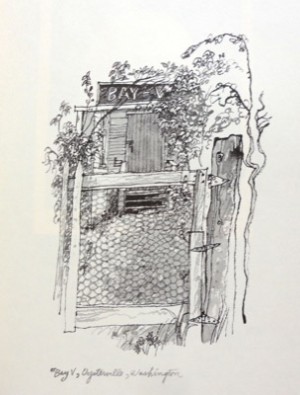
Hardcover. NY, Clarkson N. Potter, Book: Very Good, Dust Jacket: Very Good, Hardcover in a lightly worn, price-clipped dust jacket, 300 pages, b&w illustrations by Earl Thollander. Willard Espy's memoir is delightful, filled with memorable characters, with no celebrities, from his family trove of people over the centuries, from witches in Salem, Massachusetts, to pioneer oystermen on the Pacific coast of Washington state. Drawing on conversations with aged relations and friends, on historic letters and documents, Willard Espy reconstructs his own personal past to provide an account of his family that was born, grew up, and died, as the United States was being born, shaped, formed, explored, expanded.
Hardcover. US, Getty Publications, 1st, 2011, Book: Very Good, Dust Jacket: None, 352 pages. Hardcover with dust jacket. Clean, unmarked copy with only minor wear to dust jacket. Like new in publisher's shrink-wrap. Documents the burgeoning Southern Californian post-war art scene, with several essays following a more or less chronological order, and hundreds of illustrations of artworks, but also of art people (a wonderful 1963 photograph of Marcel Duchamp playing chess with a naked Eve Babitz in front of a replica of his Large Glass in Pasadena, photographs of artists working in their studios, etc). Some names are well known, others less so, but it is the versatility, the creativity and, above all, the richness and depth of this LA art scene that strike the reader-viewer through these richly illustrated pages. The birth of a genuine pop art in California (thanks to some of the most gifted artdealers in the US), of conceptual art, the creation of a new way of making sculpture, all those aspects are tackled in an informative and erudite (sometimes too erudite, though...)text that makes this book a more than valuable addition to the literature on post-war American art.
Hardcover. Baltimore Museum of Art/Pennsylvania State University Press, 1st, 2002, Book: Very Good, Dust Jacket: Very Good, Hardcover in a bright dust jacket, 297 pages. 119 color illustrations and 10 b&w. With an essay by Thomas Primeau. Catalogue entries by Deborah Carton, Susan Dackerman, Richard S. Field, Katherine Crawford Luber, Elizabeth Mansfield, Walter S. Melion, Thomas Primeau and Robert Wheaton. An old master print with color is almost invariably regarded as a suspect object because the color is presumed to be a cosmetic addition made to compensate for deficiencies of design or condition. Painted Prints challenges this deeply entrenched assumption about the material and aesthetic structure of old master prints by showing that in many cases hand coloring is not a dubious supplement to a print but is instead an integral element augmenting its expressive power, beauty, and meaning. Clean, bright copy. NOTE: Due to size and weight, DOMESTIC SHIPPING ONLY.
Hardcover. NY, Metropolitan Museum of Art , 1st, 2004, Book: Very Good, Dust Jacket: Very Good, Hardcover, 272 pages. Painters of Reality, titled after an exhibition held in Milan more than fifty years ago, is the first study in English of this major aspect of Italian art. It builds on the work of the art historian Roberto Longhi. Reexamining the subject in light of copious subsequent scholarship, the authors of this volume contribute major essays that define and discuss naturalism as it appeared in both Lombard paintings and drawings. There is also a fresh consideration of the North Italian predecessors whose influence is apparent either directly or indirectly, in the paintings of Caravaggio. More detailed discussions of the subject center on the precise elements that constituted Leonardo's "hypernaturalism": the important schools of paintings that arose in Brescia, Bergamo, Cremona, and Milan; and Caravaggio's most notable successors in northern Italy, who kept Lombard realism alive into the eighteenth century. Among the 136 paintings and drawings, many never before seen outside of Italy, are influential drawings by Leonardo and major paintings by Caravaggio. Other acknowledged masters in the history of European art are represented, including Lorenzo Lotto, Giovanni Girolamo Savoldo, Giovanni Battista Moroni, and Giacomo Ceruti. Works also appear from significant but less widely known artists such as Sofonisba, Anguissola, Vincenzo Campi, Moretto da Brescia, and Fra' Galgario.
Hardcover. Princeton NJ, Princeton University Press, 1st, 1987, Book: Very Good, Dust Jacket: Very Good, Hardcover in a bright dust jacket, In Painting as an Art, which began as the 1984 Andrew Mellon Lectures at the National Gallery of Art in Washington, D.C., philosopher Richard Wollheim transcended the boundaries and habits of both philosophy and art history to produce a large, encompassing vision of viewing art. Wollheim had three great passions--philosophy, psychology, art--and his work attempted to unify them into a theory of the experience of art. He believed that unlocking the meaning of a painting involved retrieving, almost reenacting, the creative activity that produced it.In order to fully appreciate a work of art, Wollheim argued, critics must bring to the understanding of a work of art a much richer conception of human psychology than they have in the past: "Many [critics] . . . make do with a psychology that, if they tried to live their lives by it, would leave them at the end of an ordinary day without lovers, friends, or any insight into how this came about." Many reviewers have remarked on the insightfulness of the book's final chapter, in which Wollheim contended that certain paintings by Titian, Bellini, de Kooning, and others represent the painters' attempts to project fantasies about the human body onto the canvas. Light fading to dj spine. Name on front fly leaf, otherwise clean.
Hardcover. New Haven, CT, Yale University Press, 1st, 2015, Book: Very Good, Dust Jacket: None, 480 pages. Hardcover with no dust jacket. Very clean, unmarked copy still in shrink wrap. 378 color and 10 black & white illustrations. Tight copy. While European art forms were widely disseminated, copied, and adapted throughout Latin America, colonial painting is not a derivative extension of Europe. The ongoing debate over what to call it-mestizo, hybrid, creole, indo-hispanic, tequitqui-testifies to a fundamental yet unresolved question of identity. Comparing and contrasting the Viceroyalties of New Spain, with its center in modern-day Mexico, and Peru, the authors explore the very different ways the two regions responded to the influence of the Europeans and their art. A wide range of art and artists are considered, some for the first time.
Hardcover. Layton, Utah, Gibbs Smith, 1st, 2015, Book: Very Good, Dust Jacket: None, 176 pages. Hardcover with no dust jacket. Color photographs throughout. Clean, unmarked copy with only minor wear to boards. This book collects more than two hundred fascinating and rarely seen historical photographs of Palm Springs, newly digitized from the Palm Springs Historical Society's expansive archive. Featured are many Hollywood celebrities, including Sinatra and the Rat Pack, who vacationed there, the early days of the desert paradise, various architectural masterworks, such as the fabulous El Mirador Hotel and the extraordinary, outrageous, and irreverent people of Palm Springs.
Hardcover. Boston Mills Press , 1st, 2007, Book: Very Good, Dust Jacket: Very Good, Hardcover in a bright, unclipped dust jacket. For a world coming out of economic depression in the 1930s, the Pan American Airways Clipper "flying boats" symbolized elegance and luxury, adventure and romance. Illustrated with rare period photographs, vintage travel posters, magazine ads and colorful company brochures, this fascinating book covers every aspect of the fabulous era of Pan American's graceful clippers. Like their maritime namesakes, the Clippers used the oceans to form a vast global network of travel routes. Pan Am founder Juan Trippe was a visionary who saw the importance of international travel to a changing world. His Clippers would play a key role in the evolution of transoceanic flight, setting time and distance records over the Atlantic and Pacific, providing airmail delivery between countries, and eventually serving the Allies as troop and cargo transports during World War II. A major appeal is the 200 color images and 100 historical black-and-white photographs. Clean copy.
Hardcover. NY, Simon & Schuster, 1st, 1991, Book: Very Good, Dust Jacket: Very Good, Hardcover in a bright dust jacket, 304 pages. Details the 'whole story' of events leading up to and away from the American invasion of Panama. By December 1989, when George Bush unleashed American troops, Panama had become a crisis. The U.S. Christmas invasion had one real purpose: topple Manuel Antonio Noriega, the general whose name had become synonymous with drugs, deception, and murder. Clean copy.
Hardcover. US, University of Arizona Press, 1st, 1984, Book: Very Good, Dust Jacket: Very Good, Hardcover, 252 pages. Light shelf-wear to price clipped dust jacket, else a clean, tight copy.
Hardcover. NY, Hyperion, 2nd Ed., 2006, Book: Very Good, Dust Jacket: Very Good, Hardcover, 288 pages. Canemaker's second volume on Disney animation (his first was Before the Animation Begins, pub. 11/15/96) covers new territory. Focusing on the birth and progression of the storyboard method, the noted animator/historian explores both the history and the personalities of the Disney storyboard department. He takes readers from the early Disney days (when Walt created the storyboard to add depth and substance to the animated shorts the early studio produced) to today (when ever-changing teams of story specialists gather material and prepare sequence drawings before artists flesh out those Disney masterpieces). Along the way, Canemaker reveals the human effort required to bring an animated film to life and throws in juicy tidbits garnered from his interviews with animation pioneers. Lavish illustrations accompany the text. Recommended for larger public libraries and essential for collections in film and animation history.
Hardcover. NY, Hyperion, 2nd Ed., 2006, Book: Very Good, Dust Jacket: Very Good, Hardcover, 288 pages. Canemaker's second volume on Disney animation (his first was Before the Animation Begins, pub. 11/15/96) covers new territory. Focusing on the birth and progression of the storyboard method, the noted animator/historian explores both the history and the personalities of the Disney storyboard department. He takes readers from the early Disney days (when Walt created the storyboard to add depth and substance to the animated shorts the early studio produced) to today (when ever-changing teams of story specialists gather material and prepare sequence drawings before artists flesh out those Disney masterpieces). Along the way, Canemaker reveals the human effort required to bring an animated film to life and throws in juicy tidbits garnered from his interviews with animation pioneers. Lavish illustrations accompany the text. Recommended for larger public libraries and essential for collections in film and animation history.
Hardcover. New York , De Vinne Press, 1st, 1917, Book: Very Good, Dust Jacket: None, 303 pages. Light blue and white cover. Printed for the Naval History Society. Number 112 of 700 copies. Pages untrimmed. B&w illustration with tissue guard. Worn slipcase. Inside nice and clean. Contains one page insert addressed to Naval History Society members.
Hardcover. Cambridge MA, Belknap Press/Harvard, 1st, 1979, Book: Very Good, Dust Jacket: Very Good, Hardcover in a bright dust jacket. 417 pages. As the American colonies grew more restive, and a break with the mother country ceased to be unthinkable, John Adams was forced to spend less and less time with his beloved family. Although burdened by ever-expanding responsibilities in the Second Continental Congress, he found time for an amazing amount of correspondence. The majority of his letters were written to secure the facts that would enable this duty-ridden man to decide and act effectively on the issues being debated. Military affairs, a source of never-ending concern, provide some of the most fascinating subjects, including several accounts of the Battle of Bunker Hill, assessments of various high-ranking officers, and complaints about the behavior of the riflemen sent from three states southward to aid the Massachusetts troops. Clean, tight copy.
Hardcover. Washington, Smithsonian Institution Press, 1st, 1972, Book: Good, Dust Jacket: Good, Hardcover. Volume I only. 496 pages, several b&w illustrations. Light edgewearm soiling to dust jacket, small closed tear on front cover. Foxing, soiling to top and bottom edge. Else clean and tight.
Softcover. London, 1849, Book: Very Good, Dust Jacket: None, This is 64 page extract from a larger volume (pages 443 - 506), possibly London Magazine. This is the original printing and features 4 fold-out plans and illustrations, all in excellent condition. Bound in a clear acetate folder.
Hardcover. NY, John Day, 1st, 1953, Book: Very Good, Dust Jacket: Good, Hardcover in a bright, edgeworn dust jacket, 372 pages. This book is sub-titled: "A true account, rich in detail about man and nature, of Oklahoma when it was the United States last frontier".
Hardcover. NY, Holt Rinehart & Winston, 1st, 1981, Book: Very Good, Dust Jacket: Very Good, Hardcover in a bright dust jacket with minor edgewear, 294 pages. Depicts the German occupation of Paris during World War II from the perspectives of both the defeated Parisians and the victorius Germans, accompanied by 116 contemporary photographs in b&w, some color. Clean copy.

 "Out of the Fortiesby: Lemann, Nicholas")
 "Out of the Fortiesby: Lemann, Nicholas")
 "Out to Work: A History of Wage Earning Women in the United States by: Kessler-Harris, Alice")
 "Out-Letters of the Continental Marine Committee and Board of Admiralty 1776-1780 (2 Vols.)by: Paullin (Ed.), Charles Oscar")
 "Out-Letters of the Continental Marine Committee and Board of Admiralty: August, 1776 - September, 1780, Volume Iby: Paullin (Ed.), Charles Oscar")
 "Over Cram Hill by: Russell H. Farnsworth")
 "Oysterville: Roads to Grandpa's Villageby: Willard E Espy")

 "Pacific Standard Time : Los Angeles Art, 1945-1980by: Rebecca Peabody , Andrew Perchuk, et al.")
 "Painted Prints: The Revelation of Color in Northern Renaissance & Baroque Engravings Etchings & Woodcuts by: Dackerman, Susan with an essay by Thomas Primeau")
 "Painters of Reality: The Legacy of Leonardo and Caravaggio in Lombardy (Metropolitan Museum of Art Series)by: Andrea Bayer and Mina Gregori")
 "Painting as an Art: The A.W. Mellon Lectures in the Fine Arts 1984by: Wollheim, Richard")
 "Painting in Latin America, 1550-1820: From Conquest to Independenceby: Alcala, Luisa Elena")
 "Palm Springs Paradise: Vintage Photographs from America's Desert Playgroundby: Moruzzi, Peter")
 "Pan American Clippers: The Golden Age of Flying Boats by: James Trautman")
 "Panama: The Whole Story by: Buckley, Kevin")
 "Pancho Villa and John Reed: Two Faces of Romantic Revolutionby: Tuck, Jim")
 "Paper Dreams: The Art & Artists of Disney Storyboardsby: Canemaker, John")
 "Paper Dreams: The Art & Artists of Disney Storyboardsby: Canemaker, John")
 "Papers of Francis Gregory Dallas, The: United States Navy Correspondence and Journal 1837-1859.by: Allen (ed), Gardener W.")
 "Papers of John Adams - Series III - General Correspondence and Other Papers of the Adams Statesmen - Volume 3 - May 1775-January 1776by: Robert Taylor (Editor) Gregg")
 "Papers of Joseph Henry, Theby: Reingold, Nathan")
 "Papers Relating to the First Settlement and Capture of Fort Oswego 1727-1756 (WITH FOLD-OUTS)by: O'Callaghan, E.B.")
 "Paradise Prairie by: Williams, Cecil B.")
 "Paris in the Third Reich: A History of the German Occupation, 1940-1944 by: David Pryce-Jones")