Hardcover. Berne, Kummerly + Frey, 1st, 1979, Book: Very Good, Dust Jacket: Very Good, Hardcover in a bright dust jacket. This fascinating book concerning the history of the Sinai Peninsula is 239 pages in length, with 51 text figures, and numerous fine (unnumbered) color plates. Housed in plain gray cardboard slipcase. DOMESTIC SHIPPING ONLY.
Hardcover. Poultney VT, Historical Pages Co., 1st, 2006, Book: Very Good, Dust Jacket: Very Good, Hardcover in a bright dust jacket, 153 pages. Hundreds of century-old photographs give remarkable insight into the life and times of Londonderry and South Londonderry through the eyes of those who once lived there. This collection covers the time period from 1890 to 1920 in this small, rural Vermont community through pictures of daily life and special events. Businesses, stores, churches, schools, inns, and early homesteads are all featured, as well as baptisms, horse drawn sleighs, families in their Sunday best, and its once booming rail centre. Descriptive text accompanies each photograph to bring the still frames to life and provide its historical context. Clean copy.
Softcover. Caldwell, Idaho, Caxton Printers , 1st, 1977, Book: Very Good, Dust Jacket: None, Softcover, 144 pages, b&w illustrations. A history of the circus parade and the beautifully decorated wagons that were a part of them. Clean copy.
Softcover. Medford OR, Webb Research Group, 1st, 1990, Book: Very Good, Dust Jacket: None, Softcover in pictorial wrappers, 127 pages, b&w illustrations. Fascinating history of the Rogue River Valley Railway which connected Jacksonville and Medford, Oregon and the Southern Oregon Traction Co., an electric street railway that served Medford. Illustrated throughout with black and white photos. With maps, locomotive roster, timetables, and bibliography. 127 pages with index. Clean copy.
Hardcover. Boston, Gambit , 1st, 1973, Book: Very Good, Dust Jacket: Good, Hardcover in a worn, chipped dust jacket. Emissar of Charles the First, second governor of Massachusetts, pillar of the Protectorate, and victim of Charles the Second, atypical Puritan and passionate lover, Sir Harry Vane was a man of peace who initiated genocide in the New World and found martyrdom in the Old. His experience reaches from Indian wigwam to royal palace. This is an unparalleled picture of a formative age which is with us yet. Clean copy.
Hardcover. London, Longman, Orme, Green & Longmans, 1st, 1841, Book: Very Good, Dust Jacket: None, Hardcover, leather bound, two volumes in one: 631 plus 480 pages. All edges gilt, ribbon marker, spine has black calf label with gilt lettering, raised bands with gilt decoration. Both covers with gilt design around edges, elaborate bookplate on inside front cover. A small notation dated 1854 on last page states the publication of the work was discontinued. So never a Volume 2. Covers with light scars, some discoloration to rear board, otherwise a spectacular copy of a very scarce book.
Hardcover. Cambridge, Cambridge University Press, 1st, 2000, Book: Very Good, Dust Jacket: None, 328 pages with bibliography and index. A revised and abridged version of Watkins earlier work on Soane (1753-1837), concentrating on the twelve lectures the eminent architect gave to the Royal Academy between 1810 and 1820, dealing with the huge scope of the lessons to be gained from world architecture.
Hardcover. London, Hamish Hamilton Ltd, First Edition, 1991, Book: Very Good, Dust Jacket: Very Good, 350 pages. Hardcover. Black cloth boards with silver titles to spine. Previous owner's signature to front flyleaf. Black & white illustrations throughout. Bright dust jacket with light marginal wear. Clean & unmarked text. A nice copy.
Hardcover. NY, D. Appleton and Co., 1st, 1903, Book: Very Good, Dust Jacket: None, Hardcover, green cloth with light blue and gilt stamping. 281 pages, 8 b&w plates. From a private library, bookplate, light marking.
Hardcover. NY, Thames & Hudson, 1st, 2013, Book: Very Good, Dust Jacket: Very Good, Hardcover in a bright dust jacket, still in publisher's shrink wrap. Celebrates the height of Weimar cinema through images and commentaries on more than seventy of its finest films Between the First and Second World Wars, Germany under the Weimar Republic was the scene of one of the most creative periods in film history. Through the silent era to the early years of sound, the visual flair and technical innovation of its filmmakers set an international standard for the powerful possibilities of cinema as an art form, with movies such as The Cabinet of Dr. Caligari, Nosferatu, Metropolis, and M building a legacy that shaped the world of film. Here is a showcase of more than seventy films, selected to give a wide-ranging overview of Weimar cinema at its finest. Every genre is represented, from escapist comedies and musicals to gritty depictions of contemporary city life, from period dramas to fantastical visions of the future, with themes such as sexuality and social issues tackled by iconic stars like Marlene Dietrich and Louise Brooks. A wealth of film stills captures the bold vision of great directors like Fritz Lang and Ernst Lubitsch, while the text sets the historical scene and gives intriguing insights into what the films meant to the society that created them.
Hardcover. New York, Harper Collins, 1st, 2007, Book: Very Good, Dust Jacket: Very Good, Hardcover in a very good dust jacket. Non-paginated. SIGNED BY ILLUSTRATOR WENDELL MINOR ON TITLE PAGE. Full color illustrations. Clean, bright copy.
Hardcover. Edmonton CA, Hurtig , 1st, 1973, Book: Very Good, Dust Jacket: Very Good, Hardcover, 221 pages, b&w photographs, map end papers. Edge wear, rubbing, small tears to dust jacket. Else a clean, tight copy.
Hardcover. Cambridge MA, The MIT Press, 1st, 1998, Book: Very Good, Dust Jacket: Very Good, Hardcover, 232 pages, b&w illustrations. Light edgewear to dust jacket. A clean, tight copy.
Hardcover. New York, Doubleday, 1st, 1962, Book: Very Good, Dust Jacket: Good, Hardcover, 460 pages, gray cloth covers. Dust jacket with light edgewear, chipping. SIGNED BY NIXON on tipped-in page. Xerox of dealer's letter laid in on the authenticity of Nixon's autograph. (He suggests it's authentic).
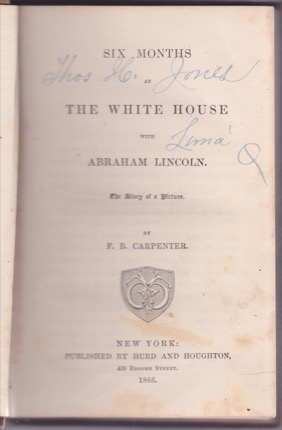
Hardcover. NY, Hurd and Houghton, 1st, 1866, Book: Very Good, Dust Jacket: None, Hardcover, 359 pages including index. Burgundy cloth with embossed rules front and back, with faded gilt lettering on spine. Name on front fly leaf (dated 1866) and title page. A clean, tight copy. Carpenter's memoir of Lincoln's tenure was written out of great admiration for Lincoln and his political platforms, in particular the Emancipation Proclamation.
Hardcover. NY, Knopf, 1st, 2012, Book: Very Good, Dust Jacket: Very Good, Hardcover in a bright, unclipped dust jacket. 418 pages, b&w illustrations. From the author of the best-selling One Minute to Midnight, a riveting account of the pivotal six-month period spanning the end of World War II, the dawn of the nuclear age, and the beginning of the Cold War. When Roosevelt, Stalin, and Churchill met in Yalta in February 1945, Hitler's armies were on the run and victory was imminent. The Big Three wanted to draft a blueprint for a lasting peace--but instead set the stage for a forty-four-year division of Europe into Soviet and western spheres of influence. After fighting side by side for nearly four years, their political alliance was rapidly fracturing. By the time the leaders met again in Potsdam in July 1945, Russians and Americans were squabbling over the future of Germany and Churchill was warning about an "iron curtain" being drawn down over the Continent. These six months witnessed some of the most dramatic moments of the twentieth century: the cataclysmic battle for Berlin, the death of Franklin Roosevelt, the discovery of the Nazi concentration camps, Churchill's electoral defeat, and the dropping of atomic bombs on Japan. While their armies linked up in the heart of Europe, the political leaders maneuvered for leverage: Stalin using his nation's wartime sacrifices to claim spoils, Churchill doing his best to halt Britain's waning influence, FDR trying to charm Stalin, Truman determined to stand up to an increasingly assertive Soviet superpower.
Hardcover. London, Chatto & Windus/Hogarth Press, 1st, 1985, Book: Very Good, Dust Jacket: None, 69 pages. hardcover with laminated boards. Clean, tight copy with little to no wear to edges.
Hardcover. London, Thames & Hudson, 1st, 2013, Book: Very Good, Dust Jacket: Very Good, 208 pages. Hardcover with dust jacket. Clean, unmarked copy with only minor wear to dust jacket. Color and black and white pictures throughout. In the 1960s, fashion changed dramatically. At the end of the 1950s, Yves Saint Laurent was starting to look for new ways to define the female form; by the 1970s, styles, markets, materials, demographics, inspirations, and the very definition of fashion had been utterly transformed. Richly illustrated with contemporary imagery, including fashion shots, advertising, and magazine features, this is an essential sourcebook. The story begins with the new internationalism that changed the fashion landscape as New York, San Francisco, Florence, London, Madrid, Rome, and Hong Kong challenged the dominance of Paris haute couture. 306 illustrations, 176 in color.
Hardcover. Bradford VT, privately printed/Green Mountain Press, 1st, 1929, Book: Very Good, Dust Jacket: None, 198 pages, Hardcover with no dust jacket. B&w illustrations, brown board covers with label on front panel. Bright, clean copy.
Softcover. Gwinn MI, Avery Color Studios, 1st, 2014, Book: Very Good, Dust Jacket: None, Softcover, 201 pages, b&w illustrations. The Reverend Law was in peril on the Great Lakes and was rescued by a U.S. Life-Saving Service Station crew. As a result of that rescue, seeing their heroic efforts first hand, Reverend Law dedicated the rest of his life to the men and women stationed at Light and Life-Saving stations throughout the United States. Whether it was bringing his "Floating Library" to stations located on the Great Lakes, regular correspondence with the crews of stations far too remote for a personal visit, or his relentless pursuit of Congress to approve a bill to provide better pay and pensions, Reverend Law became a fast friend to those serving in the Lighthouse and Life-Saving services. "Sky Pilot" was sailors' slang for a chaplain. To the men and women he served, Reverend Law was lovingly known as "The Sky Pilot of the Great Lakes." A true tale of unconquerable optimism,
Hardcover. Middletown, Connecticut, Wesleyan University Press, 1st, 1975, Book: Very Good, Dust Jacket: None, Study of American artists influenced by Dada and their relationship with American avant-garde. 283 pages, 94 black/white illustrations. Cloth bound book in near fine condition, only sign of wear is slight discoloration to the top edges of pages (light spotting), not visible when reading the book.
Hardcover. Middletown Conn. , Wesleyan University Press, 1st, 1975, Book: Very Good, Dust Jacket: Very Good, Hardcover, 283 pages, 94 black/white illustrations. Study of American artists influenced by Dada and their relationship with American avant-garde. Orange cloth, gilt lettering to spine. Pictorial dust jacket shows light wear and rubbing along edges and faded spine, else a very nice, tight, clean copy.
Hardcover. Middletown Conn. , Wesleyan University Press, 1st, 1975, Book: Very Good, Dust Jacket: None, Hardcover, 283 pages, 94 black/white illustrations. Study of American artists influenced by Dada and their relationship with American avant-garde. Orange cloth, gilt lettering to spine. A very nice, tight, clean copy.
Hardcover. Chicago, University of Chicago Press, 2nd pr., 2015, Book: Very Good, Dust Jacket: Very Good, Hardcover in a bright dust jacket, 233 pages, b&w illustrations. From the minute it opened--on Christmas Day in 1865--it was Chicago's must-see tourist attraction, drawing more than half a million visitors each year. Families, visiting dignitaries, even school groups all made trips to the South Side to tour the Union Stock Yard. There they got a firsthand look at the city's industrial prowess as they witnessed cattle, hogs, and sheep disassembled with breathtaking efficiency. At their height, the kill floors employed 50,000 workers and processed six hundred animals an hour, an astonishing spectacle of industrialized death. Slaughterhouse tells the story of the Union Stock Yard, chronicling the rise and fall of an industrial district that, for better or worse, served as the public face of Chicago for decades. Dominic A. Pacyga is a guide like no other--he grew up in the shadow of the stockyards, spent summers in their hog house and cattle yards, and maintains a long-standing connection with the working-class neighborhoods around them. Pacyga takes readers through the packinghouses as only an insider can, covering the rough and toxic life inside the plants and their lasting effects on the world outside. He shows how the yards shaped the surrounding neighborhoods and controlled the livelihoods of thousands of families. He looks at the Union Stock Yard's political and economic power and its sometimes volatile role in the city's race and labor relations. And he traces its decades of mechanized innovations, which introduced millions of consumers across the country to an industrialized food system. Clean copy.

 "Sinai: Pharaohs, Miners, Pilgrims and Soldiersby: Beno Rothenberg / Helfried Weyer")
 "Sincerely Yours: Historic Postcard Views of Londonderry & South Londonderry, Vermontby: George F. Newell")
 "Singing Wheels and Circus Wagonsby: Plowden, Gene")
 "Single-Track to Jacksonville: The Rogue River Valley Railway and the Southern Oregon Traction Company: An Oregon Documentary by: Bert Webber; Margie Webber")
 "Sir Harry Vane: His Life and Times 1613-1662by: Adamson, J. H. & H. F. Folland")
 "Sir Henry Cavendish's Debates of the House of Commons During the Thirteenth Parliament of Great Britain, Commonly Called the Unreported Parliament to Which Are Appended History of the Reign of George the Third - Vol. 1: 1768-1771")
 "Sir John Soane: The Royal Academy Lecturesby: Watkin, David (Editor)")
 "Sir Philip Sidney - Courtier Poetby: Duncan-Jones, Katherine")
 "Sir William Johnsonby: Augustus C. Buell")
 "Sirens & Sinners: A Visual History of Weimar Film 1918-1933by: Hans Helmut Prinzler")
 "Sitting Bull Remembers (SIGNED BY ILLUSTRATOR)by: Turner, Ann/Wendell Minor")
 "Sitting Bull: The Years in Canadaby: MacEwan, Grant")
 "Situationist City, The by: Sadler, Simon")
 "Six Crises (SIGNED COPY)by: Nixon, Richard M.")
 "Six Months at the White House with Abraham Lincoln:The Story of a Pictureby: F. B. Carpenter")

 "Six Months in 1945: FDR, Stalin, Churchill, and Truman--from World War to Cold Warby: Michael Dobbs")
 "Sixpenny Wonderfuls: 6d Gems from the pastby: n/a")
 "Sixties Fashion: From Less is More to Youthquakeby: Walford, Jonathan")
 "Sketches of the Town of Topsham Orange County Vermontby: Craig, Frank H.")
 "Sky Pilot of the Great Lakes: A Biography of the Reverend William H. Law (INSCRIBED COPY)by: John Kotzian / Frederick Stonehouse (Foreword)")
 "Skyscraper Primitives: Dada and the American Avant-Garde, 1910-1925by: Tashjian, Dickran")
 "Skyscraper Primitives: Dada and the American Avant-Garde, 1910-1925by: Tashjian, Dickran")
 "Skyscraper Primitives: Dada and the American Avant-Garde, 1910-1925by: Tashjian, Dickran")
 "Slaughterhouse: Chicago's Union Stock Yard and the World It Made by: Pacyga, Dominic A.")